
GEOMETRIC PERIOD 1100 750 BC NAME SOURCES o

GEOMETRIC PERIOD (1100 -750 BC)
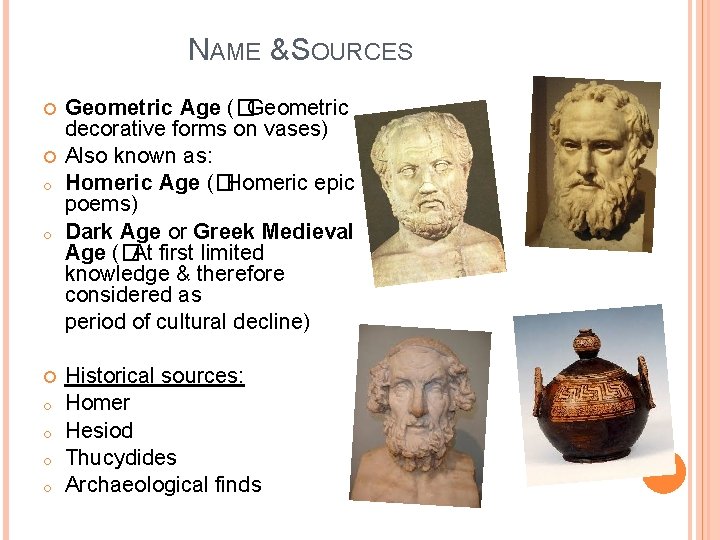
NAME & SOURCES o o o o Geometric Age (�Geometric decorative forms on vases) Also known as: Homeric Age (�Homeric epic poems) Dark Age or Greek Medieval Age (�At first limited knowledge & therefore considered as period of cultural decline) Historical sources: Homer Hesiod Thucydides Archaeological finds
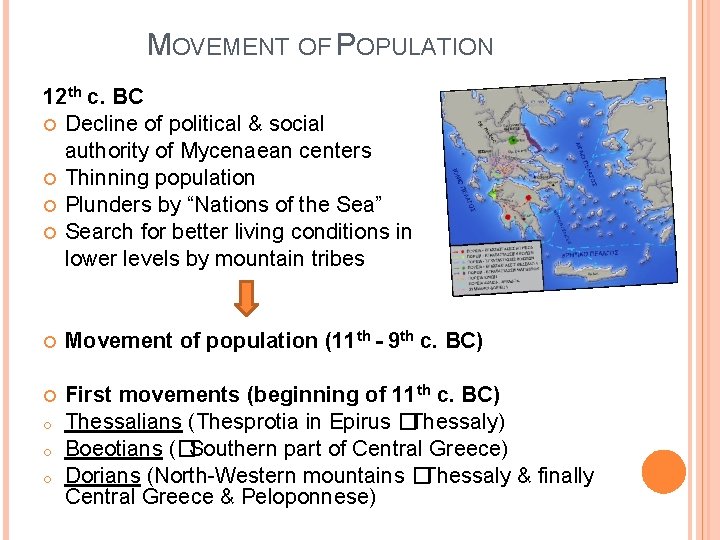
MOVEMENT OF POPULATION 12 th c. BC Decline of political & social authority of Mycenaean centers Thinning population Plunders by “Nations of the Sea” Search for better living conditions in lower levels by mountain tribes Movement of population (11 th - 9 th c. BC) First movements (beginning of 11 th c. BC) Thessalians (Thesprotia in Epirus �Thessaly) Boeotians (�Southern part of Central Greece) Dorians (North-Western mountains �Thessaly & finally Central Greece & Peloponnese) o o o
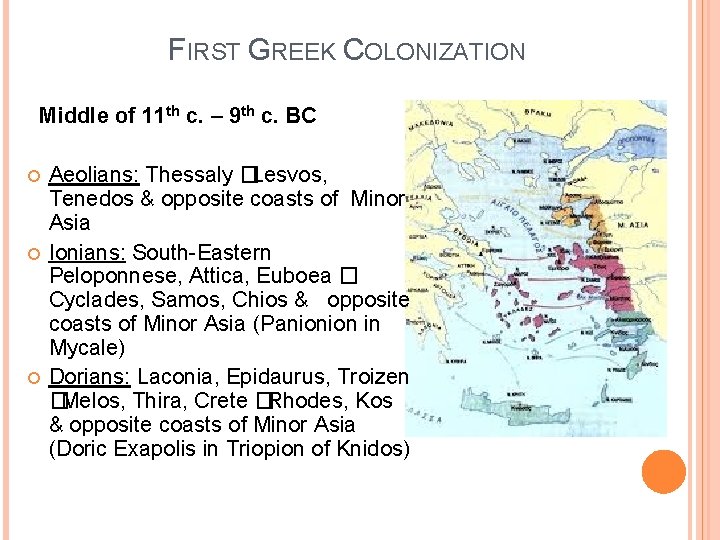
FIRST GREEK COLONIZATION Middle of 11 th c. – 9 th c. BC Aeolians: Thessaly �Lesvos, Tenedos & opposite coasts of Minor Asia Ionians: South-Eastern Peloponnese, Attica, Euboea � Cyclades, Samos, Chios & opposite coasts of Minor Asia (Panionion in Mycale) Dorians: Laconia, Epidaurus, Troizen �Melos, Thira, Crete �Rhodes, Kos & opposite coasts of Minor Asia (Doric Exapolis in Triopion of Knidos)
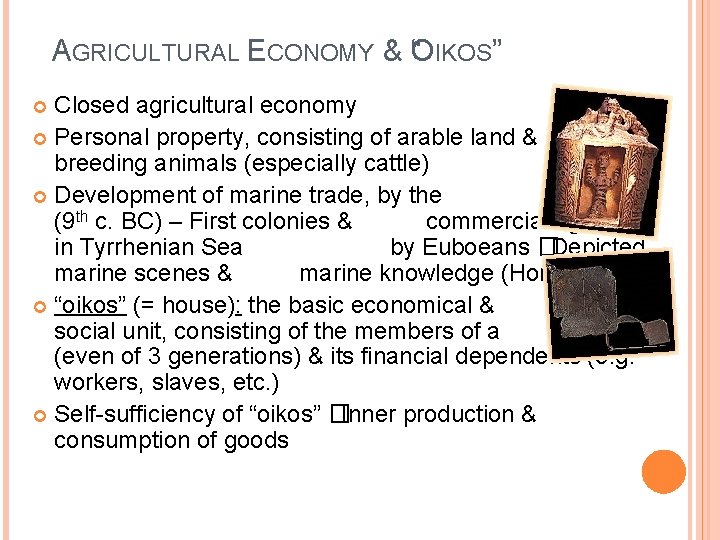
AGRICULTURAL ECONOMY & “OIKOS” Closed agricultural economy Personal property, consisting of arable land & breeding animals (especially cattle) Development of marine trade, by the landless (9 th c. BC) – First colonies & commercial agencies in Tyrrhenian Sea by Euboeans �Depicted marine scenes & marine knowledge (Homer) “oikos” (= house): the basic economical & social unit, consisting of the members of a family (even of 3 generations) & its financial dependents (e. g. workers, slaves, etc. ) Self-sufficiency of “oikos” � Inner production & consumption of goods
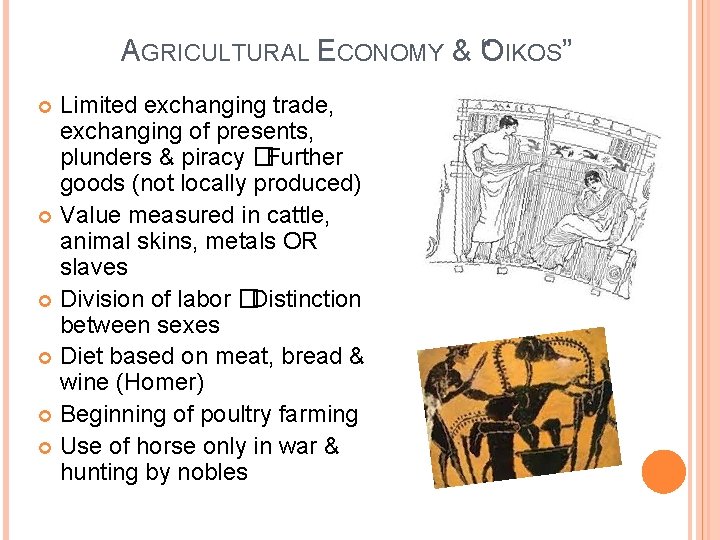
AGRICULTURAL ECONOMY & “OIKOS” Limited exchanging trade, exchanging of presents, plunders & piracy �Further goods (not locally produced) Value measured in cattle, animal skins, metals OR slaves Division of labor � Distinction between sexes Diet based on meat, bread & wine (Homer) Beginning of poultry farming Use of horse only in war & hunting by nobles
SOCIAL & POLITICAL STRATIFICATION Trojan War: last significant war of Mycenaeans Attempt of nobles to abstract authority from kings (Homer: Thersitis, murder of Agamemnon, Penelope ‘s suitors) Decline of Mycenaean kingdoms (�Lack of monumental buildings) Social groups: “Oikoi” with many powerful members & large landowning � Social group of nobles (“aristoi” – the best) Mass of people not related by blood to “oikos” (“plithos” crowd) Specialized craftsmen, financially attached to “oikos” (“dimiourgoi” - creators) o o o
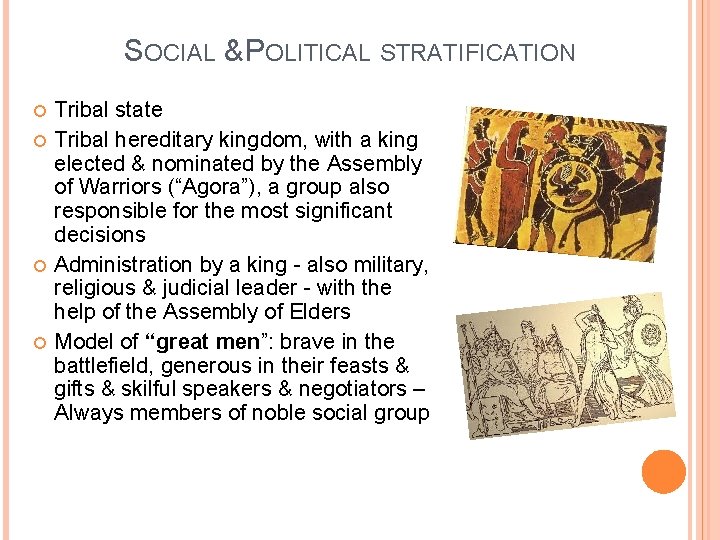
SOCIAL & POLITICAL STRATIFICATION Tribal state Tribal hereditary kingdom, with a king elected & nominated by the Assembly of Warriors (“Agora”), a group also responsible for the most significant decisions Administration by a king - also military, religious & judicial leader - with the help of the Assembly of Elders Model of “great men”: brave in the battlefield, generous in their feasts & gifts & skilful speakers & negotiators – Always members of noble social group
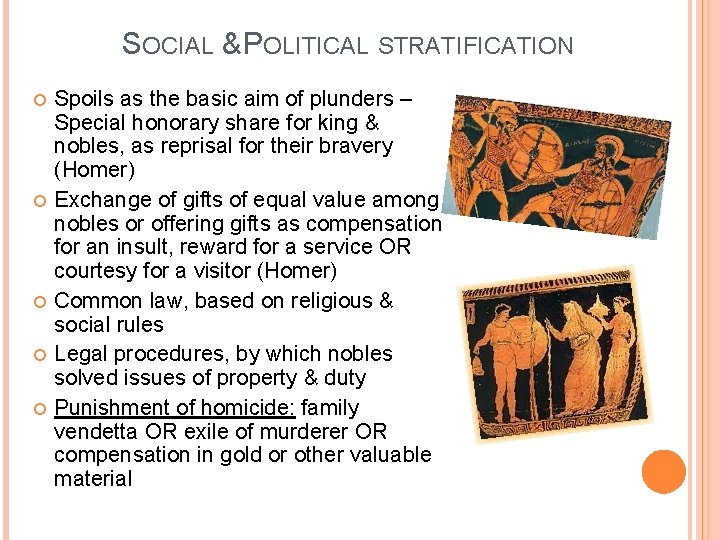
SOCIAL & POLITICAL STRATIFICATION Spoils as the basic aim of plunders – Special honorary share for king & nobles, as reprisal for their bravery (Homer) Exchange of gifts of equal value among nobles or offering gifts as compensation for an insult, reward for a service OR courtesy for a visitor (Homer) Common law, based on religious & social rules Legal procedures, by which nobles solved issues of property & duty Punishment of homicide: family vendetta OR exile of murderer OR compensation in gold or other valuable material
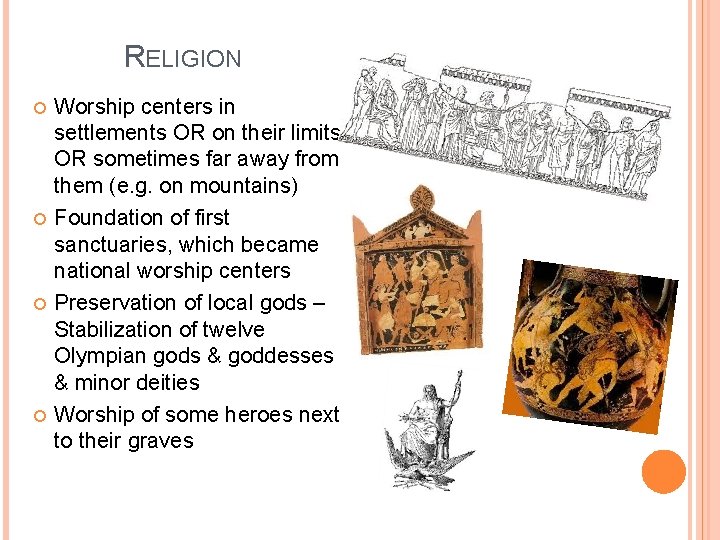
RELIGION Worship centers in settlements OR on their limits OR sometimes far away from them (e. g. on mountains) Foundation of first sanctuaries, which became national worship centers Preservation of local gods – Stabilization of twelve Olympian gods & goddesses & minor deities Worship of some heroes next to their graves
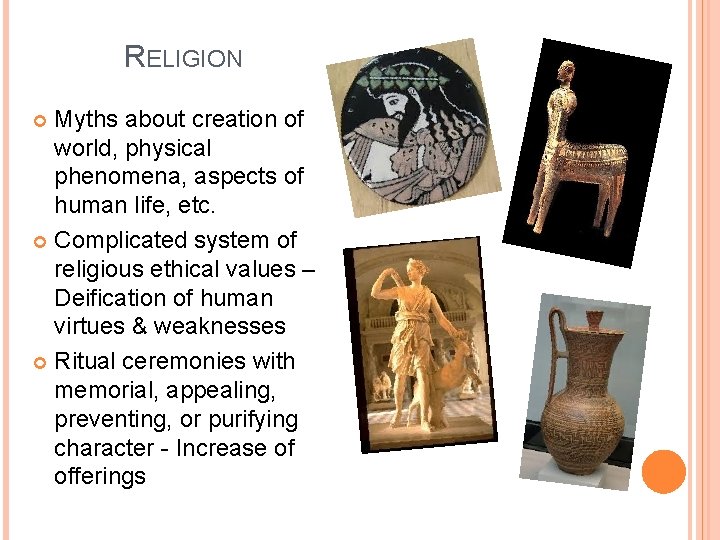
RELIGION Myths about creation of world, physical phenomena, aspects of human life, etc. Complicated system of religious ethical values – Deification of human virtues & weaknesses Ritual ceremonies with memorial, appealing, preventing, or purifying character - Increase of offerings
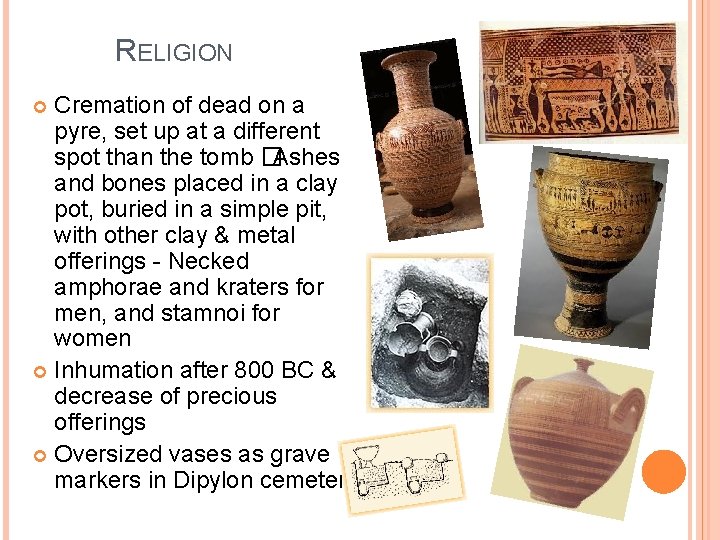
RELIGION Cremation of dead on a pyre, set up at a different spot than the tomb �Ashes and bones placed in a clay pot, buried in a simple pit, with other clay & metal offerings - Necked amphorae and kraters for men, and stamnoi for women Inhumation after 800 BC & decrease of precious offerings Oversized vases as grave markers in Dipylon cemetery
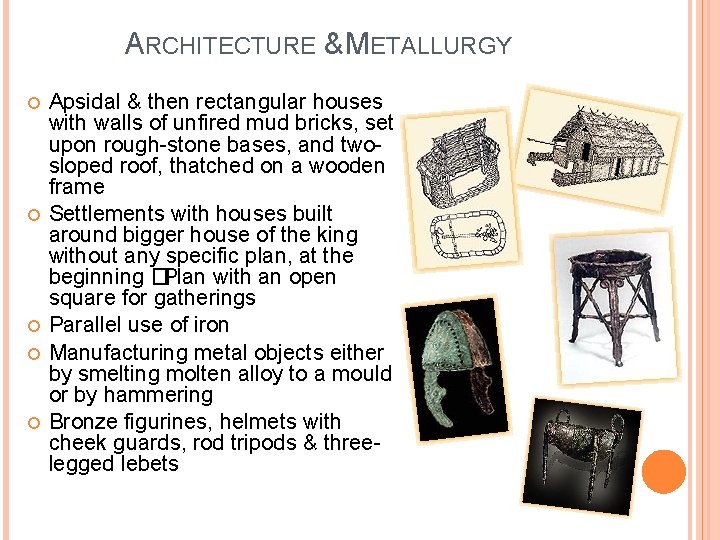
ARCHITECTURE & METALLURGY Apsidal & then rectangular houses with walls of unfired mud bricks, set upon rough-stone bases, and twosloped roof, thatched on a wooden frame Settlements with houses built around bigger house of the king without any specific plan, at the beginning �Plan with an open square for gatherings Parallel use of iron Manufacturing metal objects either by smelting molten alloy to a mould or by hammering Bronze figurines, helmets with cheek guards, rod tripods & threelegged lebets
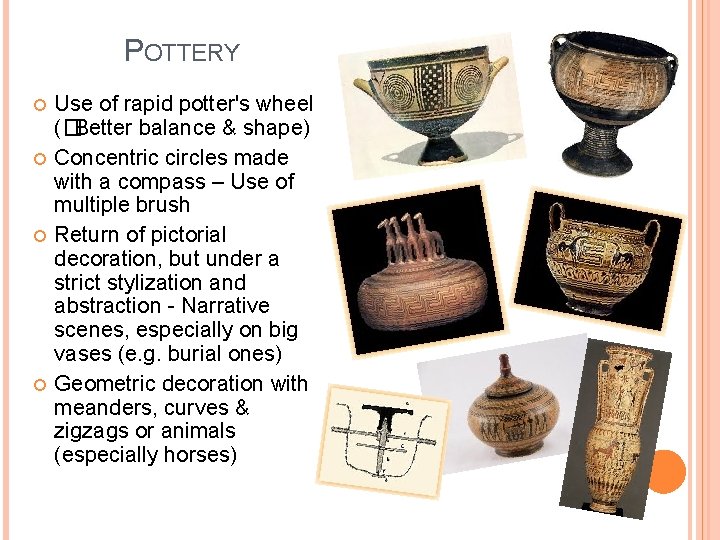
POTTERY Use of rapid potter's wheel (�Better balance & shape) Concentric circles made with a compass – Use of multiple brush Return of pictorial decoration, but under a strict stylization and abstraction - Narrative scenes, especially on big vases (e. g. burial ones) Geometric decoration with meanders, curves & zigzags or animals (especially horses)

SCRIPT & LITERATURE Creation & use of Greek Alphabetical Script (end of 9 th – beginning of 8 th c. BC) �Phoenician alphabet, after vocal assimilation & adding of vowels Homeric epic poems, written in dactylic hexameter & based on former heroic narrative songs of Mycenaean Age, sung in public or personal noble fests (“aoidoi” – “rapsodoi”) “Homeric” hymns (33), written by different poets in dactylic hexameter
HOMERIC EPIC POEMS 1 st recording in the middle of 6 th c. BC (by Peisistratus in Athens) Language: Mixture of Ionian & Aeolian lingual forms Depicting life of heroes of Mycenaean Age BUT – up to a point mixed with elements of Homeric Age “Iliad” ( 16. 000 verses): Story of conflict between Achilles & Agamemnon during Trojan War �Mostly war scenes – Promotion of physical power, fighting ability & virtue of bravery – More sonorous language “Odyssey” (12. 000 verses): Story of Odysseus, trying to return to Ithaca against Poseidon’s will �Promotion of new values such as resignation, endurance, family peace, mutual respect of men and women, conjugal love, children’s love for father, beauty of nature & more mature acceptance of human fate – More complicated & unexpected plot
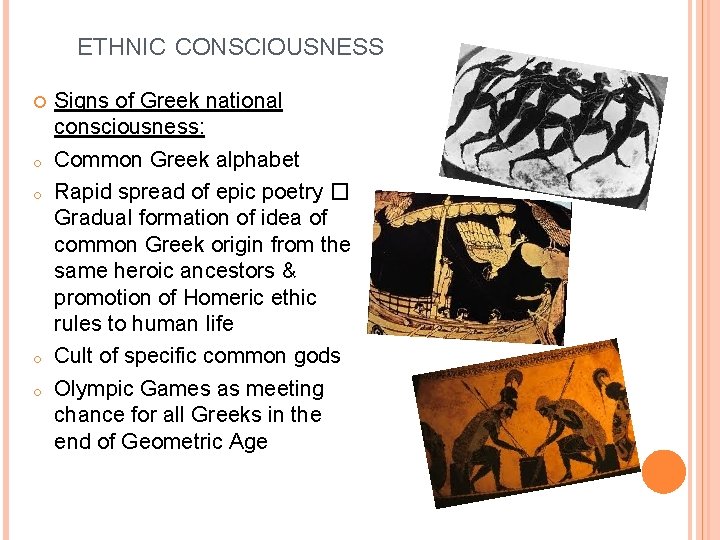
ETHNIC CONSCIOUSNESS o o Signs of Greek national consciousness: Common Greek alphabet Rapid spread of epic poetry � Gradual formation of idea of common Greek origin from the same heroic ancestors & promotion of Homeric ethic rules to human life Cult of specific common gods Olympic Games as meeting chance for all Greeks in the end of Geometric Age
- Slides: 17