
Geometric Hashing An Overview Haim J Wolfson and



- Slides: 23
Geometric Hashing: An Overview Haim J. Wolfson and Isidore Rigoutos IEEE Computational Science & Engineering, 1997 Presented by Timothy Lee March 1, 2007 Timothy Lee -- Math/CSc 870 Sp '07
Motivation - Object recognition (ultimate goal of most computer vision research). Inputs: • A database of objects. • A scene or image to recognize. Problems: 1. Objects in the scene undergo some transformations. 2. Objects may partially occlude each other. 3. Computationally expensive to retrieve each object from database and compare it against the observed scene. 6/19/2021 Timothy Lee -- Math/CSc 870 Sp '07 2
Problem Statement § Recognition under Similarity Transformation: § “Is there a transformed (rotated, translated and scaled) subset of some model pointset which matches a subset of the scene point-set? ” 6/19/2021 Timothy Lee -- Math/CSc 870 Sp '07 3
Outline 1. General Framework 2. Two Stage Algorithm 3. Complexity 4. Recognition of Polyhedra Objects 5. Recognition under Various Transformations 6. Index distributions 7. Noise modeling 8. Bayesian formulation 9. Comparisons 10. Current research 6/19/2021 Timothy Lee -- Math/CSc 870 Sp '07 4
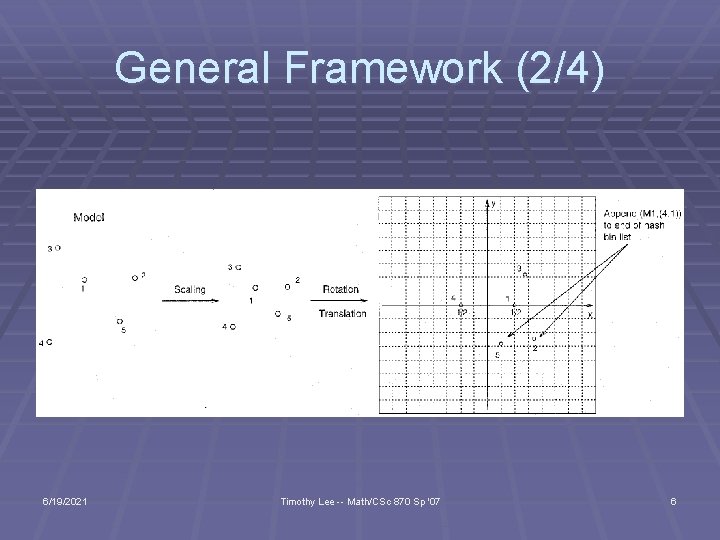
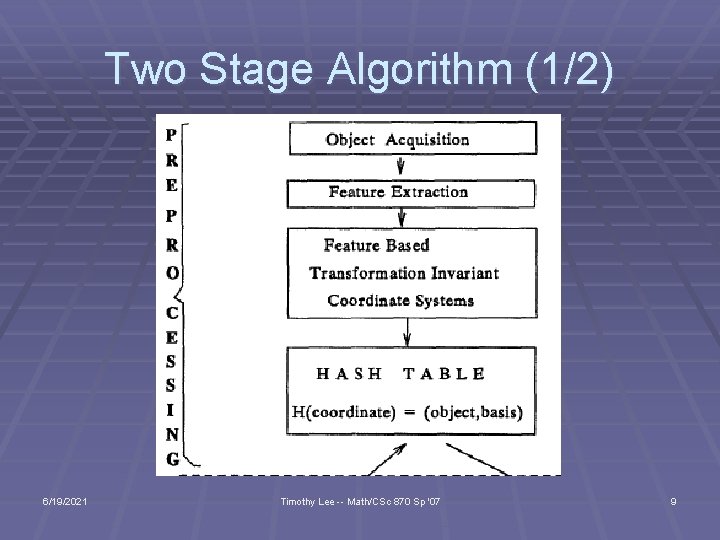
General Framework (1/4) § Two stage algorithm: 1. Preprocessing (for each model): • For each feature points pair: • Define a local coordinate basis on this pair • Compute and quantize all other feature points in this coordinate basis • Record (model, basis) in a hash table 6/19/2021 Timothy Lee -- Math/CSc 870 Sp '07 5
General Framework (2/4) 6/19/2021 Timothy Lee -- Math/CSc 870 Sp '07 6
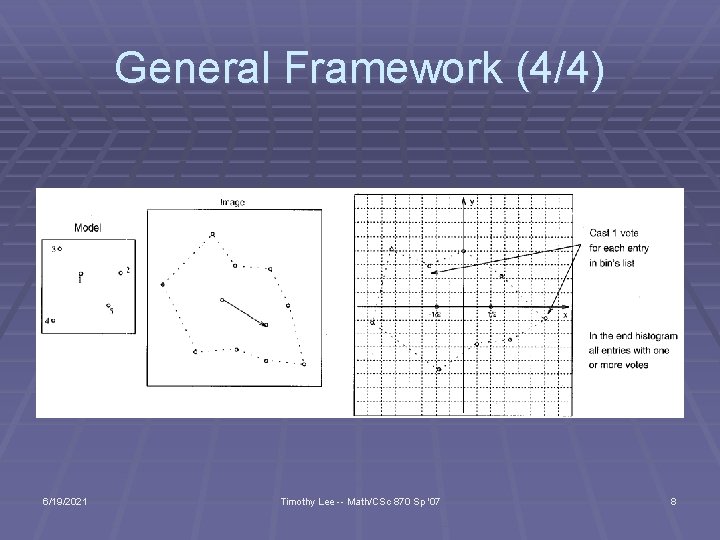
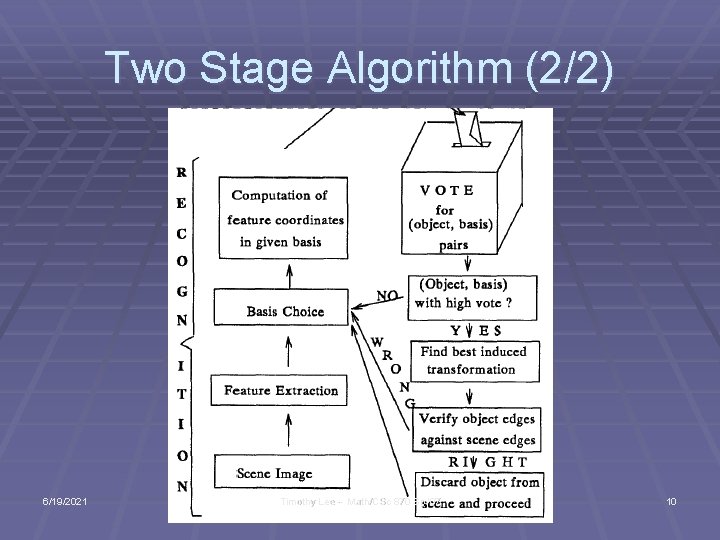
General Framework (3/4) 2. Online recognition (given a scene, extract feature points): a)Pick arbitrary ordered pair: • Compute the other points using this pair as a basis • For all the transformed points, vote all records (model, basis) appear in the corresponding entry in the hash table, and histogram them b)Matching candidates: (model, basis) pairs with large number of votes. c)Recover the transformation that results in the best leastsquares match between all corresponding feature points d)Transform the features, and verify against the input image features (if fails, repeat to 1) 6/19/2021 Timothy Lee -- Math/CSc 870 Sp '07 7
General Framework (4/4) 6/19/2021 Timothy Lee -- Math/CSc 870 Sp '07 8
Two Stage Algorithm (1/2) 6/19/2021 Timothy Lee -- Math/CSc 870 Sp '07 9
Two Stage Algorithm (2/2) 6/19/2021 Timothy Lee -- Math/CSc 870 Sp '07 10
Complexity Assume m=n, and k is the number of points to define the basis. § Preprocessing: O(nk+1) for a single model. § This is done off-line, so complexities add § Recognition: O(nk+1) against all objects in the database. 6/19/2021 Timothy Lee -- Math/CSc 870 Sp '07 11
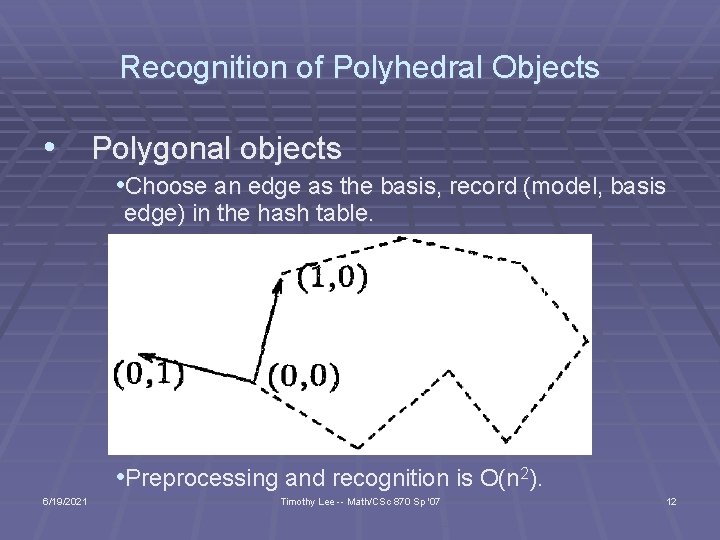
Recognition of Polyhedral Objects • Polygonal objects • Choose an edge as the basis, record (model, basis edge) in the hash table. • Preprocessing and recognition is O(n 2). 6/19/2021 Timothy Lee -- Math/CSc 870 Sp '07 12
Under Various Transformations (1/2) 1. Translation in 2 D and 3 D. • 1 -point basis. • O(n 2). 2. Similarity transformation in 2 D. • 2 -point basis. • O(n 3). 3. Similarity transformation in 3 D. • 3 -point basis. • O(n 4). 6/19/2021 Timothy Lee -- Math/CSc 870 Sp '07 13
Under Various Transformations (2/2) 4. Affine transformation • 3 -point basis. • O(n 4) 5. Projective transformation • 4 -point basis. • O(n 5) 6/19/2021 Timothy Lee -- Math/CSc 870 Sp '07 14
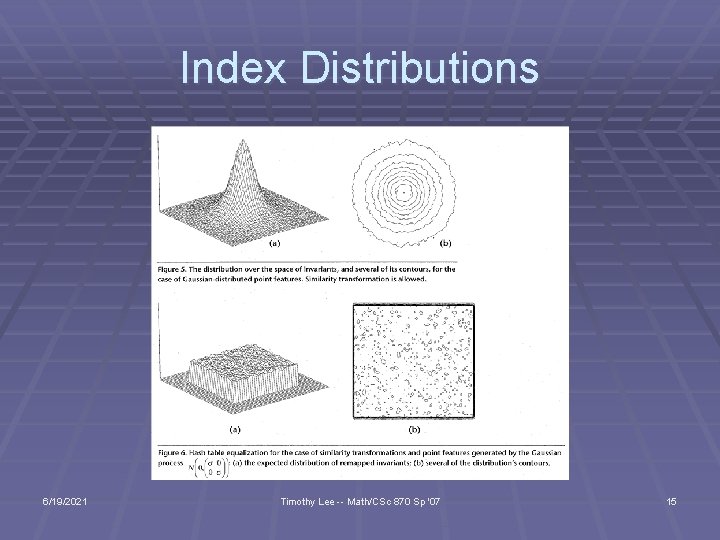
Index Distributions 6/19/2021 Timothy Lee -- Math/CSc 870 Sp '07 15
Noise Modeling (1/2) 6/19/2021 Timothy Lee -- Math/CSc 870 Sp '07 16
Noise Modeling (2/2) § Qualitative conclusions: § The larger the separation of basis points, the smaller the spread of invariants § The closer a point is to the center of its coordinate frame, the smaller the spread of invariants § “Lonely” points carry more information, but are more sensitive to noise 6/19/2021 Timothy Lee -- Math/CSc 870 Sp '07 17
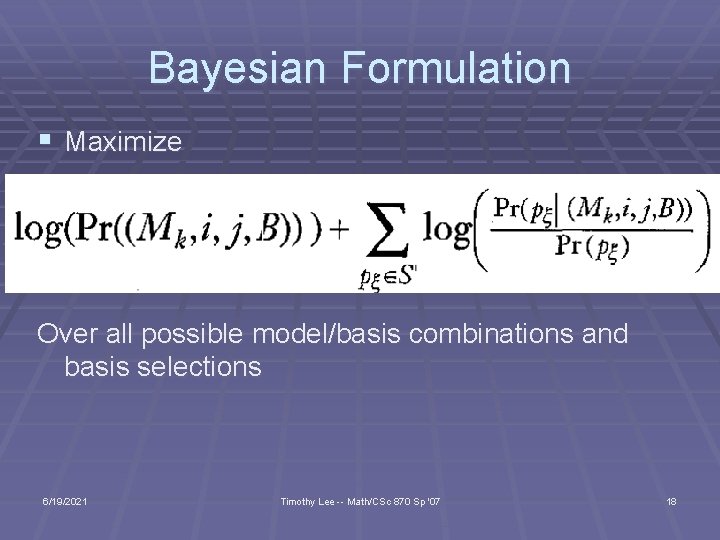
Bayesian Formulation § Maximize Over all possible model/basis combinations and basis selections 6/19/2021 Timothy Lee -- Math/CSc 870 Sp '07 18
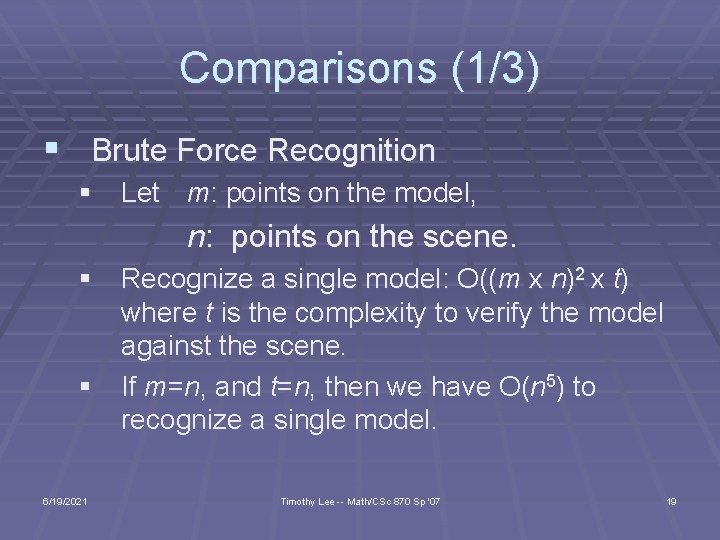
Comparisons (1/3) § Brute Force Recognition § Let m: points on the model, n: points on the scene. § Recognize a single model: O((m x n)2 x t) where t is the complexity to verify the model against the scene. § If m=n, and t=n, then we have O(n 5) to recognize a single model. 6/19/2021 Timothy Lee -- Math/CSc 870 Sp '07 19
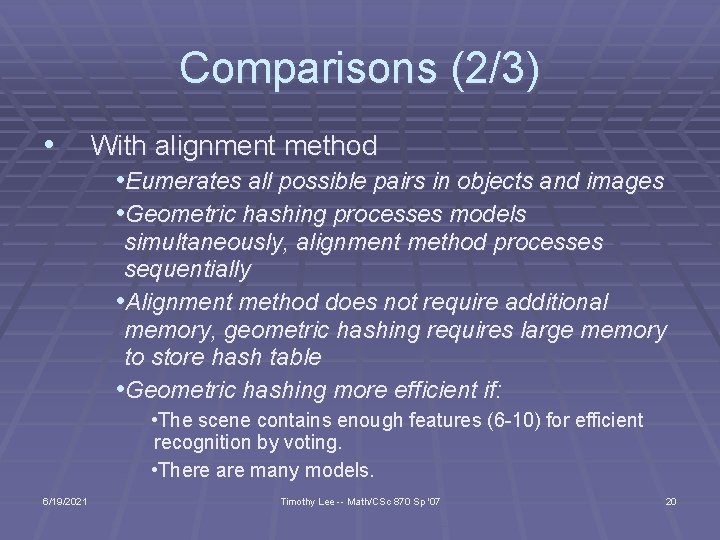
Comparisons (2/3) • With alignment method • Eumerates all possible pairs in objects and images • Geometric hashing processes models simultaneously, alignment method processes sequentially • Alignment method does not require additional memory, geometric hashing requires large memory to store hash table • Geometric hashing more efficient if: • The scene contains enough features (6 -10) for efficient recognition by voting. • There are many models. 6/19/2021 Timothy Lee -- Math/CSc 870 Sp '07 20
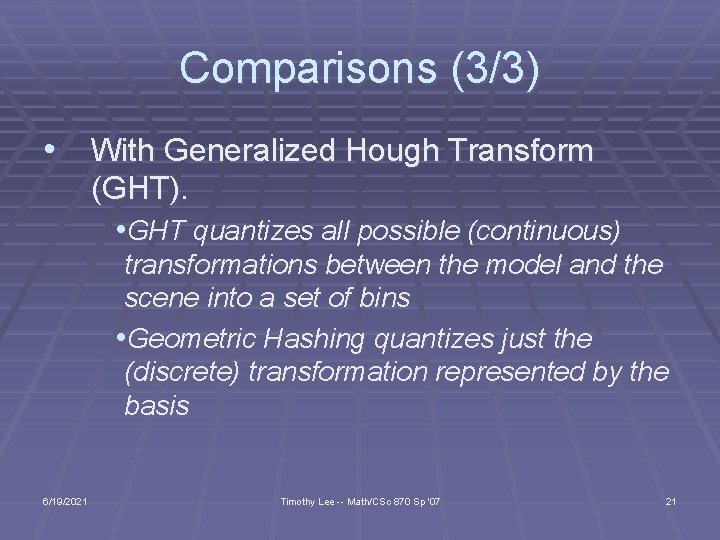
Comparisons (3/3) • With Generalized Hough Transform (GHT). • GHT quantizes all possible (continuous) transformations between the model and the scene into a set of bins • Geometric Hashing quantizes just the (discrete) transformation represented by the basis 6/19/2021 Timothy Lee -- Math/CSc 870 Sp '07 21
Summary § Able to recognize objects that have undergo an arbitrary transformation. § Can perform partial matching. § Efficient and can be parallelized easily. § Use transformation-invariant access key to the hash table. § Two phases (preprocessing and recognition). § Requires a large memory to store hash table. 6/19/2021 Timothy Lee -- Math/CSc 870 Sp '07 22
Current Research § Matching objects with internal degrees of freedom § Visual recognition of articulate objects § Docking of flexible receptor-drug molecules § Detection of partially similar molecules in drug databases 6/19/2021 Timothy Lee -- Math/CSc 870 Sp '07 23