
Geometric Design Process for the 21 st Century




















- Slides: 48
Geometric Design Process for the 21 st Century – NCHRP Report 839 Timothy R. Neuman Senior Associate Bednar Consulting LLC 1
2
Project Team and Panel CH 2 M • Tim Neuman • Richard Coakley • Srikanth Panguluri • Richard Storm MRI Global • Doug Harwood • Ingrid Potts 3 Panel n Barton Thrasher n Anthony Buczek n Daniel Dulaski n James Gattis n Deanna Maifield n Peter Martin n Hugh Mc. Gee n Dennis Toomey n Ms. Lilly Shoup n Brooke Struve n Ray Derr
Introduction NCHRP 15 -47 An Improved Geometric Design Process The recommended geometric design process reflects an understanding of: • History of highway design • Growth in knowledge of design effects on roadway performance, • Changes in emphasis and importance of road design and all road users • Legal framework that shapes implementation of public infrastructure, • Advances in technology that facilitate roadway design • Growing and seemingly permanent condition of limited resources for • Construction • Operation • Maintenance of roads Figure 5 -1 4
‘During the past 60 years, transportation needs have changed and much has been learned about the relationships among geometric design, vehicle fleet, human factors, safety, and operations. AASHTO has continually updated its policies to respond to these changes, but such updates have provided limited changes to the fundamental process or basic design approaches…. An assessment of the current design process is needed to ensure that recent advances in knowledge (e. g. , the AASHTO Highway Safety Manual) and emerging issues (e. g. , complete streets, flexible design) are appropriately addressed. ’ 5
Designing for 3 R Roads serve more than just motor vehicles Road design involves many different disciplines Context matters and it varies Safety performance should focus on elimination or mitigation of severe crashes Speed and crash severity are closely linked Performance (operational, safety) is important Performance may have many dimensions Existing roads with known problems are different from new roads Traditional design approaches (full application of AASHTO criteria) are believed by professionals to yield suboptimal results Focusing on identifying and addressing the problem(s) should be central to developing design solutions 6 Safety risk and cost-effectiveness are related to traffic volumes Designing for VLVLR Value Engineering Travel Time Reliability Safe Systems Design Matrix Practical Design Perfomance. Based Design CSS Important Insights for the Design Process Alternative Design Processes and Initiatives Complete Streets Early Research Findings
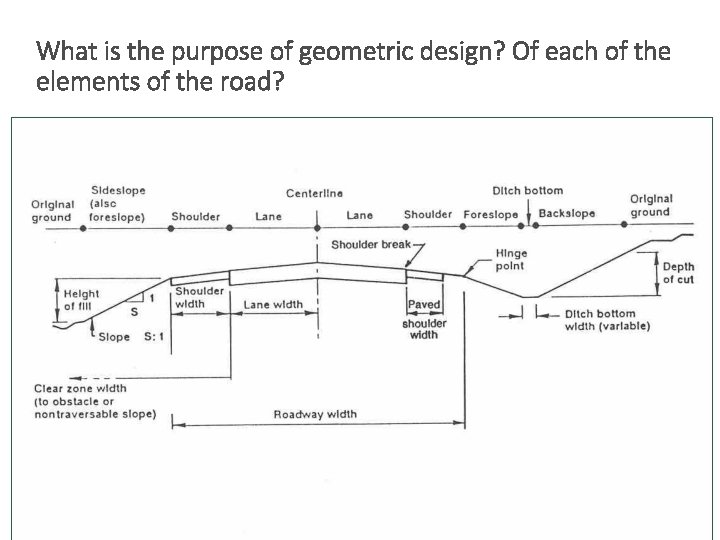
What is the purpose of geometric design? Of each of the elements of the road? 7
Fundamental Bases for Roadway Design Roadway design projects begin with a stated transportation problem. The purpose of geometric design is to provide the necessary three-dimensional framework for a facility to address the problem by providing the appropriate service to the users. Dimensional and other design standards and criteria are a means to an end. The end is transportation performance, such performance to include mobility, accessibility, safety, and state-of-good repair. Figure 5 -1 8
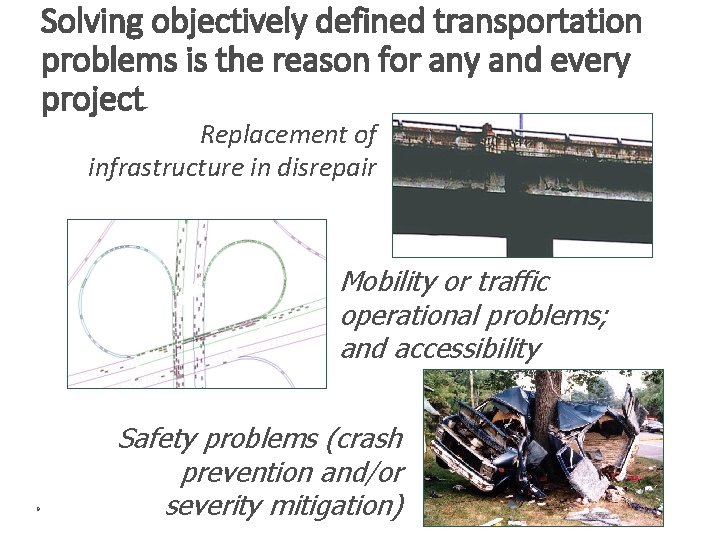
Solving objectively defined transportation problems is the reason for any and every project Replacement of infrastructure in disrepair Mobility or traffic operational problems; and accessibility 9 Safety problems (crash prevention and/or severity mitigation)
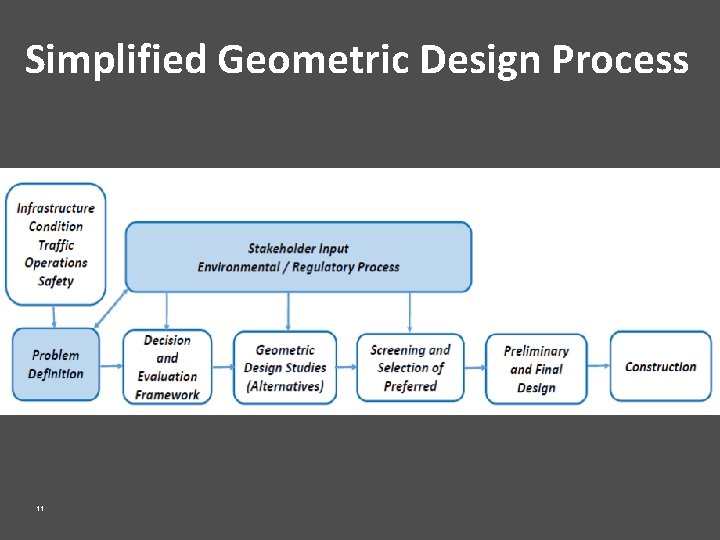
Attributes of an Effective Geometric Design Process • Efficiently conducted • Scalable • Executed by properly trained professionals • Transparent to all stakeholders • Defensible Figure 5 -1 10
Simplified Geometric Design Process Figure 5 -1 11
Recommended Highway Design Process • Step 1: Define the Transportation Problem or Need • Step 2: Identify and Charter All Project Stakeholders • Step 3: Develop the Project Scope • Step 4: Determine the Project Type and Design Development Parameters • Step 5: Establish the Project’s Context and Geometric Design Framework – Framework for Geometric Design Process – New/Reconstruction – Develop Project Evaluation Criteria w/in Context Framework – Establish Decision-making Roles and responsibilities – Determine Basic Geometric Design Control – Design or Target Speed Figure 2 -4 – Determine Basic Design Controls • Design Traffic Volumes, Design LOS, Road User Attributes 12 12
Recommended Highway Design Process • Step 6: Apply the Appropriate Geometric Design Process and Criteria • Step 7: Designing the Geometric Alternatives • Step 8: Design Decision-Making and Documentation • Step 9: Transitioning to Preliminary and Final Engineering • Step 10: Agency Operations and Maintenance Database Assembly • Step 11: Continuous Monitoring and Feedback to Agency Processes and Database Figure 2 -4 13 13
Geometric Design Context and Framework (Step 5) Current AASHTO Policy Proposed Framework • Functional Classification (3) • Functional Classification (5) • Land Use / Context Zones (6) • Urban/Rural (Land Use) • Terrain (3) • Design Vehicles • Design Year Traffic • Project Types (2) – New Construction & Reconstruction – 3 R 14 • Design Users • Design Traffic - Design Year - Service Life • Project Types (3) - New Construction - Reconstruction - 3 R
Roadway Context Zones 15 ITE Designing Walkable Urban Thoroughfares: A Context Sensitive Approach
Characteristics of Severe Crashes by Context Zone 16
Characteristics of Severe Crashes by Context Zone 17
Critical Substantive Safety Issues by Context Zone and Functional Class of Road 18
Traffic Operational Issues Vary by Context Zone and Functional Class of Road 19
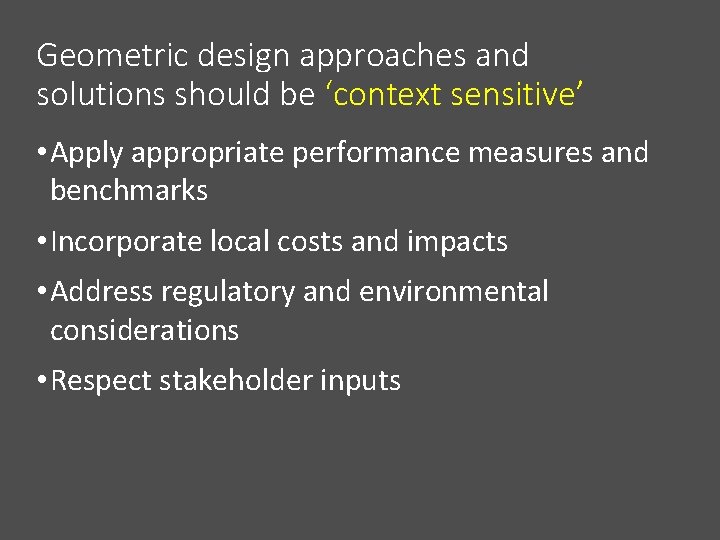
Geometric design approaches and solutions should be ‘context sensitive’ • Apply appropriate performance measures and benchmarks • Incorporate local costs and impacts • Address regulatory and environmental considerations • Respect stakeholder inputs 20
Project Types and Transportation Problems 21
Design Standards and Problem Definition The presence of one or more geometric design features that fail to meet current design criteria is NOT a transportation problem…. It is merely a condition of the context of a reconstruction or 3 R project. ‘Upgrade to current standards’ is NOT an appropriate purpose and need 22
New Construction vs reconstruction 23
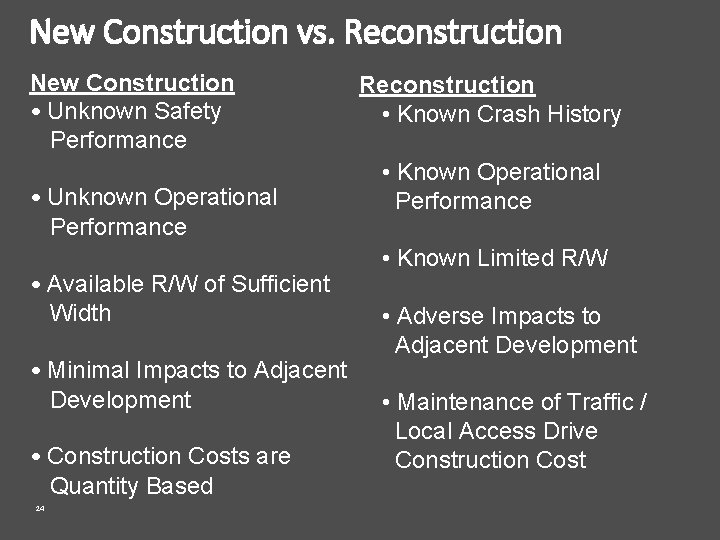
New Construction vs. Reconstruction New Construction • Unknown Safety Performance • Unknown Operational Performance • Available R/W of Sufficient Width • Minimal Impacts to Adjacent Development • Construction Costs are Quantity Based 24 Reconstruction n • Known Crash History n • Known Operational Performance n • Known Limited R/W n • Adverse Impacts to Adjacent Development n n n • Maintenance of Traffic / Local Access Drive Construction Cost
25
Paradigm shifts are in order…. . 26
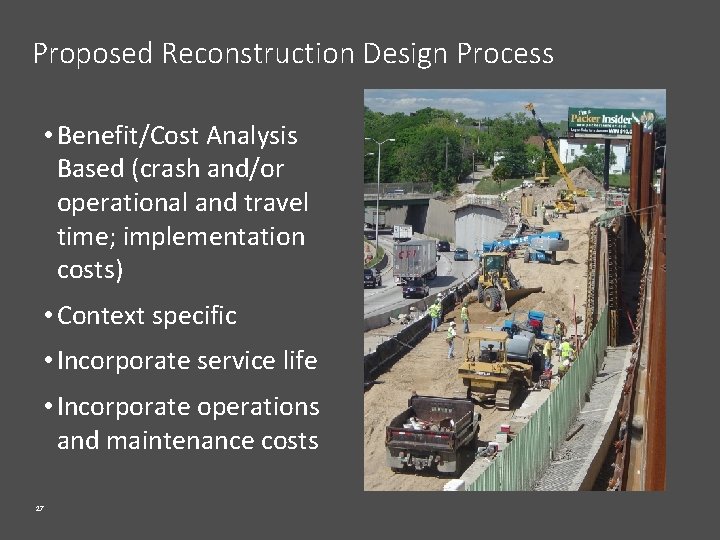
Proposed Reconstruction Design Process • Benefit/Cost Analysis Based (crash and/or operational and travel time; implementation costs) • Context specific • Incorporate service life • Incorporate operations and maintenance costs 27
Reconstruction project decisions should employ a Benefit – Cost Framework User Benefits – Travel Time Savings – Crash Reduction Costs Agency Costs – Construction Costs – Annual Maintenance Costs* – Terminal Value Projects should be evaluated over a Service Life that is much longer than the Design Life 28
Basic Design Controls 29 • Design Year Traffic • Service Life Traffic • Design or Target Speed • Design Operating Conditions – Design Level of Service – Travel Time Reliability • Road User Attributes
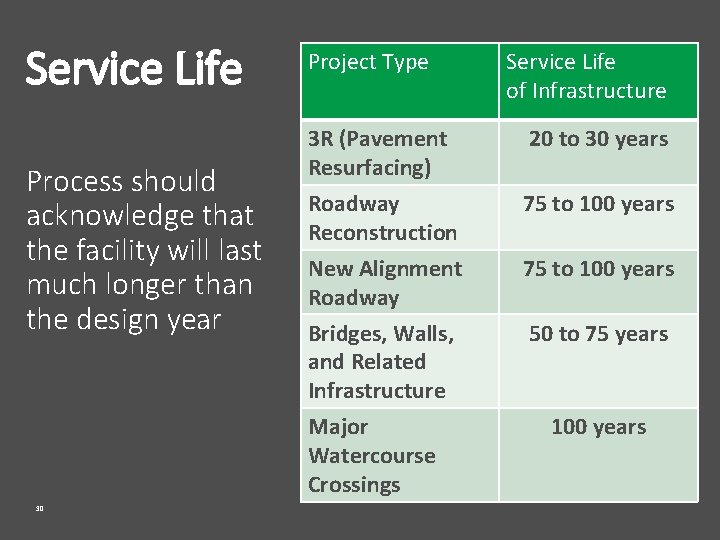
Service Life Process should acknowledge that the facility will last much longer than the design year Project Type 3 R (Pavement Resurfacing) 20 to 30 years Roadway Reconstruction 75 to 100 years New Alignment Roadway Bridges, Walls, and Related Infrastructure 75 to 100 years Major Watercourse Crossings 30 Service Life of Infrastructure 50 to 75 years 100 years
Design Exceptions ‘Doing the right thing’ may require a design exception under current policy guidance • If design exceptions are done routinely, what does that tell us about the validity of the underlying design standard or model? • If the problem is solved with it operating safely and efficiently, does it matter if it meets a dimensional criteria? 31
Implications of the proposed reconstruction design process Each project is uniquely designed to reflect the context Cost effectiveness is directly embedded in the solution No design exceptions – the right answer is what it is Agencies should be spending less on projects than they do now 32
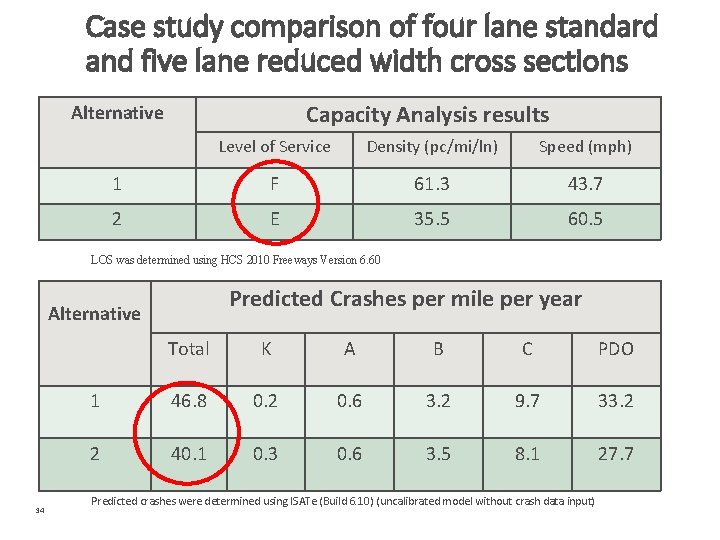
3 3 Case study comparison of four lane standard and five lane reduced width cross sections Alternative 1: 4 – 12 ft lanes with 10 ft right shoulders and 10 ft left shoulders Alternative 2: 5 – 11 ft lanes with 10 ft right shoulders and 3 ft left shoulders 33
Case study comparison of four lane standard and five lane reduced width cross sections Capacity Analysis results Alternative Level of Service Density (pc/mi/ln) Speed (mph) 1 F 61. 3 43. 7 2 E 35. 5 60. 5 LOS was determined using HCS 2010 Freeways Version 6. 60 Predicted Crashes per mile per year Alternative 34 Total K A B C PDO 1 46. 8 0. 2 0. 6 3. 2 9. 7 33. 2 2 40. 1 0. 3 0. 6 3. 5 8. 1 27. 7 Predicted crashes were determined using ISATe (Build 6. 10) (uncalibrated model without crash data input)
The Future of Geometric Design Lessened time, effort and expense to complete the design in steps 6 - 9 (per advances in design technology) Greater effort to engage stakeholders, test and evaluate design Figure 2 -4 effects and apply complex decision processes involving trade-offs (steps 1 – 8) 35 35
Geometric design is much less labor and time intensive Advanced computer aided design technologies enable • Rapid testing of alternative design solutions • Quality control • Constructability reviews • Cost estimating 36
Recommendations for revised approach to geometric design criteria for roads on new alignment • Established dimensional criteria are still needed for roads on new alignment and new roads on existing R/W • AASHTO criteria in need of improvement • Sight Distance • Horizontal Curvature • Lane Widths 37
Nominal vs. Substantive Safety – The conundrum of geometric design criteria 38
Geometric design criteria for new roads should reflect cost-effectiveness principles and be more ‘context sensitive’ • Functional models require a new look • Models may need to vary by road type and context • Criteria should include traffic volume (relative safety risk) • Criteria should incorporate known safety relationships 39
The AASHTO horizontal curve design model e + f = V 2 / 15 R where V = design speed (mph) R = radius of curve (ft) AASHTO Design Assumptions • Passenger car tracks the curve as a point mass e = superelevation • Passenger car operates at constant design speed through curve f = design side friction • ‘f’ values reflect driver comfort • Curve design should avoid loss of control due to skidding (i. e. , during cornering) • Applies to all functional classes and volume ranges 40
Does the simple AASHTO curve model make sense for all project contexts? • What about safety performance? • What about other vehicles such as trucks, buses, emergency equipment, recreational vehicles, etc. ? • How important is comfort vs. other operational conditions? • What about other performance criteria (e. g. , off-tracking)? • What about interactive effects of other criteria (grade, width, roadside)? 41
Strawman Framework for Design of Horizontal Curvature for Road Types by Context 42
Potential approaches to horizontal curvature design criteria 43
Strawman Framework for Design of Lane Widths for Road Types by Context 44
Transition in skills, knowledge and approach The ‘old model’ designer • Understands basics of vehiclecentric AASHTO models • Applying the policy and standards to produce a solution that fully meets criteria • Calculation of alignment • Balancing of earthwork • Detailing of construction plans • Compiling quantities for contract documents 45 The ‘new model’ designer • Engaging multiple stakeholders (some non-technical) • Proficient in application of tools, models and evaluation methods for operational and safety effects of design (HCM, HSM, IHSDM) • Always testing multiple alternatives • Able to design in range of speed and land -use contexts • Fully knowledgeable in environmental regulations, laws, and processes • Applying multi-attribute decision models • Knowledgeable in economic analysis; B/C principles
Contents of Future Green Books • New Construction Design Criteria – Performance-based (proven crash and/or operational and travel time relationships) – Sensitive to traffic volume – Varies by road type – Sensitive to context – Incorporate Service Life – Incorporate known operations and maintenance relationships 46 • Reconstruction Design Process – Benefit/Cost Analysis Based (crash and/or operational and travel time; implementation costs) – Context specific – Incorporate service life – Incorporate operations and maintenance costs
Final Report • Documents the findings • Performance based critique of Green Book • Includes detailed outline for a new Green Book • Provides case studies demonstrating the process • Research recommendations for new construction criteria 47
Questions timneuman. engineering@gmail. com 48