
Geometric Algebra 2 Geometric Algebra in 3 Dimensions
Geometric Algebra 2. Geometric Algebra in 3 Dimensions Dr Chris Doran ARM Research
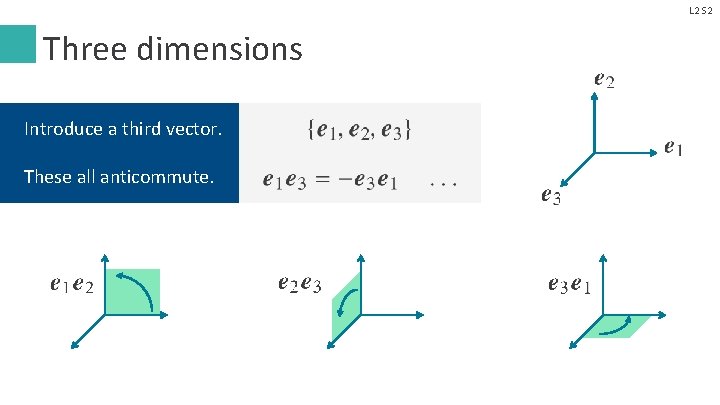
L 2 S 2 Three dimensions Introduce a third vector. These all anticommute.
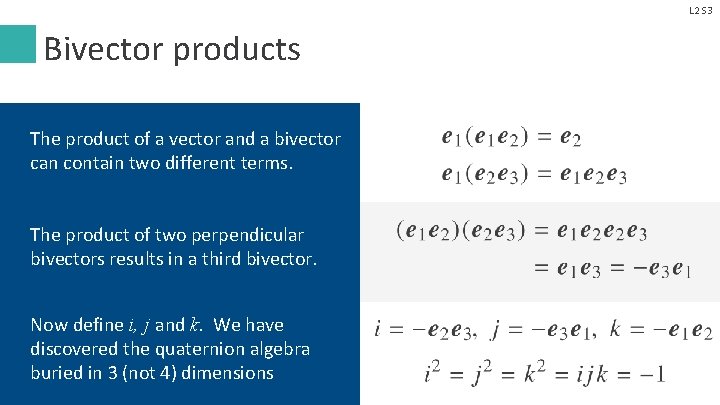
L 2 S 3 Bivector products The product of a vector and a bivector can contain two different terms. The product of two perpendicular bivectors results in a third bivector. Now define i, j and k. We have discovered the quaternion algebra buried in 3 (not 4) dimensions
L 2 S 4 Unification Quaternions arise naturally in the geometric algebra of space.
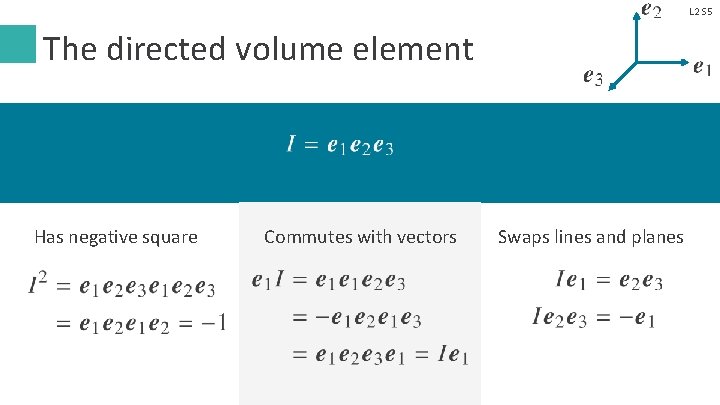
L 2 S 5 The directed volume element Has negative square Commutes with vectors Swaps lines and planes
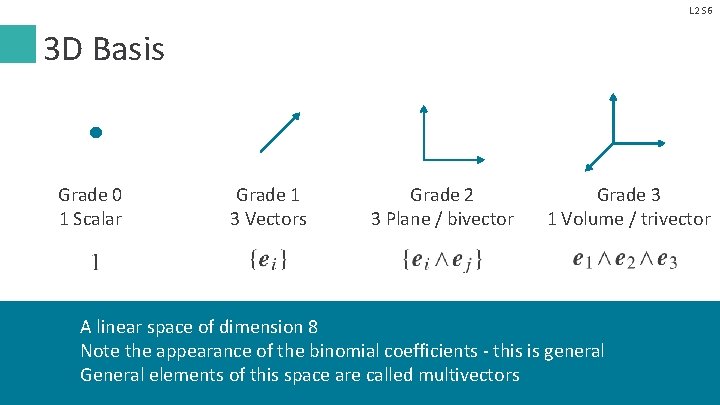
L 2 S 6 3 D Basis Grade 0 1 Scalar Grade 1 3 Vectors Grade 2 3 Plane / bivector Grade 3 1 Volume / trivector A linear space of dimension 8 Note the appearance of the binomial coefficients - this is general General elements of this space are called multivectors
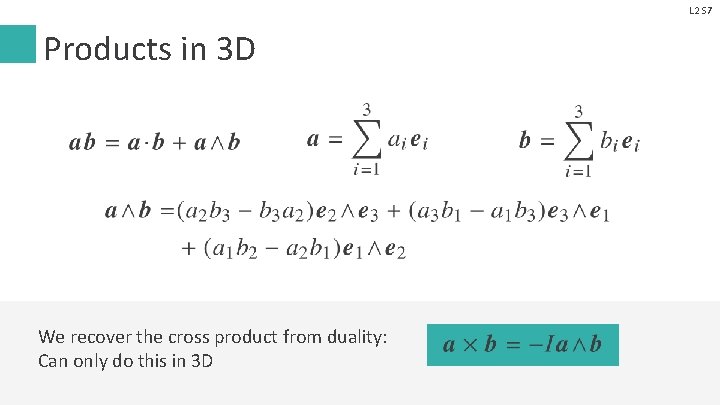
L 2 S 7 Products in 3 D We recover the cross product from duality: Can only do this in 3 D
L 2 S 8 Unification The cross product is a disguised from of the outer product in three dimensions.
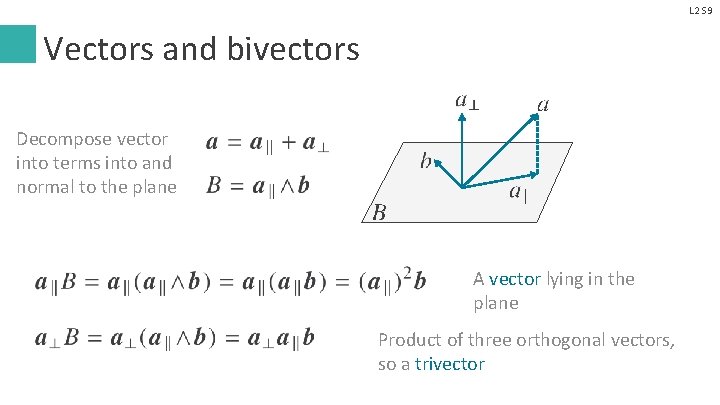
L 2 S 9 Vectors and bivectors Decompose vector into terms into and normal to the plane A vector lying in the plane Product of three orthogonal vectors, so a trivector
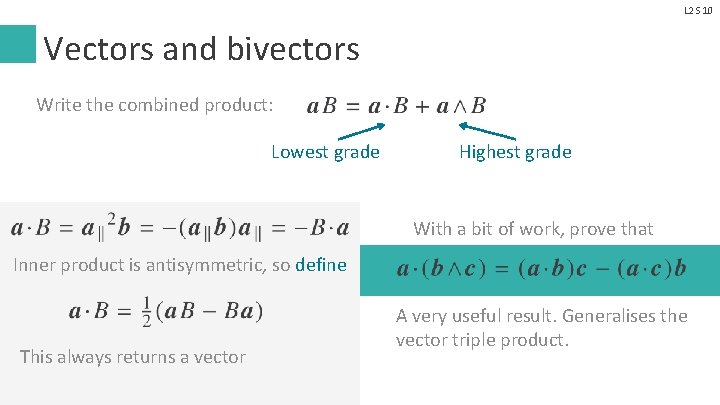
L 2 S 10 Vectors and bivectors Write the combined product: Lowest grade Highest grade With a bit of work, prove that Inner product is antisymmetric, so define This always returns a vector A very useful result. Generalises the vector triple product.
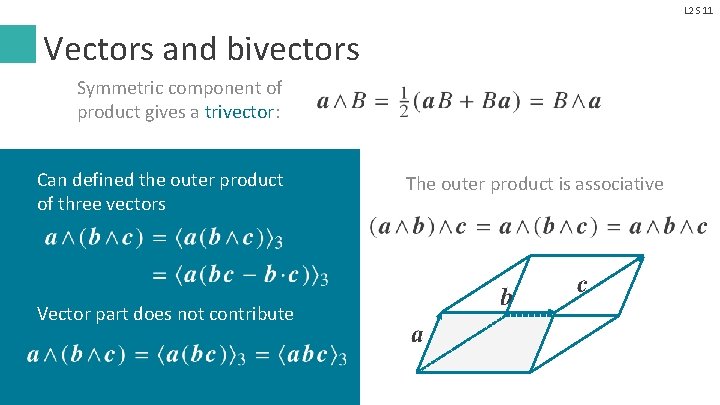
L 2 S 11 Vectors and bivectors Symmetric component of product gives a trivector: Can defined the outer product of three vectors Vector part does not contribute The outer product is associative
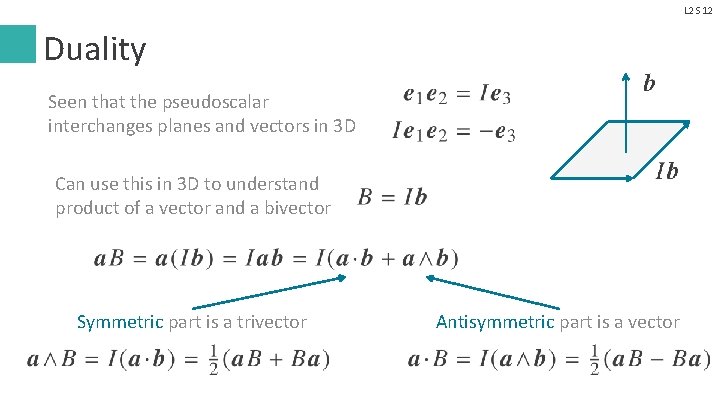
L 2 S 12 Duality Seen that the pseudoscalar interchanges planes and vectors in 3 D Can use this in 3 D to understand product of a vector and a bivector Symmetric part is a trivector Antisymmetric part is a vector
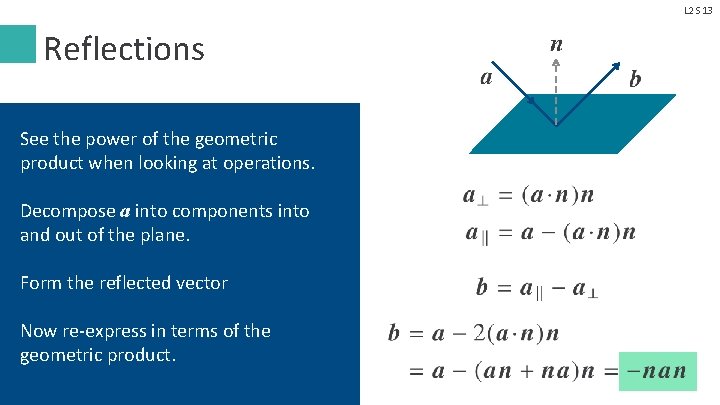
L 2 S 13 Reflections See the power of the geometric product when looking at operations. Decompose a into components into and out of the plane. Form the reflected vector Now re-express in terms of the geometric product.
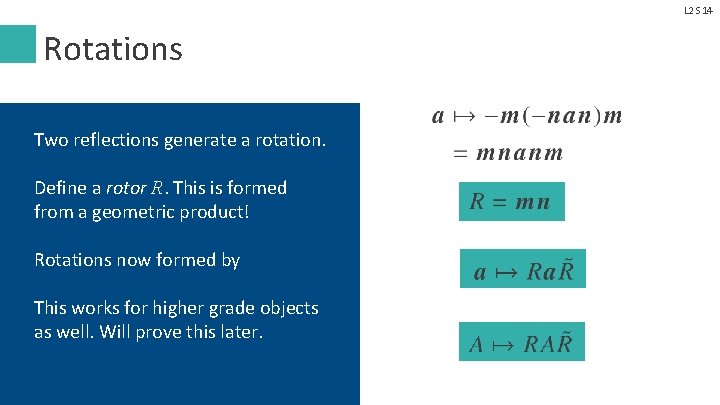
L 2 S 14 Rotations Two reflections generate a rotation. Define a rotor R. This is formed from a geometric product! Rotations now formed by This works for higher grade objects as well. Will prove this later.
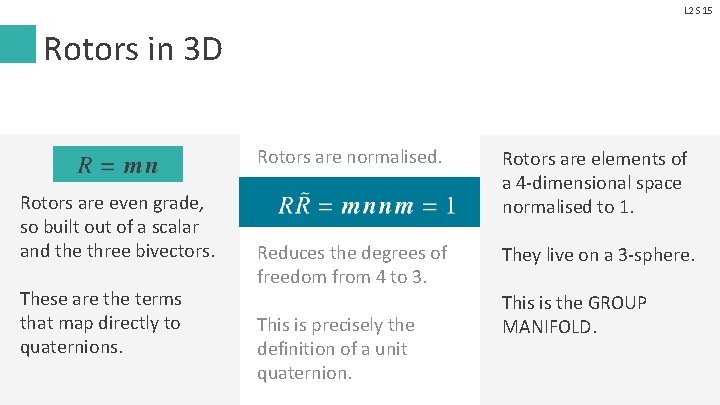
L 2 S 15 Rotors in 3 D Rotors are even grade, so built out of a scalar and the three bivectors. These are the terms that map directly to quaternions. Rotors are normalised. Rotors are elements of a 4 -dimensional space normalised to 1. Reduces the degrees of freedom from 4 to 3. They live on a 3 -sphere. This is precisely the definition of a unit quaternion. This is the GROUP MANIFOLD.
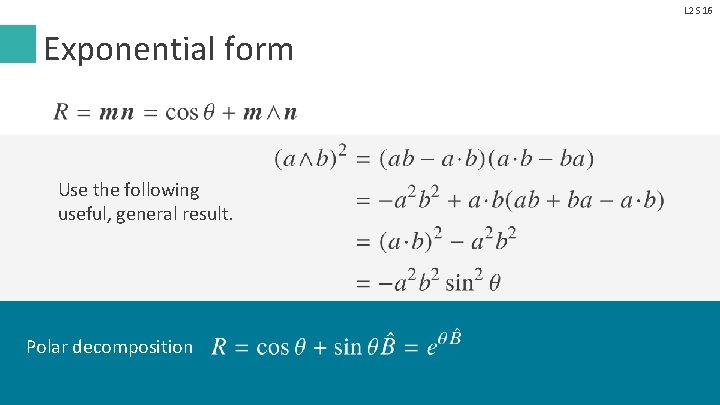
L 2 S 16 Exponential form Use the following useful, general result. Polar decomposition
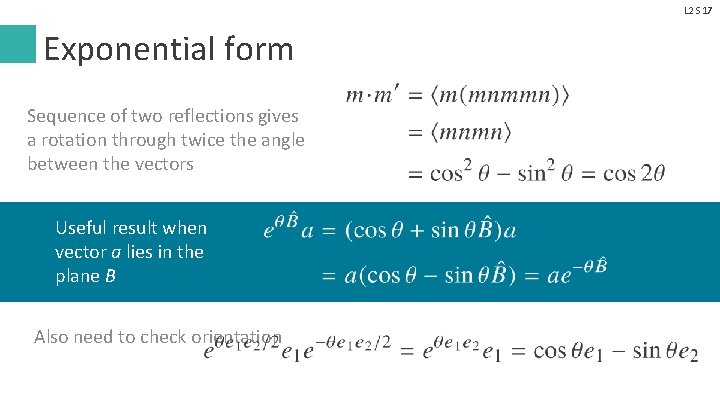
L 2 S 17 Exponential form Sequence of two reflections gives a rotation through twice the angle between the vectors Useful result when vector a lies in the plane B Also need to check orientation
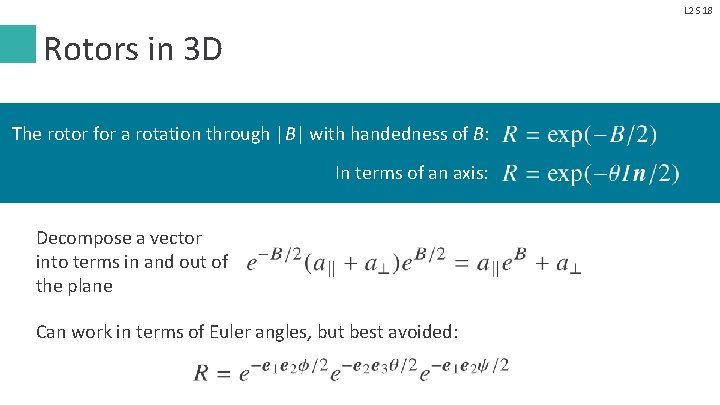
L 2 S 18 Rotors in 3 D The rotor for a rotation through |B| with handedness of B: In terms of an axis: Decompose a vector into terms in and out of the plane Can work in terms of Euler angles, but best avoided:
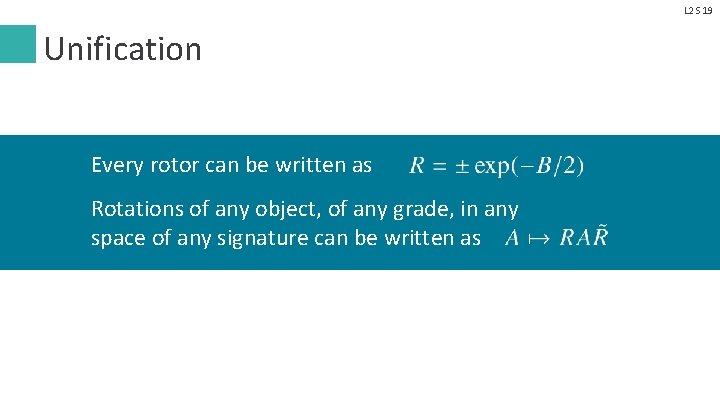
L 2 S 19 Unification Every rotor can be written as Rotations of any object, of any grade, in any space of any signature can be written as
L 2 S 20 Unification Every finite Lie group can be realised as a group of rotors. Every Lie algebra can be realised as a set of bivectors.
L 2 S 21 Resources geometry. mrao. cam. ac. uk chris. doran@arm. com cjld 1@cam. ac. uk @chrisjldoran #geometricalgebra github. com/ga
- Slides: 21