
Geology Unit 5 Weathering Erosion Deposition Soil Rivers

- Slides: 36
Geology: Unit 5 Weathering, Erosion, Deposition, Soil, Rivers and Groundwater
First things first… O On the class website, open the Weathering Chart Key and the Erosion Chart Key, respectively, to be able to complete those worksheets in your packet. Then continue with this Power. Point. O You will fill in notes starting with “Soil” on the worksheets and in this Power. Point, but you should still read all the information leading up to it.
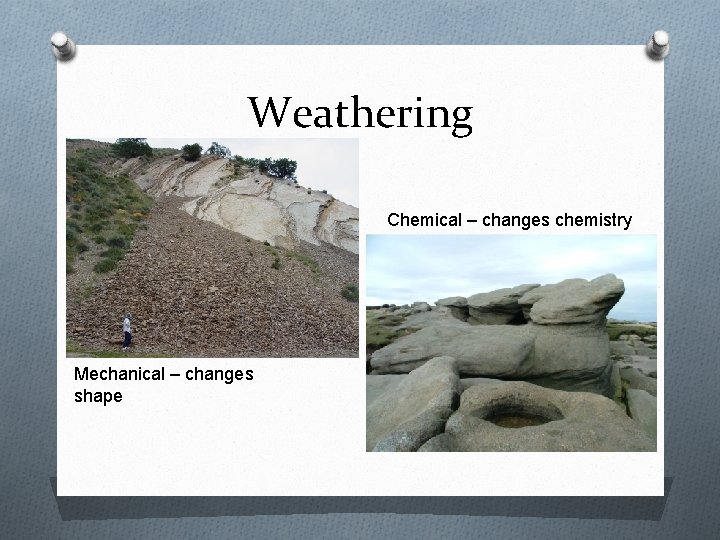
Weathering O The breakup of minerals and rocks by chemical and physical means O Mechanical – process by which rocks and minerals change in size and shape O Chemical – process by which rocks and minerals change in composition O (aka decomposition) O Rates of Weathering O Time it takes for weathering to occur O See Worksheet for details *Weathering, erosion and deposition (sedimentation) are interrelated processes that build up and break down Earth’s surface.
Weathering Chemical – changes chemistry Mechanical – changes shape
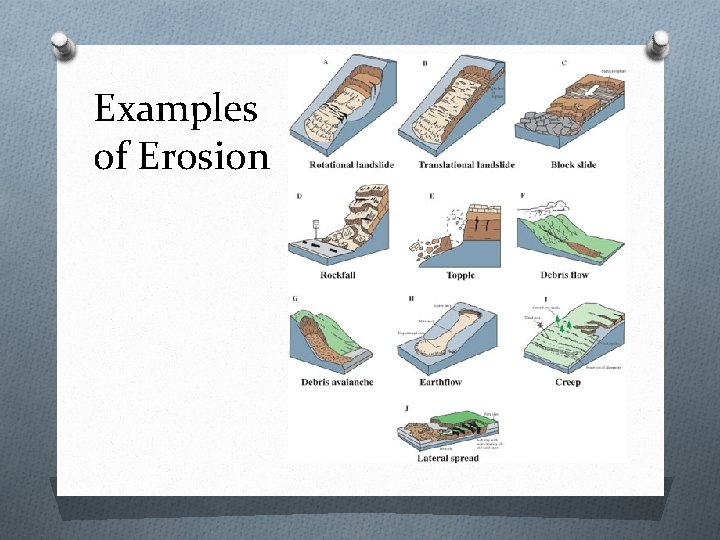
Erosion O The process that transports Earth materials from one place to another O There are 5 major types of erosion: Gravity, Water, Glaciers/Ice, Wind and Plants/Humans O Water is the most powerful type of erosion
Examples of Erosion
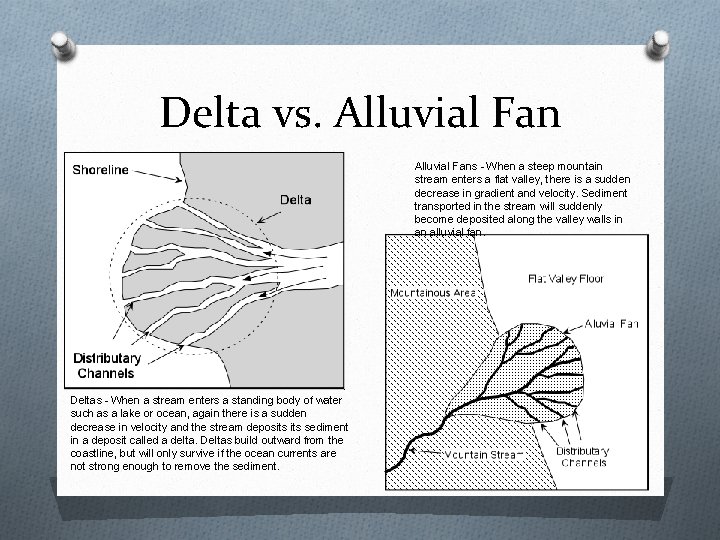
Deposition O When eroded material stops moving O When deposition occurs via water, various landforms may be created (depending on the surrounding topography): O DELTA – triangular shaped deposit that forms at the mouth of a river where it runs into a larger body of water, like the ocean O ALLUVIAL FAN – triangular shaped deposit that forms at the mouth of a river where it runs to the base of a mountain/hill
Delta vs. Alluvial Fans - When a steep mountain stream enters a flat valley, there is a sudden decrease in gradient and velocity. Sediment transported in the stream will suddenly become deposited along the valley walls in an alluvial fan. Deltas - When a stream enters a standing body of water such as a lake or ocean, again there is a sudden decrease in velocity and the stream deposits sediment in a deposit called a delta. Deltas build outward from the coastline, but will only survive if the ocean currents are not strong enough to remove the sediment.
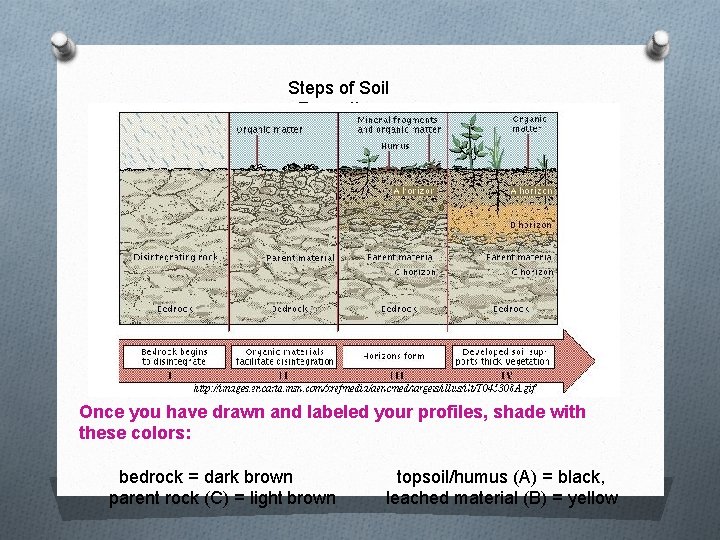
Soil – fill in your notes… O Soil is the loose covering or mixture of rock fragments and organic material that can support the growth of vegetation. O Humus is decaying organic matter. O Soil is the result of chemical and mechanical weathering and biological activity over long periods of time. The soil-forming process begins when weathering breaks solid bedrock (aka “parent rock”) into smaller pieces.
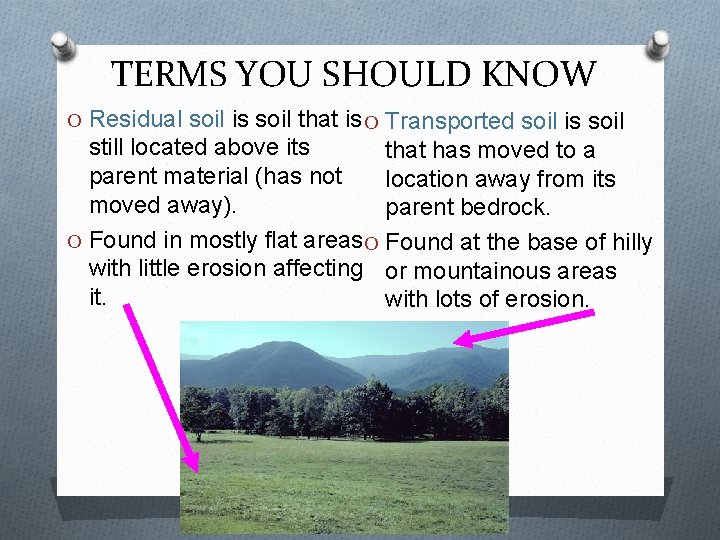
TERMS YOU SHOULD KNOW O Residual soil is soil that is O Transported soil is soil still located above its that has moved to a parent material (has not location away from its moved away). parent bedrock. O Found in mostly flat areas. O Found at the base of hilly with little erosion affecting or mountainous areas it. with lots of erosion.
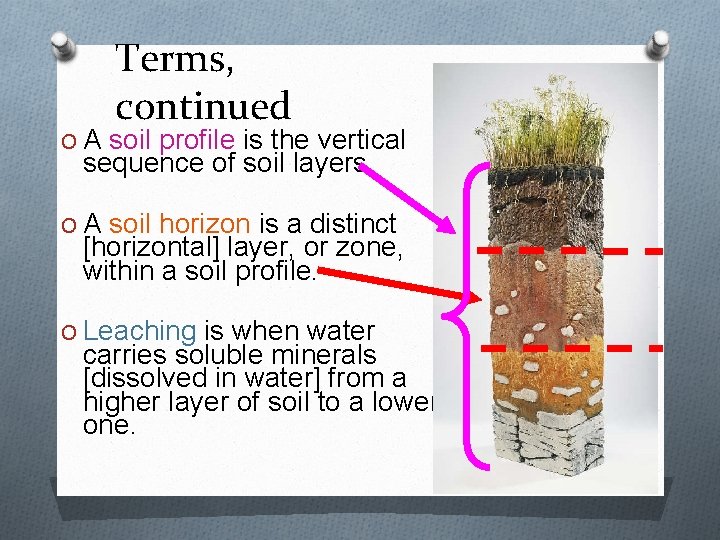
Terms, continued O A soil profile is the vertical sequence of soil layers. O A soil horizon is a distinct [horizontal] layer, or zone, within a soil profile. O Leaching is when water carries soluble minerals [dissolved in water] from a higher layer of soil to a lower one.
TOPOGRAPHY, TIME AND VEGETATION O The topography (shape of the land) of a region affects the thickness of developing soil. O Soils on slopes tend to be thin, coarse, and infertile. O Soils in lower areas, like valleys, are thick and fertile. O South facing slopes receive more direct sunlight and therefore have somewhat more vegetation and thicker soil.
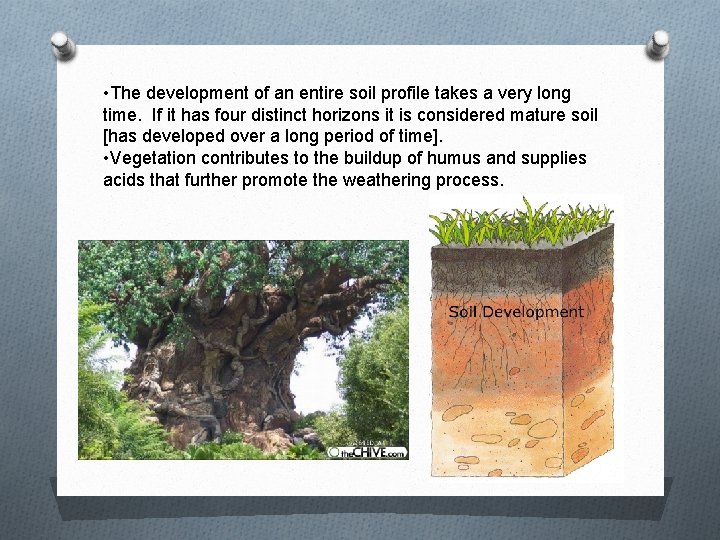
• The development of an entire soil profile takes a very long time. If it has four distinct horizons it is considered mature soil [has developed over a long period of time]. • Vegetation contributes to the buildup of humus and supplies acids that further promote the weathering process.
Steps of Soil Formation Once you have drawn and labeled your profiles, shade with these colors: bedrock = dark brown parent rock (C) = light brown topsoil/humus (A) = black, leached material (B) = yellow
Groundwater Found in Chapter 16
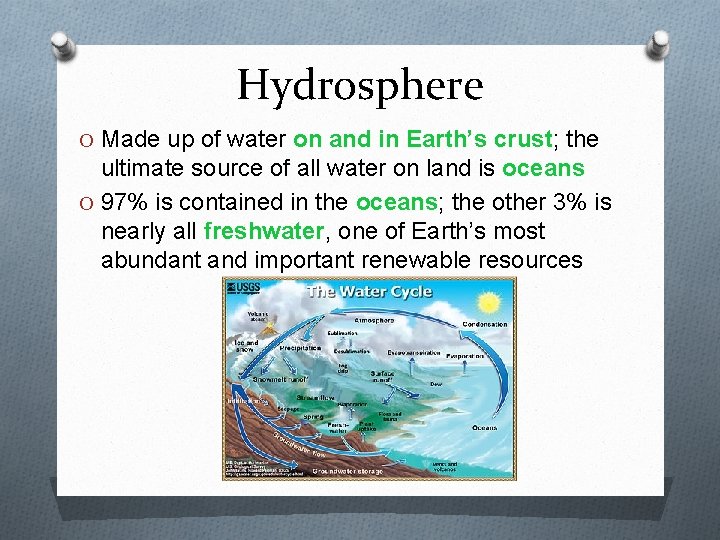
Hydrosphere O Made up of water on and in Earth’s crust; the ultimate source of all water on land is oceans O 97% is contained in the oceans; the other 3% is nearly all freshwater, one of Earth’s most abundant and important renewable resources
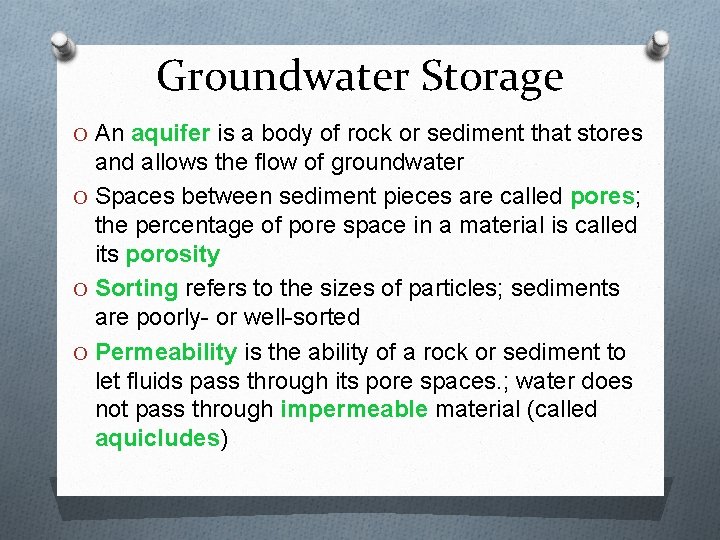
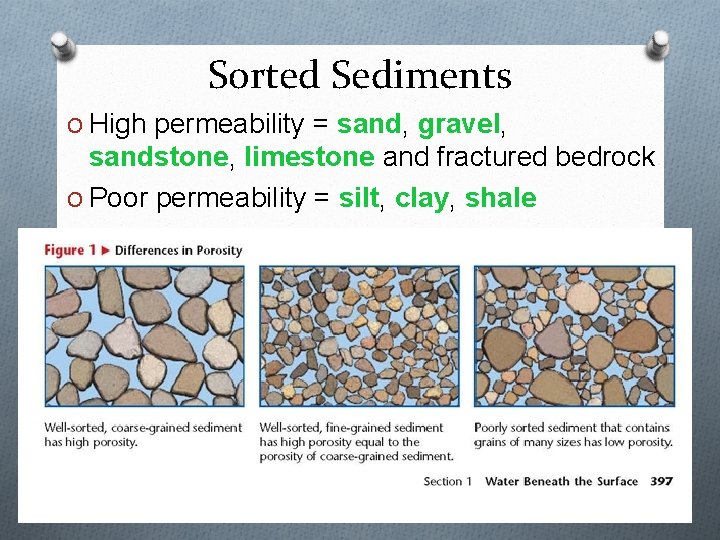
Groundwater Storage O An aquifer is a body of rock or sediment that stores and allows the flow of groundwater O Spaces between sediment pieces are called pores; the percentage of pore space in a material is called its porosity O Sorting refers to the sizes of particles; sediments are poorly- or well-sorted O Permeability is the ability of a rock or sediment to let fluids pass through its pore spaces. ; water does not pass through impermeable material (called aquicludes)
Sorted Sediments O High permeability = sand, gravel, sandstone, limestone and fractured bedrock O Poor permeability = silt, clay, shale
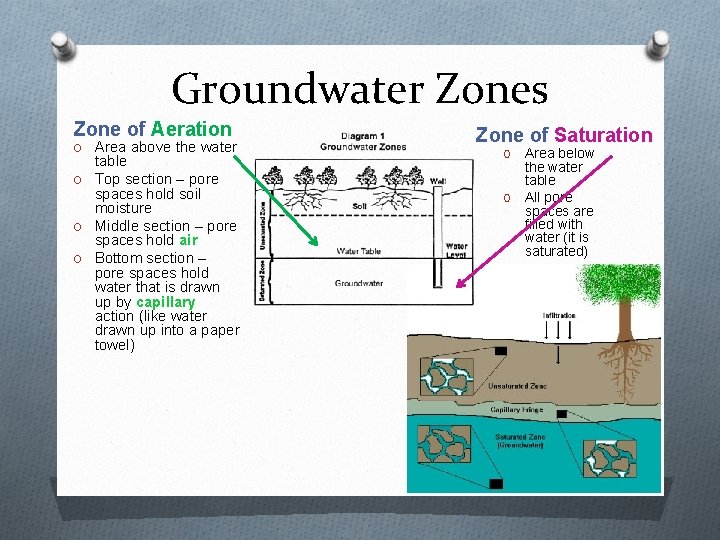
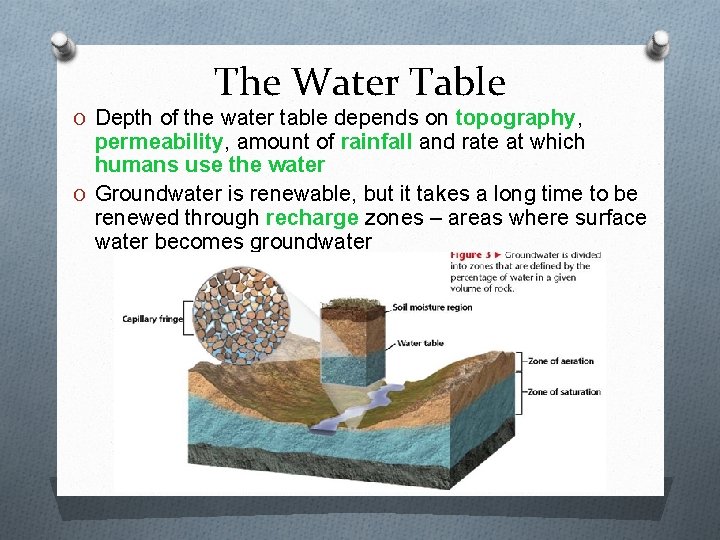
Groundwater Zones Zone of Aeration O Area above the water table O Top section – pore spaces hold soil moisture O Middle section – pore spaces hold air O Bottom section – pore spaces hold water that is drawn up by capillary action (like water drawn up into a paper towel) Zone of Saturation Area below the water table O All pore spaces are filled with water (it is saturated) O
The Water Table O Depth of the water table depends on topography, permeability, amount of rainfall and rate at which humans use the water O Groundwater is renewable, but it takes a long time to be renewed through recharge zones – areas where surface water becomes groundwater
Wells and Springs O A well is a hole that is dug to below the level of the water table through which groundwater is brought to the surface; the water table around the well begins to drop when water moves up through the well (cone of depression, or drawdown) O A spring is an area where groundwater flows to the surface because the ground is below the water table O Areas where hot groundwater rises to the surface are called hot springs; areas where hot springs erupt from surface pools are called geysers
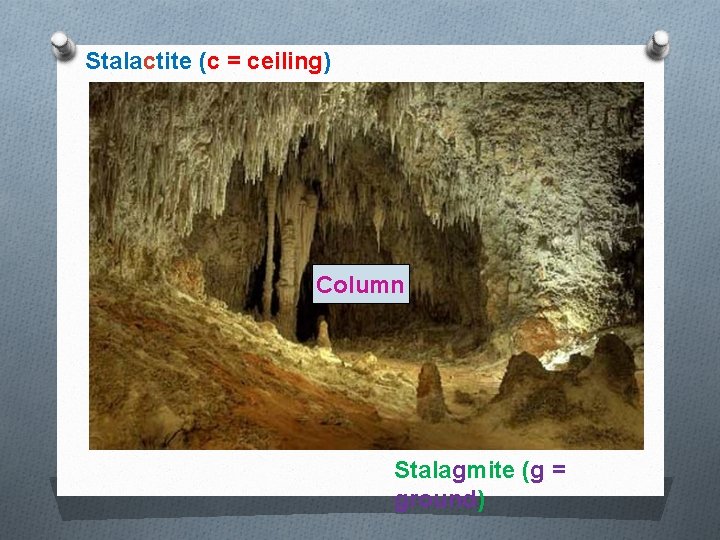
Caves O Chemical weathering causes dissolution of limestone to produce caves and caverns. O Dripstone formations that decorate many caves above the water table are either stalactites (hang from the ceiling of caves) or are stalagmites (“grow” on the ground of caves). If these grow together it is called a column. O A type of limestone that produces these features is called travertine.
Stalactite (c = ceiling) Column Stalagmite (g = ground)
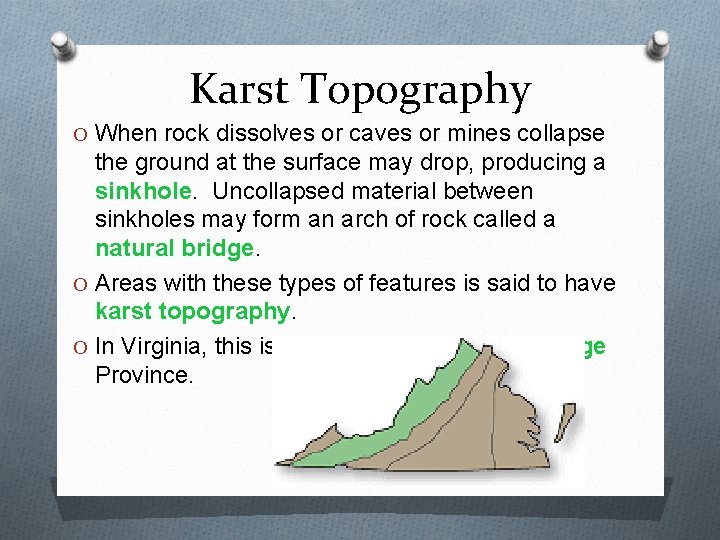
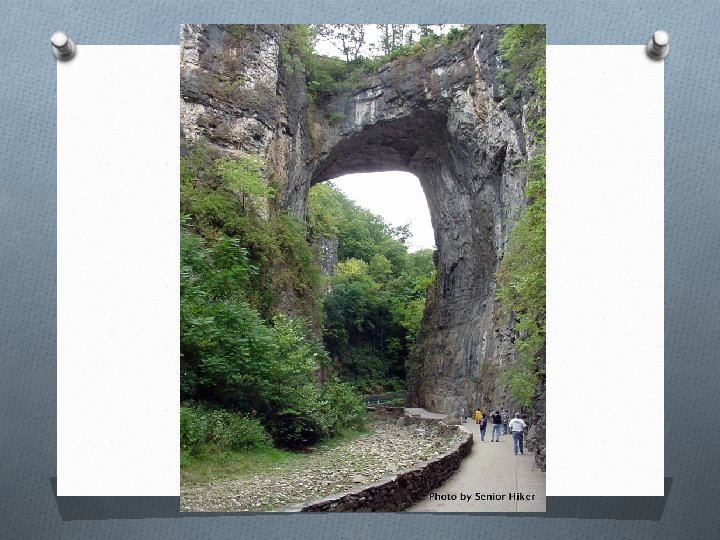
Karst Topography O When rock dissolves or caves or mines collapse the ground at the surface may drop, producing a sinkhole. Uncollapsed material between sinkholes may form an arch of rock called a natural bridge. O Areas with these types of features is said to have karst topography. O In Virginia, this is found in the Valley and Ridge Province.
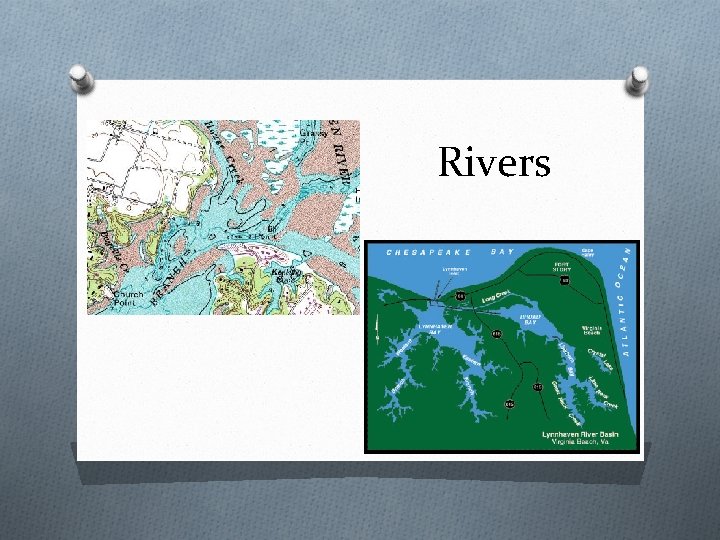
Rivers
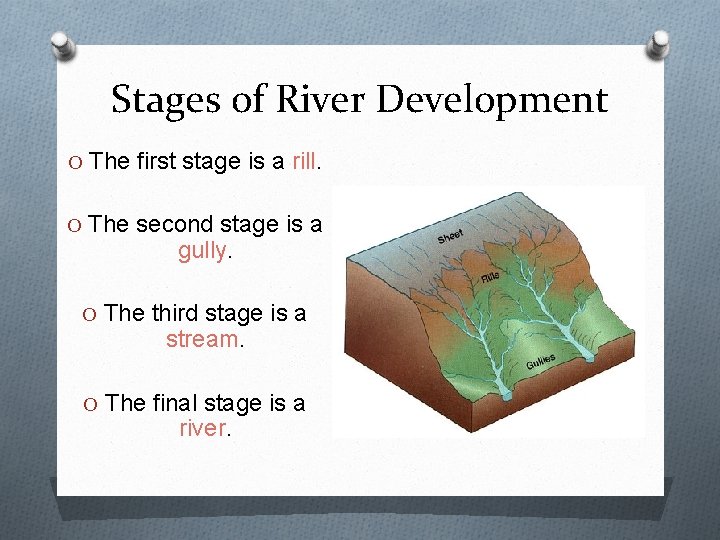
Stages of River Development O The first stage is a rill. O The second stage is a gully. O The third stage is a stream. O The final stage is a river.
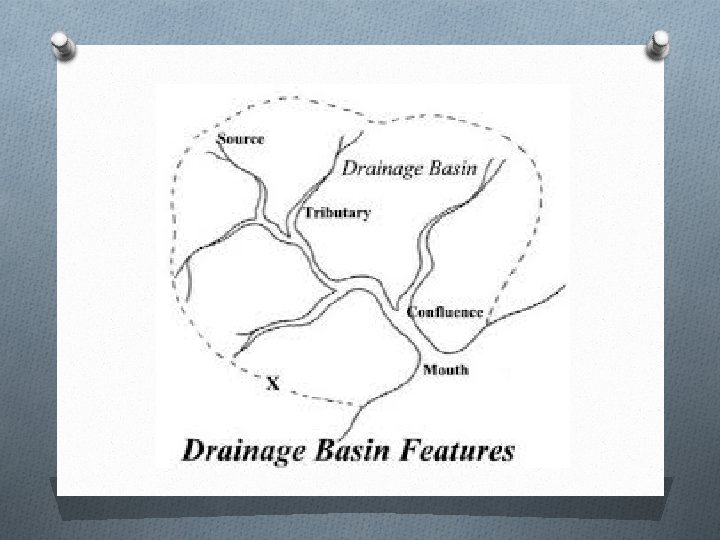
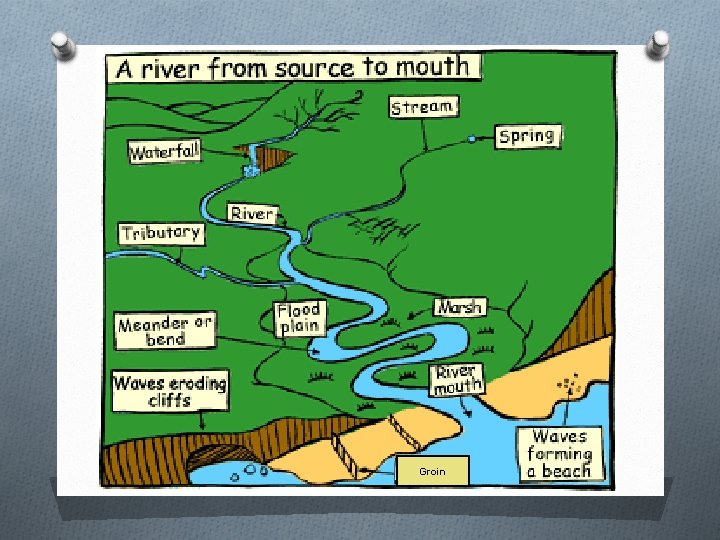
Terms to Know O Place where river starts = source O Bend or curve in a stream = meander O Flat area on either side of a river (good for farming) = floodplain O Side of a stream = bank O Where the water flows = bed O Largest part = main stream O Small streams that join the main = tributary O Where tributaries meet the main stream = confluence O Where stream enters sea/ocean, or a much slower-moving body of water = mouth
Groin
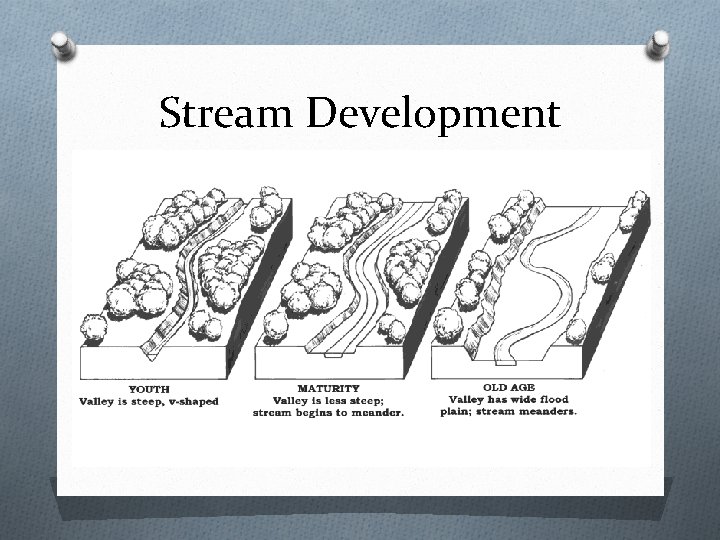
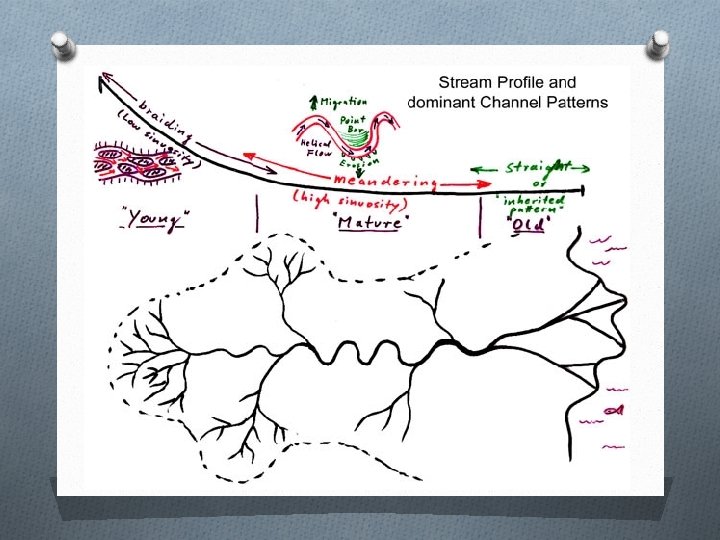
Stream Development
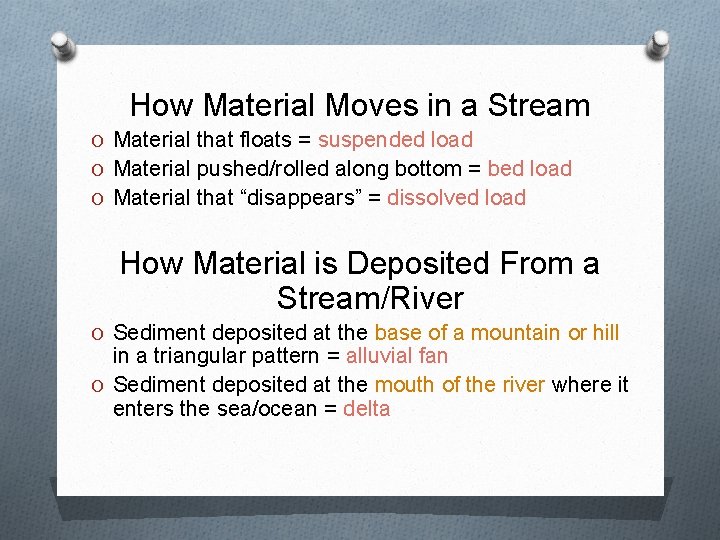
How Material Moves in a Stream O Material that floats = suspended load O Material pushed/rolled along bottom = bed load O Material that “disappears” = dissolved load How Material is Deposited From a Stream/River O Sediment deposited at the base of a mountain or hill in a triangular pattern = alluvial fan O Sediment deposited at the mouth of the river where it enters the sea/ocean = delta
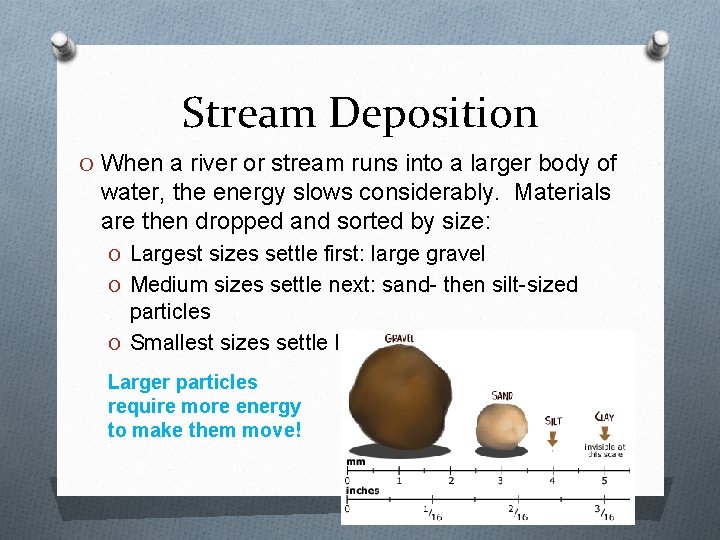
Stream Deposition O When a river or stream runs into a larger body of water, the energy slows considerably. Materials are then dropped and sorted by size: O Largest sizes settle first: large gravel O Medium sizes settle next: sand- then silt-sized particles O Smallest sizes settle last: clay-sized pieces Larger particles require more energy to make them move!
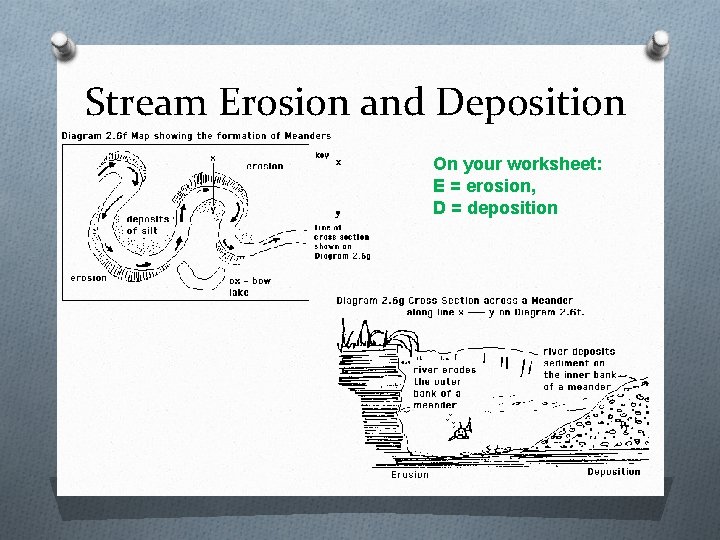
Stream Erosion and Deposition On your worksheet: E = erosion, D = deposition