
Geology The study of minerals Minerals I There
- Slides: 27
Geology The study of minerals
Minerals I. There are 5 qualities a substance must have to be a mineral. II. A mineral must: A. be naturally occurring B. be inorganic C. be solid D. have a crystal structure E. have a definite chemical composition
III. There are over 4000 minerals IV. There are three categories of rock. A. Igneous B. Sedimentary C. Metamorphic V. Over the course of thousands or even millions of years, a rock cycle occurs. A. Rock Cycle: the sequence of steps that changes rocks from one type to another.
Physical Properties I. Scientists identify minerals by looking at their physical properties A. Color B. Color Streak C. Lustre D. Hardness E. Density F. Crystal System G. Special Properties
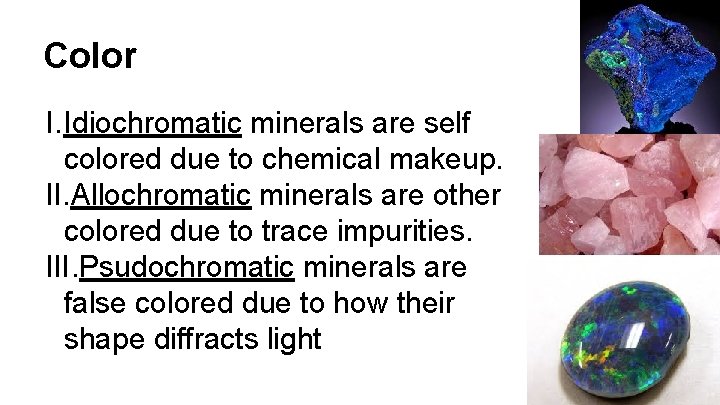
Color I. Idiochromatic minerals are self colored due to chemical makeup. II. Allochromatic minerals are other colored due to trace impurities. III. Psudochromatic minerals are false colored due to how their shape diffracts light
Streak I. The color of the powder produced when a mineral is dragged across an unweathered surface. II. The small pieces are more consistently colored. III. Extremely helpful when dealing with a highly colored material.
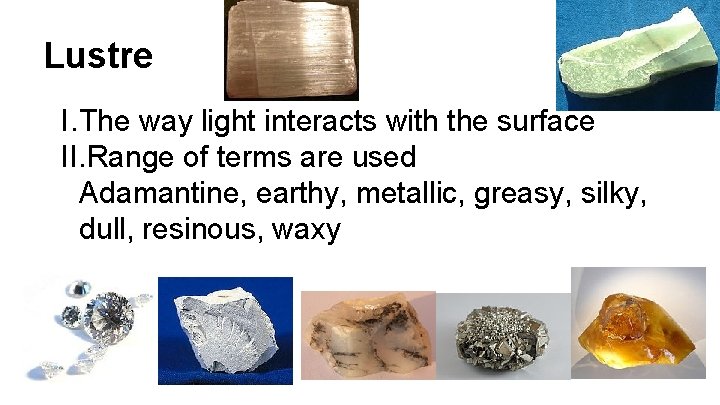
Lustre I. The way light interacts with the surface II. Range of terms are used Adamantine, earthy, metallic, greasy, silky, dull, resinous, waxy
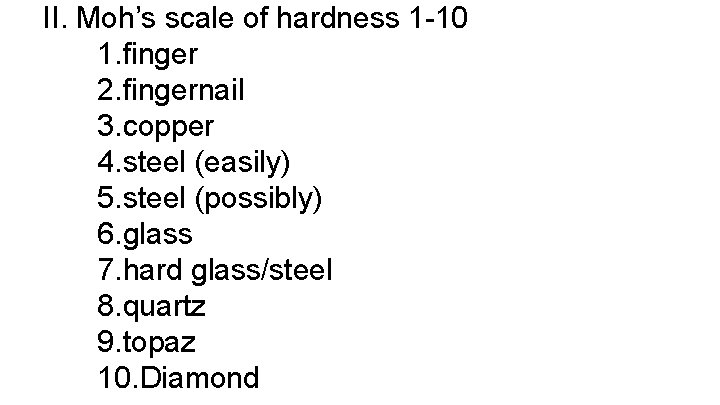
II. Moh’s scale of hardness 1 -10 1. finger 2. fingernail 3. copper 4. steel (easily) 5. steel (possibly) 6. glass 7. hard glass/steel 8. quartz 9. topaz 10. Diamond
Density I. Mass in a given space. II. Also referred to as specific gravity III. Density tests are done on bones using special x rays to determine if they have enough minerals in them
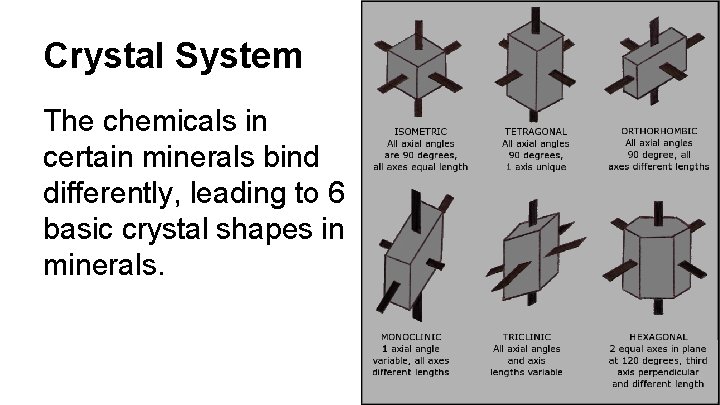
Crystal System The chemicals in certain minerals bind differently, leading to 6 basic crystal shapes in minerals.
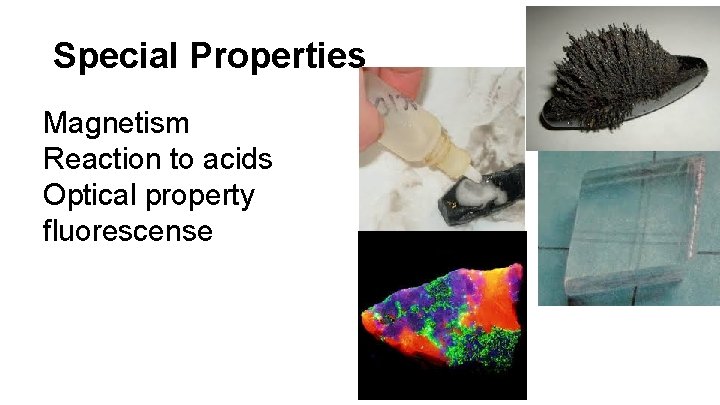
Special Properties Magnetism Reaction to acids Optical property fluorescense
Igneous Rocks I. Formed when molten rock cools and hardens II. Examples: A. Obsidion - cools quickly, glasslike B. Granite - cools slowly, intrusive (cools underground) C. Pumice - vocanic froth, extrusive (cools aboveground) III. Some igneous rocks are less dense than water due to trapped “bubbles”
Sedimentary Rock I. Forms when layers (sediment) are pressed together. (comes from the latin: to settle) II. All rocks are worn (eroded) by wind/water/ice III. Particles settle into layers, with pressure and minerals (carried by water) they stick together. IV. Hardening process takes 1000+ years
V. Law of Superposition: the layers deepest in strata, are older than the layers above them VI. Florida is underlain with limestone A. limestone dissolves due to acidic water B. sinkholes develop where overlying soil collapses into holes caused by erosion VII. Dolomite contains calcium carbonate A. what will happen if vinegar dissolves calcium carbonate and then evaporates?
Sedimentator I. Demonstrates how sediments are deposited by erosion. II. When observing a sample in a sedimentator, we can see that: A. Silt, clay, and mud become shale B. plant remains become soft coal C. sand becomes sandstone D. gravel becomes conglomerate
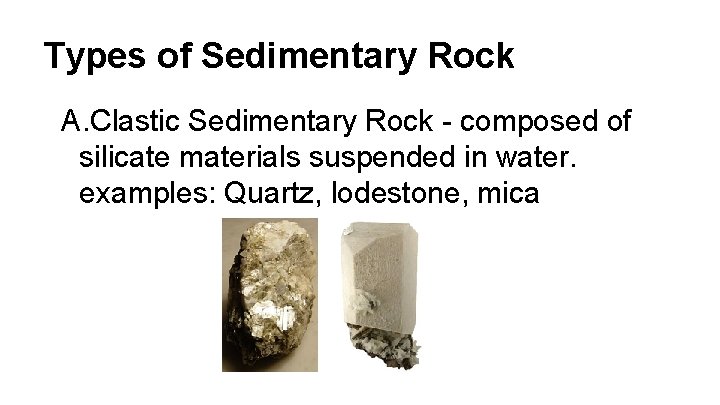
Types of Sedimentary Rock A. Clastic Sedimentary Rock - composed of silicate materials suspended in water. examples: Quartz, lodestone, mica
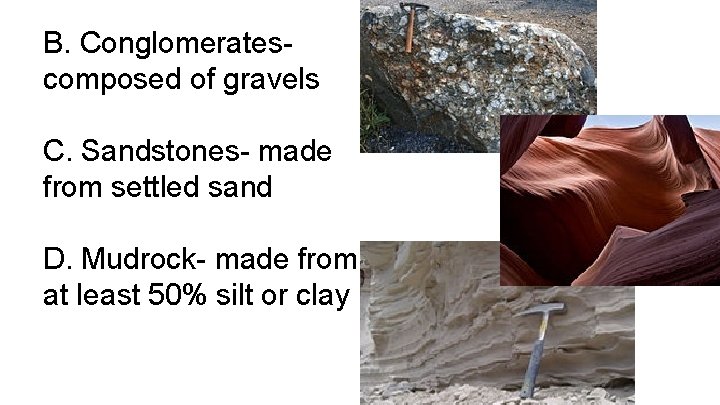
B. Conglomeratescomposed of gravels C. Sandstones- made from settled sand D. Mudrock- made from at least 50% silt or clay
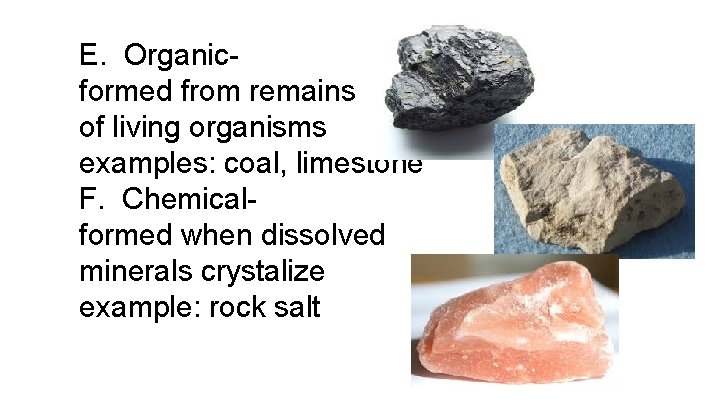
E. Organicformed from remains of living organisms examples: coal, limestone F. Chemicalformed when dissolved minerals crystalize example: rock salt
Metamorphic Rocks I. Form when heat and pressure deep inside the earth change one kind of rock into another. II. Bonds in the rock’s structure break and reform in new, denser, constructions
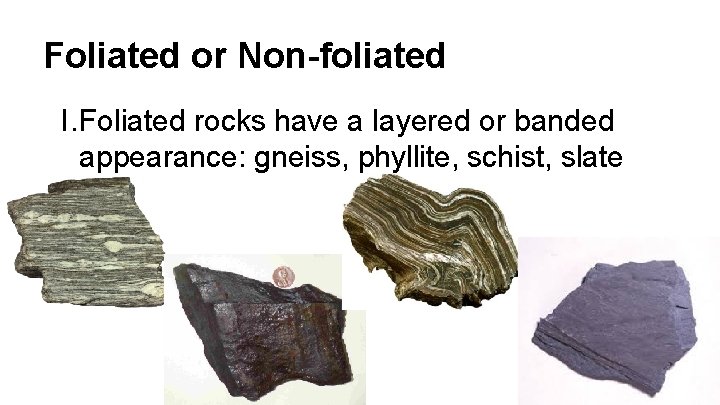
Foliated or Non-foliated I. Foliated rocks have a layered or banded appearance: gneiss, phyllite, schist, slate
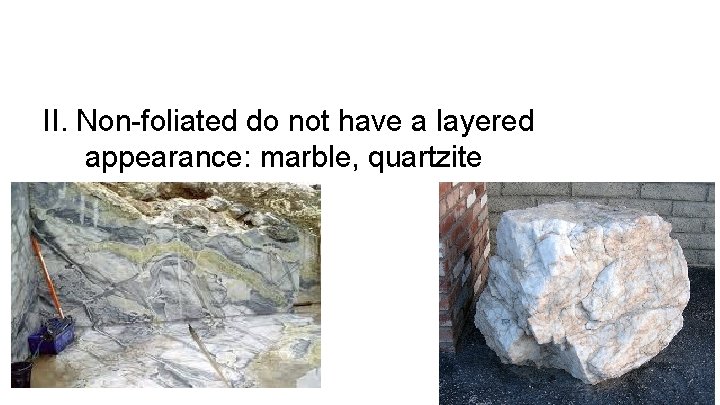
II. Non-foliated do not have a layered appearance: marble, quartzite
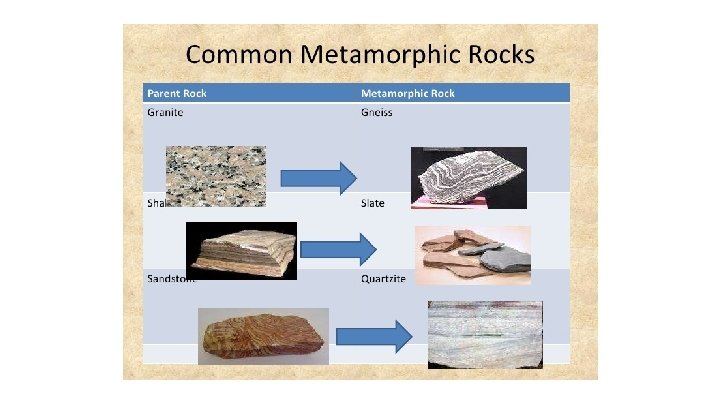
III. Examples: A. Marble - forms when limestone is exposed to high temperatures deep within the Earth’s crust B. Slate - forms when shale is exposed to huge pressure under mountains, often trapping and preserving fossils C. Magnetite (Lodestone) is rock made of iron with a specific magnetic charge. (Can be igneous, sedimentary, or metamorphic) i. sailors carried magnetite
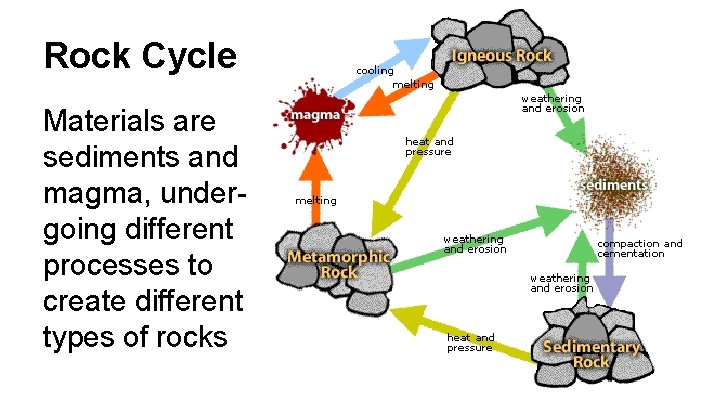
Rock Cycle Materials are sediments and magma, undergoing different processes to create different types of rocks
I. Igneous Rock: A. Due to weathering and erosion becomes sediments which, upon compaction and cementation, becomes sedimentary rock B. Due to heat and pressure becomes metamorphic rock C. Due to melting, can become lava which then can cool back into igneous rock
II. Metamorphic Rock: A. Due to weathering and erosion, sediments are created and can, through compaction and cementation, turn into sedimentary rock B. Due to melting turns into lava which, upon cooling, becomes igneous rock
III. Sedimentary Rock: A. Due to heat and pressure becomes metamorphic rock B. Due to weathering and erosion becomes sediments which, upon compaction and cementation turns back into sedimentary rock