
Geology of Mars www assignmentpoint com Geology of
- Slides: 9
Geology of Mars www. assignmentpoint. com
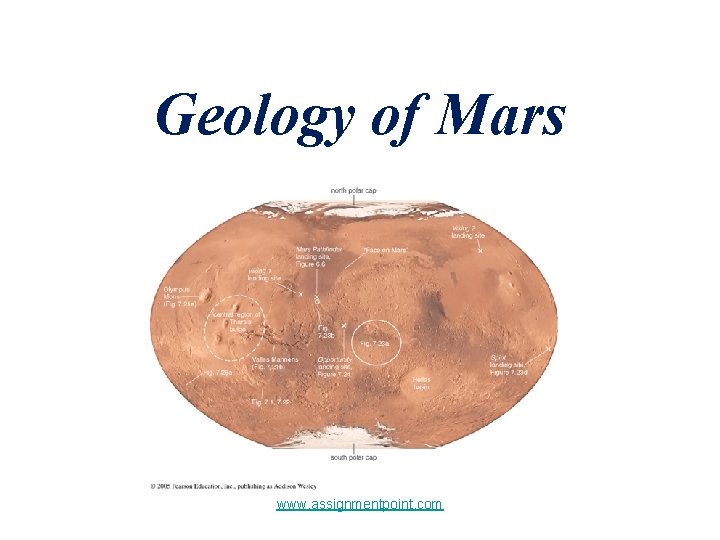
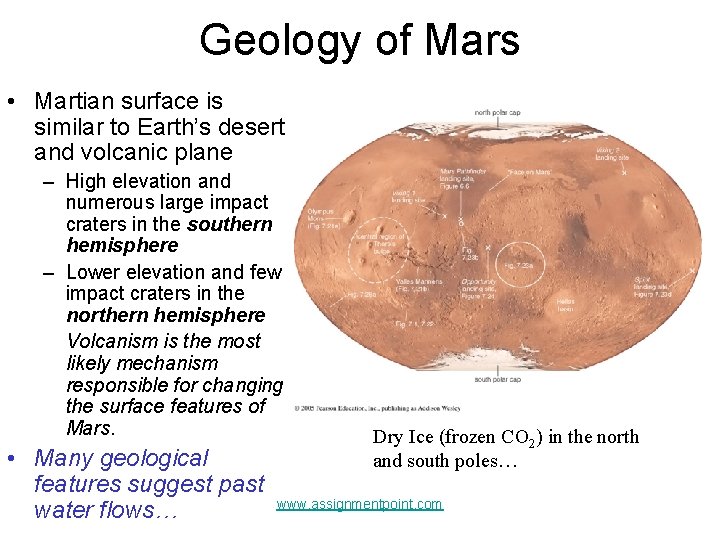
Geology of Mars • Martian surface is similar to Earth’s desert and volcanic plane – High elevation and numerous large impact craters in the southern hemisphere – Lower elevation and few impact craters in the northern hemisphere Volcanism is the most likely mechanism responsible for changing the surface features of Mars. • Many geological features suggest past water flows… Dry Ice (frozen CO 2) in the north and south poles… www. assignmentpoint. com
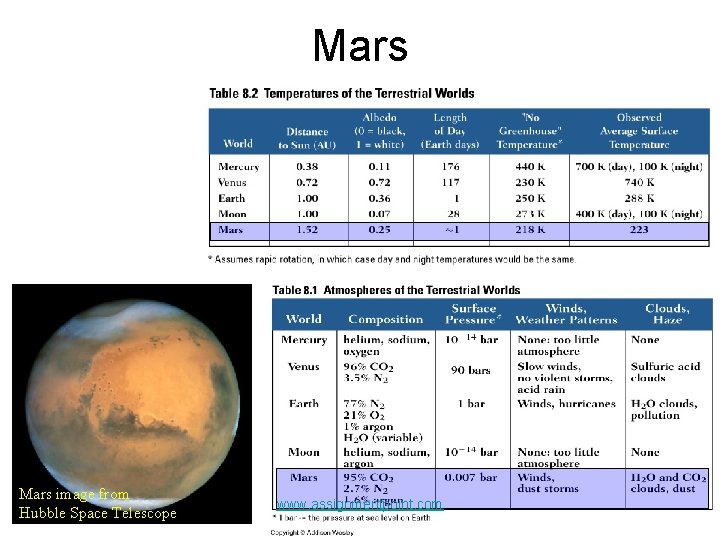
Mars image from Hubble Space Telescope www. assignmentpoint. com
Martian Season • The tilt of Mar’s rotation axis with respect to its ecliptic plane is 25. 19° • The eccentricity of Mar’s orbit around the Sun is 0. 093 • The seasons on Mars are affected by both its orbital distance and its axis tilt. – Mars is closer to the Sun during the southern hemisphere summer, and farther away from the Sun during its winter – Mars therefore has more extreme seasons in its southern hemisphere—that is, shorter, hotter summers and longer, colder winters—than in its www. assignmentpoint. com northern hemisphere.
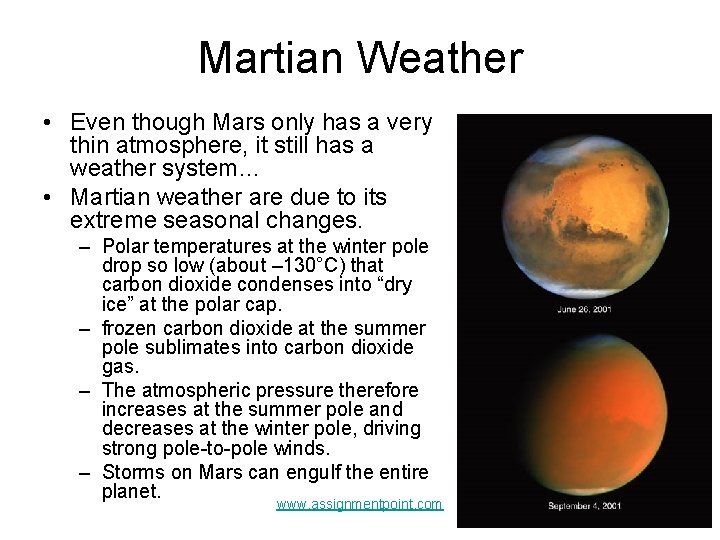
Martian Weather • Even though Mars only has a very thin atmosphere, it still has a weather system… • Martian weather are due to its extreme seasonal changes. – Polar temperatures at the winter pole drop so low (about – 130°C) that carbon dioxide condenses into “dry ice” at the polar cap. – frozen carbon dioxide at the summer pole sublimates into carbon dioxide gas. – The atmospheric pressure therefore increases at the summer pole and decreases at the winter pole, driving strong pole-to-pole winds. – Storms on Mars can engulf the entire planet. www. assignmentpoint. com
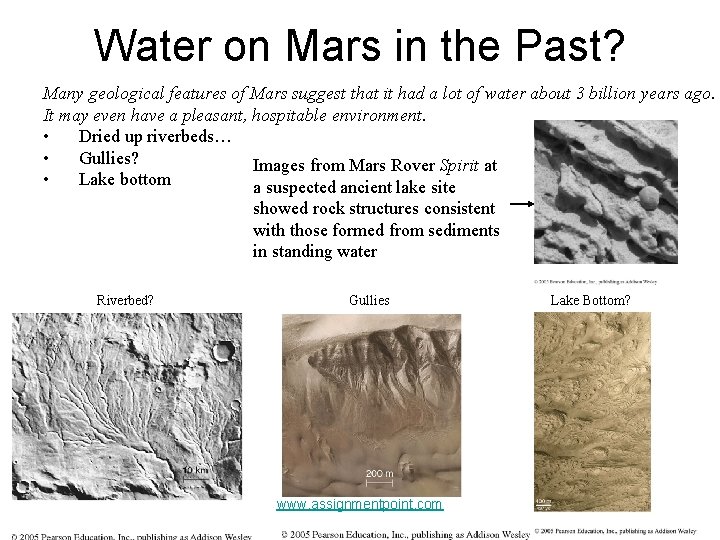
Water on Mars in the Past? Many geological features of Mars suggest that it had a lot of water about 3 billion years ago. It may even have a pleasant, hospitable environment. • Dried up riverbeds… • Gullies? Images from Mars Rover Spirit at • Lake bottom a suspected ancient lake site showed rock structures consistent with those formed from sediments in standing water Riverbed? Gullies www. assignmentpoint. com Lake Bottom?
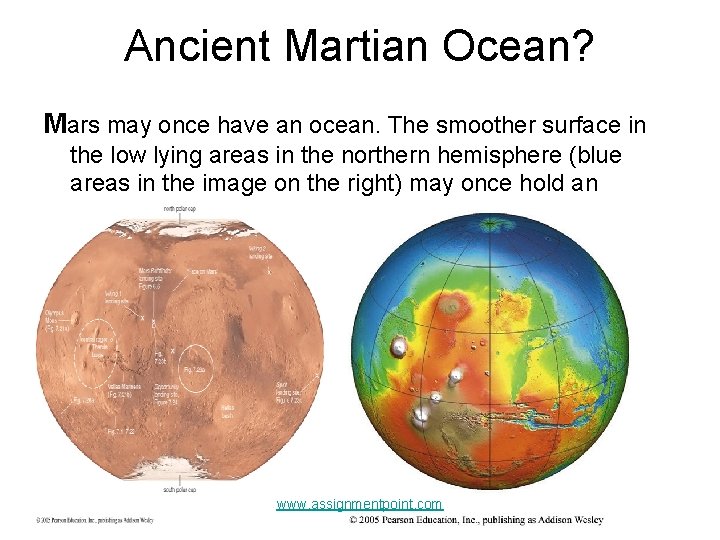
Ancient Martian Ocean? Mars may once have an ocean. The smoother surface in the low lying areas in the northern hemisphere (blue areas in the image on the right) may once hold an ocean… www. assignmentpoint. com
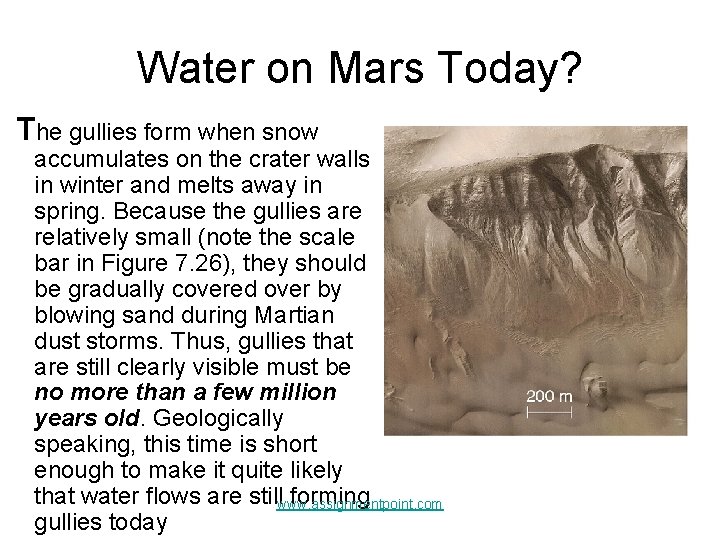
Water on Mars Today? The gullies form when snow accumulates on the crater walls in winter and melts away in spring. Because the gullies are relatively small (note the scale bar in Figure 7. 26), they should be gradually covered over by blowing sand during Martian dust storms. Thus, gullies that are still clearly visible must be no more than a few million years old. Geologically speaking, this time is short enough to make it quite likely that water flows are stillwww. assignmentpoint. com forming gullies today
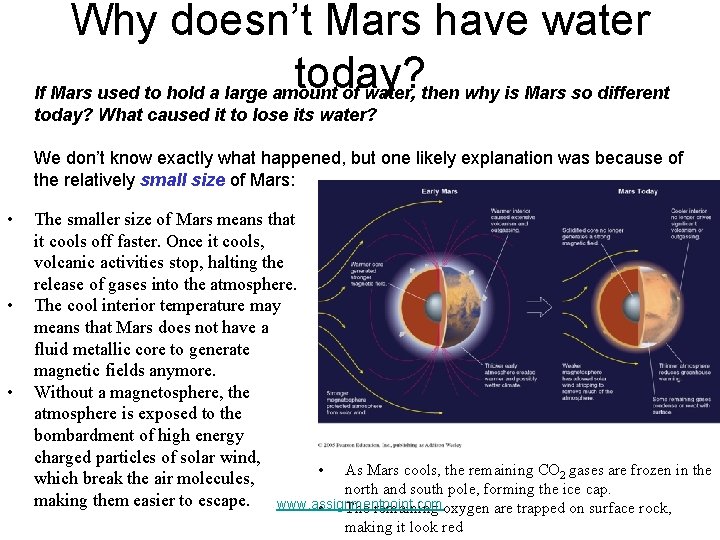
Why doesn’t Mars have water today? If Mars used to hold a large amount of water, then why is Mars so different today? What caused it to lose its water? We don’t know exactly what happened, but one likely explanation was because of the relatively small size of Mars: • • • The smaller size of Mars means that it cools off faster. Once it cools, volcanic activities stop, halting the release of gases into the atmosphere. The cool interior temperature may means that Mars does not have a fluid metallic core to generate magnetic fields anymore. Without a magnetosphere, the atmosphere is exposed to the bombardment of high energy charged particles of solar wind, • As Mars cools, the remaining CO 2 gases are frozen in the which break the air molecules, north and south pole, forming the ice cap. making them easier to escape. www. assignmentpoint. com • The remaining oxygen are trapped on surface rock, making it look red