
Geology Layers of Earth Geology study of rocks
- Slides: 10
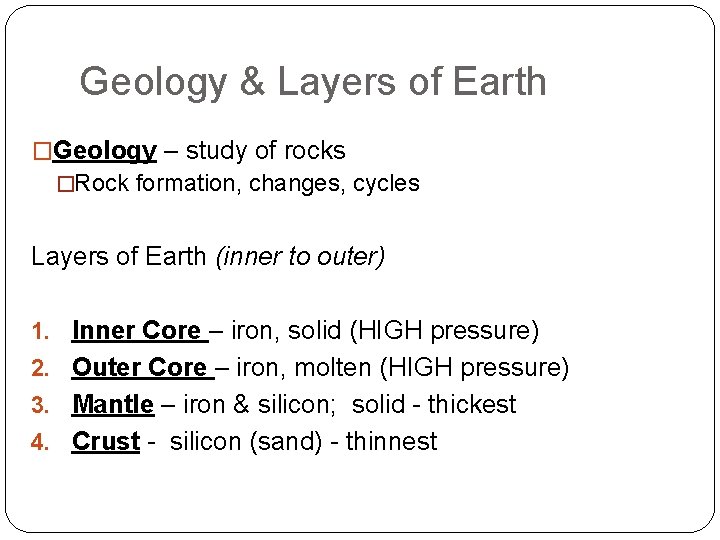
Geology & Layers of Earth �Geology – study of rocks �Rock formation, changes, cycles Layers of Earth (inner to outer) 1. Inner Core – iron, solid (HIGH pressure) 2. Outer Core – iron, molten (HIGH pressure) 3. Mantle – iron & silicon; solid - thickest 4. Crust - silicon (sand) - thinnest
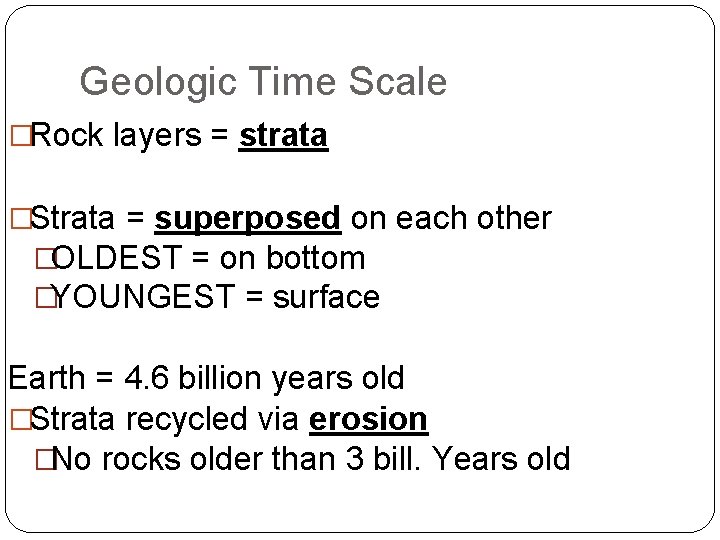
Geologic Time Scale �Rock layers = strata �Strata = superposed on each other �OLDEST = on bottom �YOUNGEST = surface Earth = 4. 6 billion years old �Strata recycled via erosion �No rocks older than 3 bill. Years old
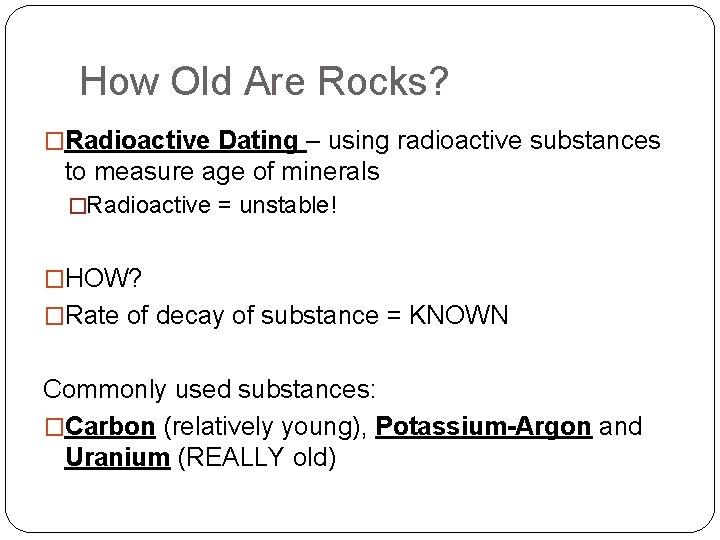
How Old Are Rocks? �Radioactive Dating – using radioactive substances to measure age of minerals �Radioactive = unstable! �HOW? �Rate of decay of substance = KNOWN Commonly used substances: �Carbon (relatively young), Potassium-Argon and Uranium (REALLY old)
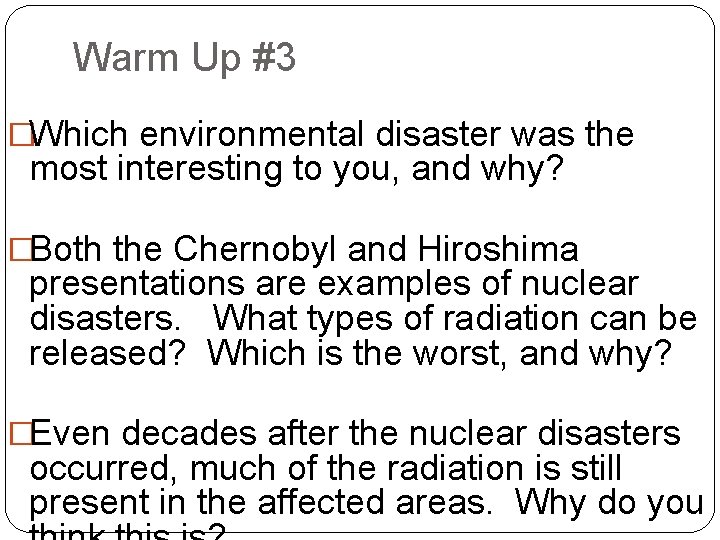
Warm Up #3 �Which environmental disaster was the most interesting to you, and why? �Both the Chernobyl and Hiroshima presentations are examples of nuclear disasters. What types of radiation can be released? Which is the worst, and why? �Even decades after the nuclear disasters occurred, much of the radiation is still present in the affected areas. Why do you
Nuclear Decay
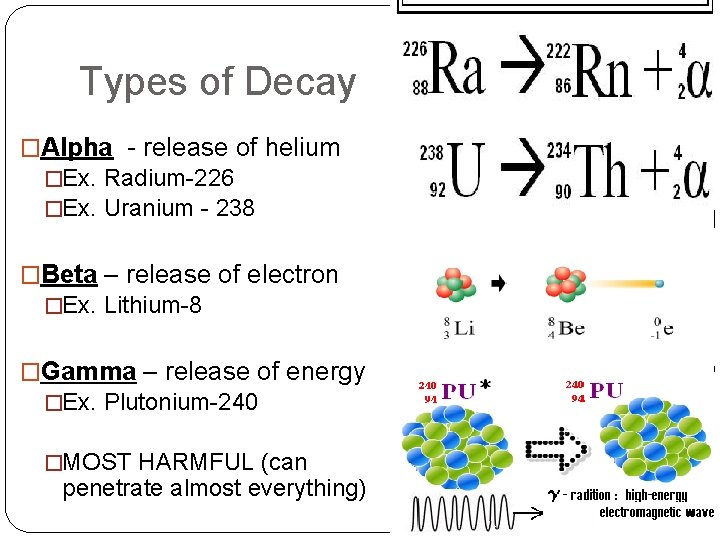
Types of Decay �Alpha - release of helium �Ex. Radium-226 �Ex. Uranium - 238 �Beta – release of electron �Ex. Lithium-8 �Gamma – release of energy �Ex. Plutonium-240 �MOST HARMFUL (can penetrate almost everything)
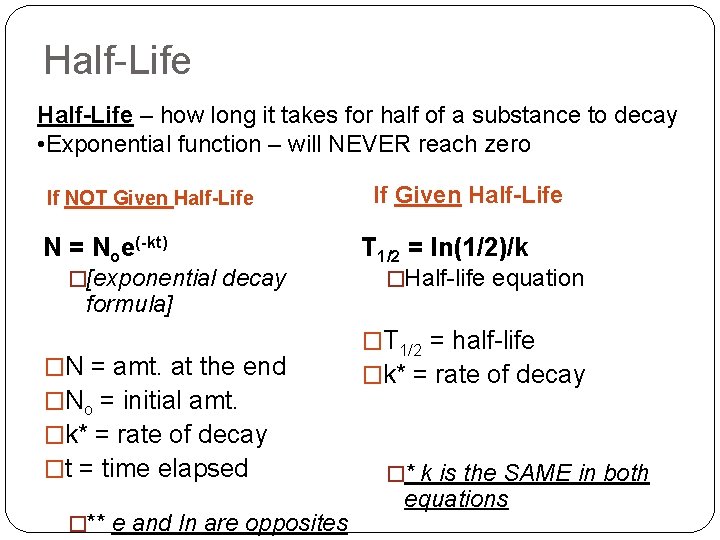
Half-Life – how long it takes for half of a substance to decay • Exponential function – will NEVER reach zero If NOT Given Half-Life N = Noe(-kt) �[exponential decay formula] �N = amt. at the end �No = initial amt. �k* = rate of decay �t = time elapsed �** e and ln are opposites If Given Half-Life T 1/2 = ln(1/2)/k �Half-life equation �T 1/2 = half-life �k* = rate of decay �* k is the SAME in both equations
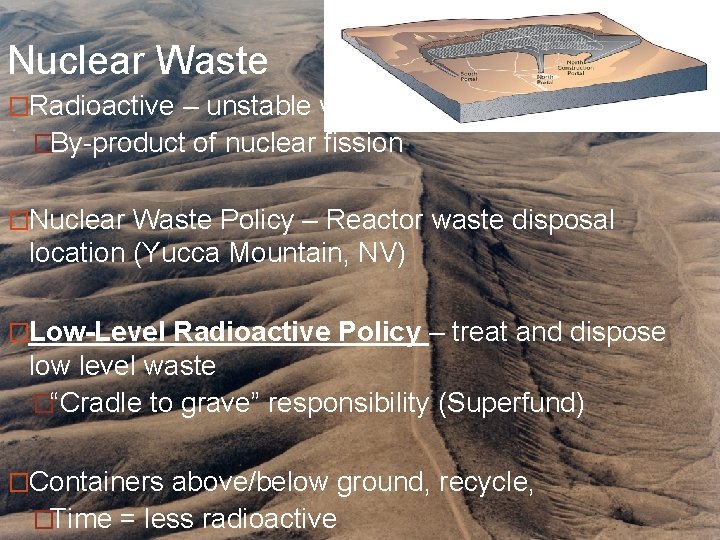
Nuclear Waste �Radioactive – unstable waste �By-product of nuclear fission �Nuclear Waste Policy – Reactor waste disposal location (Yucca Mountain, NV) �Low-Level Radioactive Policy – treat and dispose low level waste �“Cradle to grave” responsibility (Superfund) �Containers above/below ground, recycle, �Time = less radioactive
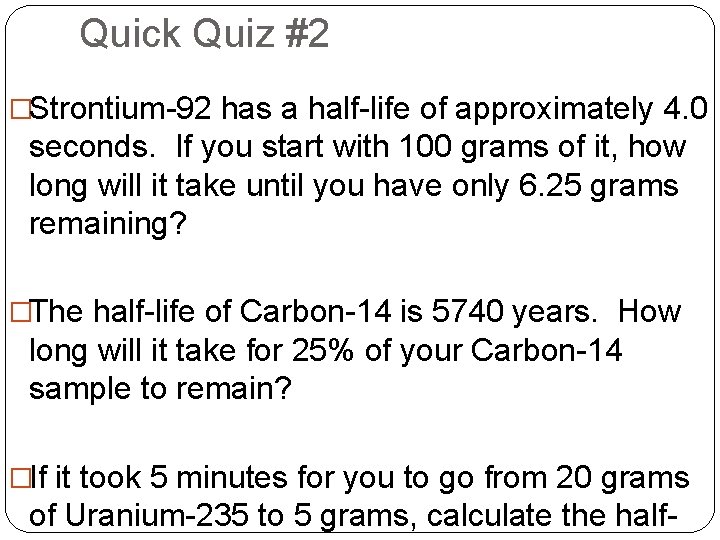
Quick Quiz #2 �Strontium-92 has a half-life of approximately 4. 0 seconds. If you start with 100 grams of it, how long will it take until you have only 6. 25 grams remaining? �The half-life of Carbon-14 is 5740 years. How long will it take for 25% of your Carbon-14 sample to remain? �If it took 5 minutes for you to go from 20 grams of Uranium-235 to 5 grams, calculate the half-
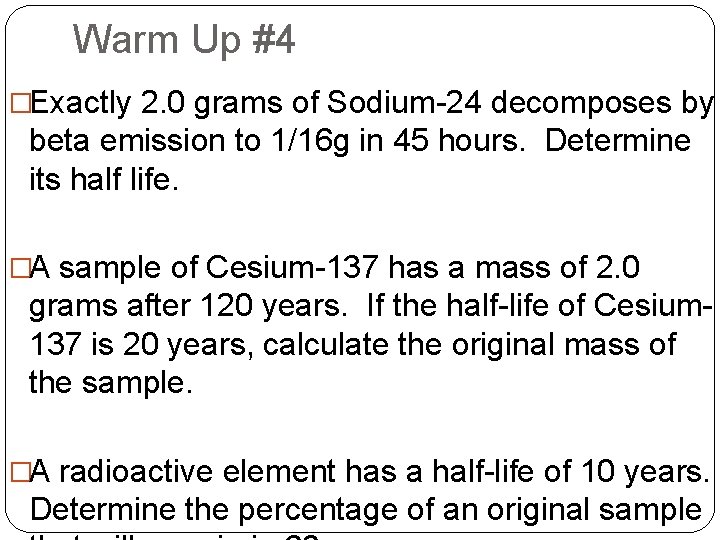
Warm Up #4 �Exactly 2. 0 grams of Sodium-24 decomposes by beta emission to 1/16 g in 45 hours. Determine its half life. �A sample of Cesium-137 has a mass of 2. 0 grams after 120 years. If the half-life of Cesium 137 is 20 years, calculate the original mass of the sample. �A radioactive element has a half-life of 10 years. Determine the percentage of an original sample