
Geology Chapter 16 Advanced Placement Environmental Science Mining
- Slides: 12
Geology Chapter 16 Advanced Placement Environmental Science
Mining for Ores An ore is an economically exploitable deposit
Gangue - Mine Tailings n Undesired waste rock associated with the valuable minerals in an ore Spoil n Waste soil and rock removed during surface mining
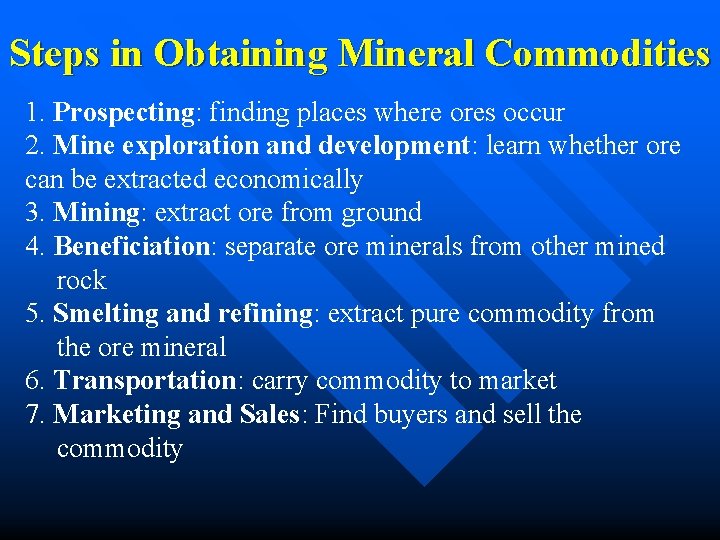
Steps in Obtaining Mineral Commodities 1. Prospecting: finding places where ores occur 2. Mine exploration and development: learn whether ore can be extracted economically 3. Mining: extract ore from ground 4. Beneficiation: separate ore minerals from other mined rock 5. Smelting and refining: extract pure commodity from the ore mineral 6. Transportation: carry commodity to market 7. Marketing and Sales: Find buyers and sell the commodity
Mining: Extract Ore from Ground Types of Mining: • Surface Mining: Scoop ore off surface or earth. • cheap. • safe for miners. • large environmental destruction. (types include: open-pit, dredging, strip, contour strip and mountaintop removal • Underground Mining: Use of shafts to reach deeply buried ores. • expensive. • hazardous for miners. • less environmental damage. (types include: mine shafts and tunnels, room and pillar and longwall mining)
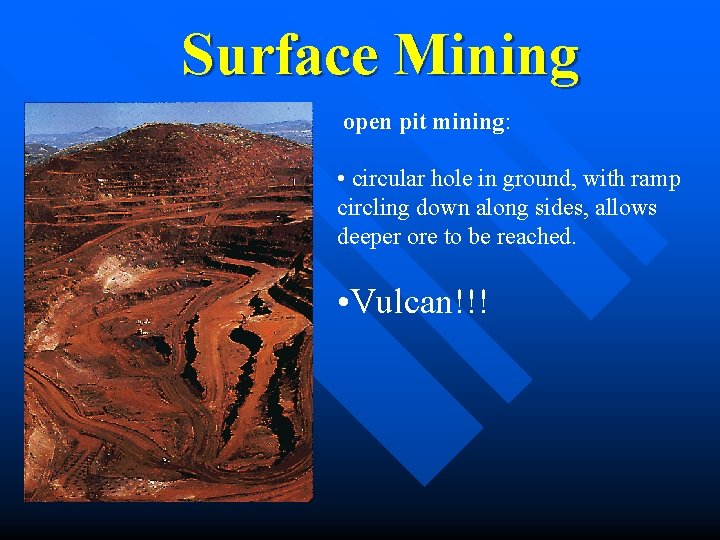
Surface Mining open pit mining: • circular hole in ground, with ramp circling down along sides, allows deeper ore to be reached. • Vulcan!!!
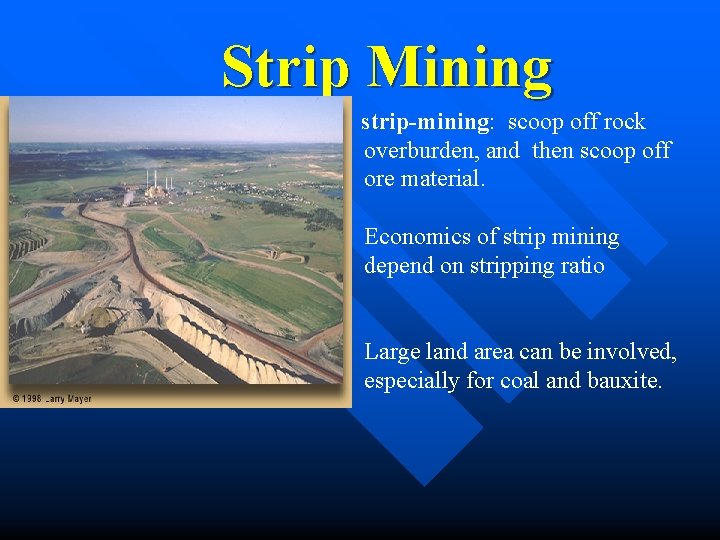
Strip Mining strip-mining: scoop off rock overburden, and then scoop off ore material. • Economics of strip mining depend on stripping ratio • Large land area can be involved, especially for coal and bauxite.
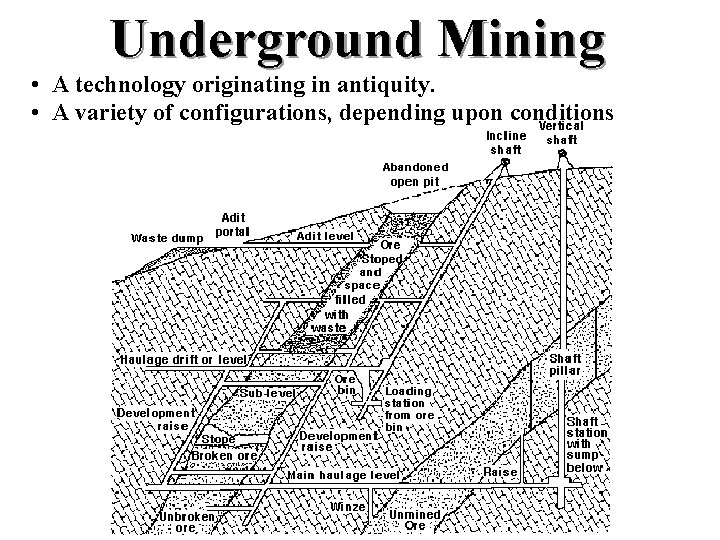
Underground Mining • A technology originating in antiquity. • A variety of configurations, depending upon conditions
Environmental Damage • Gaping holes in ground (old open pit mines). • Piles of mine tailings (non-ore removed from mines). • Accidental draining of rivers and lakes. • Disruption of ground water flow patterns. • Loss of topsoil in strip-mined regions Contamination from sulfuric acid (H 2 SO 4) produced through weathering of iron sulfide (Fe. S 2, pyrite) in tailings. • Contamination from heavy metals (e. g. arsenic,
Supplies of mineral resources Mineral is economically depleted when: it costs more to find, extract, transport, and process n 5 choices: recycle, reuse, waste less, use less find a substitute or do without n Depletion time: how long it takes to use up a certain proportion of the reserves at a given rate (usually 80% of the mineral) n
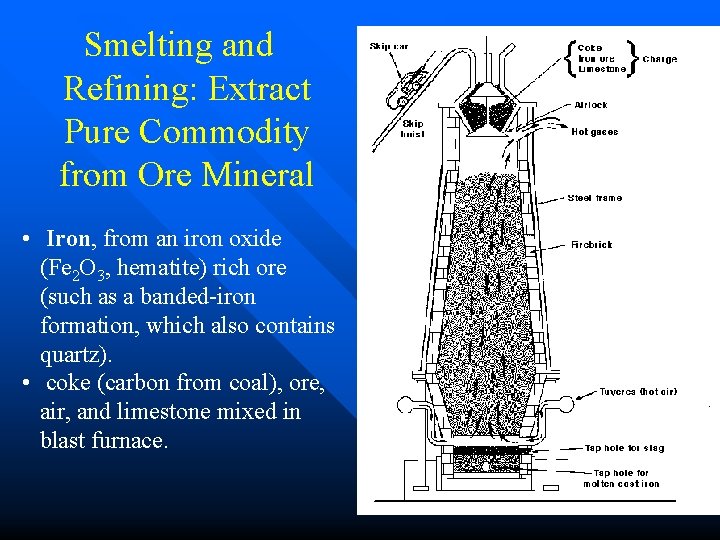
Smelting and Refining: Extract Pure Commodity from Ore Mineral • Iron, from an iron oxide (Fe 2 O 3, hematite) rich ore (such as a banded-iron formation, which also contains quartz). • coke (carbon from coal), ore, air, and limestone mixed in blast furnace.
Smelting and Refining: Environmental Problems 1. Production of huge piles of slag. 2. Emission of CO 2, a greenhouse gas, into the atmosphere. 3. Pollution associated with the generation of electricity needed in anode furnaces (especially aluminum). 4. Sulfur dioxide emissions from the refining of sulfide ores are a major source of air pollution. The sulfur dioxide combines with water to produce sulfuric acid. 5. Release of heavy metals (As, Cd, Hg), present in trace quantities in sulfide ores, into the atmosphere.