
Geology and Nonrenewable Minerals Chapter 14 We Use

Geology and Nonrenewable Minerals Chapter 14
We Use a Variety of Nonrenewable Mineral Resources § Mineral resource • Fossil fuels • Metallic minerals • Nonmetallic minerals § Ore • High-grade ore • Low-grade ore § Importance and examples of nonrenewable metal and nonmetal mineral resources
Mineral Use Has Advantages and Disadvantages § Advantages of the processes of mining and converting minerals into useful products § Disadvantages
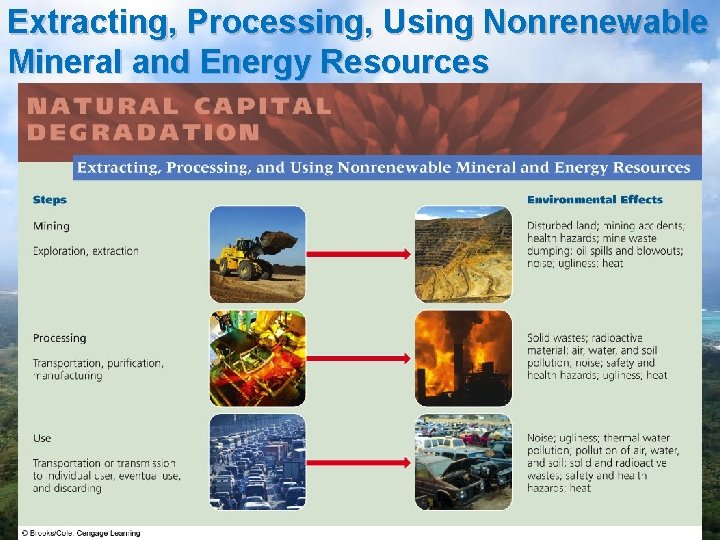
Extracting, Processing, Using Nonrenewable Mineral and Energy Resources
There Are Several Ways to Remove Mineral Deposits (1) § Surface mining • Shallow deposits removed § Subsurface mining • Deep deposits removed § Type of surface mining used depends on • Resource • Local topography
There Are Several Ways to Remove Mineral Deposits (2) § Types of surface mining • Open-pit mining • Strip mining • Contour mining • Mountaintop removal
Mining Has Harmful Environmental Effects § Scarring and disruption of the land surface • E. g. , spoils banks § Loss of rivers and streams § Subsidence § Major pollution of water and air § Effect on aquatic life § Large amounts of solid waste
Removing Metals from Ores Harmful Environmental Effects § Ore extracted by mining • Ore mineral • Gangue • Smelting § Water pollution § Liquid and solid hazardous wastes produced § Use of cyanide salt of extract gold from its ore • Summitville gold mine: Colorado, U. S.
14 -4 How Long Will Supplies of Nonrenewable Mineral Resources Last? § Concept 14 -4 A All nonrenewable mineral resources exist in finite amounts, and as we get closer to depleting any mineral resource, the environmental impacts of extracting it generally become more harmful. § Concept 14 -4 B An increase in the price of a scarce mineral resource can lead to increased supplies and more efficient use of the mineral, but there are limits to this effect.
Mineral Resources Are Distributed Unevenly § Most of the nonrenewable mineral resources supplied by • United States, Canada, Russia, South Africa, Australia § Strategic metal resources • Manganese (Mn) • Cobalt (Co) • Chromium (Cr) • Platinum (Pt)
Supplies of Nonrenewable Mineral Resources Can Be Economically Depleted § Future supply depends on • Actual or potential supply of the mineral • Rate at which it is used § When it becomes economically depleted • Recycle or reuse existing supplies • Waste less • Use less • Find a substitute • Do without
Market Prices Affect Supplies of Nonrenewable Minerals § Subsidies and tax breaks to mining companies keep mineral prices artificially low § Does this promote economic growth and national security? § Scarce investment capital hinders the development of new supplies of mineral resources
Case Study: The U. S. General Mining Law of 1872 § Encouraged mineral exploration and mining of hard-rock minerals on U. S. public lands § Developed to encourage settling the West (1800 s) § Until 1995, land could be bought for 1872 prices § Companies must pay for clean-up now
Can We Extend Supplies by Getting More Minerals from the Ocean? § Mineral resources dissolved in the ocean-low concentrations § Deposits of minerals in sediments along the shallow continental shelf and near shorelines § Hydrothermal ore deposits § Metals from the ocean floor: manganese nodules • Effect of mining on aquatic life • Environmental impact
14 -5 How Can We Use Mineral Resources More Sustainability? § Concept 14 -5 We can try to find substitutes for scarce resources, reduce resource waste, and recycle and reuse minerals.
We Can Recycle and Reuse Valuable Metals § Recycling • Lower environmental impact than mining and processing metals from ores § Reuse
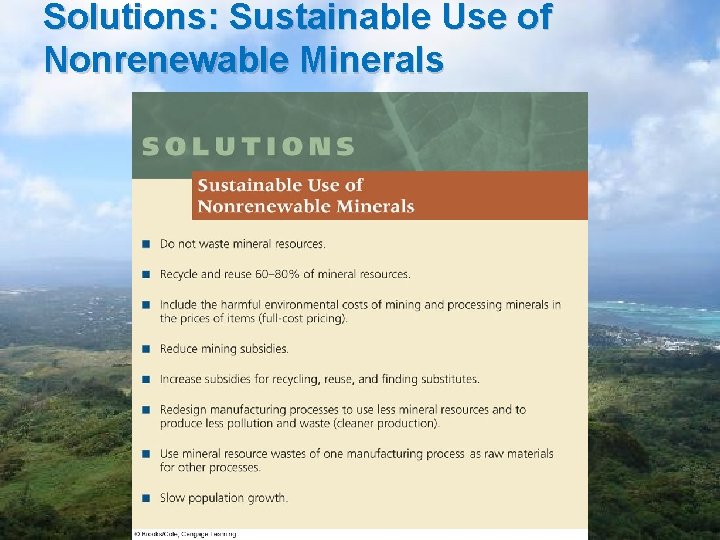
Solutions: Sustainable Use of Nonrenewable Minerals
- Slides: 17