
Geology and Exploration Criteria Object 1 To understand
- Geology and Exploration Criteria -
Object 1. To understand classify Skarn deposits 2. To understand geology, mineralogy, characteristics, and distributions from main Skarn gold deposits 3. Suggest relevant exploration criteria for economic skarn gold deposits

Classification of gold deposits 1. Intrusion-related gold deposits 2. Carlin-type gold deposits in Nevada, USA 3. Epithermal gold deposits in volcanic terranes

“Skarn” 1. Originally a term applied to coarse-grained calc-silicate gangue associated with the iron ore deposits of Sweden 2. It include a variety of calc-silicate rocks rich in calcium, iron, magnesium, aluminium, manganese that formed by replacement of originally carbonate-rich rocks. 3. Skarn deposits result from the hydrothermal interaction of hot silicate magmas and cooler sedimentary rocks
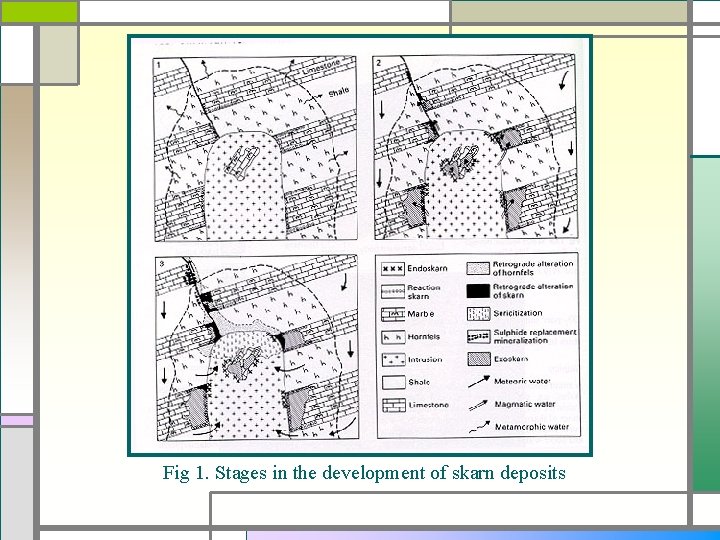
Fig 1. Stages in the development of skarn deposits
The type of skarn deposits (Enaudi et al. , 1981) Gold type 2. Iron type 3. Copper type 1. : nonpophyritic, small-size, high- gold grade in high sulfide content, intense retrograde alteration 4. Porphyry copper type : Large-scale and low-gold grade 5. Lead-zinc type : very little gold contain
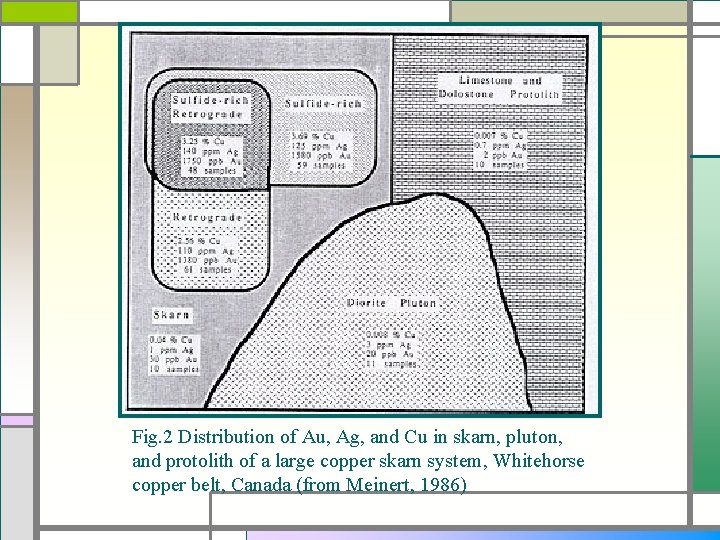
Fig. 2 Distribution of Au, Ag, and Cu in skarn, pluton, and protolith of a large copper skarn system, Whitehorse copper belt, Canada (from Meinert, 1986)

Skarn gold deposits 1. 2. 3. 4. 5. Related to copper-mineralized porphyritic intrusions Usually clastic or volcanoclastic component Age : Cambrian or older ~ Miocene Arsenopyrite and pyrrhotite are abundant Typically contain As, Bi, Te
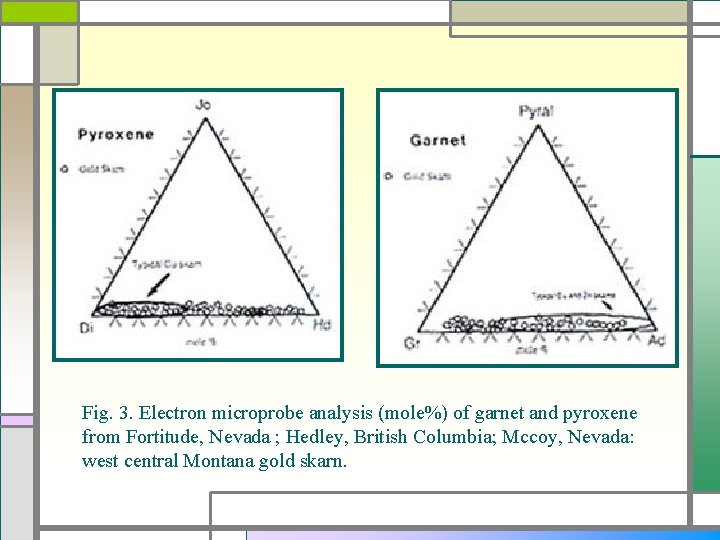
Fig. 3. Electron microprobe analysis (mole%) of garnet and pyroxene from Fortitude, Nevada ; Hedley, British Columbia; Mccoy, Nevada: west central Montana gold skarn.

Table 1. Gold Distribution in Gold Skarn Deposits Localty Size(t) Au(g/t ) Ag(g/t ) Cu(%) Bau 2, 400, 000 7. 2 0. 1 <0. 1 Beal 9, 200, 000 1. 5 1. 3 0. 0 Brown’s. Creek(u. g) 450, 000 5. 2 9. 0 Brown’s. Creek(0. p) 1, 382, 380 4. 5 Cable 1, 000 Au/Cu Au(kg) Ag(kg) Cu(tons) 17, 280 240 37. 7 13, 883 11, 960 3, 680 0. 4 11. 8 2, 340 4, 050 1, 980 9. 0 0. 4 10. 2 6, 221 12, 441 6, 082 6. 0 5. 0 3. 0 2. 0 6, 000 5, 000 30, 000 10, 300, 000 6. 9 24. 7 0. 1 86. 6 71, 379 254, 410 8, 240 930, 000 8. 5 4. 2 0. 3 25. 8 7, 905 3, 906 3, 069 Hedley(o. p) 8, 900, 000 4. 6 1. 4 0. 1 45. 6 40, 584 12, 460 8, 900 Hedle yu. g) 3, 604, 849 13. 5 3. 0 0. 1 224. 9 48, 642 10, 815 2, 163 16, 000 4. 1 1. 2 0. 4 9. 3 65, 600 19, 200 70, 400 Marn 100, 000 1. 4 2. 8 0. 3 4. 7 140 280 Maura Sipongi 113, 000 5. 6 2. 5 0. 2 28. 0 633 283 226 14, 500, 000 1. 5 0. 1 15. 0 21, 750 1, 450 14, 500 3, 900, 000 2. 8 9. 0 0. 3 9. 3 10, 920 35, 100 11, 700 Red Dome 15, 000 2. 6 4. 6 0. 5 5. 7 39, 000 69, 000 Silver Star small 50. 0 4. 0 12. 5 Southern Cross 400, 000 13. 0 16. 0 0. 1 147. 7 5, 200 6, 400 352 Suian 530, 000 13. 0 4. 9 6, 890 2, 597 1, 700, 000 6. 4 40. 6 10, 897 68, 935 Tillicum 126, 000 20. 6 2, 596 Tul Mi Chung 400, 000 12. 0 4, 800 Fortitude Golden Curry La Luz Mc. Coy Creek Minnie-Tomboy Thanksgiving 0. 4 17. 8 6, 120
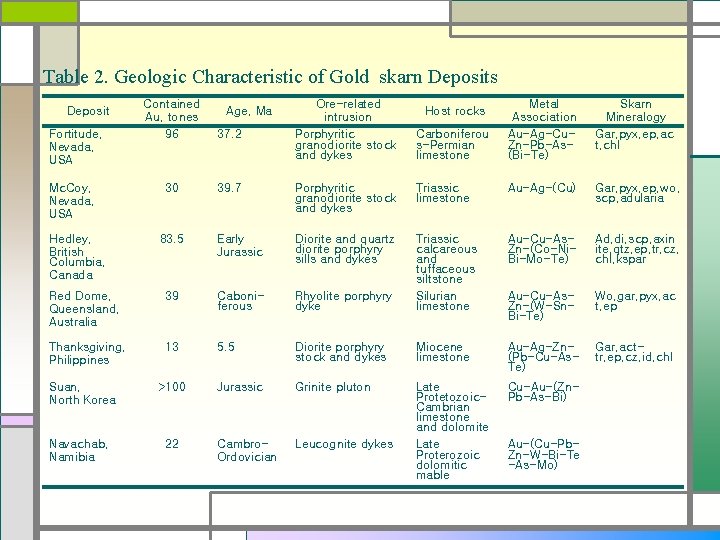
Table 2. Geologic Characteristic of Gold skarn Deposits Contained Au, tones 96 37. 2 30 39. 7 Porphyritic granodiorite stock and dykes 83. 5 Early Jurassic Diorite and quartz diorite porphyry sills and dykes Red Dome, Queensland, Australia 39 Caboniferous Thanksgiving, Philippines 13 Deposit Fortitude, Nevada, USA Mc. Coy, Nevada, USA Hedley, British Columbia, Canada Suan, North Korea >100 Navachab, Namibia 22 Metal Association Au-Ag-Cu. Zn-Pb-As(Bi-Te) Skarn Mineralogy Gar, pyx, ep, ac t, chl Triassic limestone Au-Ag-(Cu) Gar, pyx, ep, wo, scp, adularia Au-Cu-As. Zn-(Co-Ni. Bi-Mo-Te) Ad, di, scp, axin ite, qtz, ep, tr, cz, chl, kspar Rhyolite porphyry dyke Triassic calcareous and tuffaceous siltstone Silurian limestone Au-Cu-As. Zn-(W-Sn. Bi-Te) Wo, gar, pyx, ac t, ep 5. 5 Diorite porphyry stock and dykes Miocene limestone Au-Ag-Zn(Pb-Cu-As. Te) Gar, acttr, ep, cz, id, chl Jurassic Grinite pluton Cu-Au-(Zn. Pb-As-Bi) Cambro. Ordovician Leucognite dykes Late Protetozoic. Cambrian limestone and dolomite Late Proterozoic dolomitic mable Age, Ma Ore-related intrusion Porphyritic granodiorite stock and dykes Host rocks Carboniferou s-Permian limestone Au-(Cu-Pb. Zn-W-Bi-Te -As-Mo)
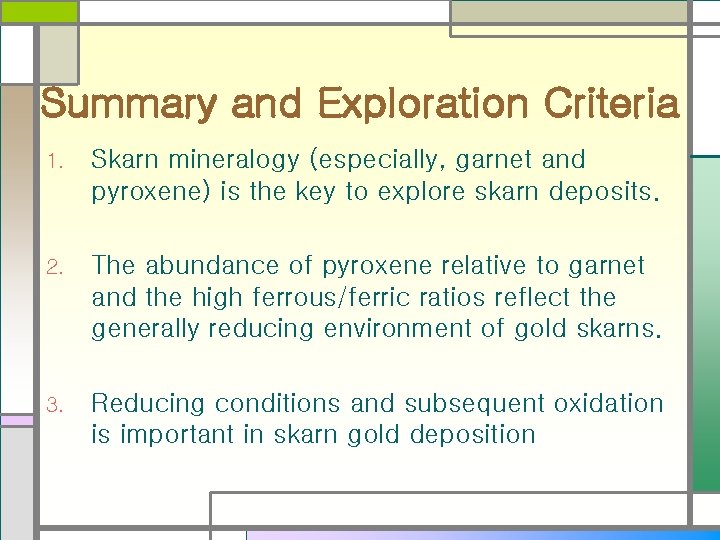
Summary and Exploration Criteria 1. Skarn mineralogy (especially, garnet and pyroxene) is the key to explore skarn deposits. 2. The abundance of pyroxene relative to garnet and the high ferrous/ferric ratios reflect the generally reducing environment of gold skarns. 3. Reducing conditions and subsequent oxidation is important in skarn gold deposition

4. Most gold skarns are associated with relatively mafic reduced plutons and contain anomalous of As, Bi, and Te. 5. Explorationists should noted that the more proximal gold-poor, garnet-rich part of a skarn deposit is likely to be more resistant to erosion and thus more likely to crop out and be sampled than the more distal gold and pyroxene-rich skarn. 6. Economic gold skarns should be sought in the distal part of under reducing conditions.
- Slides: 13