
Geology 101 Chapter 2 Plate Tectonics A Unifying



- Slides: 42
Geology 101 Chapter 2 Plate Tectonics: A Unifying Theory
Unifying Theory n A unifying theory is one that helps q explain a broad range of diverse observations q interpret many aspects of a science on a grand scale q and relate many seemingly unrelated phenomena n Plate tectonics is a unifying theory for geology.
Plate Tectonics n Plate tectonics helps to explain q earthquakes eruptions n Tectonic interactions q formation of affect mountains q atmospheric and oceanic q location of circulation and climate continents q geographic distribution, q location of ocean q evolution and extinction basins of organisms q distribution and formation of resources q volcanic
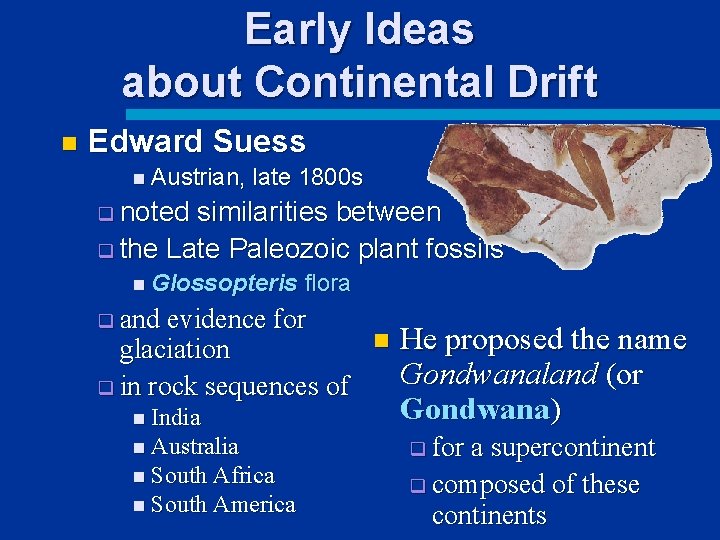
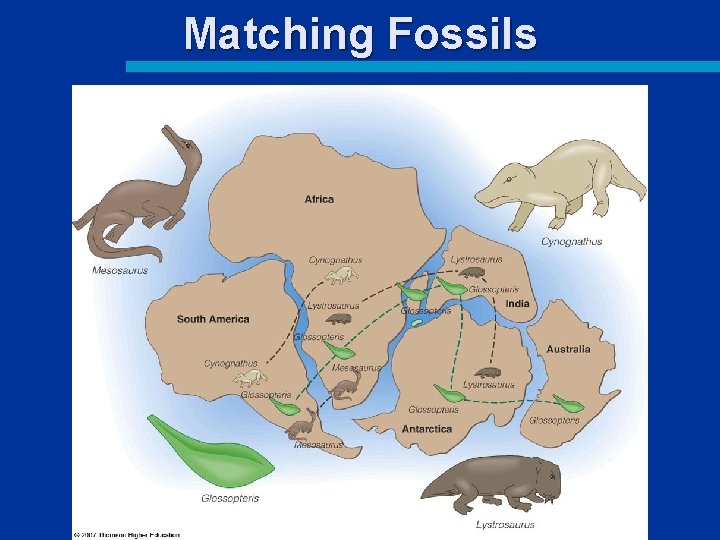
Early Ideas about Continental Drift n Edward Suess n Austrian, late 1800 s q noted similarities between q the Late Paleozoic plant fossils n Glossopteris flora q and evidence for n He proposed the name glaciation Gondwanaland (or q in rock sequences of n India n Australia n South Africa n South America Gondwana) q for a supercontinent q composed of these continents
Early Ideas about Continental Drift n Frank Taylor (American, 1910) q presented a hypothesis of continental drift with these features: n lateral movement of continents formed mountain ranges n a continent broke apart at the Mid-Atlantic Ridge to form the Atlantic Ocean n supposedly, tidal forces pulled formerly polar continents toward the equator, n when Earth captured the Moon about 100 million years ago
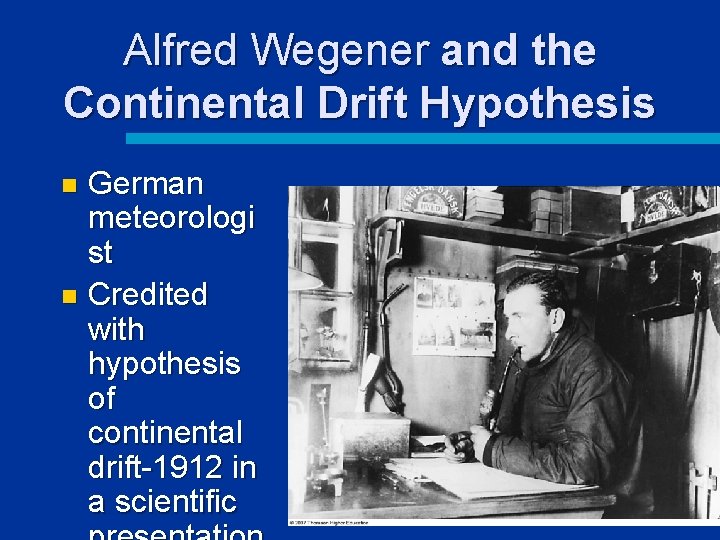
Alfred Wegener and the Continental Drift Hypothesis German meteorologi st n Credited with hypothesis of continental drift-1912 in a scientific n
Alfred Wegener and the Continental Drift Hypothesis n He proposed that all landmasses q were originally united into a supercontinent q he named Pangaea from the Greek meaning “all land” n He presented a series of maps q showing n the breakup of Pangaea He amassed a tremendous amount of geologic, paleontologic, and climatologic
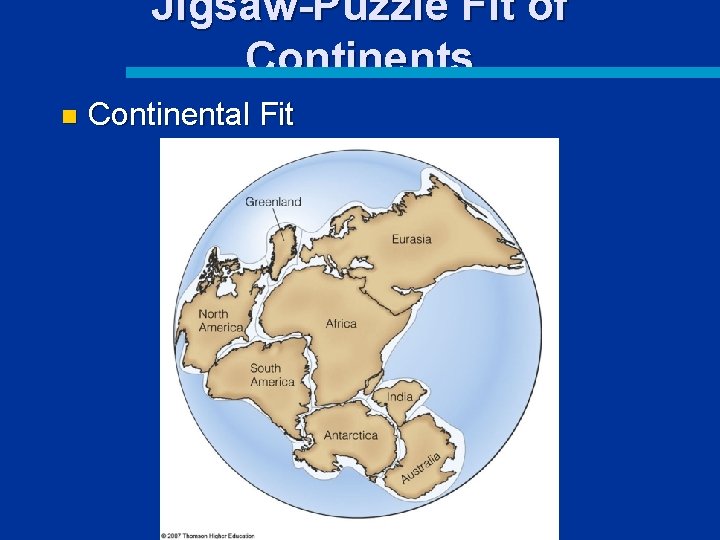
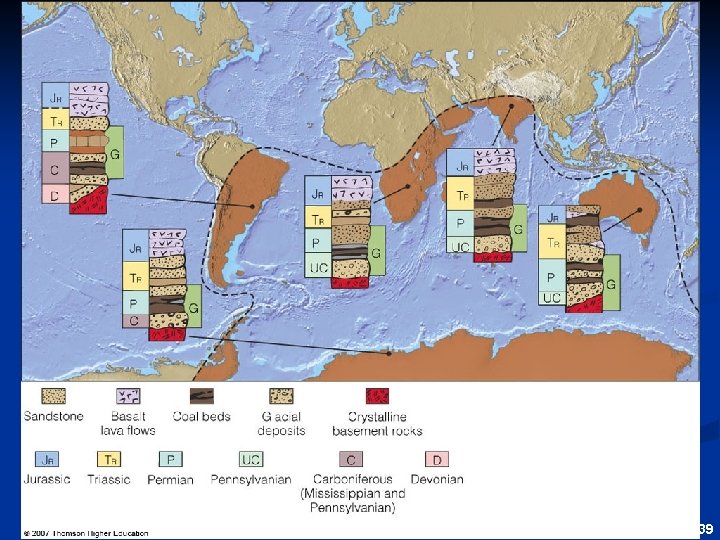
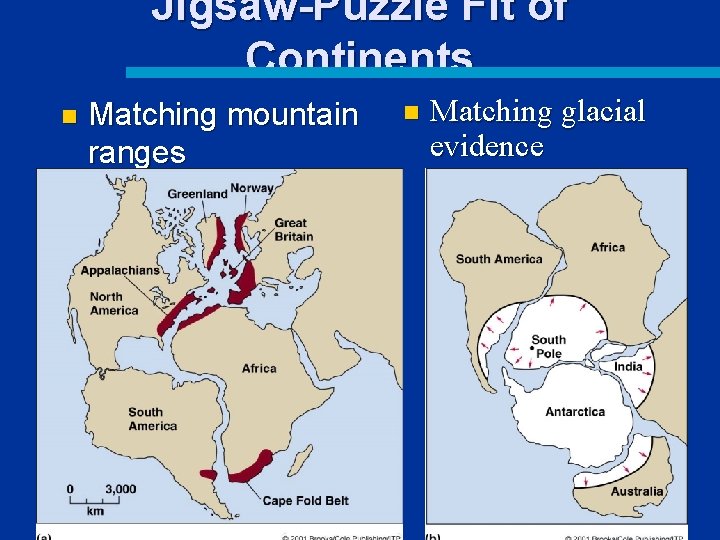
Wegener’s Evidence n Shorelines of continents fit together q matching marine, nonmarine q and glacial rock sequences q from Pennsylvanian to Jurassic age q for all five Gondwana continents n including n Antarctica Mountain ranges and glacial deposits q match up when continents are united q into a single landmass
Jigsaw-Puzzle Fit of Continents n Continental Fit
Fig. 3 -4, p. 39
Jigsaw-Puzzle Fit of Continents n Matching mountain ranges n Matching glacial evidence
Matching Fossils
The Perceived Problem with Continental Drift n Most geologists did not accept the idea of moving continents q There was no suitable mechanism to explain q how continents could move over Earth’s surface n Interest in continental drift only revived when q new evidence from studies of Earth’s magnetic field q and oceanographic research q showed that the ocean basins were geologically young features
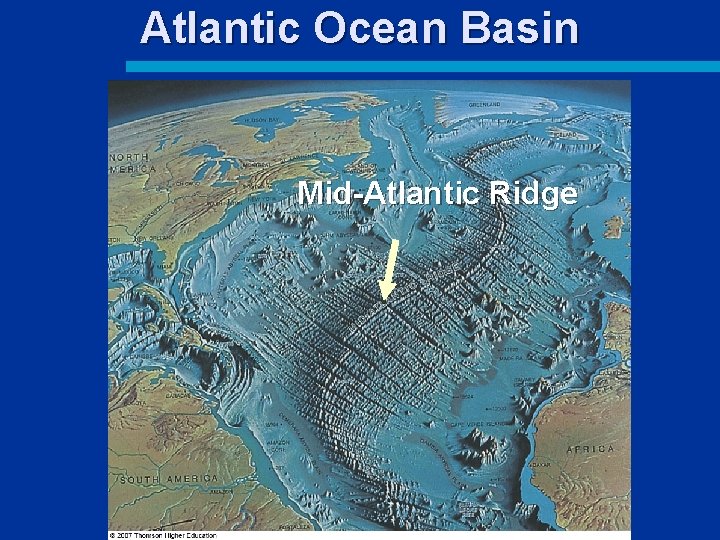
Atlantic Ocean Basin Mid-Atlantic Ridge
Seafloor Spreading n Harry Hess, in 1962, proposed theory of seafloor spreading: q Continents and oceanic crust move together q Seafloor separates at oceanic ridges n where new crust forms from upwelling and cooling magma, and n the new crust moves laterally away from the ridge q The mechanism that drives seafloor spreading was thermal convection cells in the mantle n hot magma rises from mantle to form new crust
Oceanic Crust Is Young n Seafloor spreading theory indicates that q oceanic crust is geologically young because q it forms during spreading q and is destroyed during subduction n Radiometric dating confirms q the oldest oceanic crust q is less than 180 million years old n whereas oldest continental crust q is 3. 96 billion yeas old
Age of Ocean Basins
Plate Tectonics n Plate tectonic theory is based on the simple model that q the lithosphere is rigid q it consists of oceanic and continental crust with upper mantle q it consists of variable-sized pieces called plates q with plate regions containing continental crust n up q and to 250 km thick plate regions containing oceanic crust n up to 100 km thick
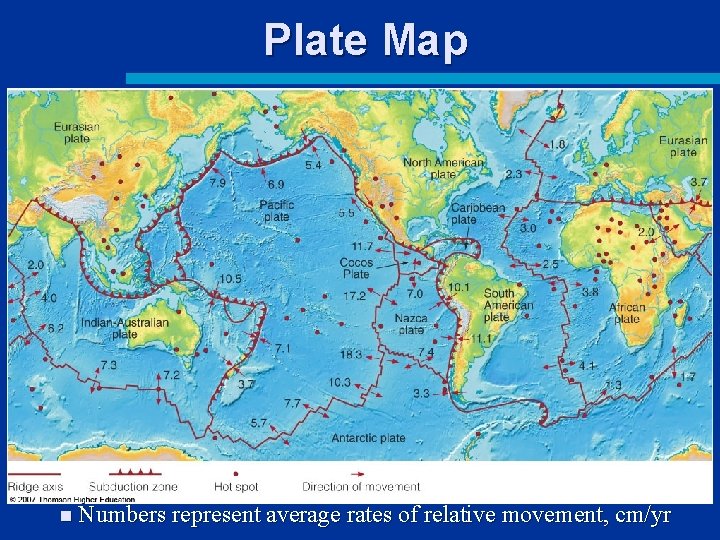
Plate Map n Numbers represent average rates of relative movement, cm/yr
Plate Tectonics and Boundaries The lithospheric plates overlie hotter and weaker semiplastic asthenosphere n Movement of the plates n q results from some type of heat-transfer system within the asthenosphere n As plates move over the asthenosphere q they separate, mostly at oceanic ridges q they collide, in areas such as oceanic trenches q where they may be subducted back into the mantle
Divergent Boundaries n Divergent plate boundaries q or spreading ridges, occur q where plates are separating q and new oceanic lithosphere is forming. n Crust is extended q thinned n and fractured The magma q originates q is from partial melting of the mantle basaltic q intrudes into vertical fractures to form dikes q or is extruded as lava flows
Divergent Boundaries n Successive injections of magma cool and solidify q form new oceanic crust q n Divergent boundaries most commonly occur along the crests of oceanic ridges q such as the Mid-Atlantic Ridge q n Ridges have rugged topography resulting from displacement of rocks along large fractures q shallow earthquakes q
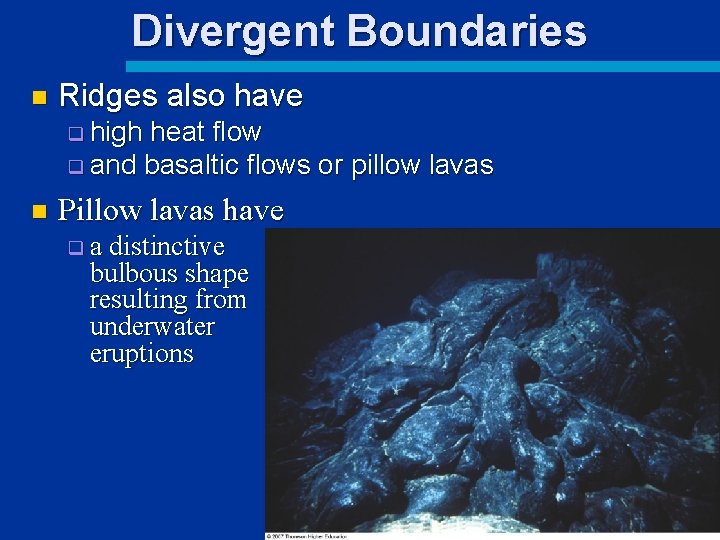
Divergent Boundaries n Ridges also have q high heat flow q and basaltic flows or pillow lavas n Pillow lavas have q a distinctive bulbous shape resulting from underwater eruptions
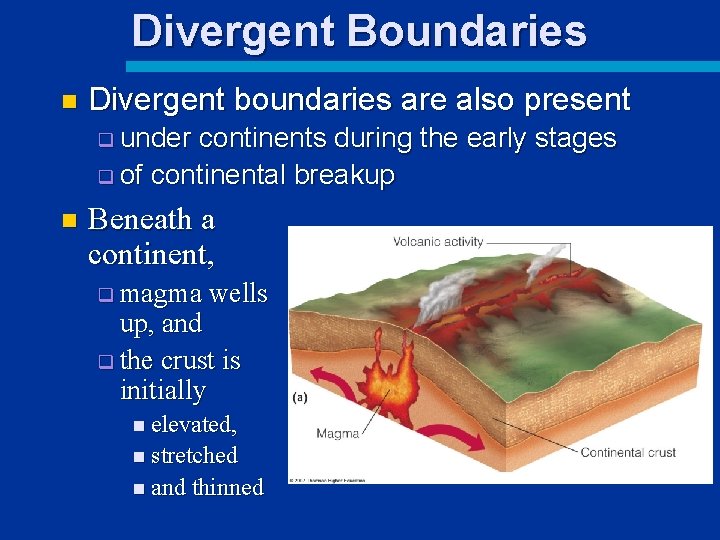
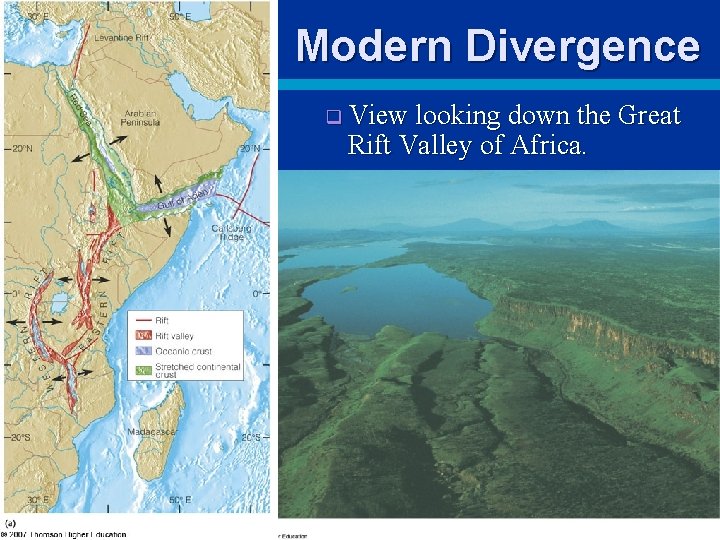
Divergent Boundaries n Divergent boundaries are also present q under continents during the early stages q of continental breakup n Beneath a continent, q magma wells up, and q the crust is initially n elevated, n stretched n and thinned
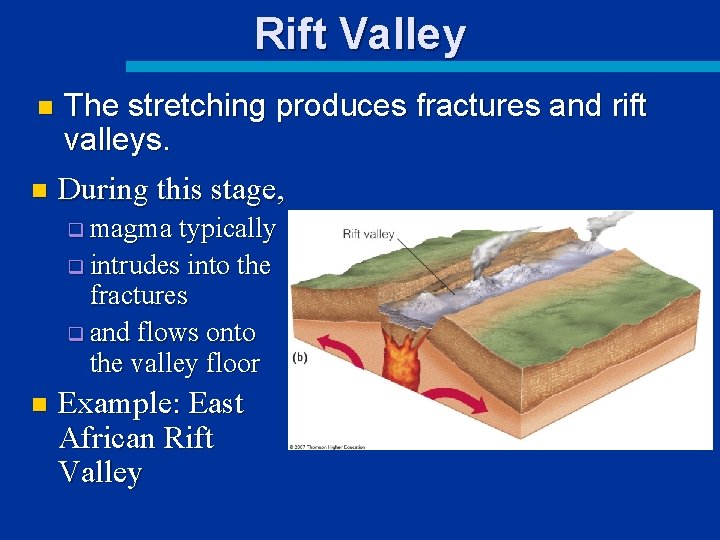
Rift Valley The stretching produces fractures and rift valleys. n During this stage, n q magma typically q intrudes into the fractures q and flows onto the valley floor n Example: East African Rift Valley
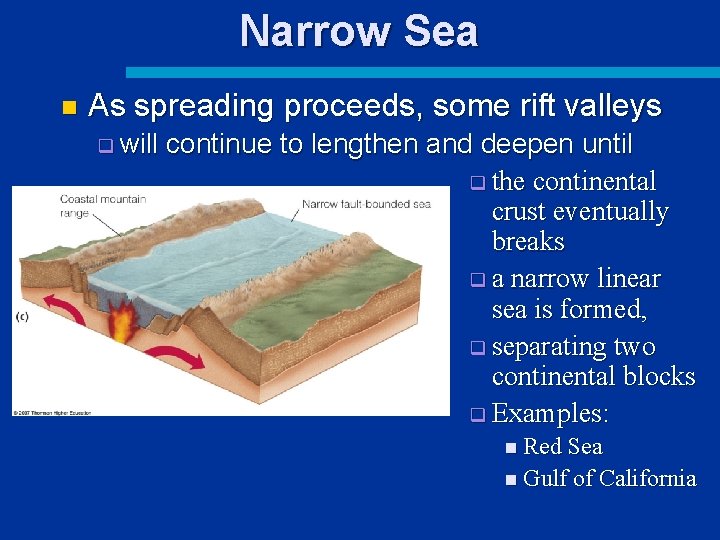
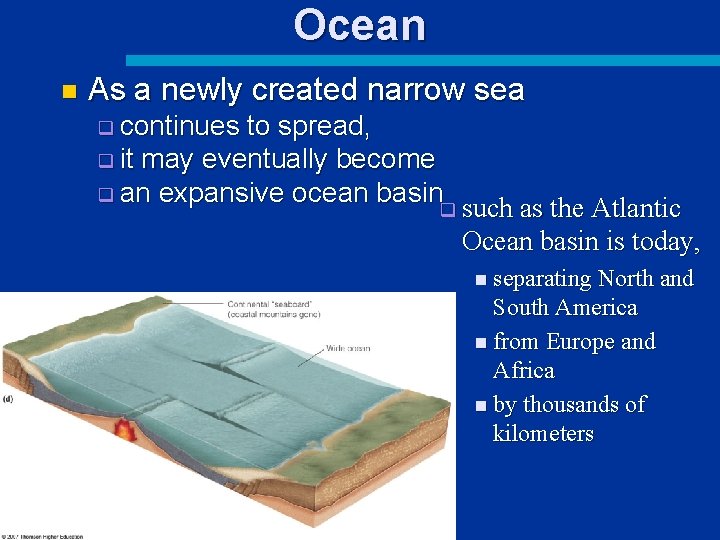
Narrow Sea n As spreading proceeds, some rift valleys q will continue to lengthen and deepen until q the continental crust eventually breaks q a narrow linear sea is formed, q separating two continental blocks q Examples: n Red Sea n Gulf of California
Modern Divergence q View looking down the Great Rift Valley of Africa. n Little Magadi soda lake
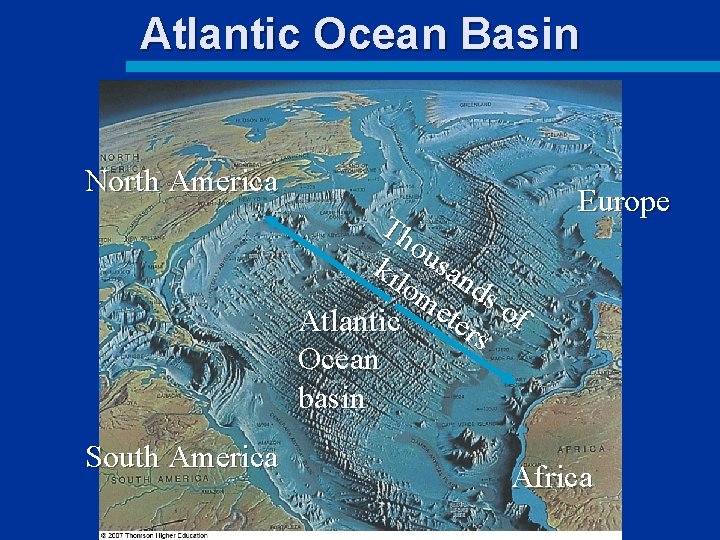
Ocean n As a newly created narrow sea q continues to spread, q it may eventually become q an expansive ocean basin q such as the Atlantic Ocean basin is today, n separating North and South America n from Europe and Africa n by thousands of kilometers
Atlantic Ocean Basin North America Th ou kil san om ds Atlantic eters of Ocean basin South America Europe Africa
Convergent Boundaries n Older crust must be destroyed q at convergent boundaries q so that Earth’s surface area remains the same n Where two plates collide, q subduction occurs n when an oceanic plate n descends beneath the margin of another plate q The subducting plate n moves into the asthenosphere n is heated n and eventually incorporated into the mantle
Convergent Boundaries n Convergent boundaries are characterized by q deformation q volcanism q mountain building q metamorphism q earthquake activity q valuable mineral deposits n Convergent boundaries are of three types: q oceanic-oceanic q oceanic-continental
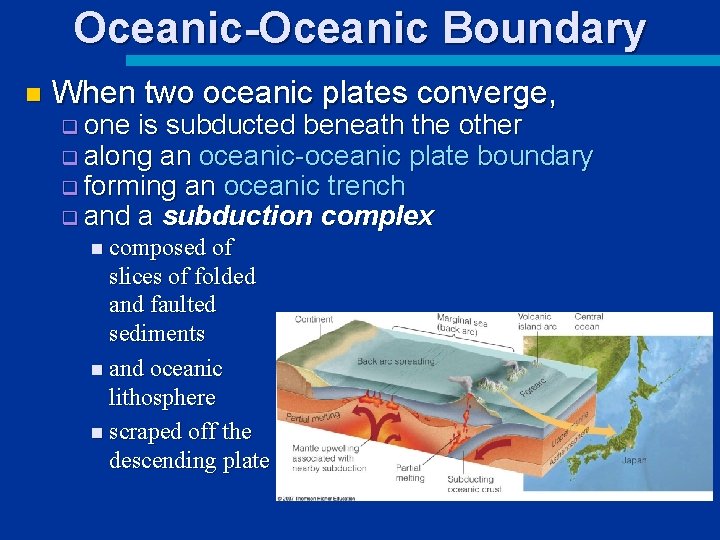
Oceanic-Oceanic Boundary n When two oceanic plates converge, q one is subducted beneath the other q along an oceanic-oceanic plate boundary q forming an oceanic trench q and a subduction complex n composed of slices of folded and faulted sediments n and oceanic lithosphere n scraped off the descending plate
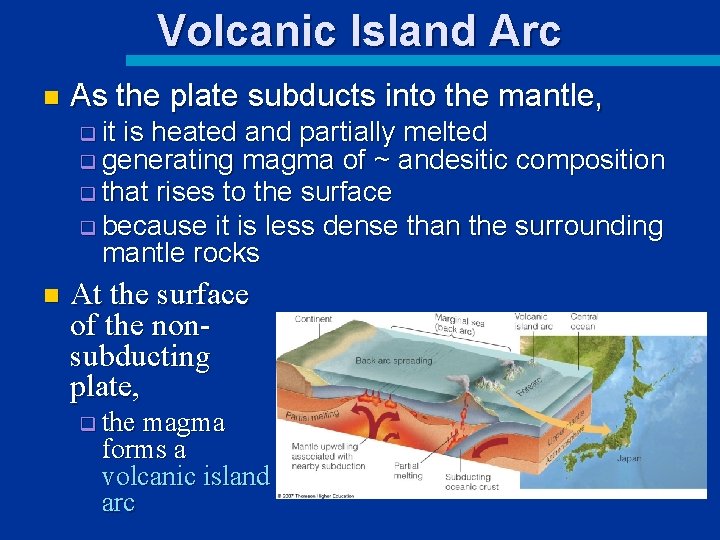
Volcanic Island Arc n As the plate subducts into the mantle, q it is heated and partially melted q generating magma of ~ andesitic q that composition rises to the surface q because it is less dense than the surrounding mantle rocks n At the surface of the nonsubducting plate, q the magma forms a volcanic island arc
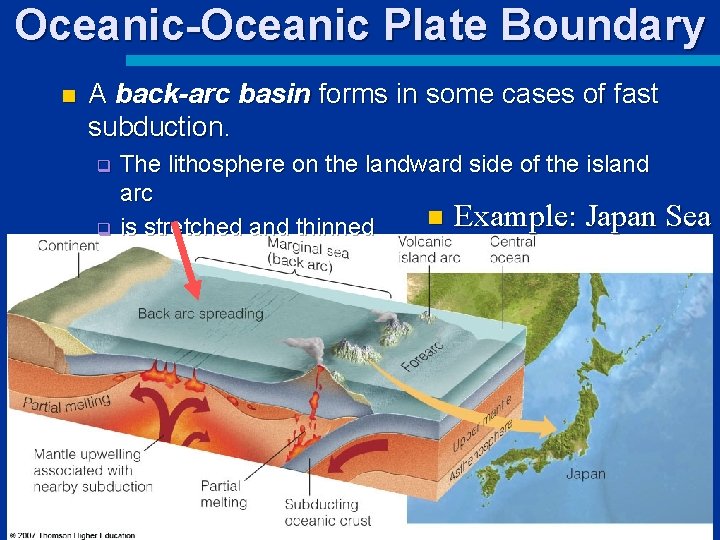
Oceanic-Oceanic Plate Boundary n A back-arc basin forms in some cases of fast subduction. The lithosphere on the landward side of the island arc n Example: Japan Sea q is stretched and thinned q
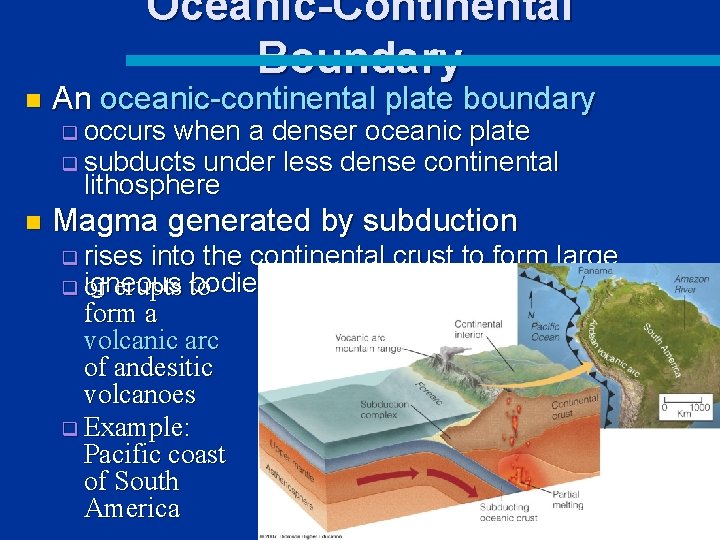
Oceanic-Continental Boundary n An oceanic-continental plate boundary q occurs when a denser oceanic plate q subducts under less dense continental lithosphere n Magma generated by subduction q rises into the continental igneous bodies q or erupts to form a volcanic arc of andesitic volcanoes q Example: Pacific coast of South America crust to form large
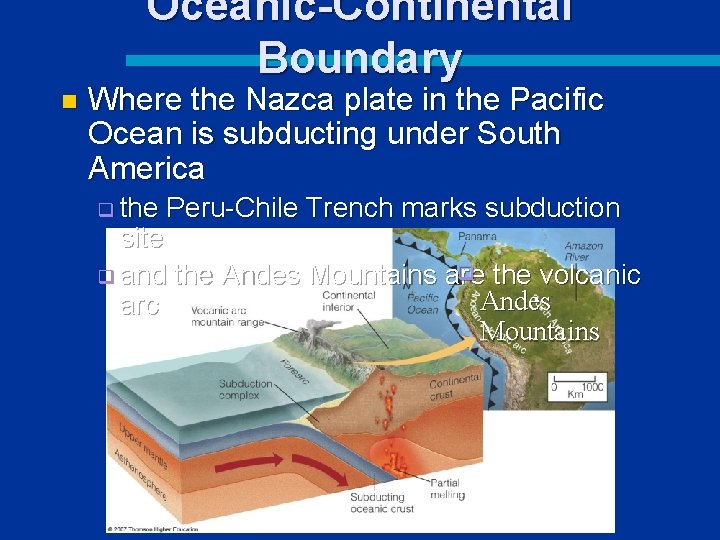
Oceanic-Continental Boundary n Where the Nazca plate in the Pacific Ocean is subducting under South America q the Peru-Chile Trench marks subduction site q the volcanic q and the Andes Mountains are Andes arc Mountains
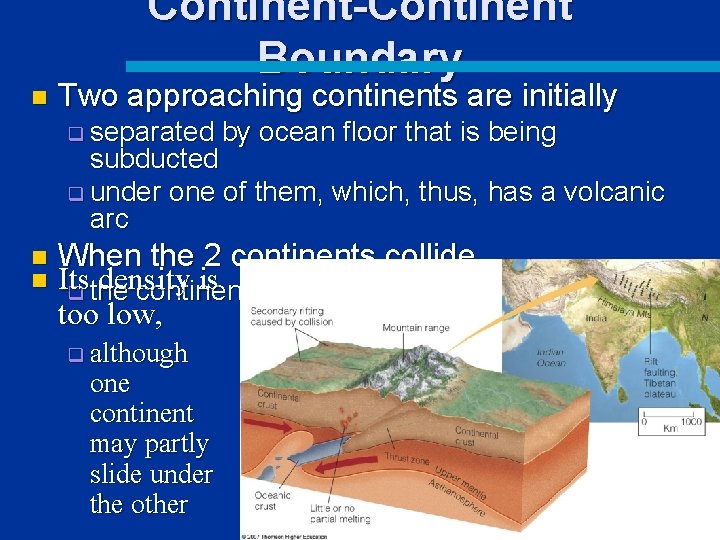
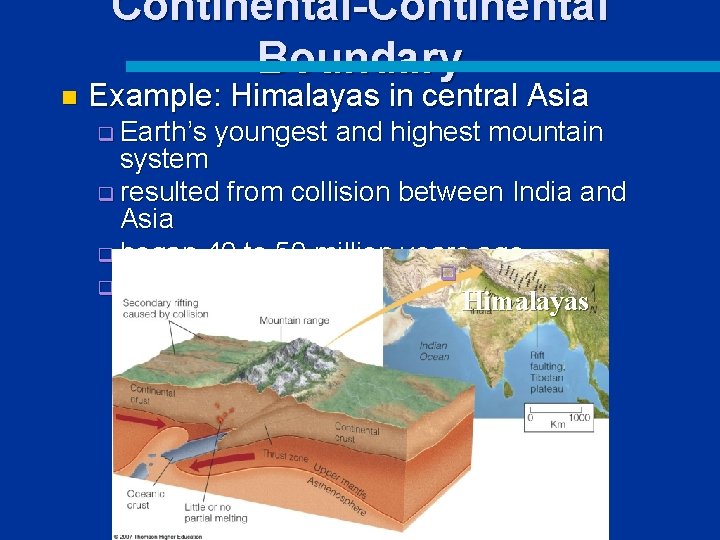
Continent-Continent Boundary n Two approaching continents are initially q separated by ocean floor that is being subducted q under one of them, which, thus, has a volcanic arc n When the 2 continents collide n Its density is q the continental lithosphere cannot subduct too low, q although one continent may partly slide under the other
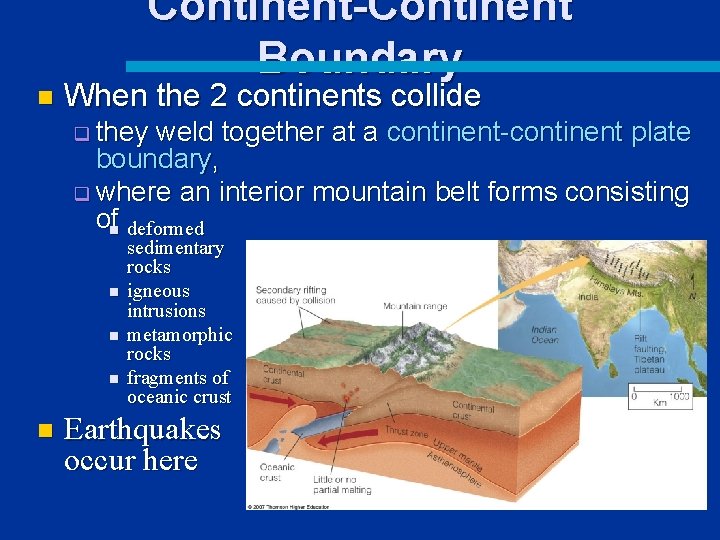
Continent-Continent Boundary n When the 2 continents collide q they weld together at a continent-continent plate boundary, q where an interior mountain belt forms consisting ofn deformed n n sedimentary rocks igneous intrusions metamorphic rocks fragments of oceanic crust Earthquakes occur here
Continental-Continental Boundary n Example: Himalayas in central Asia q Earth’s youngest and highest mountain system q resulted from collision between India and Asia q began 40 to 50 million years ago q q and is still continuing Himalayas
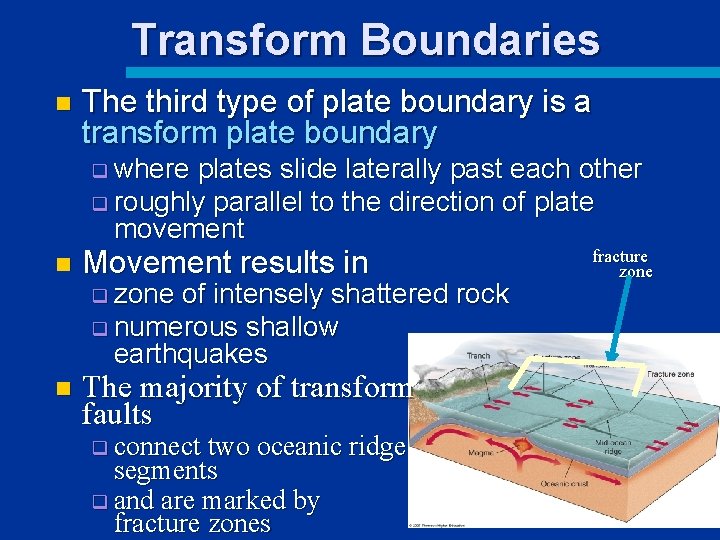
Transform Boundaries n The third type of plate boundary is a transform plate boundary q where plates slide laterally past each other q roughly parallel to the direction of plate movement n Movement results in n The majority of transform faults q zone of intensely shattered rock q numerous shallow earthquakes q connect two oceanic ridge segments q and are marked by fracture zones fracture zone
Transform Boundaries n Other kinds of transform plate boundaries q connect two trenches q or connect a ridge to a trench q or even a ridge or trench to another transform fault n Transforms can also extend into continents
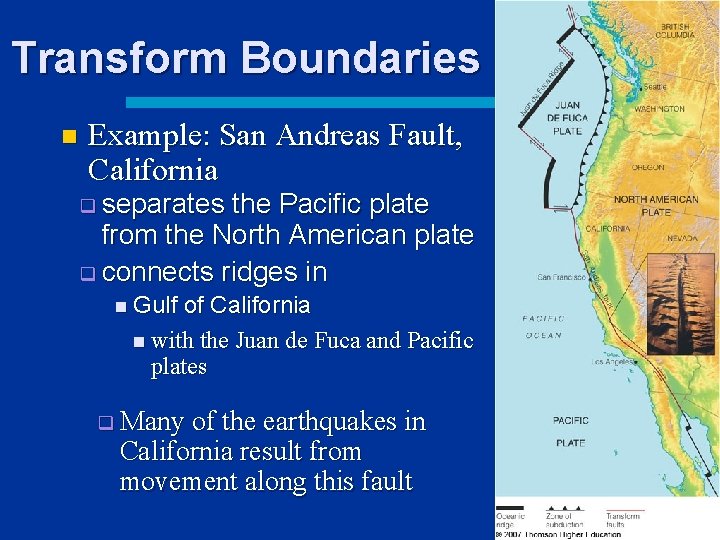
Transform Boundaries n Example: San Andreas Fault, California q separates the Pacific plate from the North American plate q connects ridges in n Gulf of California n with the Juan de Fuca and Pacific plates q Many of the earthquakes in California result from movement along this fault