
Geological structures 1 b Fractures and Faults Lecture
Geological structures 1 b Fractures and Faults
Lecture guide • • Stress and strain Stages of deformation Evidence of former deformation Fracture of brittle rocks – Joints definition and importance – Fault geometry and nomenclature • Definition and classification • Rocks produced by faulting (fault rocks) • Features associated with fault planes
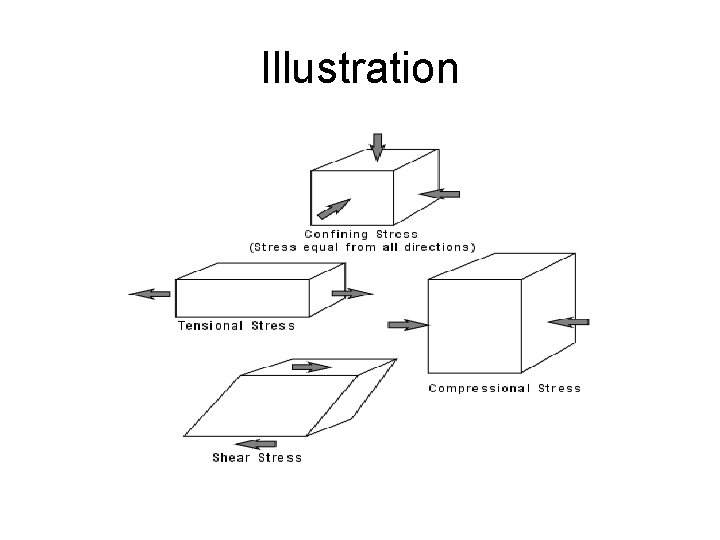
Stress and strain • Rocks are constantly subjected to forces causing them to bend, twist, or fracture. • They deform or strain (change shape or size). The forces that cause deformation are referred to as stresses. • To understand rock deformation we must first explore stress and strain.
Stress and strain • Among the stresses that deform rock is confining stress (isotropic). • 3 kinds of differential stress (anisotropic) occur. • Tensional stress (or extensional stress), which stretches rock; • Compressional stress, which squeezes rock; • Shear stress, which result in slippage and translation
Illustration
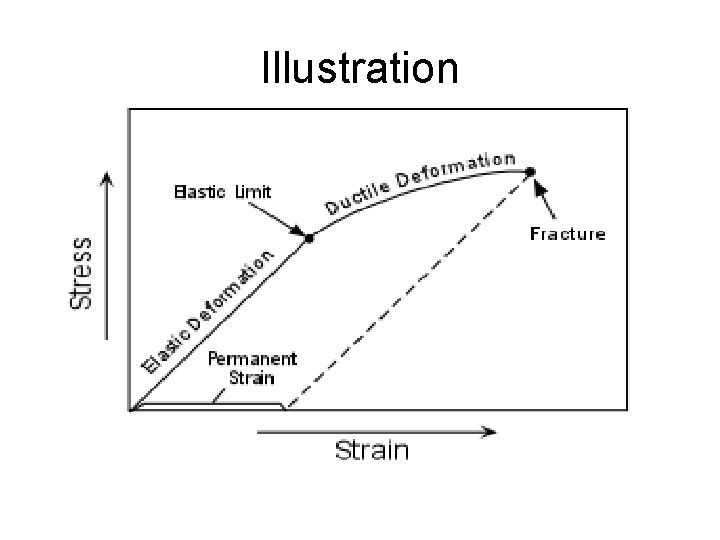
Stages of deformation • A change in shape, size or volume is referred to as strain. • When stress is applied to rock, the rock passes through some stages of deformation.
Illustration
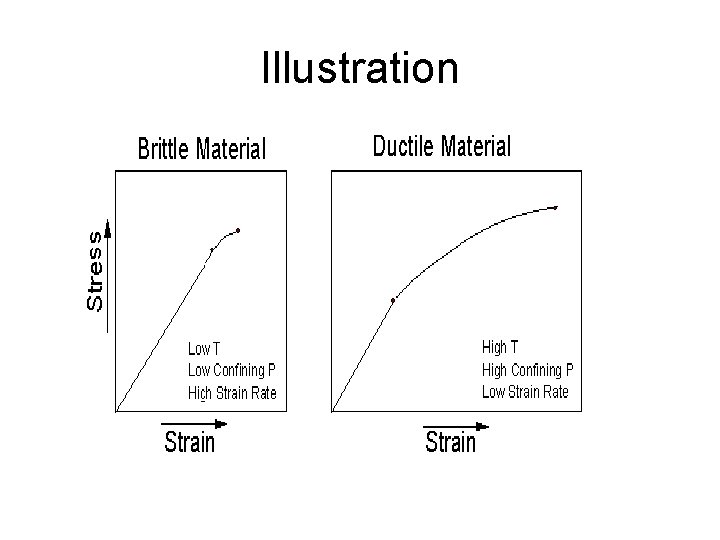
Behaviour of material under stress • Brittle materials have a small to large region of elastic behavior, but only a small region of ductile behavior before they fracture. • Ductile materials have a small region of elastic behavior and a large region of ductile behavior before they fracture.
Illustration
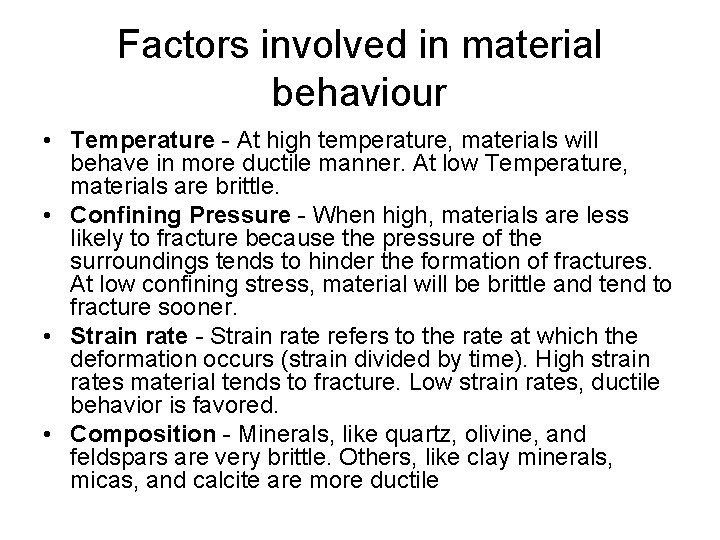
Factors involved in material behaviour • Temperature - At high temperature, materials will behave in more ductile manner. At low Temperature, materials are brittle. • Confining Pressure - When high, materials are less likely to fracture because the pressure of the surroundings tends to hinder the formation of fractures. At low confining stress, material will be brittle and tend to fracture sooner. • Strain rate - Strain rate refers to the rate at which the deformation occurs (strain divided by time). High strain rates material tends to fracture. Low strain rates, ductile behavior is favored. • Composition - Minerals, like quartz, olivine, and feldspars are very brittle. Others, like clay minerals, micas, and calcite are more ductile
Earth’s structure
Evidence of former deformation
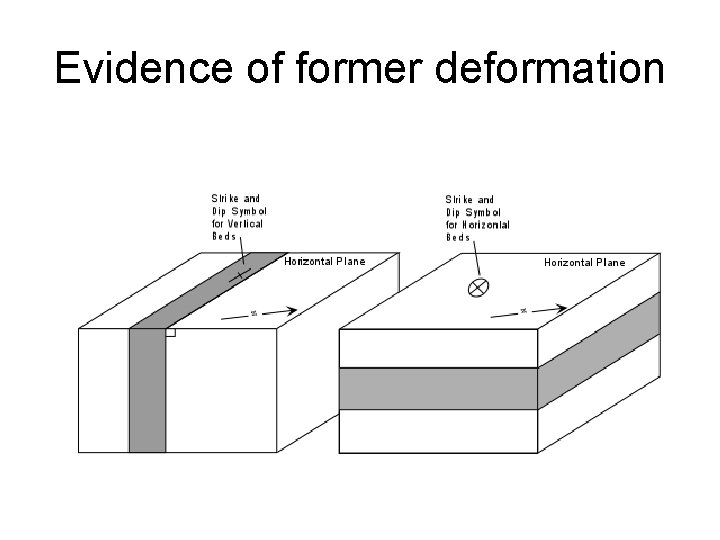
Evidence of former deformation
Fracture of brittle rocks (Joints) • Definition: Fractures along which no appreciable or observable displacement has occurred. • Joints develop preferentially in brittle rather than ductile rocks • A group of parallel joints is called a joint set and several intersecting sets make a joint system
Importance of joints • Provide permeability for ground water migration as well as migration and accumulation of petroleum; also controls drainage patterns and shape coastlines. Due to passage provision, weathering can take place. • Controls mineralization, hence modern prospecting techniques include detailed fracture analyses • Useful in engineering works (major construction projects are affected by joint systems, since all joints are structural weaknesses, within rocks and allowances must be made for them in project planning)
Joint Types • Shrinkage joints: (caused by tensional forces as a result of drying out of sediments or cooling and contraction of igneous bodies; can result in a structure called columnar joints) • Sheet joints: a set of joints may develop which are more or less parallel to the surface of the ground, especially in plutonic igneous intrusions. They probably arise as a result of the unloading of the rock mass when the cover is eroded away • Tectonic joints: these arise as a direct result of folding or faulting in rocks.
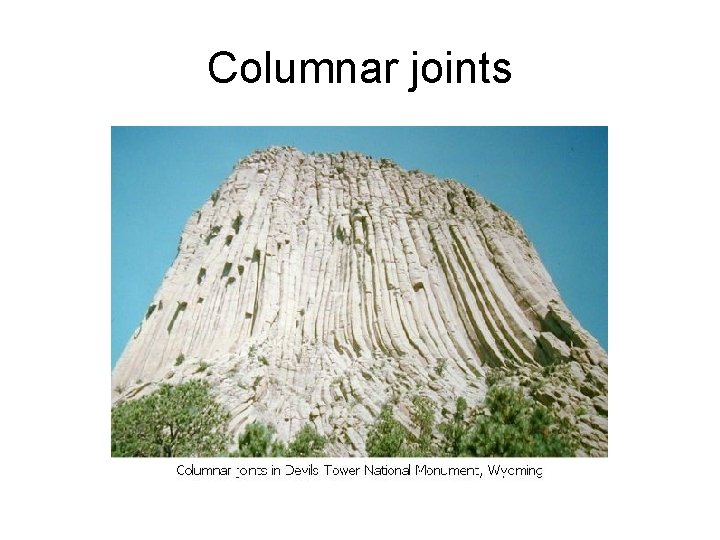
Columnar joints
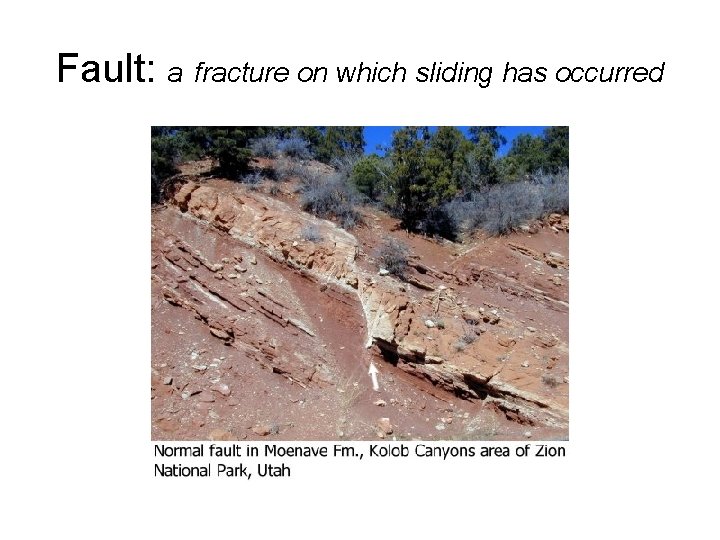
Fault: a fracture on which sliding has occurred
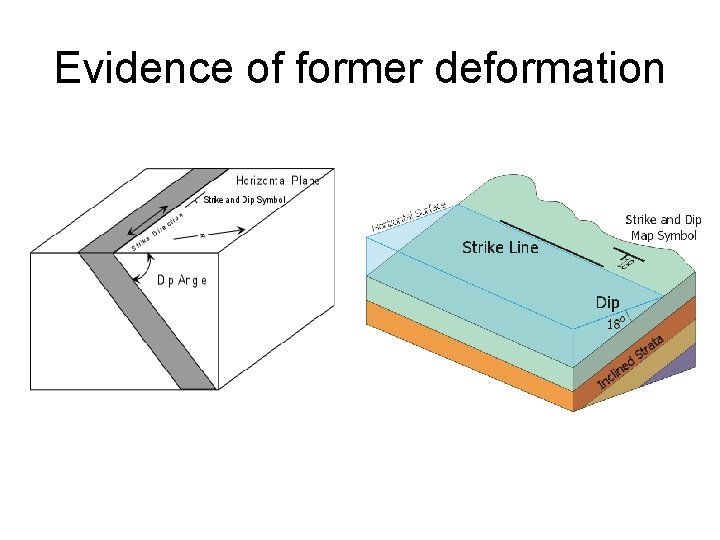
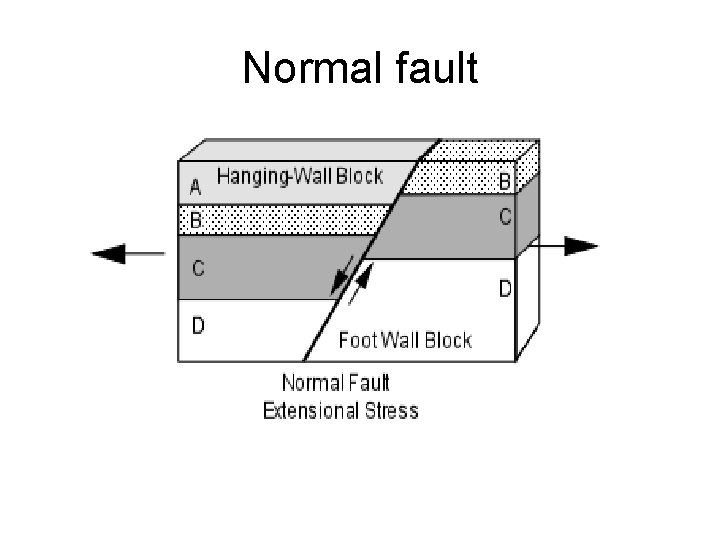
Fault geometry and nomenclature • Definition: A fault is a structure along which displacement has taken place. • A fault plane can be vertical, horizontal or at some angle in between whose orientation can be described by a strike and dip measurement. • If a fault plane (surface along which movement has taken place) is inclined to the horizontal, the rock mass above it is the hanging wall, below it is the footwall.
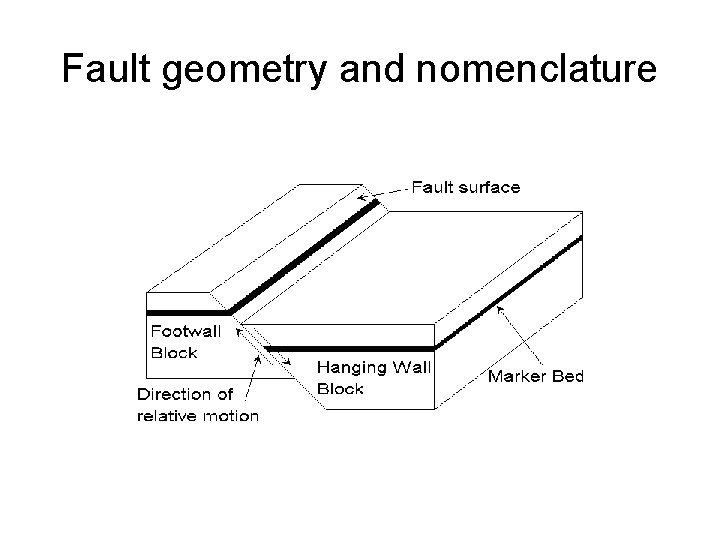
Fault geometry and nomenclature
Fault Classification • Geometry: dip-slip, strike-slip, oblique, etc. • Sense of movement: Normal, Reverse, Transform. • Responsible forces: Tension, Gravity and Compressional
Geometric and Kinematic Classification Of Faults may be classified according to the following categories: • Pattern of sets and systems • Relation to regional structure or topography • Direction of relative displacement
PATTERN OF SETS AND SYSTEMS We may classify faults according to the pattern in which they occur. • Radial Faults- As their name implies, they are more or less radialy arranged around a present or former center of igneous activity. Faults that form cylindrical pattern around a central area are termed ring faults. • Parallel Faults- that are successively offset in a constant direction or along an arc are said to be arranged en echelon, a French term meaning in ladder-rung fashion
RELATION TO REGIONAL STRUCTURE OR TOPOGRAPHY We may also classify faults by their geographic orientation. Thus one speaks of north-south, east -west trending faults etc. We may classify them according to their relations to other structures. • Longitudinal Faults- have their traces aligned more or less parallel to regional structural trends. • Cross or Transverse Faults- Transect the regional structure at large angles
DIRECTION OF RELATIVE DISPLACEMENT • Displacement along the Dip- A fault whose predominant component of displacements is along the line of dip is a Dip-slip Fault, which can be either normal or reverse. A normal fault dips toward the block that seems relatively lowered, or the hanging-wall moves up with respect to the foot-wall. Reverse Faults- Dips towards the block that seems relatively raised, or the hanging-wall moves up with respect to the foot-wall. This is also known as thrust fault.
• Displacement along the strike- A faults whose predominant slip is along its strike is a strike- slip fault. Common partial synonyms of the strike-slip fault are wrench fault and transcurrent faults.

Geometry of displacement • Displacement is with respect to horizontal and vertical components are • Heave (horizontal) • Throw (vertical) • Throw is normally quoted rather than true displacement.
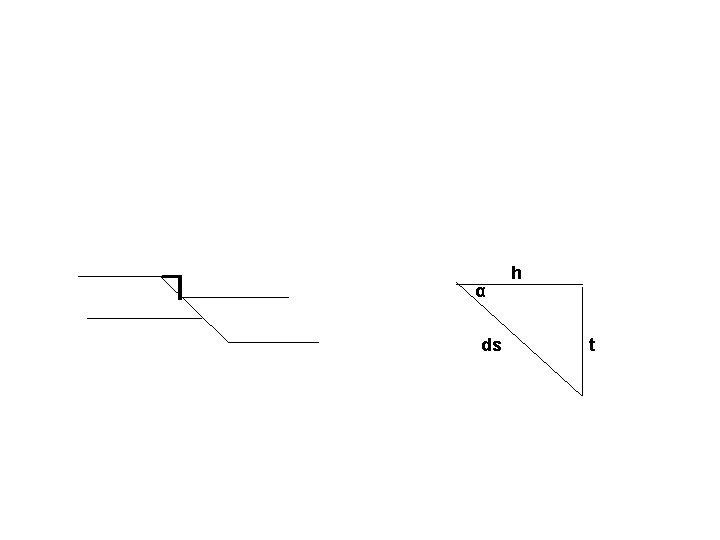
α ds h t
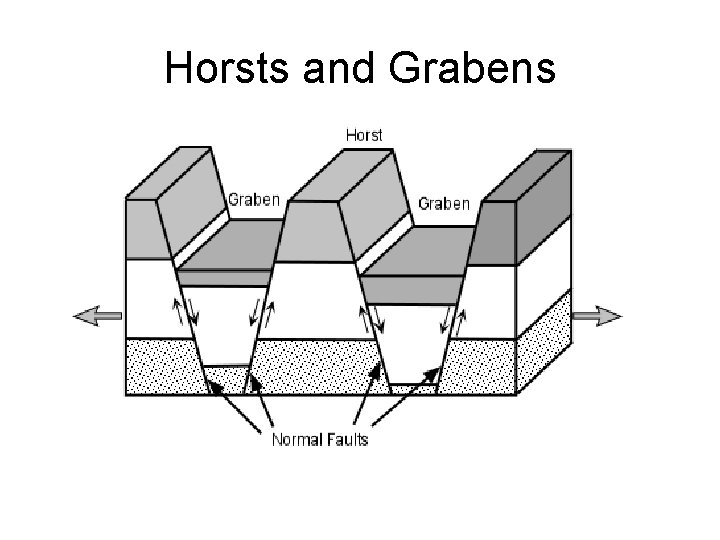
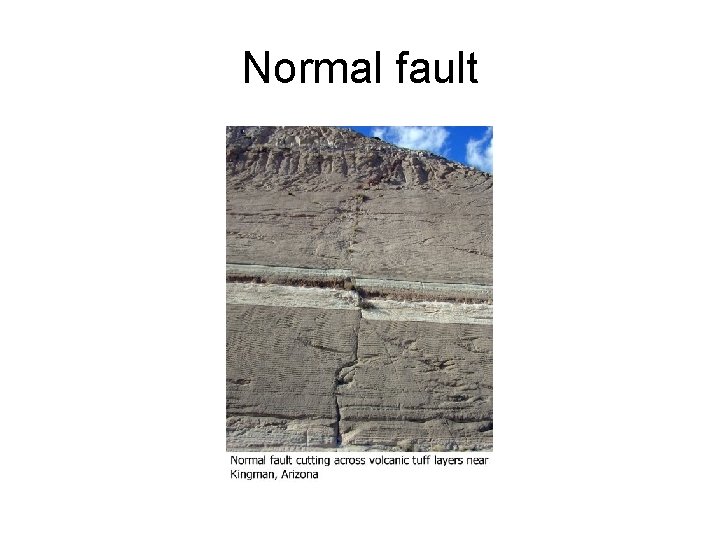
Sense of movement: Normal fault • Hanging block moves down relative to the footwall • Most normal faults are small, having displacements of only a meter or so. • Normal faults indicate the existence of tensional stresses that tend to pull the crust apart • Results in graben and horsts
Normal fault
Horsts and Grabens
Normal fault
HORST AND GRABENS • Horsts & Grabens - Due to the tensional stress responsible for normal faults, they often occur in a series, with adjacent faults dipping in opposite directions. In such a case the down-dropped blocks form grabens and the uplifted blocks form horsts. In areas where tensional stress has recently affected the crust, the grabens may form rift valleys.
Reverse faults • Faults that result from compressional stresses in brittle rocks, where the hanging -wall block has moved up relative to the footwall; • Reverse faults (dips greater than 35˚); • Thrust faults (dips less than about 35˚) both occurring in compressional environments.
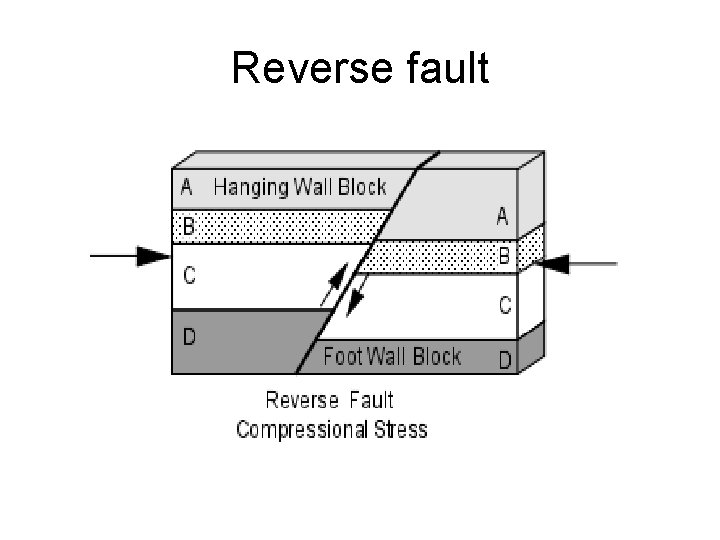
Reverse fault
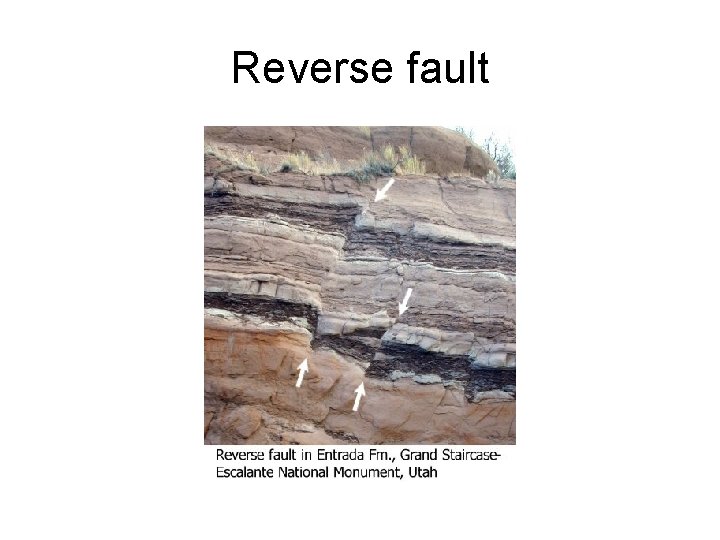
Reverse fault
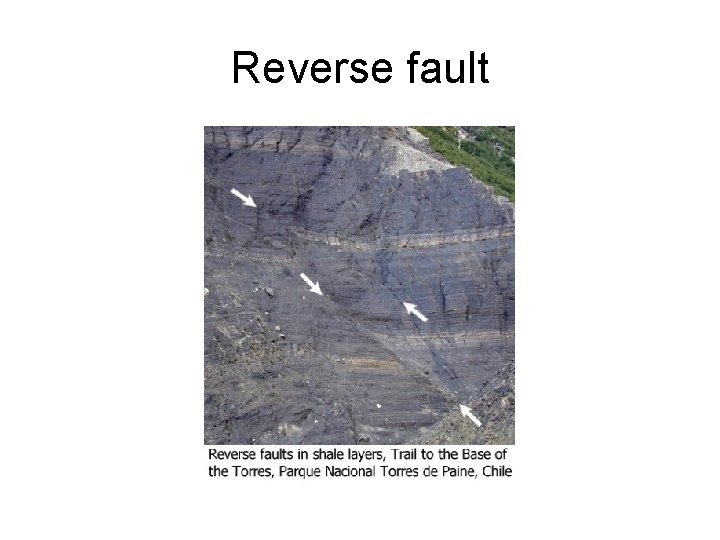
Reverse fault
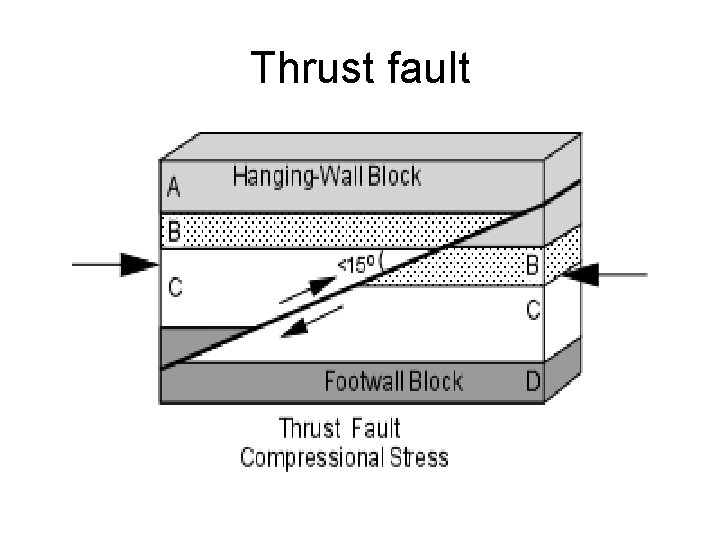
Thrust fault
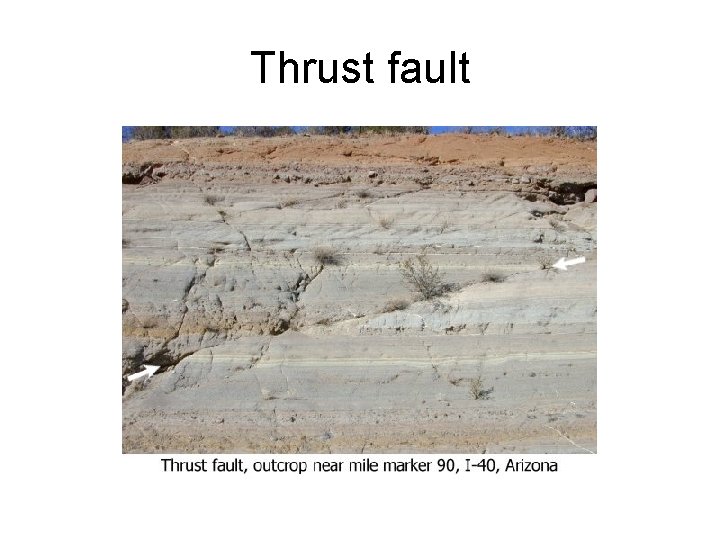
Thrust fault
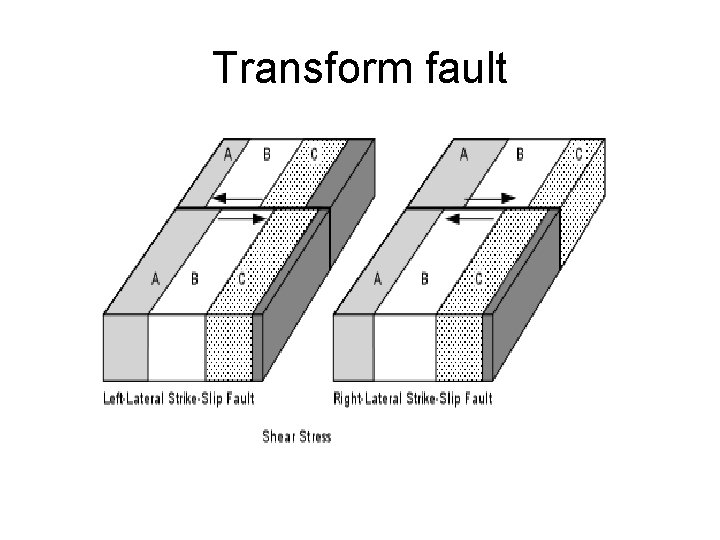
Transform fault
Rocks produced by faulting • Fault breccia: coarse angular broken rock debris in zone along fault • Fault gouge: finely ground rock paste in thin zone along fault plane. These are more susceptible to erosion giving rise to depression often associated with fault outcrops.
Fault planes: Associated features • Slickensides: striated or shiny surfaces on a fault plane caused by rubbing or polishing action • Fault drag: disturbance and folding of rock near fault.
Recognizing faults • The most obvious is the appearance of displacement or offset; • Displacement disrupts the layers in rocks, so that layers on one side of a fault are not continuous with layers on the other side; • Faults may also leave a mark on the landscape; • Faults surfaces and their borders typically look different from bedding planes.
- Slides: 44