
Geological Storage of Hydrogen Learning from natural hydrogen
- Slides: 10
Geological Storage of Hydrogen: Learning from natural hydrogen analogues EGU 2020 – Sharing Geoscience Online – 4 th – 8 th May Christopher J. Mc. Mahon[1] Dr. Jennifer J. Roberts[1], Dr. Gareth Johnson[1], Prof. Zoe K. Shipton[1], Dr. Katriona Edlmann [2] [1] Department of Civil and Environmental Engineering, University of Strathclyde [2] School of Geosciences, University of Edinburgh Faults and Fluid Flow (Fa. FF) Research Group
Why study hydrogen seeps? • Hydrogen has the potential to aid decarbonisation across many sectors (industry, transport, heat, power) • If hydrogen use becomes widespread / in a ‘hydrogen economy’, seasonal geological hydrogen storage is likely to be needed. • To support the intermittency of renewable energy. • Like any engineered geoenergy system, safe and secure containment of hydrogen is important. • Secure storage requires robust site selection and monitoring approaches. • In the absence of large-scale industrial examples of engineered geological hydrogen storage - and leakage - we look to natural analogues. 2
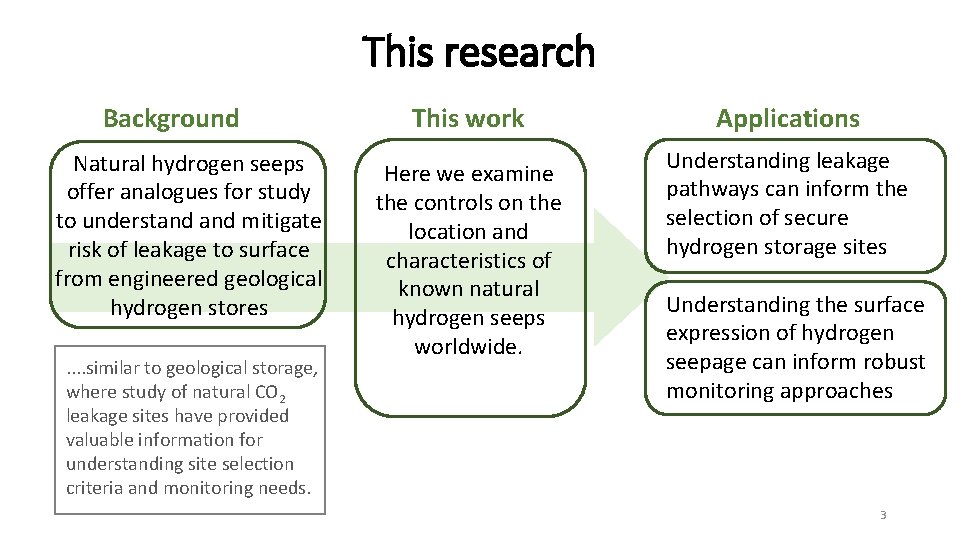
This research Background Natural hydrogen seeps offer analogues for study to understand mitigate risk of leakage to surface from engineered geological hydrogen stores. . similar to geological storage, where study of natural CO 2 leakage sites have provided valuable information for understanding site selection criteria and monitoring needs. This work Here we examine the controls on the location and characteristics of known natural hydrogen seeps worldwide. Applications Understanding leakage pathways can inform the selection of secure hydrogen storage sites Understanding the surface expression of hydrogen seepage can inform robust monitoring approaches 3
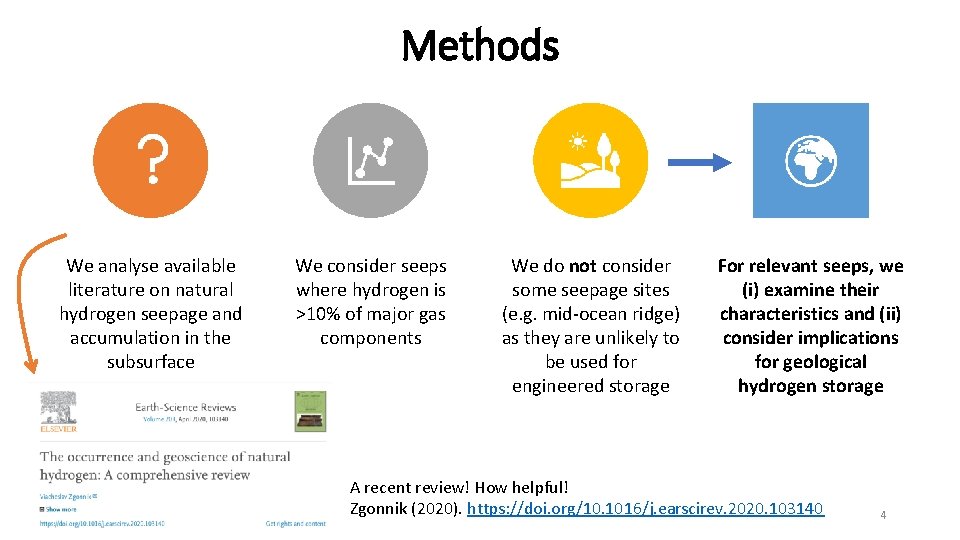
Methods We analyse available literature on natural hydrogen seepage and accumulation in the subsurface We consider seeps where hydrogen is >10% of major gas components We do not consider some seepage sites (e. g. mid-ocean ridge) as they are unlikely to be used for engineered storage For relevant seeps, we (i) examine their characteristics and (ii) consider implications for geological hydrogen storage A recent review! How helpful! Zgonnik (2020). https: //doi. org/10. 1016/j. earscirev. 2020. 103140 4
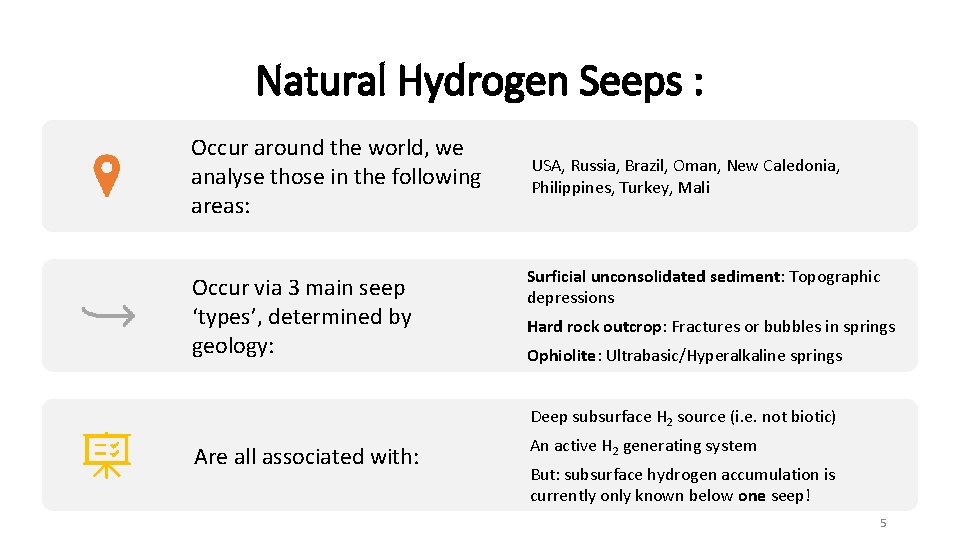
Natural Hydrogen Seeps : Occur around the world, we analyse those in the following areas: Occur via 3 main seep ‘types’, determined by geology: USA, Russia, Brazil, Oman, New Caledonia, Philippines, Turkey, Mali Surficial unconsolidated sediment: Topographic depressions Hard rock outcrop: Fractures or bubbles in springs Ophiolite: Ultrabasic/Hyperalkaline springs Deep subsurface H 2 source (i. e. not biotic) Are all associated with: An active H 2 generating system But: subsurface hydrogen accumulation is currently only known below one seep! 5
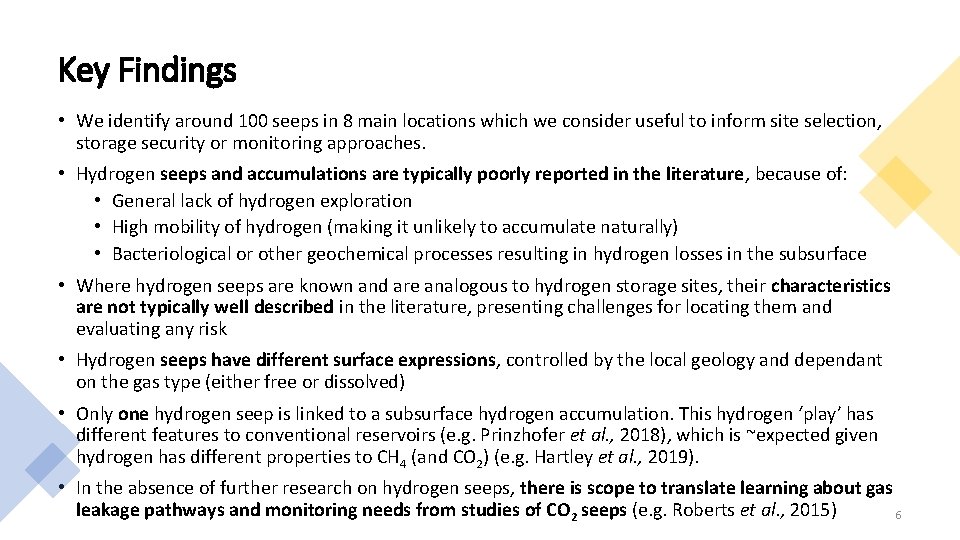
Key Findings • We identify around 100 seeps in 8 main locations which we consider useful to inform site selection, storage security or monitoring approaches. • Hydrogen seeps and accumulations are typically poorly reported in the literature, because of: • General lack of hydrogen exploration • High mobility of hydrogen (making it unlikely to accumulate naturally) • Bacteriological or other geochemical processes resulting in hydrogen losses in the subsurface • Where hydrogen seeps are known and are analogous to hydrogen storage sites, their characteristics are not typically well described in the literature, presenting challenges for locating them and evaluating any risk • Hydrogen seeps have different surface expressions, controlled by the local geology and dependant on the gas type (either free or dissolved) • Only one hydrogen seep is linked to a subsurface hydrogen accumulation. This hydrogen ‘play’ has different features to conventional reservoirs (e. g. Prinzhofer et al. , 2018), which is ~expected given hydrogen has different properties to CH 4 (and CO 2) (e. g. Hartley et al. , 2019). • In the absence of further research on hydrogen seeps, there is scope to translate learning about gas leakage pathways and monitoring needs from studies of CO 2 seeps (e. g. Roberts et al. , 2015) 6
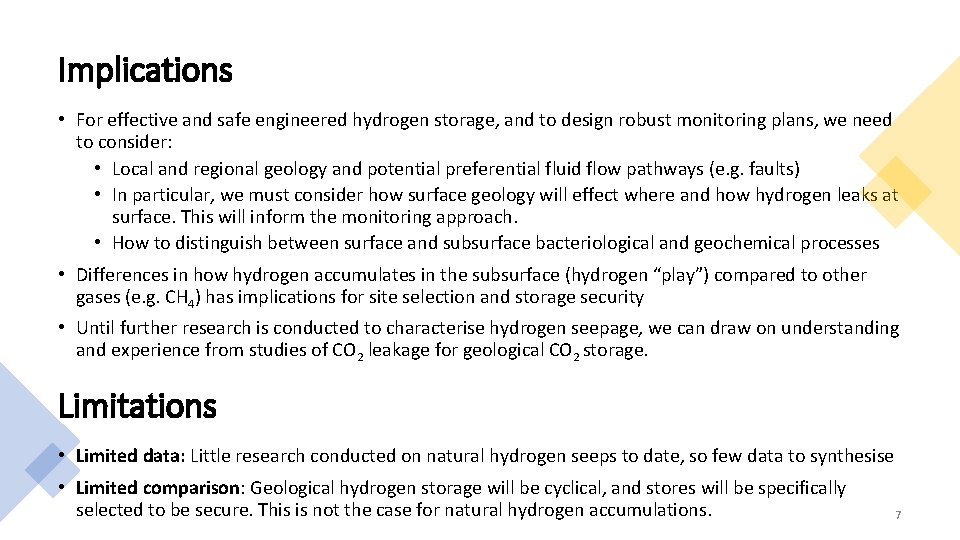
Implications • For effective and safe engineered hydrogen storage, and to design robust monitoring plans, we need to consider: • Local and regional geology and potential preferential fluid flow pathways (e. g. faults) • In particular, we must consider how surface geology will effect where and how hydrogen leaks at surface. This will inform the monitoring approach. • How to distinguish between surface and subsurface bacteriological and geochemical processes • Differences in how hydrogen accumulates in the subsurface (hydrogen “play”) compared to other gases (e. g. CH 4) has implications for site selection and storage security • Until further research is conducted to characterise hydrogen seepage, we can draw on understanding and experience from studies of CO 2 leakage for geological CO 2 storage. Limitations • Limited data: Little research conducted on natural hydrogen seeps to date, so few data to synthesise • Limited comparison: Geological hydrogen storage will be cyclical, and stores will be specifically selected to be secure. This is not the case for natural hydrogen accumulations. 7
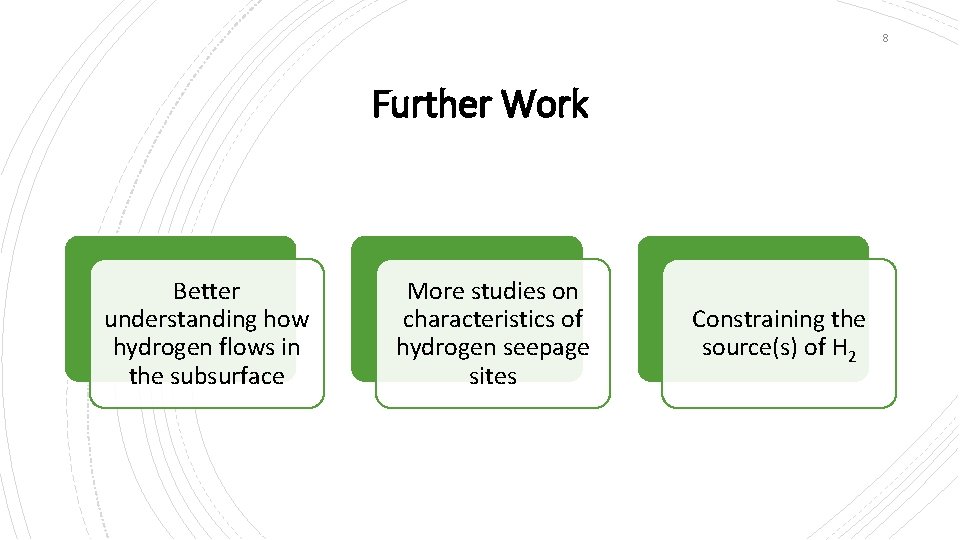
8 Further Work Better understanding how hydrogen flows in the subsurface More studies on characteristics of hydrogen seepage sites Constraining the source(s) of H 2
Thank you! Email: christopher. mcmahon@strath. ac. uk Twitter: @Chris. Mc. Mahon 7 Twitter: @Faf. Fclyde Instagram: faffclyde 9
References Hartley, P. G. , Stalker, L. , Roberts, J. and Mabon, L. (2019). Communicating leakage risk in the hydrogen economy: lessons already learned from geoenergy industries. 8 th International Conference on Hydrogen Safety (ICHS 2019). Prinzhofer, A. , Cisse, C. S. T. , Diallo, A. B. (2018). Discovery of a large accumulation of natural hydrogen in Bourakebougou (Mali), International Journal of Hydrogen Energy, Vol. 43, pp. 19315 -19326. Roberts, J. J. , Wood, R. A. , Wilkinson, M. and Haszeldine, S. (2015). Surface controls on the characteristics of natural CO 2 seeps: implications for engineered CO 2 stores. Geofluids, Vol. 15, Iss. 3, pp. 453 -463. Zgonnik, V. (2020). The occurrence and geoscience of natural hydrogen: A comprehensive review. Earth. Science Reviews, p. 103140. 10