
GEOLOGICAL PHENOMENA THE EARTH IN MOTION VOLCANOES EARTHQUAKES


- Slides: 23
GEOLOGICAL PHENOMENA THE EARTH IN MOTION VOLCANOES EARTHQUAKES OROGENESIS – MOUNTAIN FORMATION EROSION THE WATER CYCLE WINDS NATURAL & RENEWABLE ENERGY SOURCES
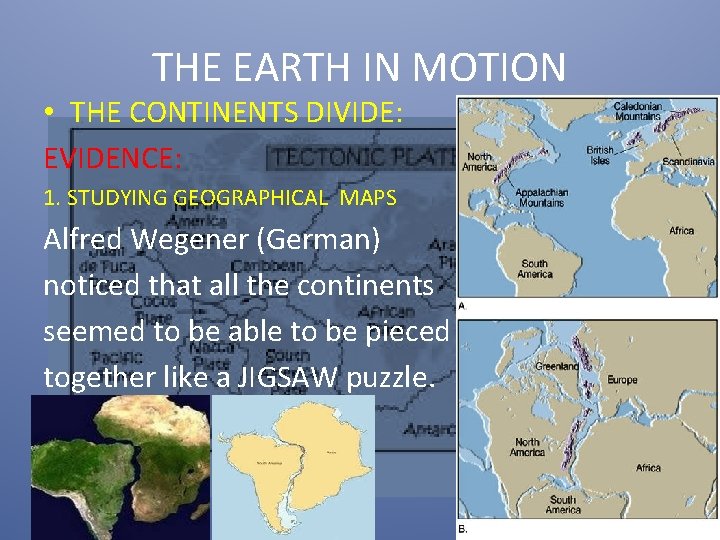
THE EARTH IN MOTION • THE CONTINENTS DIVIDE: EVIDENCE: 1. STUDYING GEOGRAPHICAL MAPS Alfred Wegener (German) noticed that all the continents seemed to be able to be pieced together like a JIGSAW puzzle.
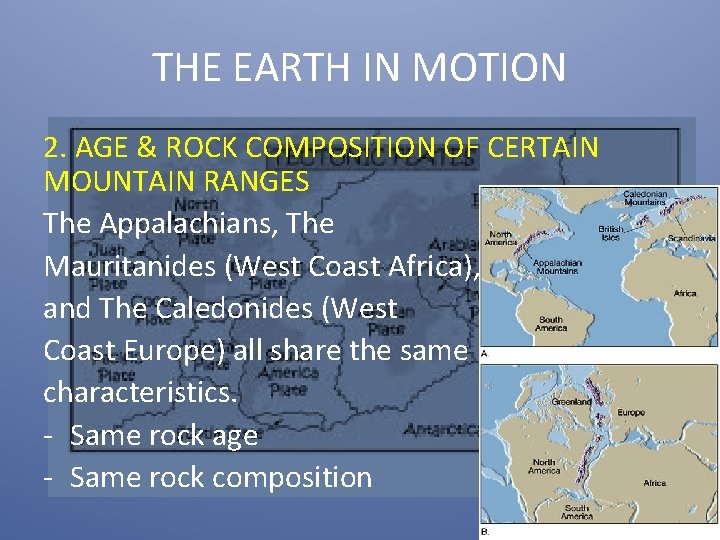
THE EARTH IN MOTION 2. AGE & ROCK COMPOSITION OF CERTAIN MOUNTAIN RANGES The Appalachians, The Mauritanides (West Coast Africa), and The Caledonides (West Coast Europe) all share the same characteristics. - Same rock age - Same rock composition
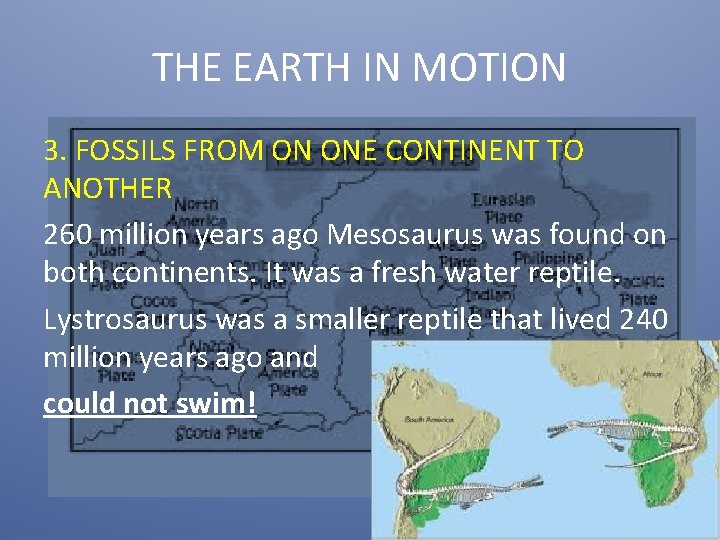
THE EARTH IN MOTION 3. FOSSILS FROM ON ONE CONTINENT TO ANOTHER 260 million years ago Mesosaurus was found on both continents. It was a fresh water reptile. Lystrosaurus was a smaller reptile that lived 240 million years ago and could not swim!
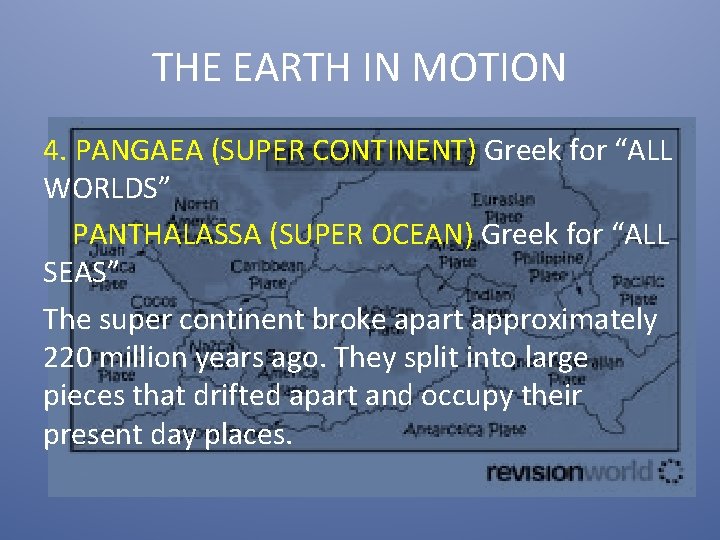
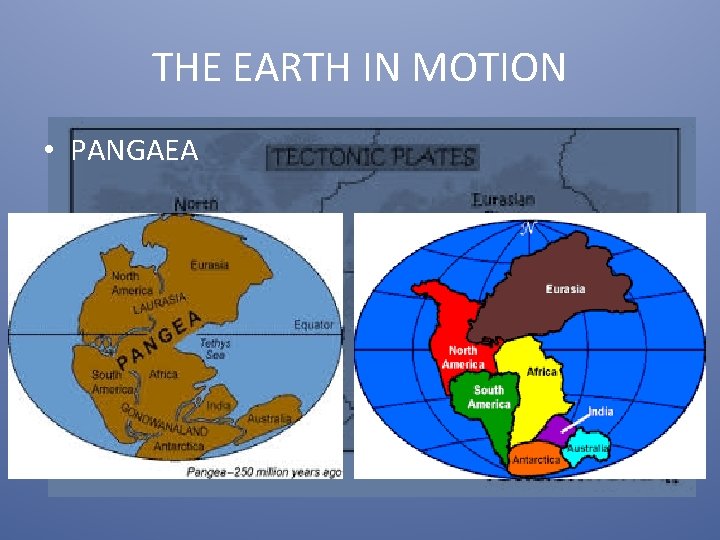
THE EARTH IN MOTION 4. PANGAEA (SUPER CONTINENT) Greek for “ALL WORLDS” PANTHALASSA (SUPER OCEAN) Greek for “ALL SEAS” The super continent broke apart approximately 220 million years ago. They split into large pieces that drifted apart and occupy their present day places.
THE EARTH IN MOTION • PANGAEA
THE EARTH IN MOTION TECTONIC PLATES • 1960 S – Sonar is invented (helped MAP the ocean depths) • DISCOVERIES: 1. Continental Shelves – underwater extensions of the continents (like an extension of the beach). Confirmed that their contours fit like a jigsaw puzzle. 2. Oceanic Ridges – long chains of underwater mountain ranges (they are the borders of each plate as the drift apart). 3. Convection Currents – a movement that occurs in a liquid or solid when a temperature difference exists within a substance. Hot circulates and rises to the top while the cool sinks.
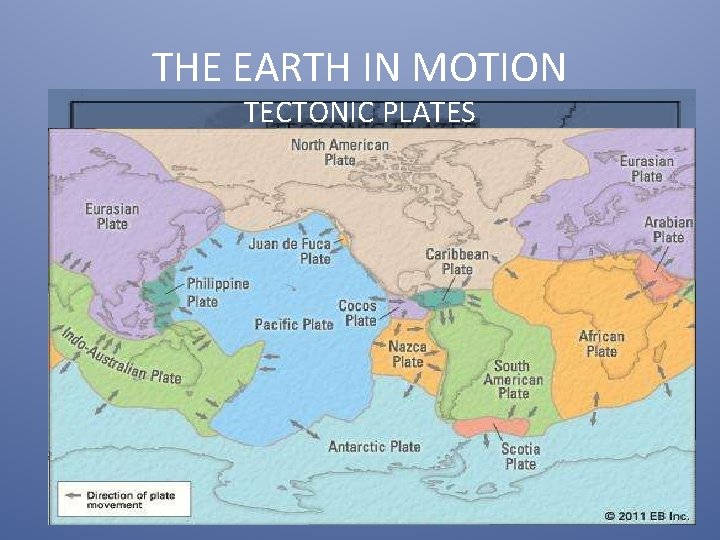
THE EARTH IN MOTION TECTONIC PLATES
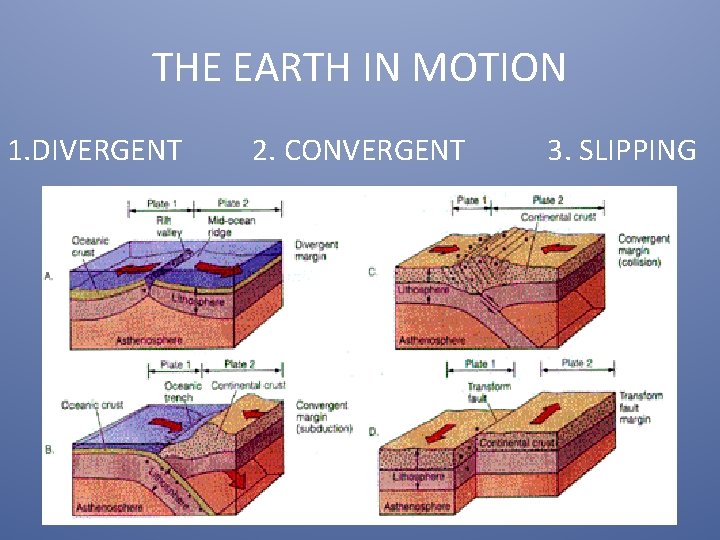
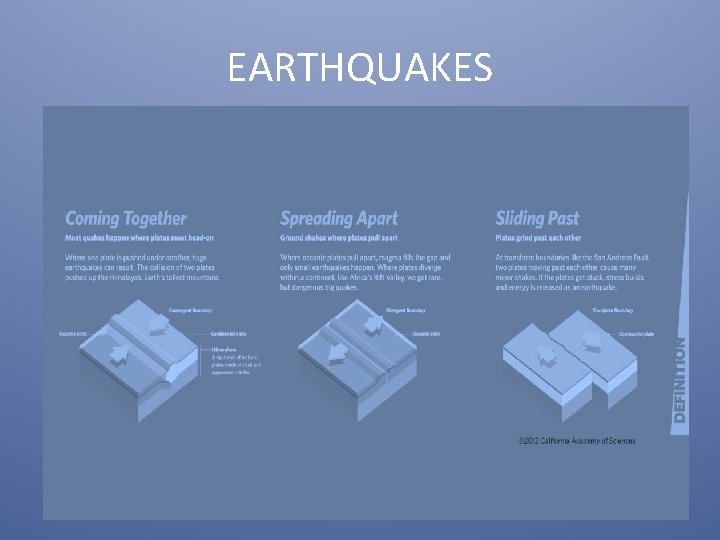
THE EARTH IN MOTION TECTONIC PLATES How the Plates move? Plates move anywhere from 1 cm to 20 cm a year. Mountains form, Earthquakes occur, and Volcanoes erupt. 1. DIVERGENCE – plates move apart. They create a rift or fault. Magma can infiltrate and form new crust creating oceanic ridges and volcanoes. 2. CONVERGENCE – plates move toward each other. (AKA Subduction zone). One plate disappears beneath another. That crust gets recycled. The sinking creates an oceanic trench. The other part rises creating mountain ranges and volcanoes. 3. SLIPPING – (AKA Transform Fault). Plates slide against each other in opposite directions
THE EARTH IN MOTION 1. DIVERGENT 2. CONVERGENT 3. SLIPPING
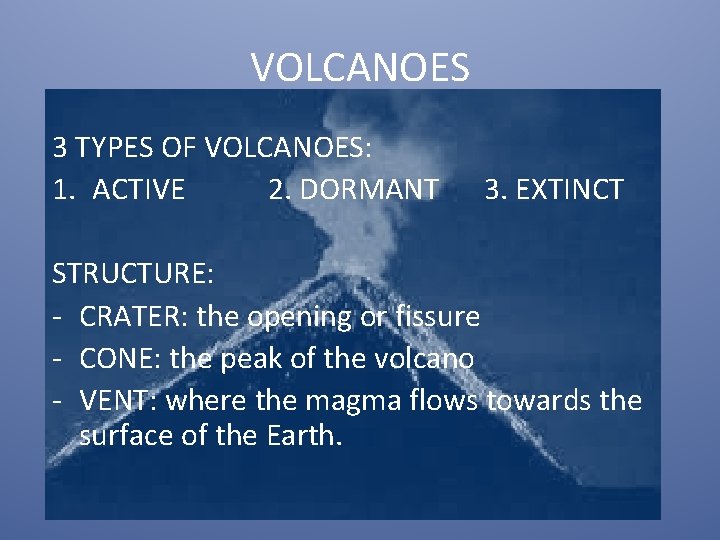
VOLCANOES 3 TYPES OF VOLCANOES: 1. ACTIVE 2. DORMANT 3. EXTINCT STRUCTURE: - CRATER: the opening or fissure - CONE: the peak of the volcano - VENT: where the magma flows towards the surface of the Earth.
EARTHQUAKES • Earthquakes – AKA tremors or seisms. The phenomena of the movement of the Earth’s crust. • Shock waves – friction of varying intensity produced by tectonic plate movement. • Seismic waves – spread through the ground in every direction from the earthquake’s point of origin. • Tsunamis – Japanese term for “Harbour Wave”. Originate from the point of the earthquake, the ocean waves travel very quickly and get higher and higher as they reach the continental shelf
EARTHQUAKES
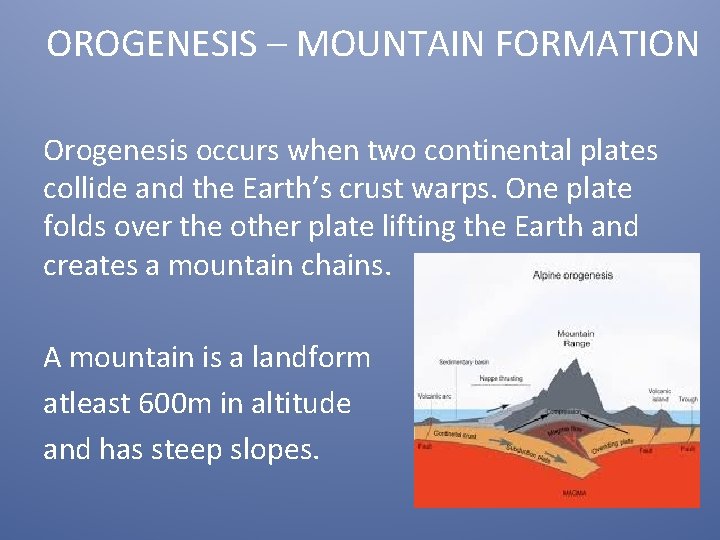
OROGENESIS – MOUNTAIN FORMATION Orogenesis occurs when two continental plates collide and the Earth’s crust warps. One plate folds over the other plate lifting the Earth and creates a mountain chains. A mountain is a landform atleast 600 m in altitude and has steep slopes.
EROSION • A force that results in the flattening of the landscape. 1) Weathering – run off and freeze/thaw cycle 2) Transportation – rock fragments carried away by wind, water, glacier, or gravity 3) Sedimentation – fragments accumulated at the bottom of the oceans, valleys, or plains
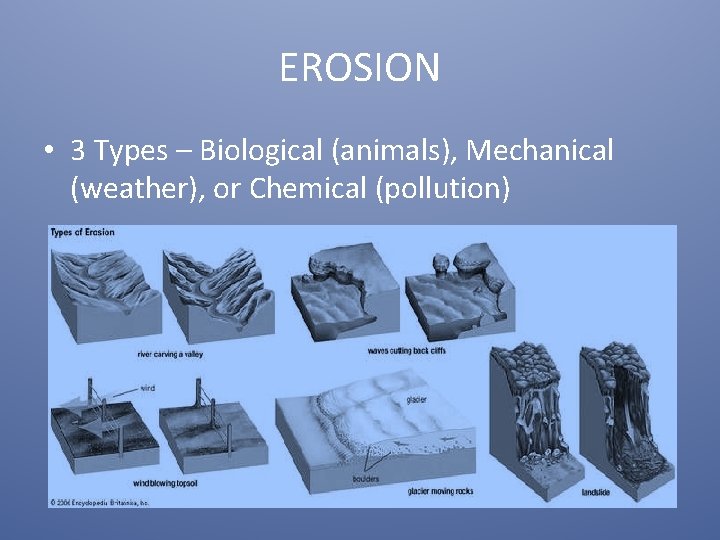
EROSION • 3 Types – Biological (animals), Mechanical (weather), or Chemical (pollution)
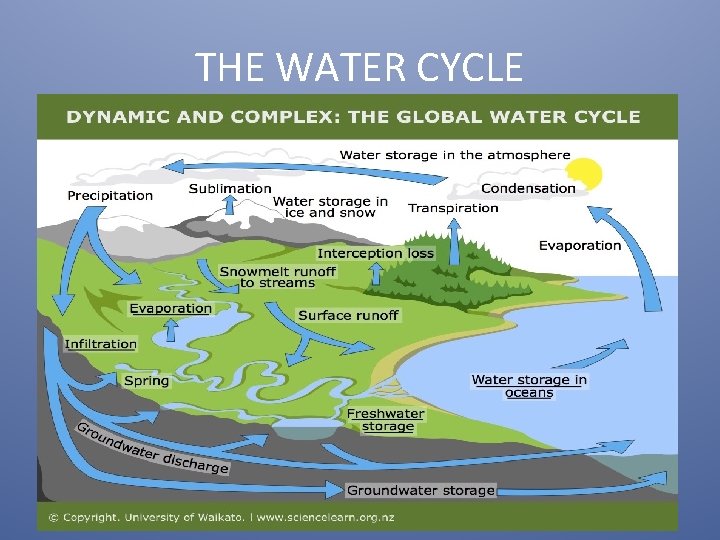
THE WATER CYCLE • The Earth is 75% water • The total quantity of water on Earth has remained relatively constant because of the water cycle constantly recycles the water through evaporation, transportation, and precipitation. • Water always returns to its point of departure because of its successive changes of state.
THE WATER CYCLE
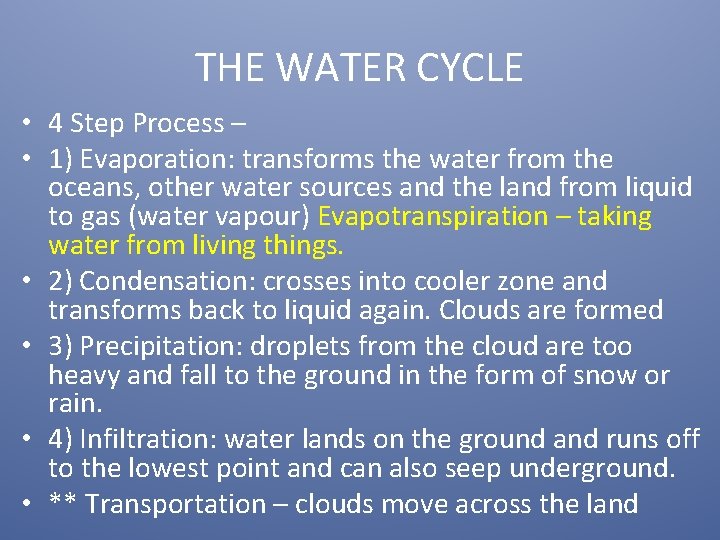
THE WATER CYCLE • 4 Step Process – • 1) Evaporation: transforms the water from the oceans, other water sources and the land from liquid to gas (water vapour) Evapotranspiration – taking water from living things. • 2) Condensation: crosses into cooler zone and transforms back to liquid again. Clouds are formed • 3) Precipitation: droplets from the cloud are too heavy and fall to the ground in the form of snow or rain. • 4) Infiltration: water lands on the ground and runs off to the lowest point and can also seep underground. • ** Transportation – clouds move across the land
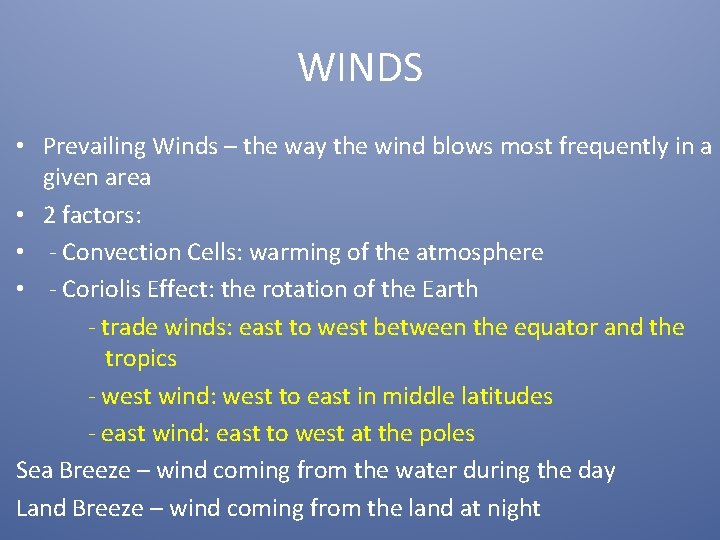
WINDS • Prevailing Winds – the way the wind blows most frequently in a given area • 2 factors: • - Convection Cells: warming of the atmosphere • - Coriolis Effect: the rotation of the Earth - trade winds: east to west between the equator and the tropics - west wind: west to east in middle latitudes - east wind: east to west at the poles Sea Breeze – wind coming from the water during the day Land Breeze – wind coming from the land at night
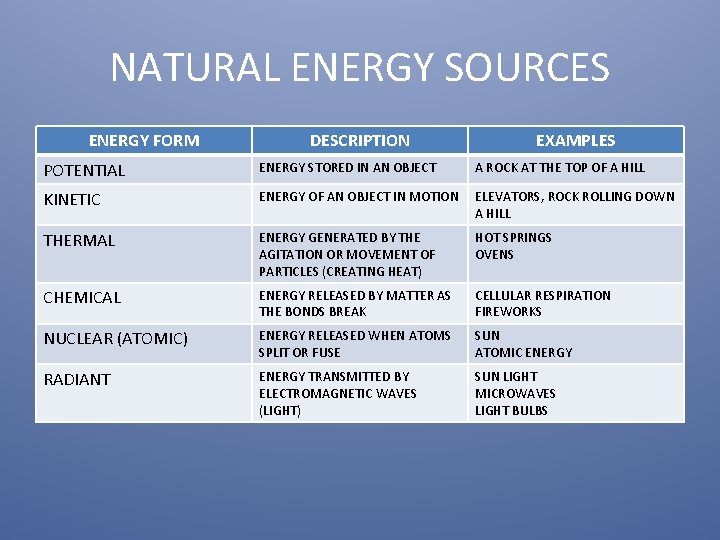
NATURAL ENERGY SOURCES ENERGY FORM DESCRIPTION EXAMPLES POTENTIAL ENERGY STORED IN AN OBJECT A ROCK AT THE TOP OF A HILL KINETIC ENERGY OF AN OBJECT IN MOTION ELEVATORS, ROCK ROLLING DOWN A HILL THERMAL ENERGY GENERATED BY THE AGITATION OR MOVEMENT OF PARTICLES (CREATING HEAT) HOT SPRINGS OVENS CHEMICAL ENERGY RELEASED BY MATTER AS THE BONDS BREAK CELLULAR RESPIRATION FIREWORKS NUCLEAR (ATOMIC) ENERGY RELEASED WHEN ATOMS SPLIT OR FUSE SUN ATOMIC ENERGY RADIANT ENERGY TRANSMITTED BY ELECTROMAGNETIC WAVES (LIGHT) SUN LIGHT MICROWAVES LIGHT BULBS
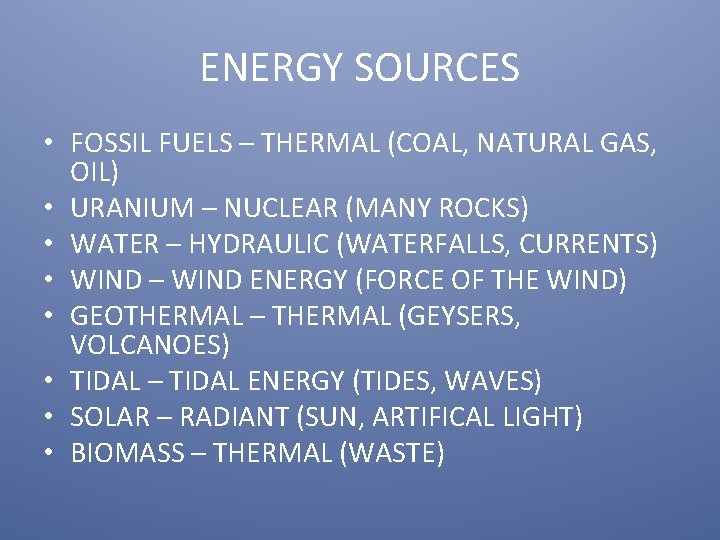
ENERGY SOURCES • FOSSIL FUELS – THERMAL (COAL, NATURAL GAS, OIL) • URANIUM – NUCLEAR (MANY ROCKS) • WATER – HYDRAULIC (WATERFALLS, CURRENTS) • WIND – WIND ENERGY (FORCE OF THE WIND) • GEOTHERMAL – THERMAL (GEYSERS, VOLCANOES) • TIDAL – TIDAL ENERGY (TIDES, WAVES) • SOLAR – RADIANT (SUN, ARTIFICAL LIGHT) • BIOMASS – THERMAL (WASTE)
RENEWABLE ENERGY RESOURCES WATER TIDAL WIND SOLAR GEOTHERMAL BIOMASS ADVANTAGES: - OFTEN REUSABLE, UNLLIMITED SUPPLY, OFTEN CLEAN or NON POLLUTING DISADVANTAGES: - EXPENSIVE, NOT EASY TO HARNESS