
Geologic Time M Dubar 8 th Grade Science
Geologic Time M. Dubar 8 th Grade Science EGMMS
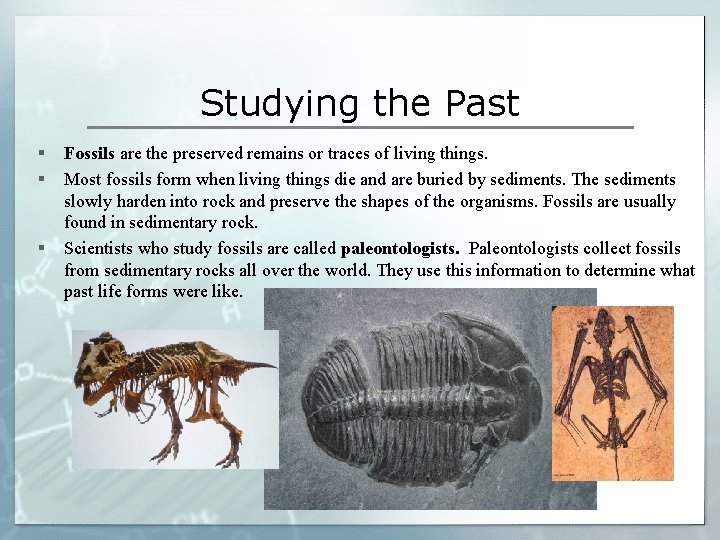
Studying the Past § § § Fossils are the preserved remains or traces of living things. Most fossils form when living things die and are buried by sediments. The sediments slowly harden into rock and preserve the shapes of the organisms. Fossils are usually found in sedimentary rock. Scientists who study fossils are called paleontologists. Paleontologists collect fossils from sedimentary rocks all over the world. They use this information to determine what past life forms were like.
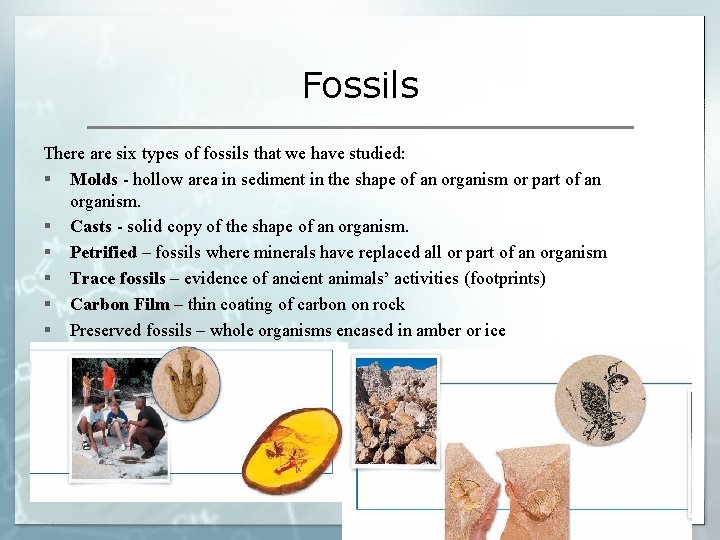
Fossils There are six types of fossils that we have studied: § Molds - hollow area in sediment in the shape of an organism or part of an organism. § Casts - solid copy of the shape of an organism. § Petrified – fossils where minerals have replaced all or part of an organism § Trace fossils – evidence of ancient animals’ activities (footprints) § Carbon Film – thin coating of carbon on rock § Preserved fossils – whole organisms encased in amber or ice
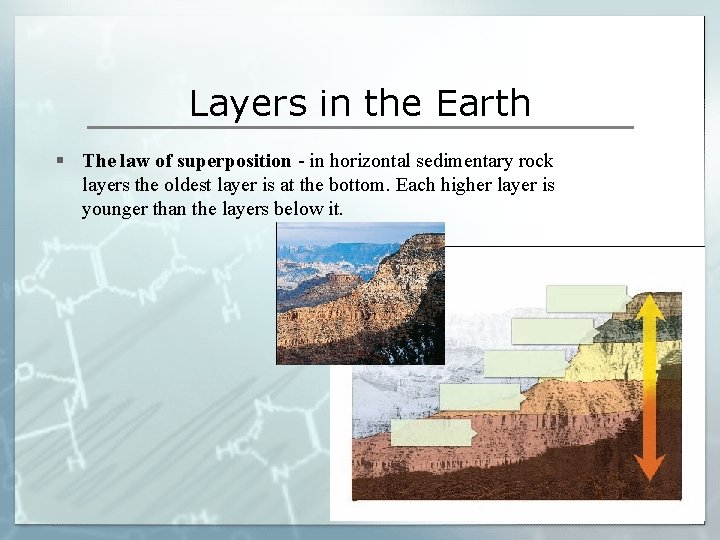
Layers in the Earth § The law of superposition - in horizontal sedimentary rock layers the oldest layer is at the bottom. Each higher layer is younger than the layers below it.
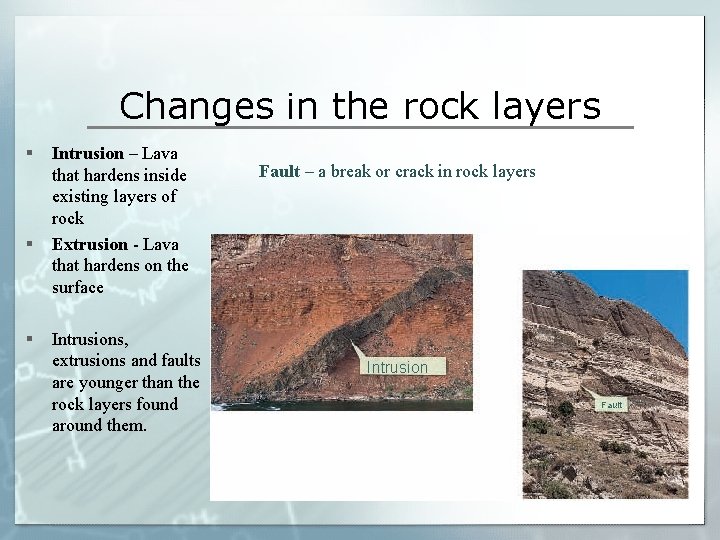
Changes in the rock layers § § § Intrusion – Lava that hardens inside existing layers of rock Extrusion - Lava that hardens on the surface Intrusions, extrusions and faults are younger than the rock layers found around them. Fault – a break or crack in rock layers Intrusion Fault
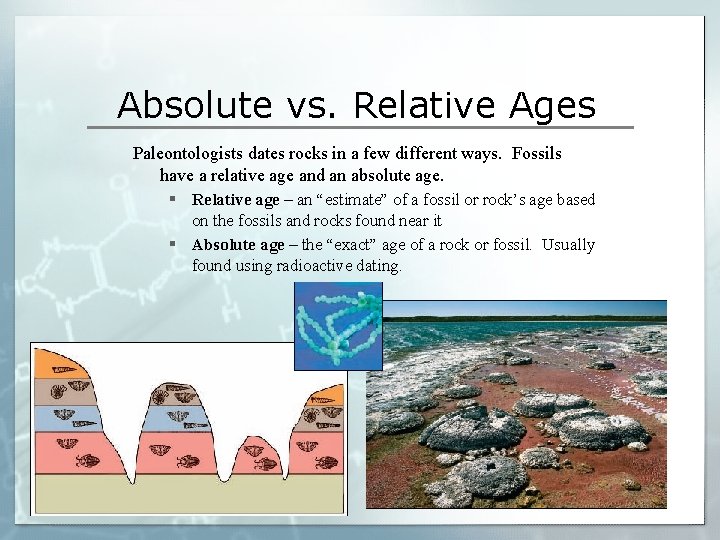
Absolute vs. Relative Ages Paleontologists dates rocks in a few different ways. Fossils have a relative age and an absolute age. § Relative age – an “estimate” of a fossil or rock’s age based on the fossils and rocks found near it § Absolute age – the “exact” age of a rock or fossil. Usually found using radioactive dating.
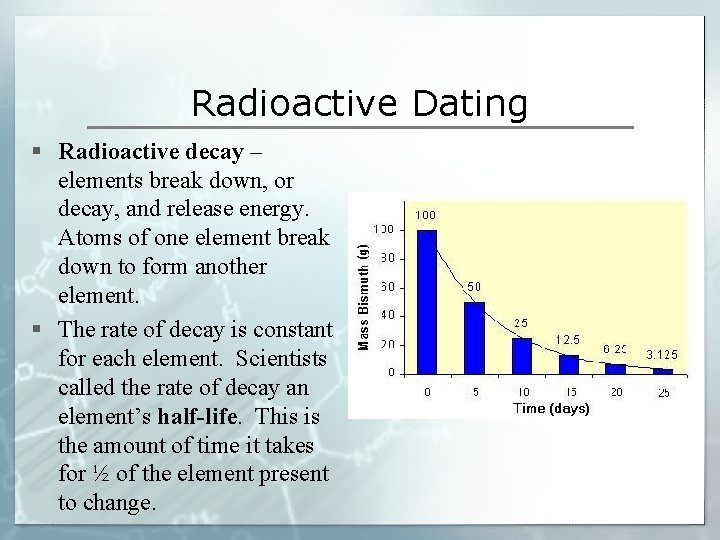
Radioactive Dating § Radioactive decay – elements break down, or decay, and release energy. Atoms of one element break down to form another element. § The rate of decay is constant for each element. Scientists called the rate of decay an element’s half-life. This is the amount of time it takes for ½ of the element present to change.
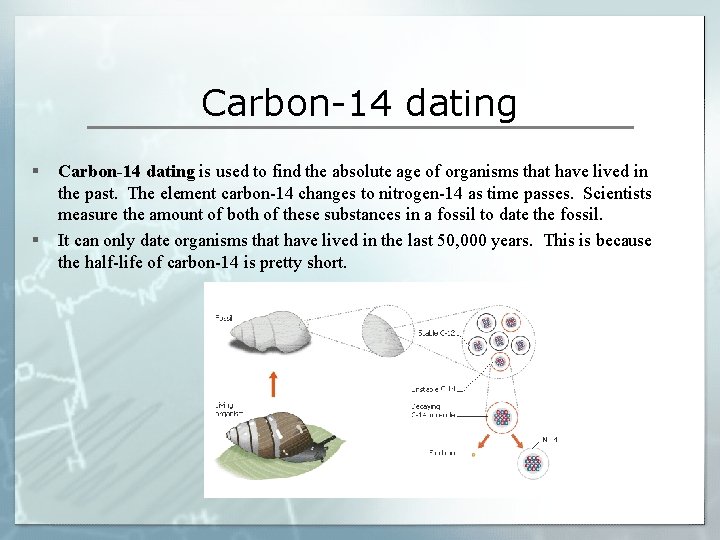
Carbon-14 dating § § Carbon-14 dating is used to find the absolute age of organisms that have lived in the past. The element carbon-14 changes to nitrogen-14 as time passes. Scientists measure the amount of both of these substances in a fossil to date the fossil. It can only date organisms that have lived in the last 50, 000 years. This is because the half-life of carbon-14 is pretty short.
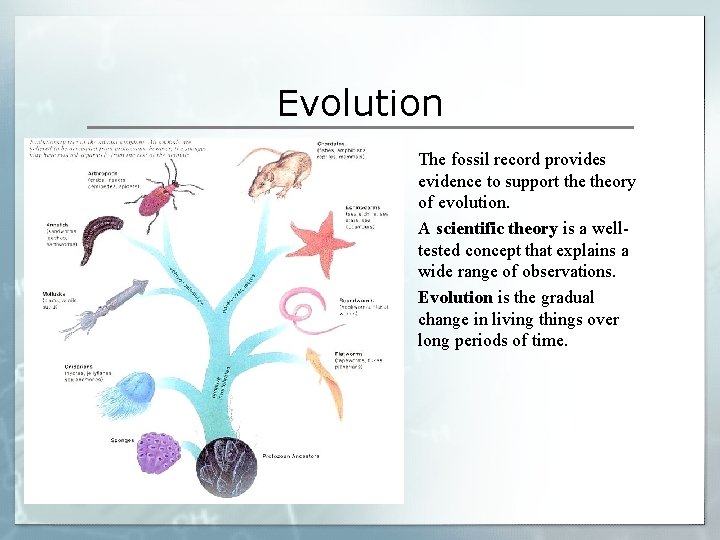
Evolution § § § The fossil record provides evidence to support theory of evolution. A scientific theory is a welltested concept that explains a wide range of observations. Evolution is the gradual change in living things over long periods of time.
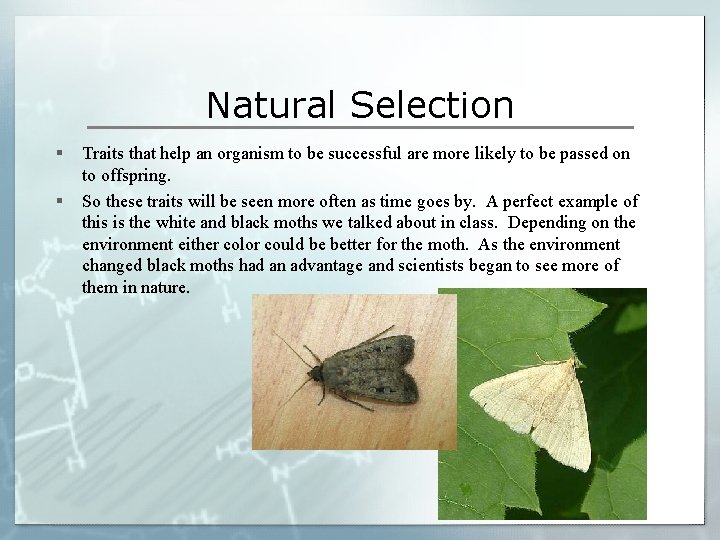
Natural Selection § § Traits that help an organism to be successful are more likely to be passed on to offspring. So these traits will be seen more often as time goes by. A perfect example of this is the white and black moths we talked about in class. Depending on the environment either color could be better for the moth. As the environment changed black moths had an advantage and scientists began to see more of them in nature.
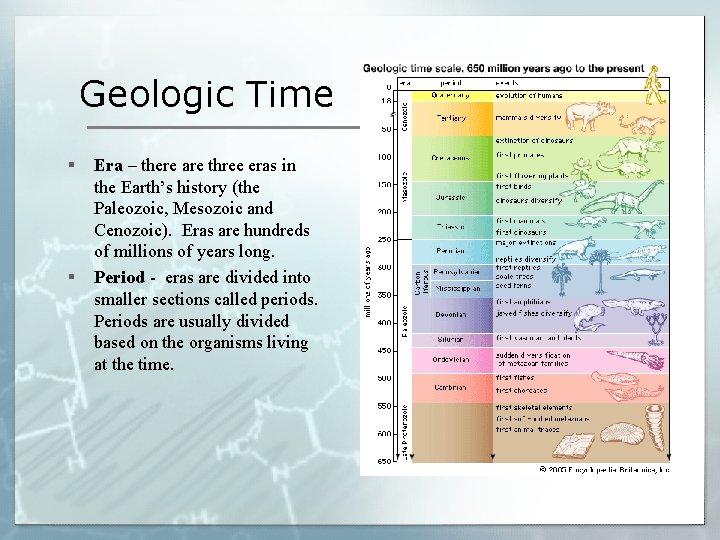
Geologic Time § § Era – there are three eras in the Earth’s history (the Paleozoic, Mesozoic and Cenozoic). Eras are hundreds of millions of years long. Period - eras are divided into smaller sections called periods. Periods are usually divided based on the organisms living at the time.
- Slides: 11