
GEOL 3400 Geologic Hazards Volcanic Explosivity Index VEI
- Slides: 13
GEOL 3400: Geologic Hazards Volcanic Explosivity Index (VEI)
Volcanic Hazards: VEI GEOL 3400: Geologic Hazards Introduction • the size of an eruption can vary depending upon the experience and position of the individual observing the eruption – no measure such as magnitude like there is for earthquakes • physical parameters that could be used to rank the size of an eruption quantitatively include: – height of the eruptive cloud – volume of eruptive material – distances objects of fixed size are thrown – explosive energy as registered by an atmospheric shock wave • to be useful, any scheme devised to rank eruptions must be applicable to past eruptions as well 01 -Sep-21 2
Volcanic Hazards: VEI Introduction GEOL 3400: Geologic Hazards • another problem is nature of eruptions: – effusive: non-explosive eruption of lava from a vent – explosive: material blasted from vent in large volcanic explosion • eruptions also have different durations and volcanic products 01 -Sep-21 3
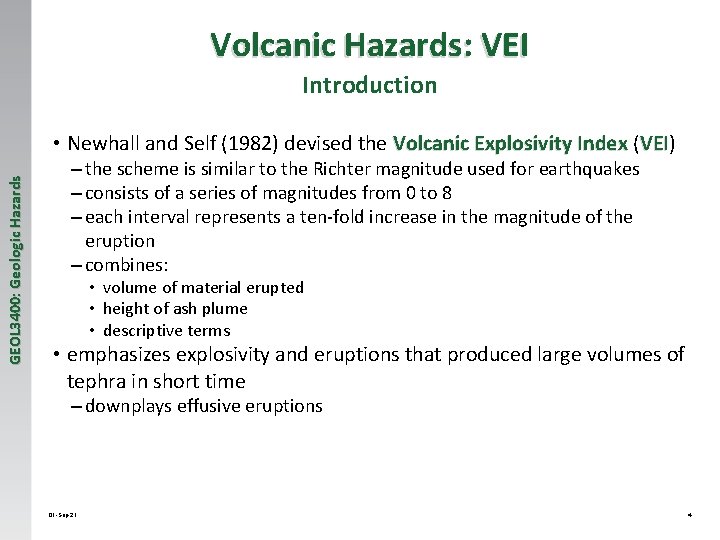
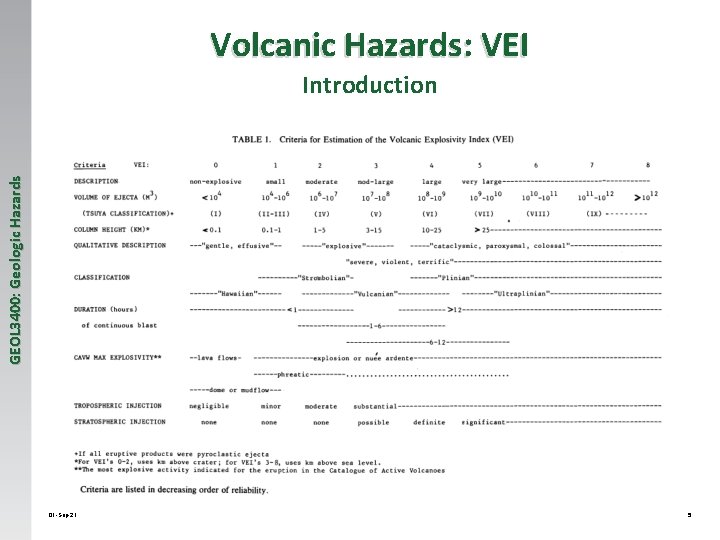
Volcanic Hazards: VEI Introduction GEOL 3400: Geologic Hazards • Newhall and Self (1982) devised the Volcanic Explosivity Index (VEI VEI) – the scheme is similar to the Richter magnitude used for earthquakes – consists of a series of magnitudes from 0 to 8 – each interval represents a ten-fold increase in the magnitude of the eruption – combines: • volume of material erupted • height of ash plume • descriptive terms • emphasizes explosivity and eruptions that produced large volumes of tephra in short time – downplays effusive eruptions 01 -Sep-21 4
Volcanic Hazards: VEI GEOL 3400: Geologic Hazards Introduction 01 -Sep-21 5
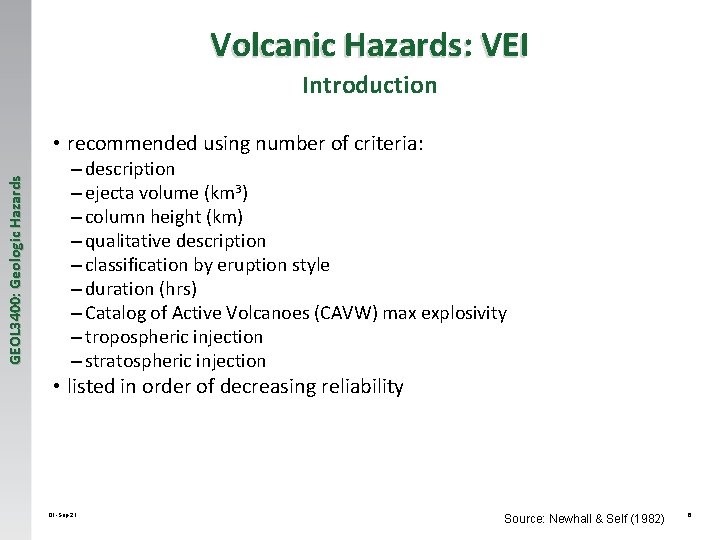
Volcanic Hazards: VEI Introduction GEOL 3400: Geologic Hazards • recommended using number of criteria: – description – ejecta volume (km 3) – column height (km) – qualitative description – classification by eruption style – duration (hrs) – Catalog of Active Volcanoes (CAVW) max explosivity – tropospheric injection – stratospheric injection • listed in order of decreasing reliability 01 -Sep-21 Source: Newhall & Self (1982) 6
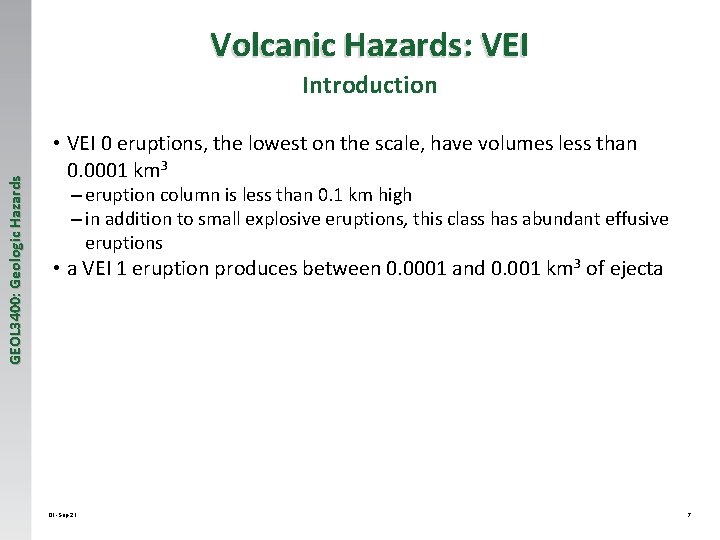
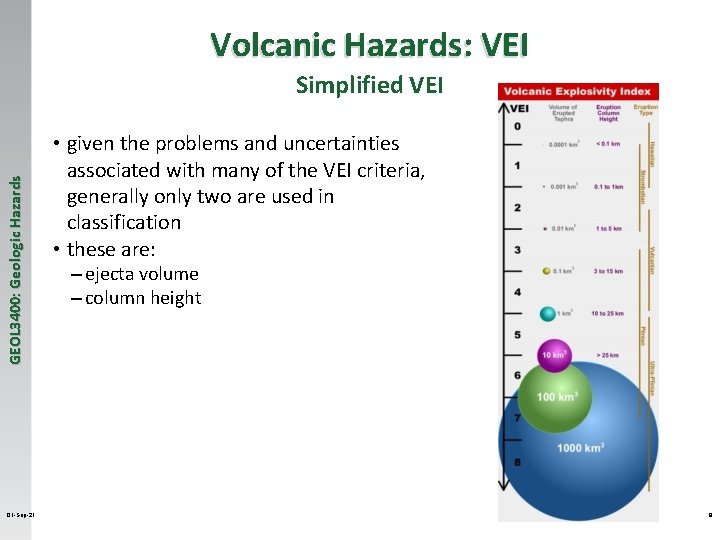
Volcanic Hazards: VEI GEOL 3400: Geologic Hazards Introduction • VEI 0 eruptions, the lowest on the scale, have volumes less than 0. 0001 km 3 – eruption column is less than 0. 1 km high – in addition to small explosive eruptions, this class has abundant effusive eruptions • a VEI 1 eruption produces between 0. 0001 and 0. 001 km 3 of ejecta 01 -Sep-21 7
Volcanic Hazards: VEI GEOL 3400: Geologic Hazards Introduction 01 -Sep-21 Source: Newhall & Self (1982) 8
Volcanic Hazards: VEI GEOL 3400: Geologic Hazards Simplified VEI 01 -Sep-21 • given the problems and uncertainties associated with many of the VEI criteria, generally only two are used in classification • these are: – ejecta volume – column height 9
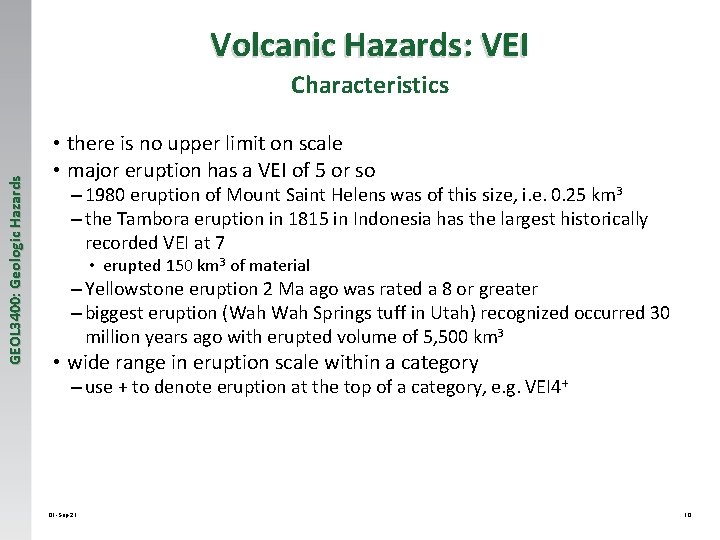
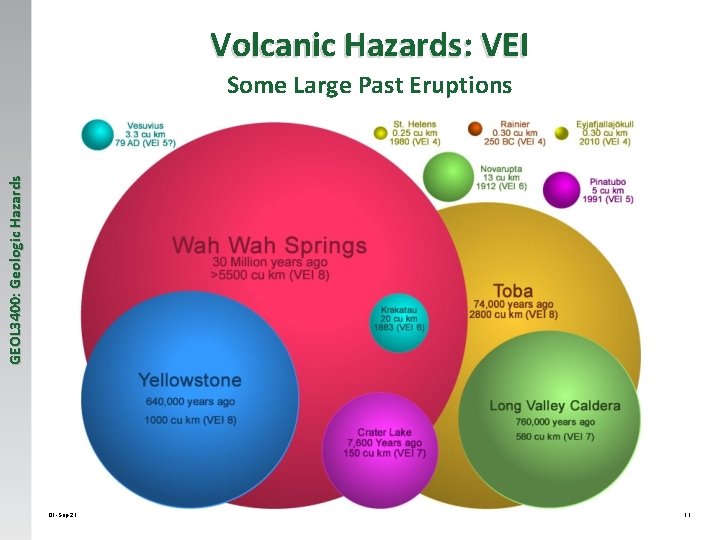
Volcanic Hazards: VEI GEOL 3400: Geologic Hazards Characteristics • there is no upper limit on scale • major eruption has a VEI of 5 or so – 1980 eruption of Mount Saint Helens was of this size, i. e. 0. 25 km 3 – the Tambora eruption in 1815 in Indonesia has the largest historically recorded VEI at 7 • erupted 150 km 3 of material – Yellowstone eruption 2 Ma ago was rated a 8 or greater – biggest eruption (Wah Springs tuff in Utah) recognized occurred 30 million years ago with erupted volume of 5, 500 km 3 • wide range in eruption scale within a category – use + to denote eruption at the top of a category, e. g. VEI 4+ 01 -Sep-21 10
Volcanic Hazards: VEI GEOL 3400: Geologic Hazards Some Large Past Eruptions 01 -Sep-21 11
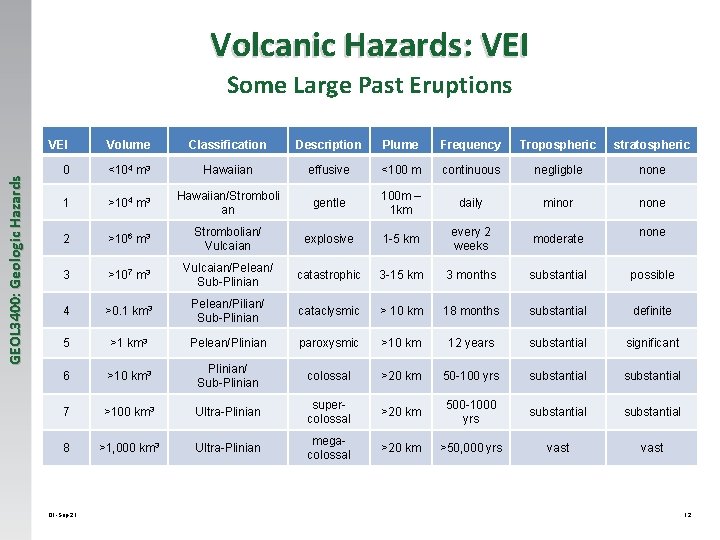
Volcanic Hazards: VEI GEOL 3400: Geologic Hazards Some Large Past Eruptions VEI Volume Classification Description Plume Frequency Tropospheric stratospheric 0 <104 m 3 Hawaiian effusive <100 m continuous negligble none 1 >104 m 3 Hawaiian/Stromboli an gentle 100 m – 1 km daily minor none 2 >106 m 3 Strombolian/ Vulcaian explosive 1 -5 km every 2 weeks moderate 3 >107 m 3 Vulcaian/Pelean/ Sub-Plinian catastrophic 3 -15 km 3 months substantial possible 4 >0. 1 km 3 Pelean/Pilian/ Sub-Plinian cataclysmic > 10 km 18 months substantial definite 5 >1 km 3 Pelean/Plinian paroxysmic >10 km 12 years substantial significant 6 >10 km 3 Plinian/ Sub-Plinian colossal >20 km 50 -100 yrs substantial 7 >100 km 3 Ultra-Plinian supercolossal >20 km 500 -1000 yrs substantial 8 >1, 000 km 3 Ultra-Plinian megacolossal >20 km >50, 000 yrs vast 01 -Sep-21 none 12
Volcanic Hazards: VEI GEOL 3400: Geologic Hazards Summary 01 -Sep-21 13