
Geoid and Geoid Change Discussion Topics Roger Haagmans
- Slides: 11
Geoid and Geoid Change: Discussion Topics Roger Haagmans, Boulder, 21 October 2009 1
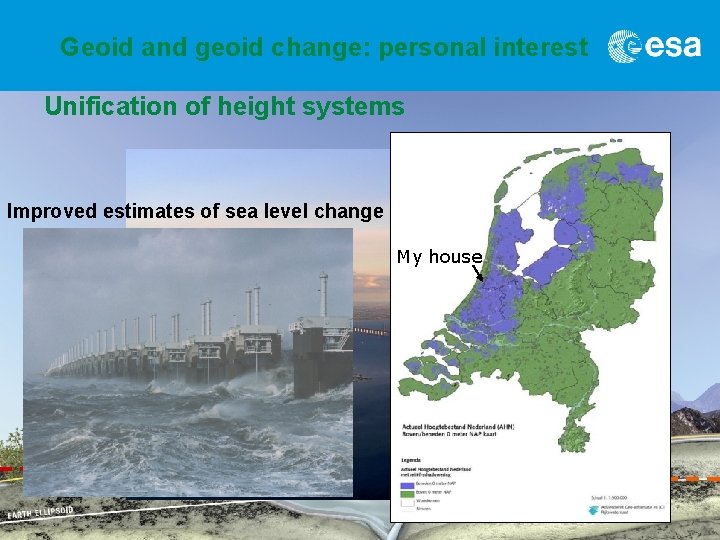
Geoid and geoid change: personal interest Unification of height systems Improved estimates of sea level change My house 2
Geoid and geoid change • Gravimetric geoid: definition equipotential surface • What about change? “GRACE”, future constellations and/or terrestrial gravity measure all changes that cause the equipotential to change in time: “all periods and all spatial scales” – Change in time wrt “static mean” choice should integrate to zero otherwise the Earth is growing/shrinking – For every epoch the mass redistributes regionally (e. g. land ice to sea) but the global integral is every time the same 3
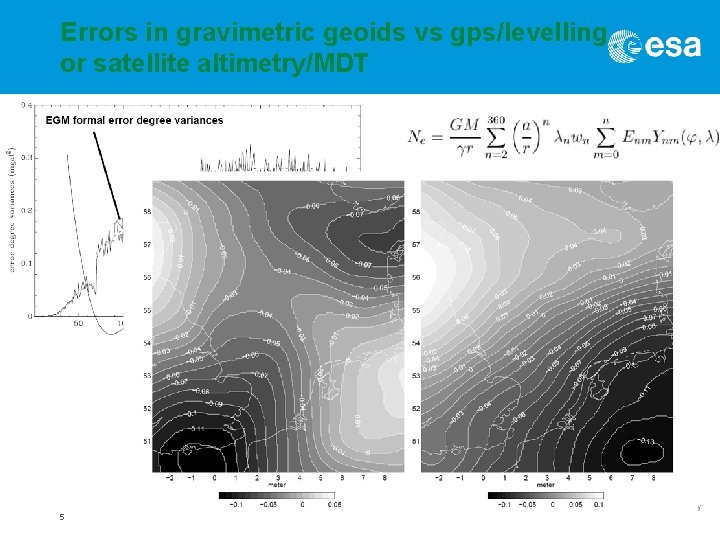
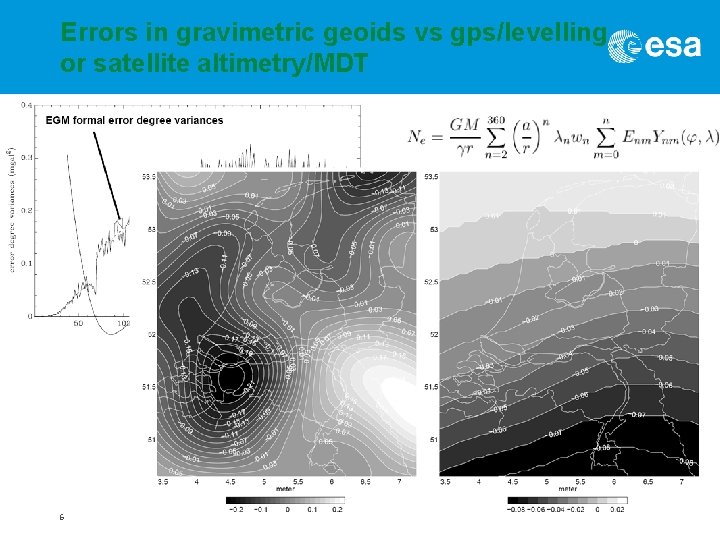
Current status “Static geoid” • Took years to arrive at present situation (gravity and auxiliary data (topography/density)) • Produce gravimetric geoid with sufficient weight for the local data (local data should determine the local to regional scales rather than a global model!!!) • Re-analysis of “higher” latitude satellite data residuals (GRACE + GOCE) for improving the geoid • carefully analyse error characteristics: also in comparison to GNSS & levelling and Altimetry & MDT 4
Errors in gravimetric geoids vs gps/levelling or satellite altimetry/MDT 5
Errors in gravimetric geoids vs gps/levelling or satellite altimetry/MDT 6
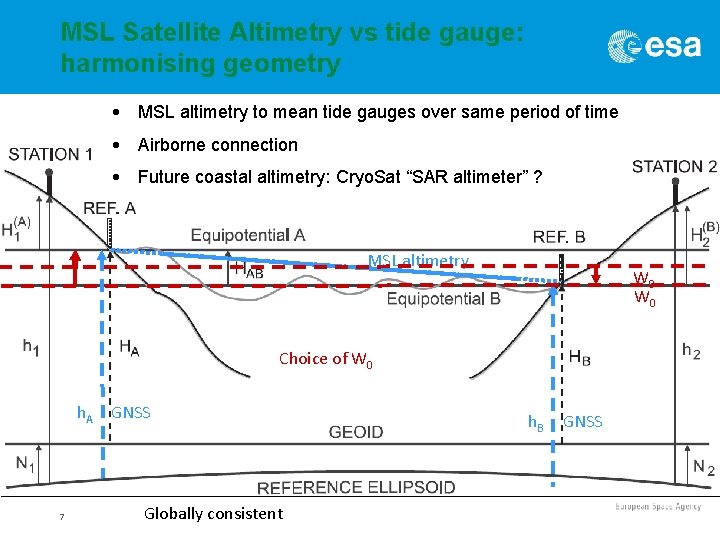
MSL Satellite Altimetry vs tide gauge: harmonising geometry • MSL altimetry to mean tide gauges over same period of time • Airborne connection • Future coastal altimetry: Cryo. Sat “SAR altimeter” ? MSL altimetry W 0 Choice of W 0 h. A GNSS 7 Globally consistent h. B GNSS
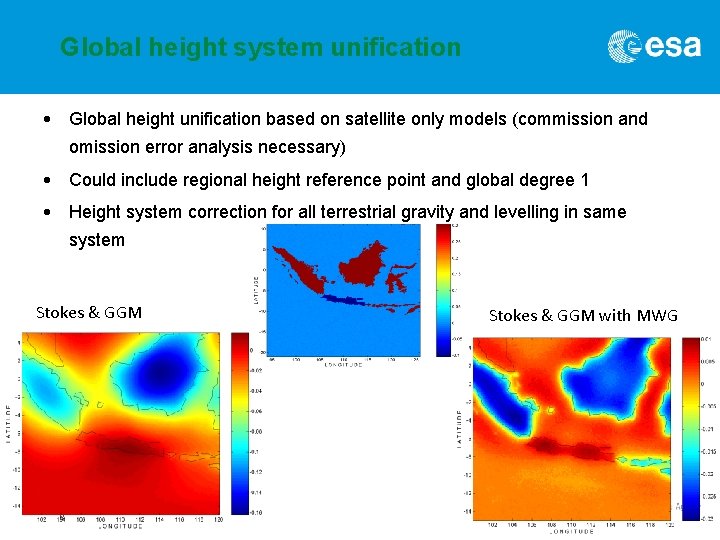
Global height system unification • Global height unification based on satellite only models (commission and omission error analysis necessary) • Could include regional height reference point and global degree 1 • Height system correction for all terrestrial gravity and levelling in same system Stokes & GGM 8 Stokes & GGM with MWG
Geoid change and surface change What does it mean to isolate a specific effect of the geoid change e. g. PGR & GIA? - incomplete according “definition” but maybe ok for application - accurate enough from satellite data or drowning in corrections errors/filters and noise (do we understand the error characteristics)? - accurate enough from ground data combination of geometry and gravity? - does equipotential change necessarily mean geometrical change (at ocean expansion from temperature!) ? 9
Geoid change and surface change - 2 effects on measurement: + geometric change in ΔH= Δh- ΔN over characteristic distance (if distance << phenomenon expected change in ΔH <<) + set up of instrument different (spirit level) following different local gravity vector as a consequence mass change (too inaccurate ? ) - tide gauges follow change as well: change in height reference point possible - Re-analyse levelling heights and keep certain benchmarks for validation purposes 10
Geoid change and surface change USER REQUIREMENTS: - Geoid definition: space-time validity with certain accuracy - GNSS based Levelling: regional requirements probably ok? - tide gauges/altimetry & height system unification: global requirements - put setup for North-America in global context (gravity changes from satellite missions relate to mass transport/re-distribution in the Earth System - difficult and unnecessary to try to isolate specific phenomena in first processing and data base – then tailor made product) - planning tools (with simulator capability) for future networks (used to be a strenght of geodesists) - do we need to define specs for future satellite missions (towards a continuous operational series ? 11