
Geography Year 7 Revision Pack Map Skills and
- Slides: 5
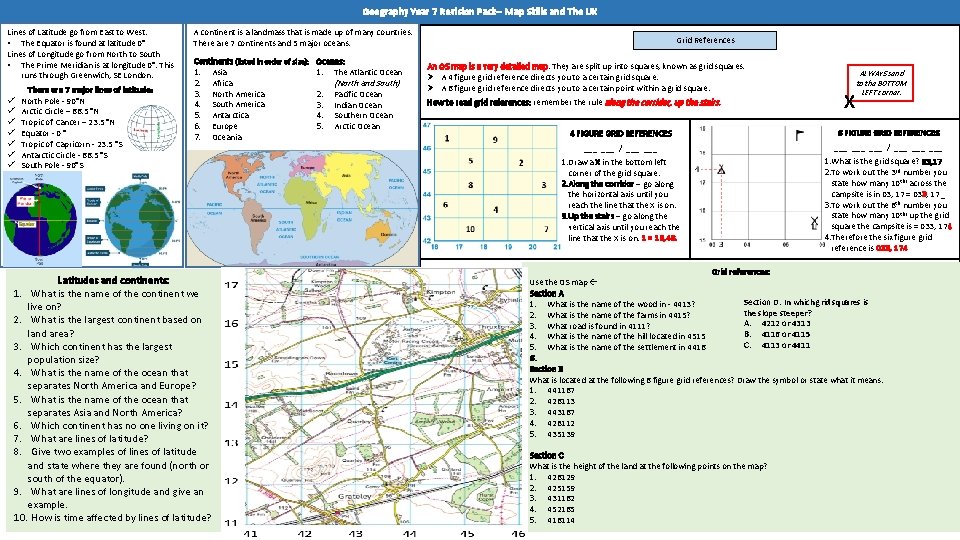
Geography Year 7 Revision Pack– Map Skills and The UK Lines of Latitude go from East to West. • The Equator is found at latitude 0° Lines of Longitude go from North to South • The Prime Meridian is at longitude 0°. This runs through Greenwich, SE London. ü ü ü ü There are 7 major lines of latitude: North Pole 90°N Arctic Circle – 66. 5 °N Tropic of Cancer – 23. 5 °N Equator 0 ° Tropic of Capricorn 23. 5 °S Antarctic Circle 66. 5 °S South Pole 90°S A continent is a landmass that is made up of many countries. There are 7 continents and 5 major oceans. Continents (listed in order of size): 1. Asia 2. Africa 3. North America 4. South America 5. Antarctica 6. Europe 7. Oceania Latitudes and continents: 1. What is the name of the continent we live on? 2. What is the largest continent based on land area? 3. Which continent has the largest population size? 4. What is the name of the ocean that separates North America and Europe? 5. What is the name of the ocean that separates Asia and North America? 6. Which continent has no one living on it? 7. What are lines of latitude? 8. Give two examples of lines of latitude and state where they are found (north or south of the equator). 9. What are lines of longitude and give an example. 10. How is time affected by lines of latitude? Oceans: 1. The Atlantic Ocean 2. 3. 4. 5. (North and South) Pacific Ocean Indian Ocean Southern Ocean Arctic Ocean Grid References An OS map is a very detailed map. They are split up into squares, known as grid squares. Ø A 4 figure grid reference directs you to a certain grid square. Ø A 6 figure grid reference directs you to a certain point within a grid square. How to read grid references: remember the rule along the corridor, up the stairs. X ALWAYS send to the BOTTOM LEFT corner. 4 FIGURE GRID REFERENCES 6 FIGURE GRID REFERENCES ___ ___ / ___ ___ ___ 1. What is the grid square? 03, 17 2. To work out the 3 rd number you 1. Draw a X in the bottom left corner of the grid square. 2. Along the corridor – go along the horizontal axis until you reach the line that the X is on. 3. Up the stairs – go along the vertical axis until you reach the line that the X is on. 1 = 16, 46. Use the OS map Section A 1. What is the name of the wood in 4413? 2. What is the name of the farms in 4415? 3. What road is found in 4111? 4. What is the name of the hill located in 4515 5. What is the name of the settlement in 4416 state how many 10 ths across the campsite is in 03, 17 = 033, 17 _ 3. To work out the 6 th number you state how many 10 ths up the grid square the campsite is = 033, 174 4. Therefore the six figure grid reference is 033, 174 Grid references: Section D: In which grid squares is the slope steeper? A. 4212 or 4313 B. 4116 or 4115 C. 4113 or 4411 6. Section B What is located at the following 6 figure grid references? Draw the symbol or state what it means. 1. 441167 2. 426113 3. 443167 4. 428112 5. 435139 Section C What is the height of the land at the following points on the map? 1. 426129 2. 425159 3. 431162 4. 452165 5. 416114
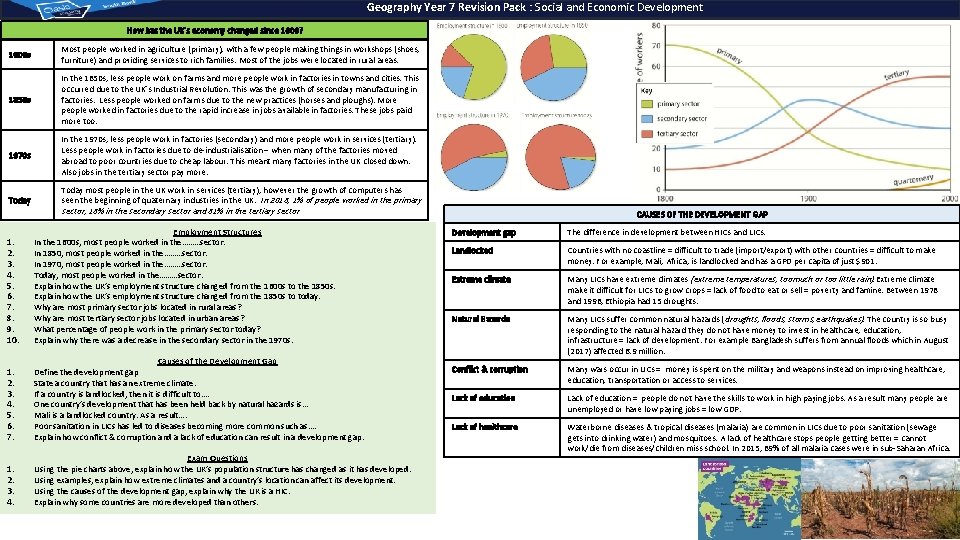
Geography Year 7 Revision Pack : Social and Economic Development How has the UK’s economy changed since 1600? 1600 s Most people worked in agriculture (primary), with a few people making things in workshops (shoes, furniture) and providing services to rich families. Most of the jobs were located in rural areas. 1850 s In the 1850 s, less people work on farms and more people work in factories in towns and cities. This occurred due to the UK’s Industrial Revolution. This was the growth of secondary manufacturing in factories. Less people worked on farms due to the new practices (horses and ploughs). More people worked in factories due to the rapid increase in jobs available in factories. These jobs paid more too. 1970 s In the 1970 s, less people work in factories (secondary) and more people work in services (tertiary). Less people work in factories due to de industrialisation – when many of the factories moved abroad to poor countries due to cheap labour. This meant many factories in the UK closed down. Also jobs in the tertiary sector pay more. Today most people in the UK work in services (tertiary), however the growth of computers has seen the beginning of quaternary industries in the UK. In 2018, 1% of people worked in the primary sector, 18% in the secondary sector and 81% in the tertiary sector 1. 2. 3. 4. 5. 6. 7. 8. 9. 10. Employment Structures In the 1600 s, most people worked in the………sector. In 1850, most people worked in the………sector. In 1970, most people worked in the………sector. Today, most people worked in the………sector. Explain how the UK’s employment structure changed from the 1600 s to the 1850 s. Explain how the UK’s employment structure changed from the 1850 s to today. Why are most primary sector jobs located in rural areas? Why are most tertiary sector jobs located in urban areas? What percentage of people work in the primary sector today? Explain why there was a decrease in the secondary sector in the 1970 s. 1. 2. 3. 4. 5. 6. 7. Causes of the Development Gap Define the development gap State a country that has an extreme climate. If a country is landlocked, then it is difficult to…. One country’s development that has been held back by natural hazards is… Mali is a landlocked country. As a result…. Poor sanitation in LICs has led to diseases becoming more common such as…. Explain how conflict & corruption and a lack of education can result in a development gap. 1. 2. 3. 4. Exam Questions Using the pie charts above, explain how the UK’s population structure has changed as it has developed. Using examples, explain how extreme climates and a country’s location can affect its development. Using the causes of the development gap, explain why the UK is a HIC. Explain why some countries are more developed than others. CAUSES OF THE DEVELOPMENT GAP Development gap The difference in development between HICs and LICs. Landlocked Countries with no coastline = difficult to trade (import/export) with other countries = difficult to make money. For example, Mali, Africa, is landlocked and has a GPD per capita of just $901. Extreme climate Many LICs have extreme climates (extreme temperatures, toomuch or too little rain). Extreme climate make it difficult for LICs to grow crops = lack of food to eat or sell = poverty and famine. Between 1978 and 1998, Ethiopia had 15 droughts. Natural Hazards Many LICs suffer common natural hazards ( droughts, floods, storms, earthquakes). The country is so busy responding to the natural hazard they do not have money to invest in healthcare, education, infrastructure = lack of development. For example Bangladesh suffers from annual floods which in August (2017) affected 6. 9 million. Conflict & corruption Many wars occur in LICs = money is spent on the military and weapons instead on improving healthcare, education, transportation or access to services. Lack of education = people do not have the skills to work in high paying jobs. As a result many people are unemployed or have low paying jobs = low GDP. Lack of healthcare Waterborne diseases & tropical diseases (malaria) are common in LICs due to poor sanitation (sewage gets into drinking water) and mosquitoes. A lack of healthcare stops people getting better = cannot work/die from diseases/children miss school. In 2015, 89% of all malaria cases were in sub Saharan Africa.
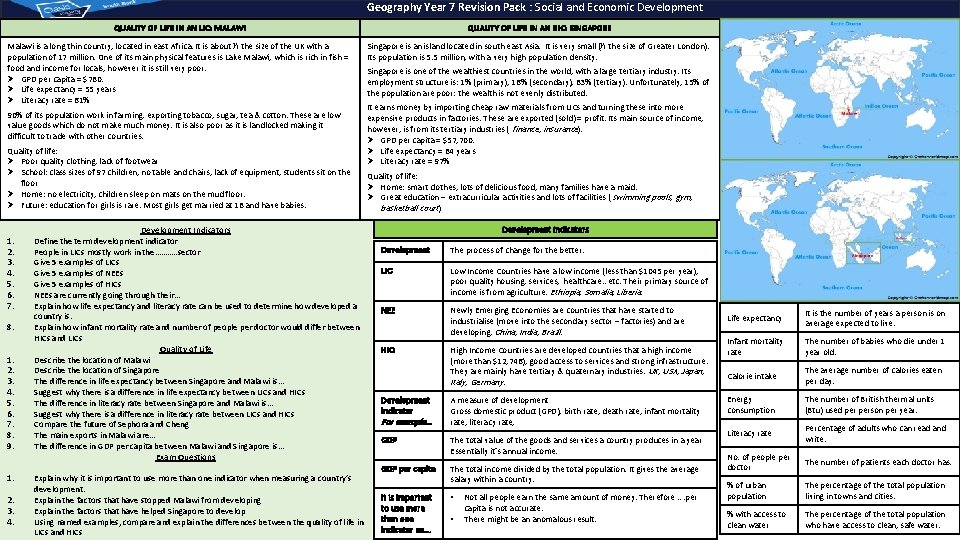
Geography Year 7 Revision Pack : Social and Economic Development QUALITY OF LIFE IN AN LIC: MALAWI QUALITY OF LIFE IN AN HIC: SINGAPORE Malawi is a long thin country, located in east Africa. It is about ½ the size of the UK with a population of 17 million. One of its main physical features is Lake Malawi, which is rich in fish = food and income for locals, however it is still very poor. Ø GPD per capita = $780. Ø Life expectancy = 55 years Ø Literacy rate = 61% Singapore is an island located in south east Asia. It is very small (½ the size of Greater London). Its population is 5. 5 million, with a very high population density. 90% of its population work in farming, exporting tobacco, sugar, tea & cotton. These are low value goods which do not make much money. It is also poor as it is landlocked making it difficult to trade with other countries. Quality of life: Ø Poor quality clothing, lack of footwear Ø School: class sizes of 97 children, no table and chairs, lack of equipment, students sit on the floor Ø Home: no electricity, children sleep on mats on the mud floor. Ø Future: education for girls is rare. Most girls get married at 18 and have babies. 1. 2. 3. 4. 5. 6. 7. 8. 9. 1. 2. 3. 4. Development Indicators Define the term development indicator People in LICs mostly work in the………. . sector Give 5 examples of LICs Give 5 examples of NEEs Give 5 examples of HICs NEEs are currently going through their… Explain how life expectancy and literacy rate can be used to determine how developed a country is. Explain how infant mortality rate and number of people per doctor would differ between HICs and LICs Quality of Life Describe the location of Malawi Describe the location of Singapore The difference in life expectancy between Singapore and Malawi is… Suggest why there is a difference in life expectancy between LICs and HICs The difference in literacy rate between Singapore and Malawi is… Suggest why there is a difference in literacy rate between LICs and HICs Compare the future of Sephora and Cheng The main exports in Malawi are… The difference in GDP per capita between Malawi and Singapore is… Exam Questions Explain why it is important to use more than one indicator when measuring a country’s development. Explain the factors that have stopped Malawi from developing Explain the factors that have helped Singapore to develop Using named examples, compare and explain the differences between the quality of life in LICs and HICs Singapore is one of the wealthiest countries in the world, with a large tertiary industry. Its employment structure is: 1% (primary), 16% (secondary), 83% (tertiary). Unfortunately, 15% of the population are poor: the wealth is not evenly distributed. It earns money by importing cheap raw materials from LICs and turning these into more expensive products in factories. These are exported (sold) = profit. Its main source of income, however, is from its tertiary industries ( finance, insurance). Ø GPD per capita = $57, 700. Ø Life expectancy = 84 years Ø Literacy rate = 97% Quality of life: Ø Home: smart clothes, lots of delicious food, many families have a maid. Ø Great education – extracurricular activities and lots of facilities ( swimming pools, gym, basketball court) Development Indicators Development The process of change for the better. LIC Low Income Countries have a low income (less than $1045 per year), poor quality housing, services, healthcare…etc. Their primary source of income is from agriculture. Ethiopia, Somalia, Liberia. NEE Newly Emerging Economies are countries that have started to industrialise (move into the secondary sector – factories) and are developing. China, India, Brazil. HIC High Income Countries are developed countries that a high income (more than $12, 746), good access to services and strong infrastructure. They are mainly have tertiary & quaternary industries. UK, USA, Japan, Italy, Germany. Development indicator A measure of development Gross domestic product (GPD), birth rate, death rate, infant mortality rate, literacy rate, GDP The total value of the goods and services a country produces in a year Essentially it’s annual income. GDP per capita The total income divided by the total population. It gives the average salary within a country. It is important to use more than one indicator as…. • For example… • Not all people earn the same amount of money. Therefore …. per capita is not accurate. There might be an anomalous result. Life expectancy It is the number of years a person is on average expected to live. Infant mortality rate The number of babies who die under 1 year old. Calorie intake The average number of calories eaten per day. Energy consumption The number of British thermal units (Btu) used person per year. Literacy rate Percentage of adults who can read and write. No. of people per doctor The number of patients each doctor has. % of urban population The percentage of the total population living in towns and cities. % with access to clean water The percentage of the total population who have access to clean, safe water.
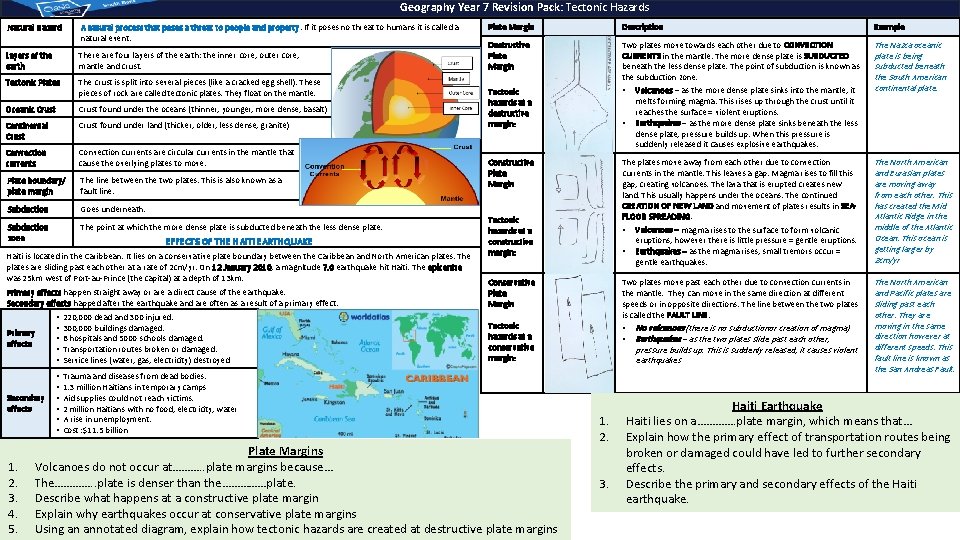
Geography Year 7 Revision Pack: Tectonic Hazards Natural Hazard A natural process that poses a threat to people and property. If it poses no threat to humans it is called a natural event. Layers of the earth There are four layers of the earth: the inner core, outer core, mantle and crust. Tectonic Plates The crust is split into several pieces (like a cracked egg shell). These pieces of rock are called tectonic plates. They float on the mantle. Oceanic Crust found under the oceans (thinner, younger, more dense, basalt) Continental Crust found under land (thicker, older, less dense, granite) Convection currents are circular currents in the mantle that cause the overlying plates to move. Plate boundary/ plate margin The line between the two plates. This is also known as a fault line. Subduction Goes underneath. Subduction zone The point at which the more dense plate is subducted beneath the less dense plate. EFFECTS OF THE HAITI EARTHQUAKE Haiti is located in the Caribbean. It lies on a conservative plate boundary between the Caribbean and North American plates. The plates are sliding past each other at a rate of 2 cm/yr. On 12 January 2010, a magnitude 7. 0 earthquake hit Haiti. The epicentre was 25 km west of Port au Prince (the capital) at a depth of 13 km. Primary effects happen straight away or are a direct cause of the earthquake. Secondary effects happed after the earthquake and are often as a result of a primary effect. Primary effects • • • 220, 000 dead and 300 injured. 300, 000 buildings damaged. 8 hospitals and 5000 schools damaged. Transportation routes broken or damaged. Service lines (water, gas, electricity) destroyed Secondary effects • • • Trauma and diseases from dead bodies. 1. 3 million Haitians in temporary camps Aid supplies could not reach victims. 2 million Haitians with no food, electricity, water A rise in unemployment. Cost : $11. 5 billion 1. 2. 3. 4. 5. Plate Margin Description Example Destructive Plate Margin Two plates move towards each other due to CONVECTION CURRENTS in the mantle. The more dense plate is SUBDUCTED beneath the less dense plate. The point of subduction is known as the subduction zone. • Volcanoes – as the more dense plate sinks into the mantle, it melts forming magma. This rises up through the crust until it reaches the surface = violent eruptions. • Earthquakes – as the more dense plate sinks beneath the less dense plate, pressure builds up. When this pressure is suddenly released it causes explosive earthquakes. The Nazca oceanic plate is being subducted beneath the South American continental plate. The plates move away from each other due to convection currents in the mantle. This leaves a gap. Magma rises to fill this gap, creating volcanoes. The lava that is erupted creates new land. This usually happens under the oceans. The continued CREATION OF NEW LAND and movement of plates results in SEAFLOOR SPREADING. • Volcanoes – magma rises to the surface to form volcanic eruptions, however there is little pressure = gentle eruptions. • Earthquakes – as the magma rises, small tremors occur = gentle earthquakes. The North American and Eurasian plates are moving away from each other. This has created the Mid Atlantic Ridge in the middle of the Atlantic Ocean. This ocean is getting larger by 2 cm/yr Two plates move past each other due to convection currents in the mantle. They can move in the same direction at different speeds or in opposite directions. The line between the two plates is called the FAULT LINE. The North American and Pacific plates are sliding past each other. They are moving in the same direction however at different speeds. This fault line is known as the San Andreas Fault. Tectonic hazards at a destructive margin: Constructive Plate Margin Tectonic hazards at a constructive margin: Conservative Plate Margin Tectonic hazards at a conservative margin: Plate Margins Volcanoes do not occur at………. . plate margins because… The…………. . plate is denser than the……………plate. Describe what happens at a constructive plate margin Explain why earthquakes occur at conservative plate margins Using an annotated diagram, explain how tectonic hazards are created at destructive plate margins • • 1. 2. 3. No volcanoes (there is no subductionor creation of magma) Earthquakes – as the two plates slide past each other, pressure builds up. This is suddenly released, it causes violent earthquakes Haiti Earthquake Haiti lies on a…………. plate margin, which means that… Explain how the primary effect of transportation routes being broken or damaged could have led to further secondary effects. Describe the primary and secondary effects of the Haiti earthquake.
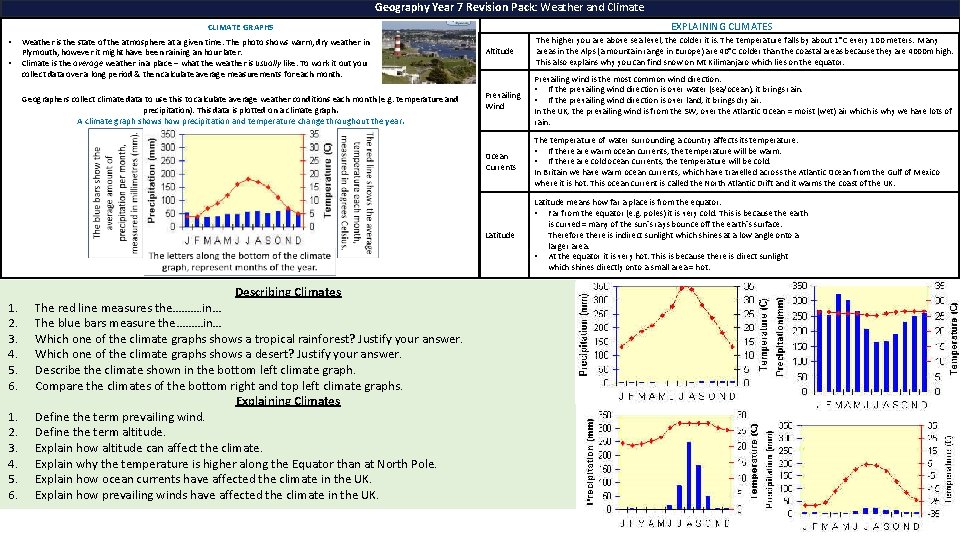
Geography Year 7 Revision Pack: Weather and Climate EXPLAINING CLIMATES CLIMATE GRAPHS • • Weather is the state of the atmosphere at a given time. The photo shows warm, dry weather in Plymouth, however it might have been raining an hour later. Climate is the average weather in a place – what the weather is usually like. To work it out you collect data over a long period & then calculate average measurements for each month. Geographers collect climate data to use this to calculate average weather conditions each month (e. g. temperature and precipitation). This data is plotted on a climate graph. A climate graph shows how precipitation and temperature change throughout the year. 1. 2. 3. 4. 5. 6. Describing Climates The red line measures the………. in… The blue bars measure the………in… Which one of the climate graphs shows a tropical rainforest? Justify your answer. Which one of the climate graphs shows a desert? Justify your answer. Describe the climate shown in the bottom left climate graph. Compare the climates of the bottom right and top left climate graphs. Explaining Climates Define the term prevailing wind. Define the term altitude. Explain how altitude can affect the climate. Explain why the temperature is higher along the Equator than at North Pole. Explain how ocean currents have affected the climate in the UK. Explain how prevailing winds have affected the climate in the UK. Altitude The higher you are above sea level, the colder it is. The temperature falls by about 1°C every 100 meters. Many areas in the Alps (a mountain range in Europe) are 40°C colder than the coastal areas because they are 4000 m high. This also explains why you can find snow on Mt Kilimanjaro which lies on the equator. Prevailing Wind Prevailing wind is the most common wind direction. • If the prevailing wind direction is over water (sea/ocean), it brings rain. • If the prevailing wind direction is over land, it brings dry air. In the UK, the prevailing wind is from the SW, over the Atlantic Ocean = moist (wet) air which is why we have lots of rain. Ocean Currents The temperature of water surrounding a country affects its temperature. • If there are warm ocean currents, the temperature will be warm. • If there are cold ocean currents, the temperature will be cold. In Britain we have warm ocean currents, which have travelled across the Atlantic Ocean from the Gulf of Mexico where it is hot. This ocean current is called the North Atlantic Drift and it warms the coast of the UK. Latitude means how far a place is from the equator. • Far from the equator (e. g. poles) it is very cold. This is because the earth is curved = many of the sun’s rays bounce off the earth’s surface. Therefore there is indirect sunlight which shines at a low angle onto a larger area. • At the equator it is very hot. This is because there is direct sunlight which shines directly onto a small area = hot.