
Geography of Water Part II Water Terminology Freshwater
- Slides: 6
Geography of Water, Part II
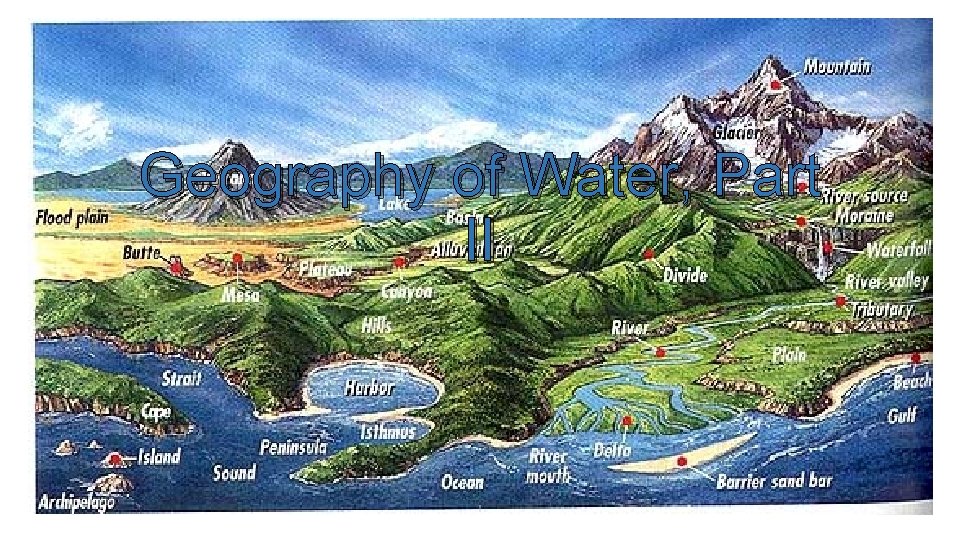
Water Terminology – “Freshwater” • Reservoir- a natural or artificial place where water is collected and stored for use, especially water for supplying a community, irrigating land, furnishing power, etc. • Lake- a body of fresh or salt water of considerable size, surrounded by land • Waterway- a river, canal, or other body of water serving as a route or way of travel or transport • Stream/Creek- a general term for a body of flowing water; natural water course containing water at least part of the year. In hydrology, it is generally applied to the water flowing in a natural channel as distinct from a canal • Storm drain- a sewer for carrying off rainfall drained from paved surfaces, roofs, etc • Aquifer- a geologic formation(s) that is water bearing. A geological formation or structure that stores and/or transmits water, such as to wells and springs. Use of the term is usually restricted to those water-bearing formations capable of yielding water in sufficient quantity to constitute a usable supply for people's uses • Artesian Water/Well- groundwater that is under pressure when tapped by a well and is able to rise above the level at which it is first encountered. • Freshwater- water that contains less than 1, 000 milligrams per liter (mg/L) of dissolved solids; generally, more than 500 mg/L of dissolved solids is undesirable for drinking and many industrial uses • Groundwater- water that flows or seeps downward and saturates soil or rock, supplying springs and wells. The upper surface of the saturate zone is called the water table. (2) Water stored underground in rock crevices and in the pores of geologic materials that make up the Earth's crust • River- A natural stream of water of considerable volume, larger than a brook or creek • Spring- a water body formed when the side of a hill, a valley bottom or other excavation intersects a flowing body of groundwater at or below the local water table, below which the subsurface material is saturated with water • Hot Spring- a thermal spring with water warmer than 98°F, usually heated by emanation or passage near hot or molten rock. • Geyser- a hot spring that intermittently sends up fountainlike jets of water and steam into the air.
Water Terminology – Marine/Features and Functions • Estuary- an arm or inlet of the sea at the lower end of a river • Cove- a small indentation or recess in the shoreline of a sea, lake, or river • Bay- a body of water forming an indentation of the shoreline, larger than a cove but smaller than a gulf (San Francisco Bay, actually an estuary • Gulf- a portion of an ocean or sea partly enclosed by land (Gulf of Mexico, Gulf of California) Sound- a relatively narrow passage of water between bodies of water or between the mainland an island (Long Island Sound) • Sound– • Channel- a wide strait, as between a continent and an island • Sea- the salt waters that cover the greater part of the earth's surface • Ocean- 1. the vast body of salt water that covers almost three fourths of the earth's surface. 2. any of the geographical divisions of this body, commonly given as the Atlantic, Pacific, Indian, Arctic, and Antarctic oceans. • Strait- A narrow waterway joining two larger bodies of water (Strait of Gibraltar, Strait of Hormuz) • Bight- 1. A bend or curve in the shore of a sea or river. 2. a body of water bounded by a bend. 3. a bay or gulf • Condensation- the process of water vapor in the air turning into liquid water. Water drops on the outside of a cold glass of water are condensed water. Condensation is the opposite process of evaporation • Evaporation- the process of liquid water becoming water vapor, including vaporization from water surfaces, land surfaces, and snow fields, but not from leaf surfaces • Transpiration- the passage of water through a plant from the roots through the vascular system to the atmosphere.
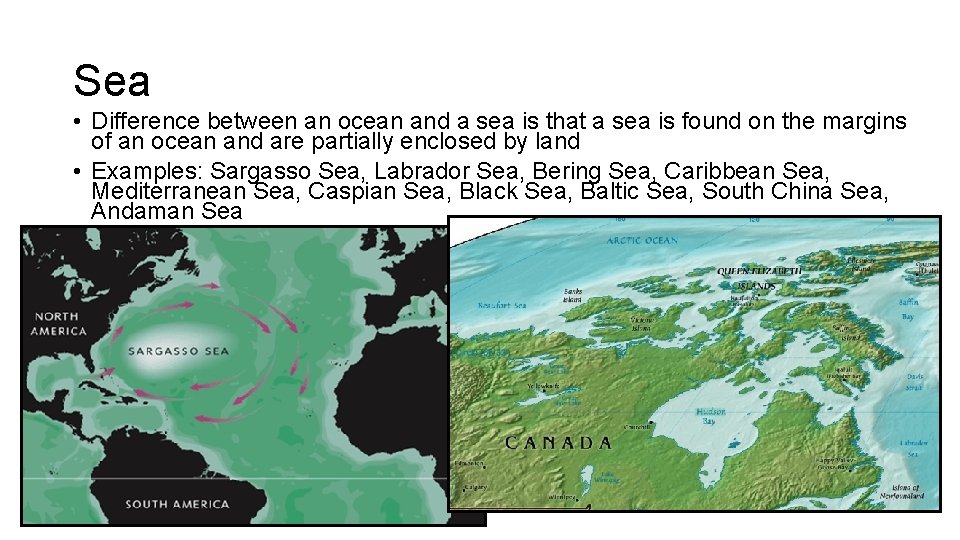
Sea • Difference between an ocean and a sea is that a sea is found on the margins of an ocean and are partially enclosed by land • Examples: Sargasso Sea, Labrador Sea, Bering Sea, Caribbean Sea, Mediterranean Sea, Caspian Sea, Black Sea, Baltic Sea, South China Sea, Andaman Sea
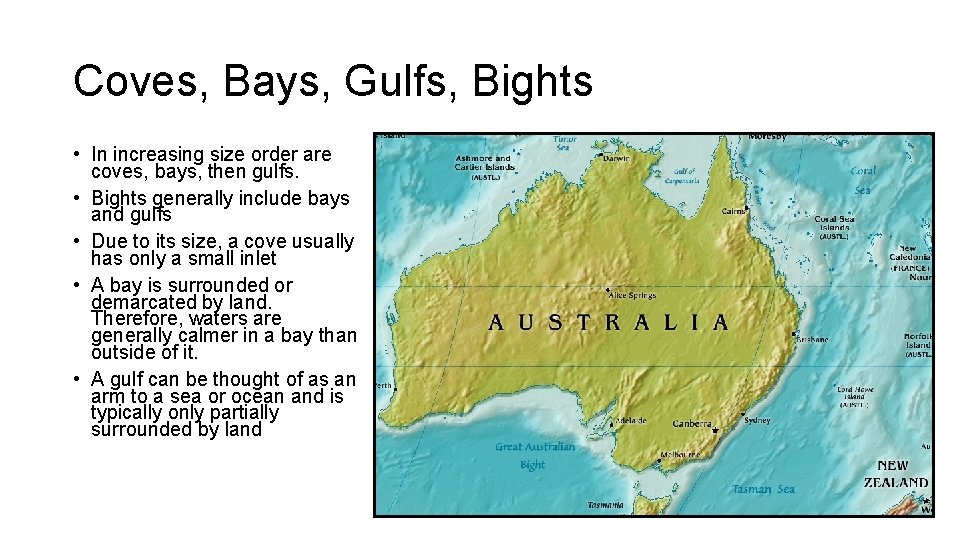
Coves, Bays, Gulfs, Bights • In increasing size order are coves, bays, then gulfs. • Bights generally include bays and gulfs • Due to its size, a cove usually has only a small inlet • A bay is surrounded or demarcated by land. Therefore, waters are generally calmer in a bay than outside of it. • A gulf can be thought of as an arm to a sea or ocean and is typically only partially surrounded by land
Water Facts • All water of Earth would make up a sphere 860 miles in diameter • The Earth’s total diameter of 7, 926 miles • The volume of the sphere of water would be 332. 5 million mi 3 (one mi 3 = about 1. 1 trillion gallons. So 332. 5 million mi 3 = 365, 750, 000, 000 gallons) • Total amount of water of Earth remains relatively the same; just the phase and quality changes • Water makes up 71% of the Earth’s surface • Oceans, seas, and bays account for 96. 5% of Earth’s water • Only 2% of all water is freshwater; 98% is saltwater • The average precipitation per day for the lower 48 states of the U. S. is 4. 4 trillion gallons