
Geography of Soils Current News Weather Soil Development



- Slides: 25
Geography of Soils • • Current News & Weather Soil Development and Soil Profiles Soil Characteristics Human Impact on Soils For Next Class: Read Chapter 19 © 2018 Pearson Education, Inc.
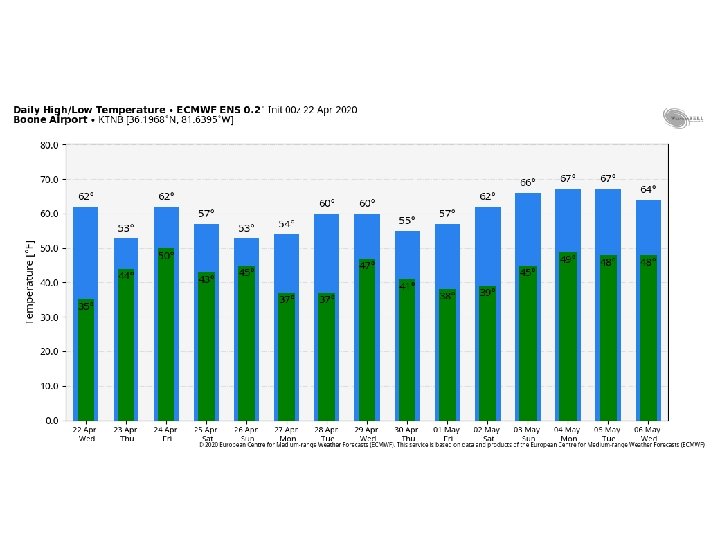
COVID-19 Coverage • https: //twitter. com/Laurie_Garrett? ref_src= twsrc%5 Egoogle%7 Ctwcamp%5 Eserp%7 Ctwgr%5 Eauthor • https: //www. nytimes. com/interactive/2020/ 04/22/us/coronavirus-deathrates. html? action=click&module=Spotlight &pgtype=Homepage • https: //www. ft. com/coronavirus-latest © 2018 Pearson Education, Inc.
Learning Objectives • Define soil and soil science and list four components of soil. • Describe the principal soil-formation factors and the horizons of a typical soil profile. • Describe the physical properties used to classify soils: color, texture, structure, consistence, porosity, and soil moisture. • Explain basic soil chemistry, including cation-exchange capacity, and relate these concepts to soil fertility. • Describe the 12 soil orders of the Soil Taxonomy classification system and explain their general distribution across Earth. © 2018 Pearson Education, Inc.
Controls of Soil Formation • What are the controls of soil formation? Which is most important? © 2018 Pearson Education, Inc.
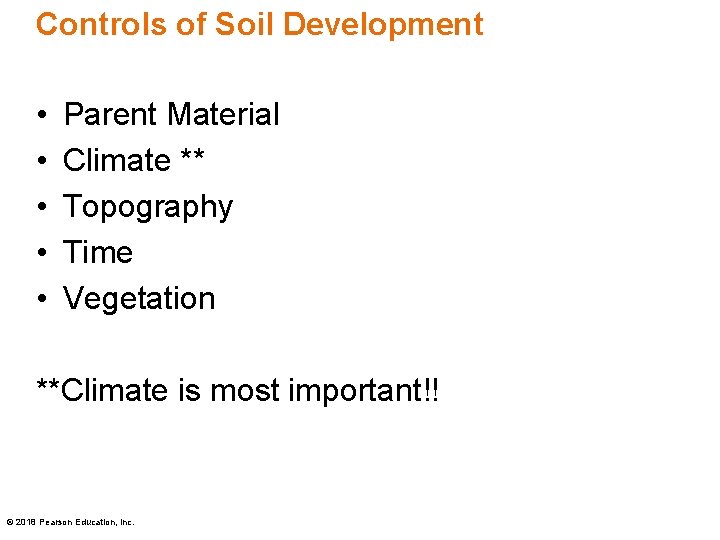
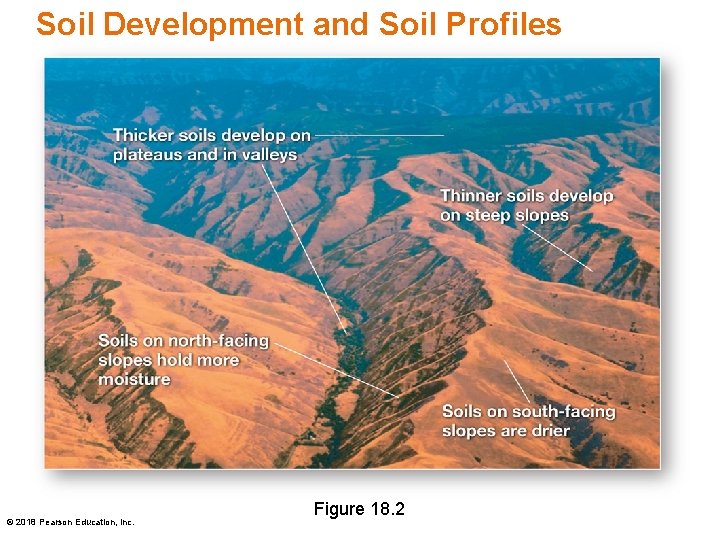
Controls of Soil Development • • • Parent Material Climate ** Topography Time Vegetation **Climate is most important!! © 2018 Pearson Education, Inc.
Soil Development and Soil Profiles © 2018 Pearson Education, Inc. Figure 18. 2
© 2018 Pearson Education, Inc.
Pedology • Ped means “soil” or “earth. ” • Pedology studies the origin, classification, distribution, and description of soil. • A pedon is a hexagonal column measuring 1 to 10 m 2 in top surface area. A pedon is the basic soil sampling unit in soil surveys. • Many pedons together in one area make up a polypedon. The polypedon is the basic soil mapping unit in soil maps. © 2018 Pearson Education, Inc.
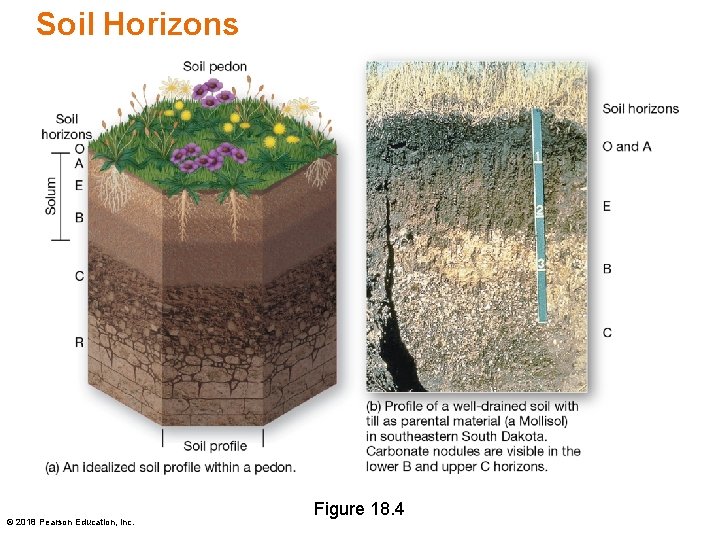
Soil Horizons © 2018 Pearson Education, Inc. Figure 18. 4
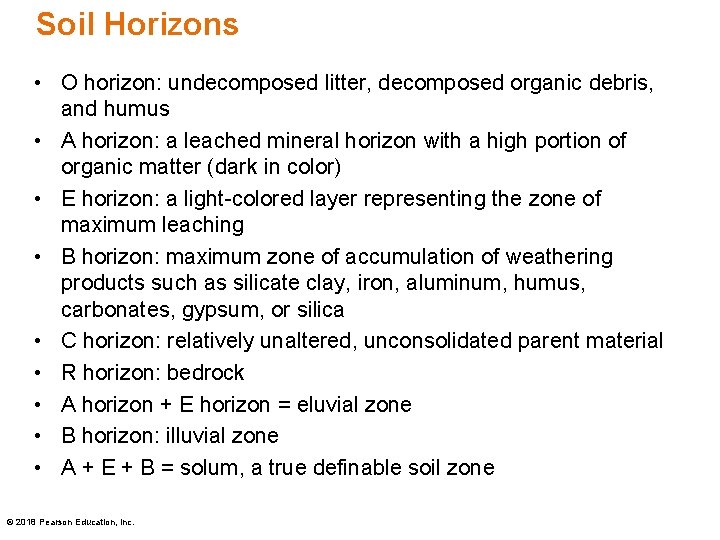
Soil Horizons • O horizon: undecomposed litter, decomposed organic debris, and humus • A horizon: a leached mineral horizon with a high portion of organic matter (dark in color) • E horizon: a light-colored layer representing the zone of maximum leaching • B horizon: maximum zone of accumulation of weathering products such as silicate clay, iron, aluminum, humus, carbonates, gypsum, or silica • C horizon: relatively unaltered, unconsolidated parent material • R horizon: bedrock • A horizon + E horizon = eluvial zone • B horizon: illuvial zone • A + E + B = solum, a true definable soil zone © 2018 Pearson Education, Inc.
Soil Properties • Soil texture • Soil color • Soil structure • Soil chemistry • Soil acidity and alkalinity © 2018 Pearson Education, Inc.
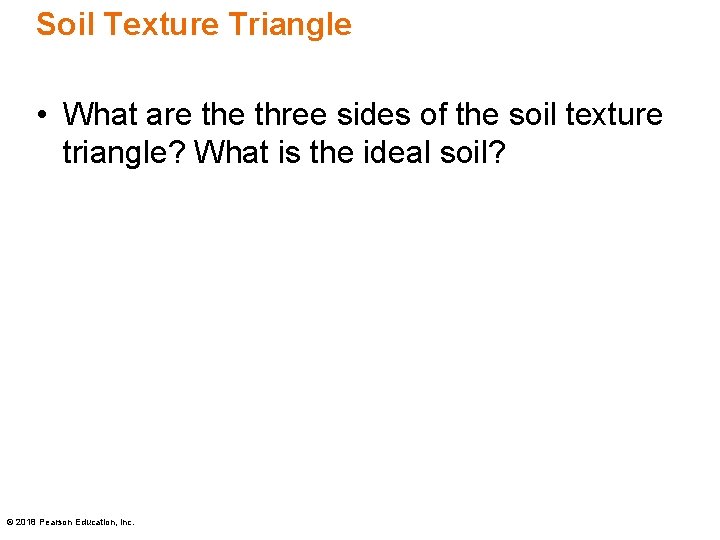
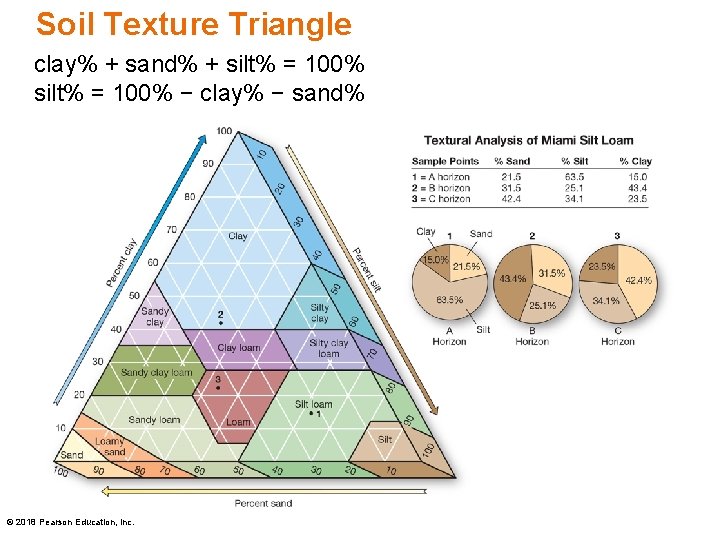
Soil Texture Triangle • What are three sides of the soil texture triangle? What is the ideal soil? © 2018 Pearson Education, Inc.
Soil Texture Triangle clay% + sand% + silt% = 100% − clay% − sand% © 2018 Pearson Education, Inc.
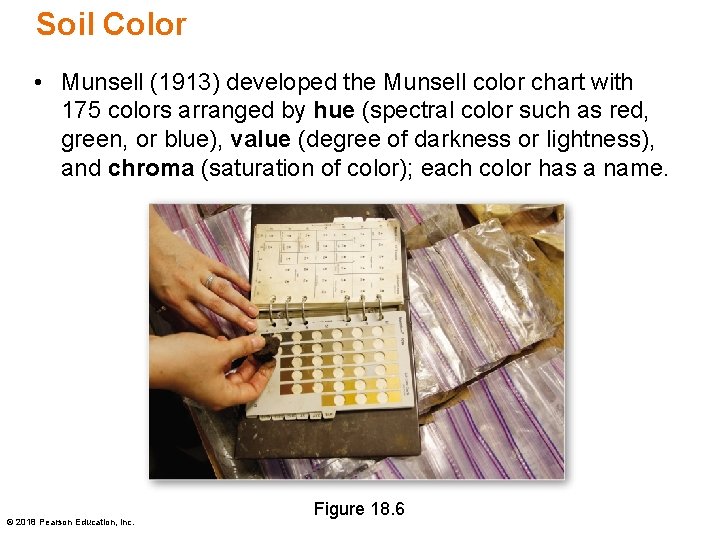
Soil Color • Munsell (1913) developed the Munsell color chart with 175 colors arranged by hue (spectral color such as red, green, or blue), value (degree of darkness or lightness), and chroma (saturation of color); each color has a name. © 2018 Pearson Education, Inc. Figure 18. 6
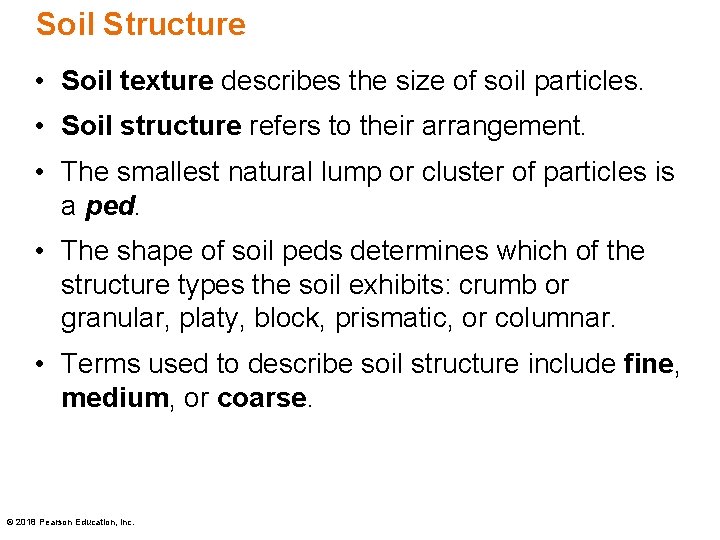
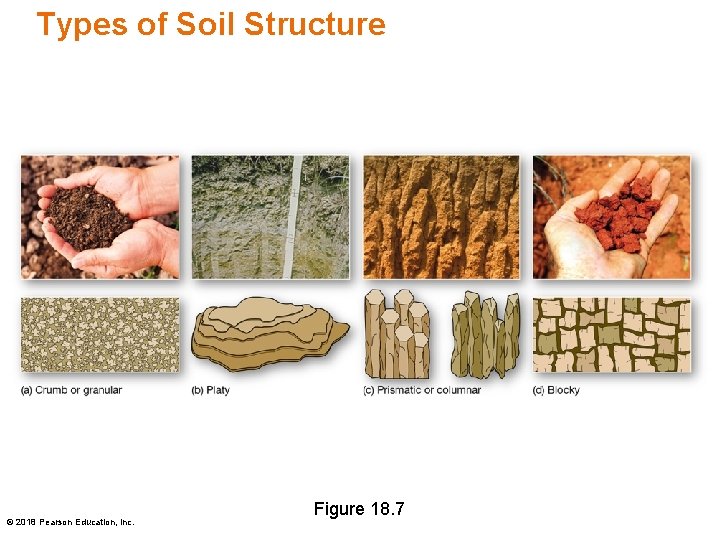
Soil Structure • Soil texture describes the size of soil particles. • Soil structure refers to their arrangement. • The smallest natural lump or cluster of particles is a ped. • The shape of soil peds determines which of the structure types the soil exhibits: crumb or granular, platy, block, prismatic, or columnar. • Terms used to describe soil structure include fine, medium, or coarse. © 2018 Pearson Education, Inc.
Types of Soil Structure © 2018 Pearson Education, Inc. Figure 18. 7
Soil Consistence • Wet soil is sticky and moldable. • Moist soil is filled to half of field capacity and is loose to friable to firm. • Dry soil is brittle and rigid and ranges from loose to soft to extremely hard. © 2018 Pearson Education, Inc.
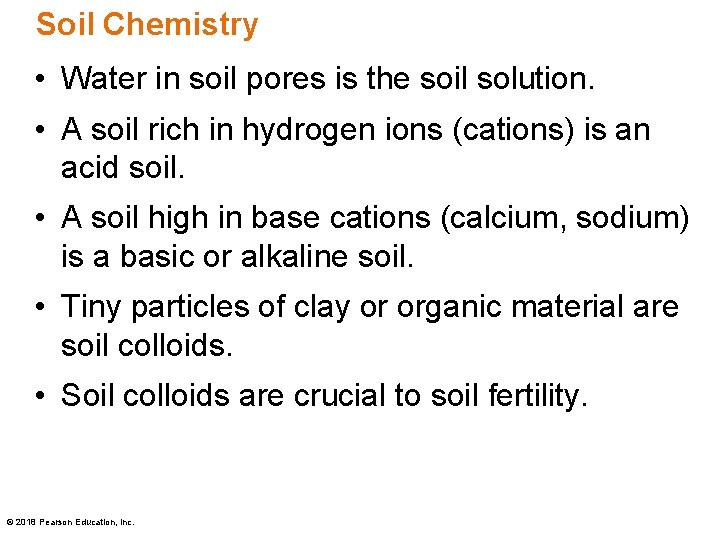
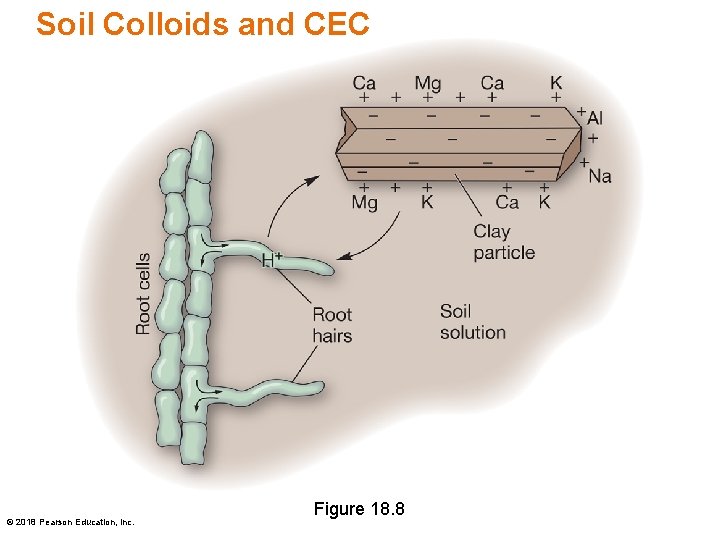
Soil Chemistry • Water in soil pores is the soil solution. • A soil rich in hydrogen ions (cations) is an acid soil. • A soil high in base cations (calcium, sodium) is a basic or alkaline soil. • Tiny particles of clay or organic material are soil colloids. • Soil colloids are crucial to soil fertility. © 2018 Pearson Education, Inc.
Soil Colloids and CEC © 2018 Pearson Education, Inc. Figure 18. 8
p. H Scale © 2018 Pearson Education, Inc. Figure 18. 9
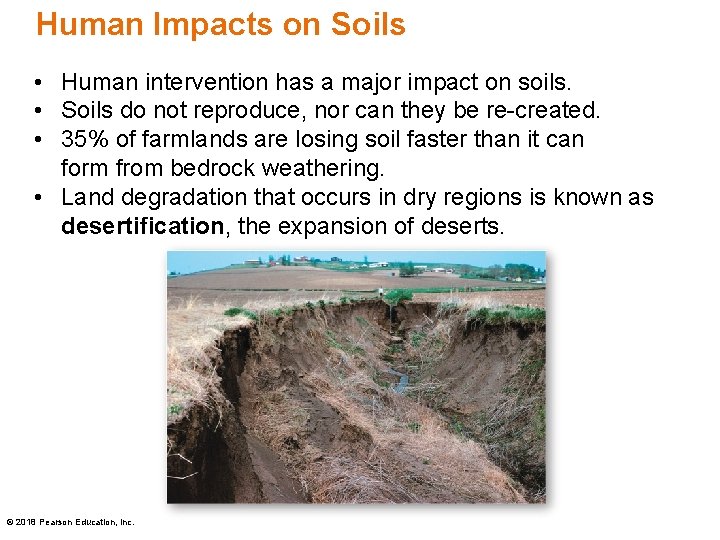
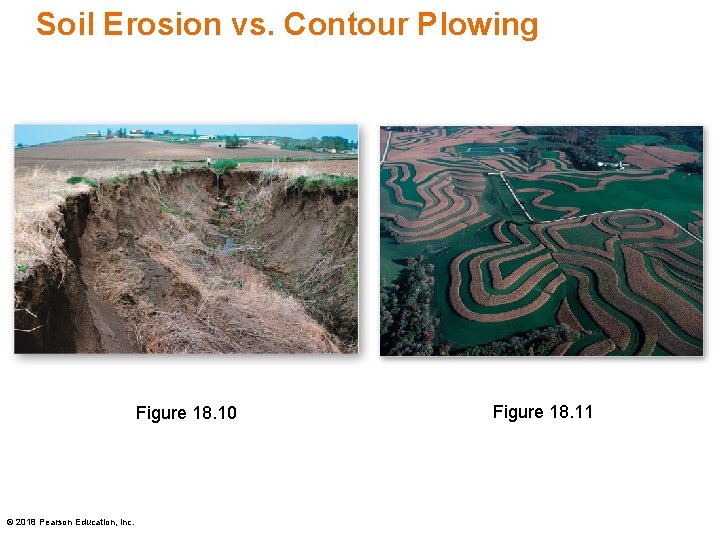
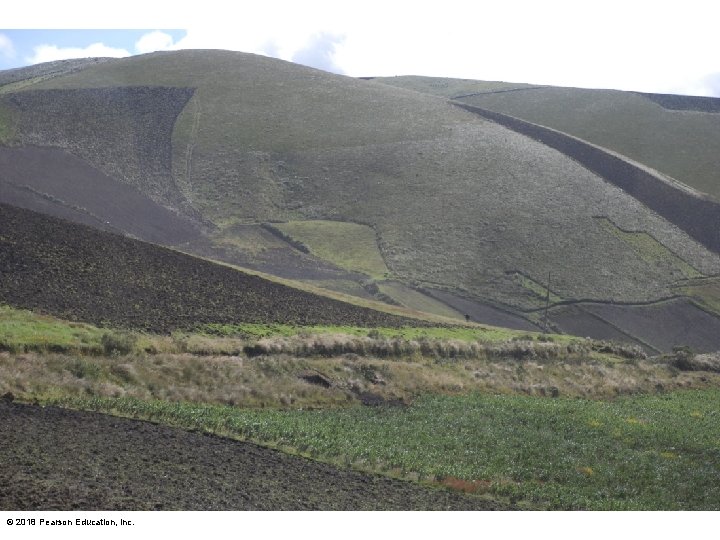
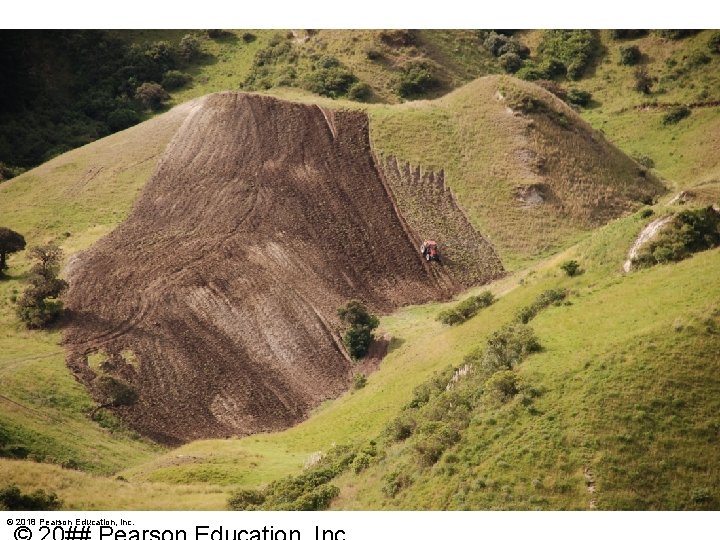
Human Impacts on Soils • Human intervention has a major impact on soils. • Soils do not reproduce, nor can they be re-created. • 35% of farmlands are losing soil faster than it can form from bedrock weathering. • Land degradation that occurs in dry regions is known as desertification, the expansion of deserts. © 2018 Pearson Education, Inc.
Soil Erosion vs. Contour Plowing Figure 18. 10 © 2018 Pearson Education, Inc. Figure 18. 11
© 2018 Pearson Education, Inc.
© 2018 Pearson Education, Inc.