
Geography Looking at Geography and The Five Themes


- Slides: 27
Geography Looking at Geography and The Five Themes
What is Geography? ? ? • Geography is the study of the world, its people and the landscapes they create.
• Think of geography and all that is involved. A good way to break all this information down is to put it into categories and then sub-categories. MR. LIP
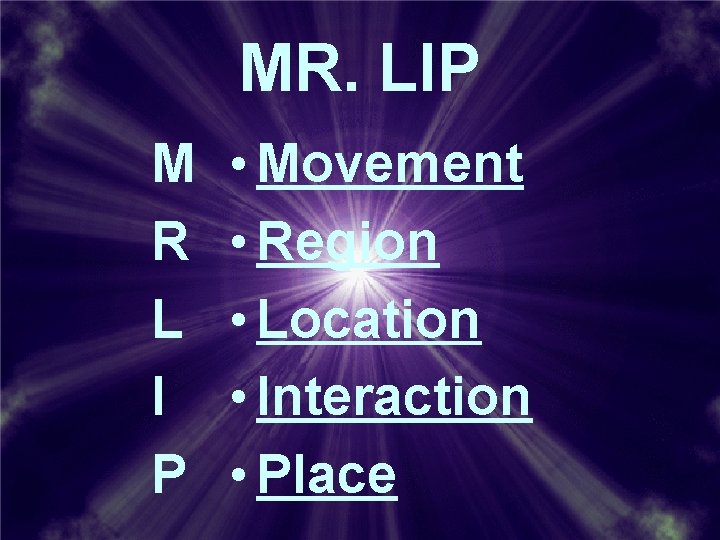
MR. LIP M R L I P • Movement • Region • Location • Interaction • Place
Movement - People - Goods - Ideas
People • People interact with each other through movement. – We interact with each other through travel, trade, information flows (E-Mail) and political events.
Goods • The movement of import and export goods and mass communication have played major roles in shaping our world. – They travel from place to place and they communicate and trade goods. – How do we move from place to place? – How do we actually get goods we want?
Ideas • Not only do humans move but also ideas move; fashions move; fads move. – What is an example of an idea that moves? Fashion? Fad? – How do we depend on people in other places? – How would our lives change if our movement options changed?
Region – Formal – defined lines and borders – Functional – has a function, particular area/region for a paper route. – Vernacular (perceptual) – people’s perception
What is a region? • the basic unit of study in geography that shows a connection in terms of human or physical features.
Formal Regions • Defined by boundaries – Example: United States, Kentwood, Great Britain. • These regional boundaries are not open to dispute, therefore physical regions fall under this category – Example: The Rockies, the Great Lakes States.
Functional Regions • Defined by a function – Example: United Airlines Service area or a newspaper service area. • If the function ceases to exists, the region no longer exists.
Vernacular Regions • Loosely defined by people's perception – Example: The South, The Middle East.
• What are characteristics of the Kentwood Community? • What region do you define as the South? The North? • What characteristics and perceptions go along with these regions?
Location – Relative Location – about/in comparison to… – Absolute Location – using longitude and latitude
Absolute Location • latitude and longitude (a global location) or a street address (local location). – Paris, France is 48. 51' North latitude and 2. 20' East longitude
Relative Locations • Landmarks, time, direction or distance from one place to another and may associate a particular place with another.
Human-Environmental Interaction – Humans adapt to the environment • Example: clothing – Humans modify the environment • Example: build houses, cut down trees, etc. – Humans depend on the environment • Example: natural resources, food, climate, etc.
Adapt • People adapt to the environment by wearing clothing that is suitable for summer and winter; rain and shine.
Modify • People modify our environment by heating and cooling buildings for comfort or dig tunnels for railroads.
Depend • People depend on the Great Lakes for our water and transportation.
• Given the choice, where would you live? Why? • What is the environment? • How do people interact with the environment? • How do the physical features affect us?
• How have we adapted to or changed our landscape? – Example: in the Sudan even though everything is seemingly barren, the land still supports farmers and nomadic herders. People and animals have adapted to a hot, dry climate.
Place – Physical Characteristics – natural landforms, bodies of water, etc. – Human Characteristics – man made
Physical Characteristics • Mountains, rivers, soil, beaches, wildlife, etc.
Human Characteristics • Buildings, roads, clothing, and food habits.
• How is Kentwood connected to other places? • What are the human and physical characteristics of Kentwood? • How do these shape our lives?