
Geography Knowledge Organiser Year 9 1 China Physical

- Slides: 2
Geography Knowledge Organiser: Year 9. 1 – China Physical Geography of China Fact File Yangtze River Longest river in China, the third longest in the world (6, 300 kms in length). Population 1. 434 billion Economy All of the business activity going on within a country HDI 0. 752 Poverty Lack of the means to meet basic needs such as food, clothing and shelter. Yellow River Second longest river in China (5, 464 kms in length) GNI $12 trillion Trade The action of buying and selling goods and services. Plateau of Tibet A large flat area of high mountainous land in southwest China. It is an average of 4, 500 metres above sea level and home to Mount Everest, the highest mountain in the world. It has a population of 3 million people and the region has been occupied by China since 1950. GNI per capita $8, 690 Urbanisation The increasing number of people living in urban areas (towns and cities). Life Expectancy 76. 4 years Population The number of inhabitants in a particular place Literacy Rate 95. 12% Overpopulation When a country or area has too many inhabitants to sustain its needs. Urban Pop. 59% One-Child Policy Birth rate 12. 95 per 1000 A policy introduced by the Chinese government in 1979 which limited families in urban areas to one child only. The policy was ended in 2016. Death rate 7. 26 per 1000 Gender imbalance When there are more people of one gender than another in a population. Currency Chinese Yuan Ageing Population When there are more elderly people in a population than young people. Development Improvements to the standard of living and quality of life of a country. Subsistence farming Farming the land for crops or rearing animals for a person or family’s own use. Sub-tropical: Mild & wet* Commercial farming Selling crops or animals raised through farming for a profit. Temperate: Cool & wet* Communism A form of government where the state owns and controls everything in a country. Free enterprise A type of economy where products, prices and services are determined by what can be sold on the market, not by the government. *Monsoon climate: These areas experience wet summers caused by moist air blowing inland from the Pacific Ocean Trans-National Corporation (TNC) A company or organisation which has operations in more than one country, such as Amazon, Apple, Nike or Adidas. Globalisation The process of creating a more connected world with increases in the global movements of goods (trade) and people (migration). Features of China Belt & Road Initiative An initiative by the Chinese government which increases its international links through investing in infrastructure projects in many countries around the world. Gobi Desert A cold desert in the north of China crossing into Mongolia. Population and Economic Development in China Climate Zones of China Tropical: Hot & wet* Mountain: Cold & dry Desert: Cold & very dry “Roof of the world” A name given to Tibet due to its height above sea level. The Water Tower of Asia A name given to Tibet on account of it being the source of many of China’s rivers including the Yangtze and the Yellow River. Economic inequality Uneven distribution of income and money in different parts of a country. Three-Gorges Dam The largest hydro-electric dam in the world completed in 2006 at a cost of $23 billion. It was constructed to generate power and control the flow of the Yangtze River. Sweatshop A factory, often producing clothing, where people work long hours for low wages. Great Wall of China A wall of over 21, 000 kms built to protect China in the 7 th Century Biodiversity The variety of plant and animal life living in a particular area or ecosystem.
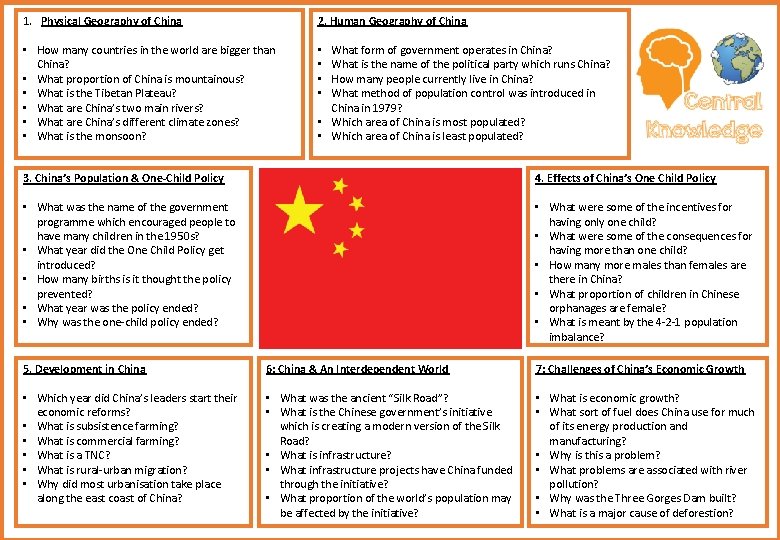
1. Physical Geography of China 2. Human Geography of China • How many countries in the world are bigger than China? • What proportion of China is mountainous? • What is the Tibetan Plateau? • What are China’s two main rivers? • What are China’s different climate zones? • What is the monsoon? • • What form of government operates in China? What is the name of the political party which runs China? How many people currently live in China? What method of population control was introduced in China in 1979? • Which area of China is most populated? • Which area of China is least populated? 3. China’s Population & One-Child Policy 4. Effects of China’s One Child Policy • What was the name of the government programme which encouraged people to have many children in the 1950 s? • What year did the One Child Policy get introduced? • How many births is it thought the policy prevented? • What year was the policy ended? • Why was the one-child policy ended? • What were some of the incentives for having only one child? • What were some of the consequences for having more than one child? • How many more males than females are there in China? • What proportion of children in Chinese orphanages are female? • What is meant by the 4 -2 -1 population imbalance? 5. Development in China 6: China & An Interdependent World 7: Challenges of China’s Economic Growth • Which year did China’s leaders start their economic reforms? • What is subsistence farming? • What is commercial farming? • What is a TNC? • What is rural-urban migration? • Why did most urbanisation take place along the east coast of China? • What was the ancient “Silk Road”? • What is the Chinese government’s initiative which is creating a modern version of the Silk Road? • What is infrastructure? • What infrastructure projects have China funded through the initiative? • What proportion of the world’s population may be affected by the initiative? • What is economic growth? • What sort of fuel does China use for much of its energy production and manufacturing? • Why is this a problem? • What problems are associated with river pollution? • Why was the Three Gorges Dam built? • What is a major cause of deforestion?