
Geography Knowledge Organiser Year 7 Unit 2 Weather
- Slides: 1
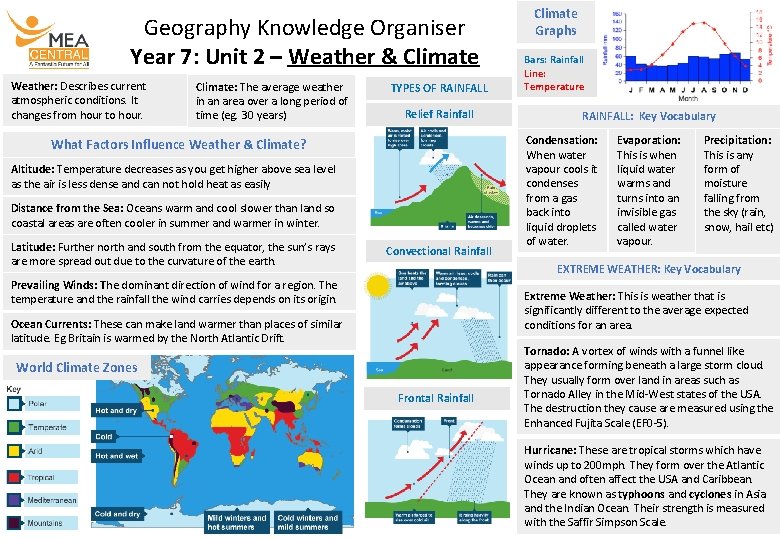
Geography Knowledge Organiser Year 7: Unit 2 – Weather & Climate Weather: Describes current atmospheric conditions. It changes from hour to hour. Climate: The average weather in an area over a long period of time (eg. 30 years) TYPES OF RAINFALL Relief Rainfall What Factors Influence Weather & Climate? Altitude: Temperature decreases as you get higher above sea level as the air is less dense and can not hold heat as easily Distance from the Sea: Oceans warm and cool slower than land so coastal areas are often cooler in summer and warmer in winter. Latitude: Further north and south from the equator, the sun’s rays are more spread out due to the curvature of the earth. Convectional Rainfall Climate Graphs Bars: Rainfall Line: Temperature RAINFALL: Key Vocabulary Condensation: When water vapour cools it condenses from a gas back into liquid droplets of water. Evaporation: This is when liquid water warms and turns into an invisible gas called water vapour. Precipitation: This is any form of moisture falling from the sky (rain, snow, hail etc) EXTREME WEATHER: Key Vocabulary Prevailing Winds: The dominant direction of wind for a region. The temperature and the rainfall the wind carries depends on its origin. Extreme Weather: This is weather that is significantly different to the average expected conditions for an area. Ocean Currents: These can make land warmer than places of similar latitude. Eg Britain is warmed by the North Atlantic Drift. World Climate Zones Frontal Rainfall Tornado: A vortex of winds with a funnel like appearance forming beneath a large storm cloud. They usually form over land in areas such as Tornado Alley in the Mid-West states of the USA. The destruction they cause are measured using the Enhanced Fujita Scale (EF 0 -5). Hurricane: These are tropical storms which have winds up to 200 mph. They form over the Atlantic Ocean and often affect the USA and Caribbean. They are known as typhoons and cyclones in Asia and the Indian Ocean. Their strength is measured with the Saffir Simpson Scale.