
Geography Early History of Latin America What four




- Slides: 24
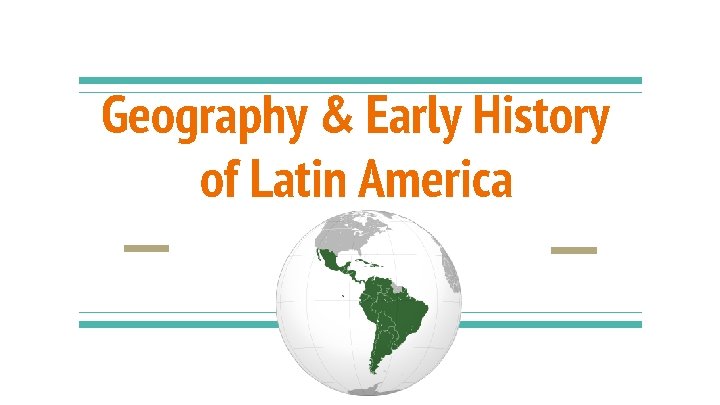
Geography & Early History of Latin America
What four factors influence climate and which one of these factors influences the climate of Latin America most? How? Location, elevation, wind patterns, and ocean currents affect climate. Latin America’s location close to the equator make it warmer.
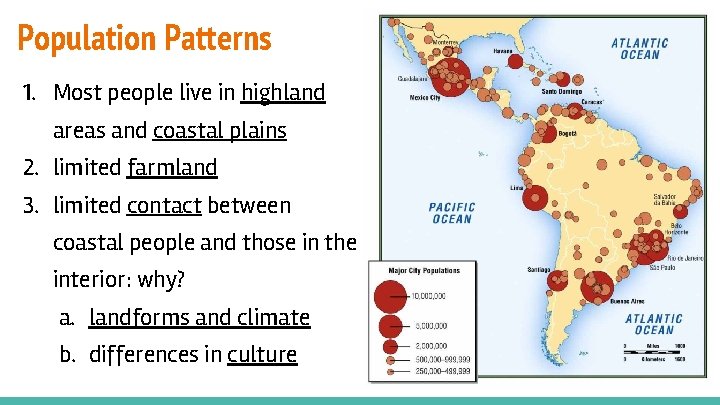
Population Patterns 1. Most people live in highland areas and coastal plains 2. limited farmland 3. limited contact between coastal people and those in the interior: why? a. landforms and climate b. differences in culture
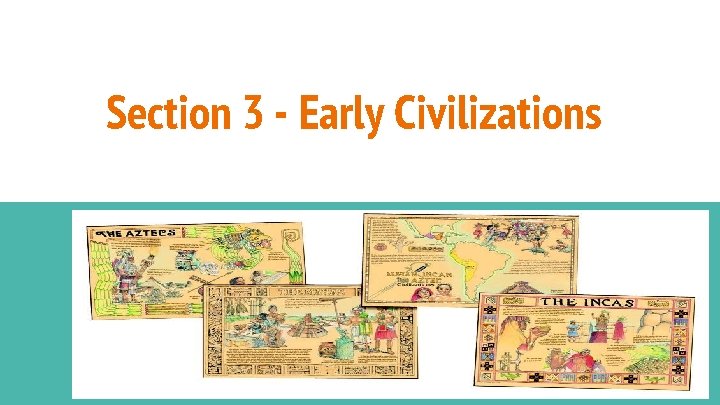
Section 3 - Early Civilizations
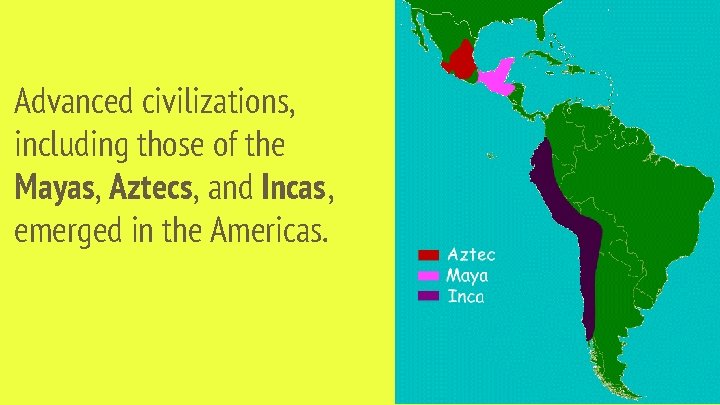
Advanced civilizations, including those of the Mayas, Aztecs, and Incas, emerged in the Americas.
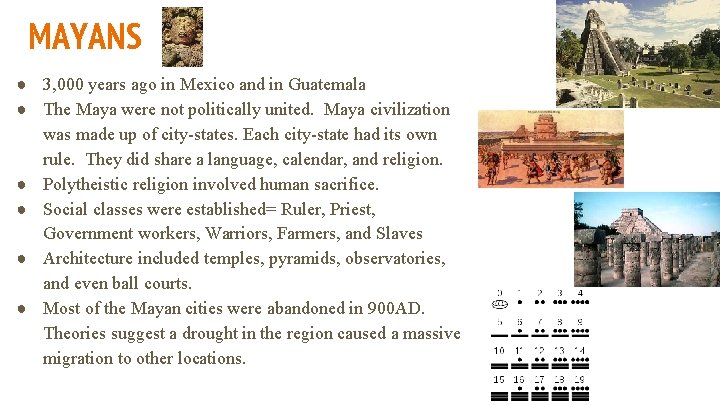
MAYANS ● 3, 000 years ago in Mexico and in Guatemala ● The Maya were not politically united. Maya civilization was made up of city-states. Each city-state had its own rule. They did share a language, calendar, and religion. ● Polytheistic religion involved human sacrifice. ● Social classes were established= Ruler, Priest, Government workers, Warriors, Farmers, and Slaves ● Architecture included temples, pyramids, observatories, and even ball courts. ● Most of the Mayan cities were abandoned in 900 AD. Theories suggest a drought in the region caused a massive migration to other locations.
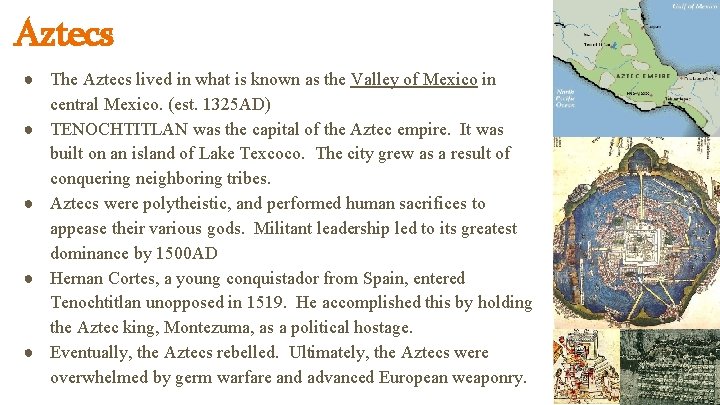
Aztecs ● The Aztecs lived in what is known as the Valley of Mexico in central Mexico. (est. 1325 AD) ● TENOCHTITLAN was the capital of the Aztec empire. It was built on an island of Lake Texcoco. The city grew as a result of conquering neighboring tribes. ● Aztecs were polytheistic, and performed human sacrifices to appease their various gods. Militant leadership led to its greatest dominance by 1500 AD ● Hernan Cortes, a young conquistador from Spain, entered Tenochtitlan unopposed in 1519. He accomplished this by holding the Aztec king, Montezuma, as a political hostage. ● Eventually, the Aztecs rebelled. Ultimately, the Aztecs were overwhelmed by germ warfare and advanced European weaponry.
INCAS ● The Sapa Inca (emperor) had absolute power. The emperor claimed to be the son of the sun, and was considered the empire’s religious leader. ● Inca were polytheistic. They used gold to adorn themselves and their temples. They believed in reincarnation. ● The Inca performed successful skull surgery. They also used medicines to make patients unconscious during surgery. ● A civil war weakened the Inca Empire, followed . by an outbreak of smallpox. Ultimately, the Inca Empire was conquered by Francisco Pizarro, a Spanish conquistador ● Pizarro held the Inca emperor, Atahualpa, as a political prisoner until he no longer served his purpose. The execution of Atahualpa ended 300 years of Inca rule.
Big Idea #1 Latin America is a vast cultural region that includes lands in the Western Hemisphere that were influenced by Spanish and Portuguese settlers.
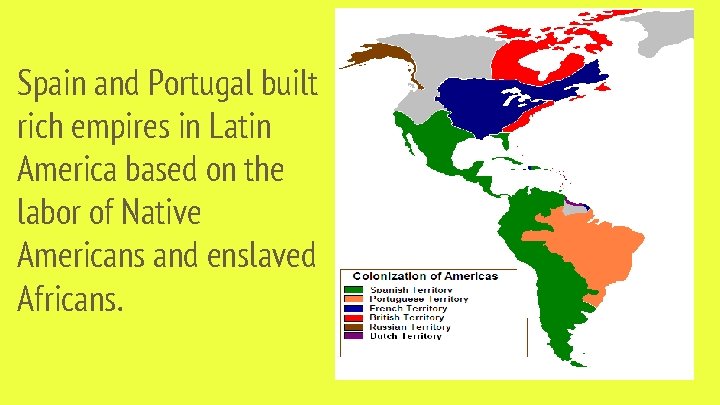
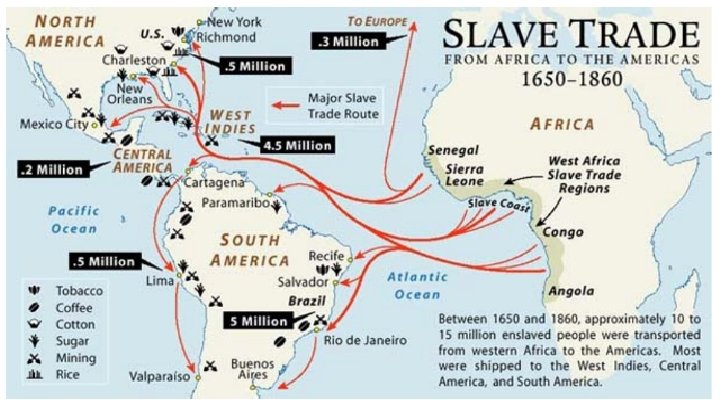
Spain and Portugal built rich empires in Latin America based on the labor of Native Americans and enslaved Africans.
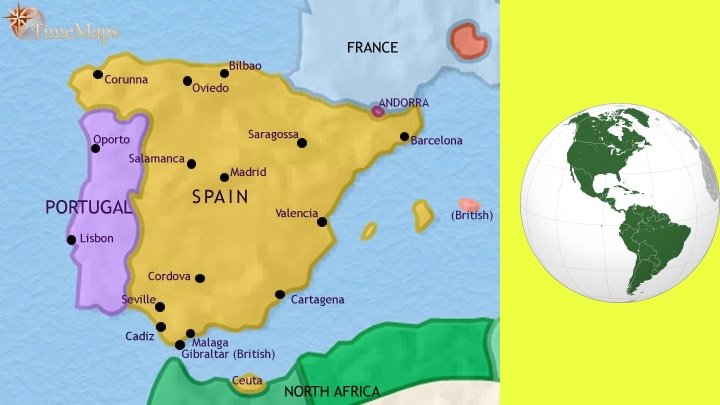
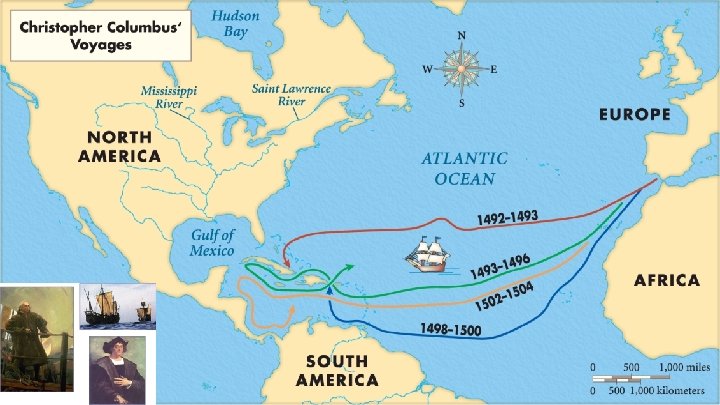
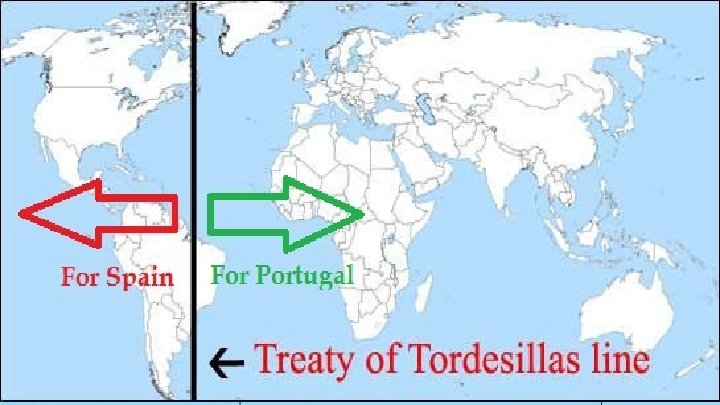
Europeans Explore the Americas ● 1493 - Pope Alexander VI established a line of demarcation. ● The Treaty of Tordesillas resolved a dispute between Spain and Portugal over the right to claim new lands. It did two things: ○ This gave Portugal the right to control the route around Africa to India ○ Spain claimed the new lands of the Americas, except for what is now Brazil.
Circumnavigation - Part 1 ● 1520 - Ferdinand Magellan, discovered the strait at the southernmost tip of South America. ○ His crew became the first known people to circumnavigate, or sail around, the globe.
Spanish Rule in the Americas ● ● Two Kingdoms: New Spain and Peru; both ruled by a viceroy (an official who rules in place of a king ○ cabildos (councils made up of wealthy landowners) governed towns Mercantilism: belief that a country should gain as much gold as possible by exporting more goods than they imported. ○ supply raw materials to parent country ○ serve as a market for manufactured goods
The Search for Labor ● Encomienda system - settlers’ right to demand taxes or labor from the people living on the land. Results: ○ genocide of many Native American groups ○ haciendas - large plantations owned by Spanish settlers
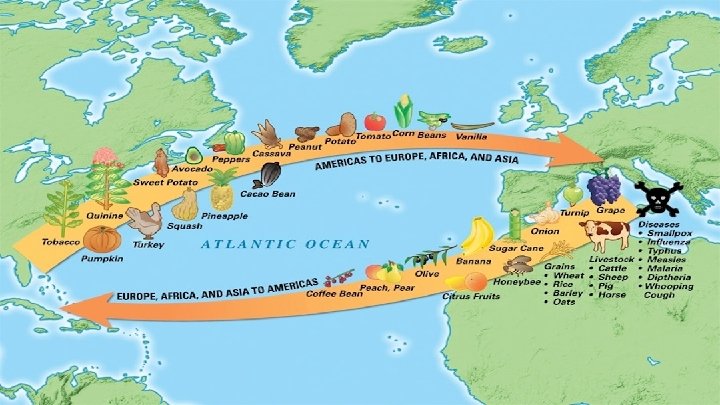
The Columbian Exchange ● The Columbian Exchange was a series of interchanges that permanently changed the world’s ecosystems and changed nearly every culture around the world. ○ Native Americans and Europeans learned new farming methods and were introduced to new crops and foods ○ Europeans also brought diseases that killed millions of Native Americans
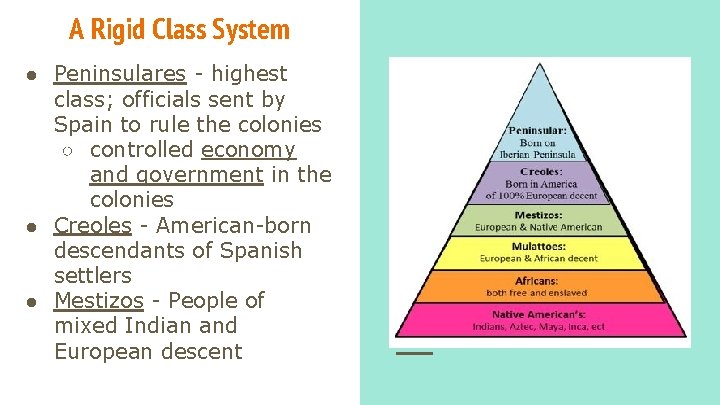
Peoples of Latin America 1. Native Americans; after 1492: Europeans; 1800 s: Asians; 1500 -1800: Africans a. children of Native Americans and Europeans: mestizos
A Rigid Class System ● Peninsulares - highest class; officials sent by Spain to rule the colonies ○ controlled economy and government in the colonies ● Creoles - American-born descendants of Spanish settlers ● Mestizos - People of mixed Indian and European descent
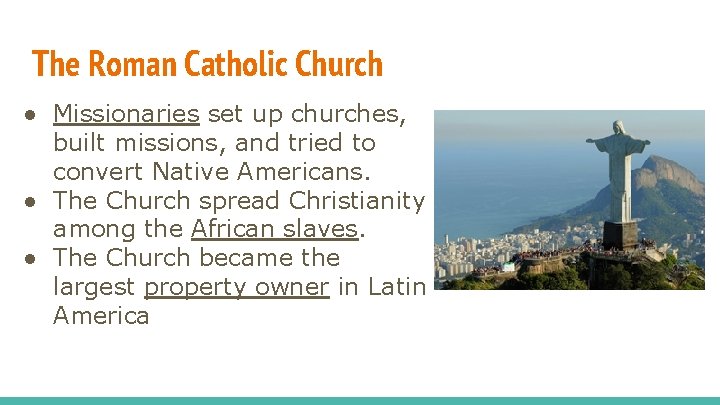
The Roman Catholic Church ● Missionaries set up churches, built missions, and tried to convert Native Americans. ● The Church spread Christianity among the African slaves. ● The Church became the largest property owner in Latin America
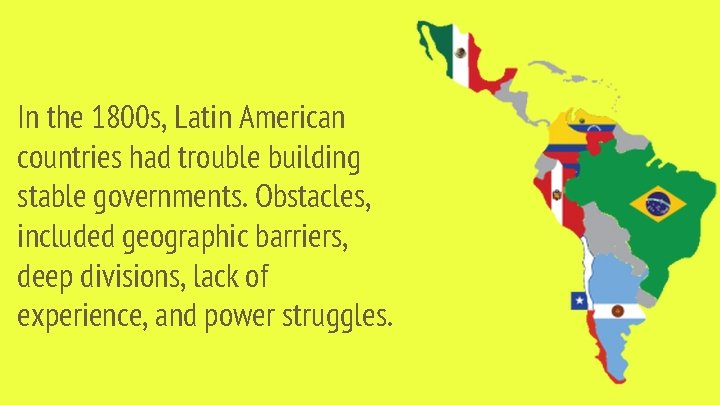
In the 1800 s, Latin American countries had trouble building stable governments. Obstacles, included geographic barriers, deep divisions, lack of experience, and power struggles.
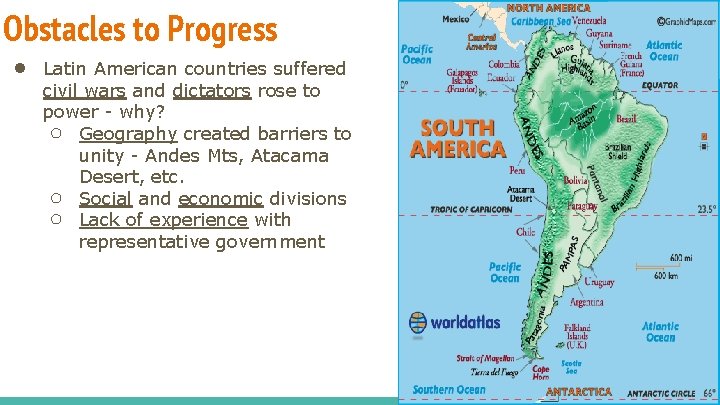
Obstacles to Progress ● Latin American countries suffered civil wars and dictators rose to power - why? ○ Geography created barriers to unity - Andes Mts, Atacama Desert, etc. ○ Social and economic divisions ○ Lack of experience with representative government
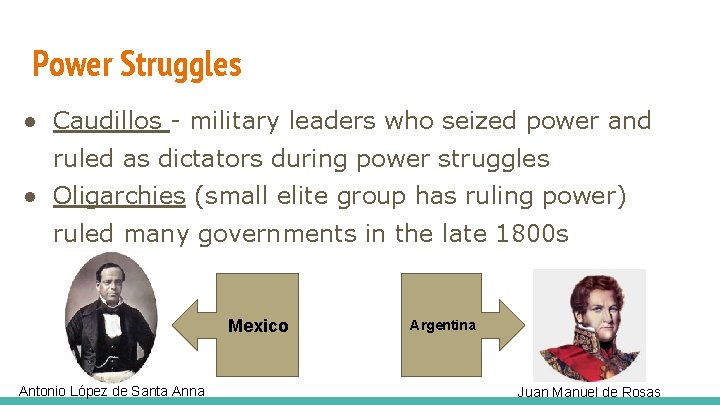
Power Struggles ● Caudillos - military leaders who seized power and ruled as dictators during power struggles ● Oligarchies (small elite group has ruling power) ruled many governments in the late 1800 s Mexico Antonio López de Santa Anna Argentina Juan Manuel de Rosas
Economic Dependence and Growth ● Latin American countries exported raw materials to Europe & U. S. and imported manufactured goods. ● Many wanted to modernize; foreigners provided capital to improve transportation and developed the raw materials ● Latin American nations had to borrow large sums of $$ - led to economic imperialism