
Geography Curriculum Map KS 3 Curriculum Map Year
- Slides: 6
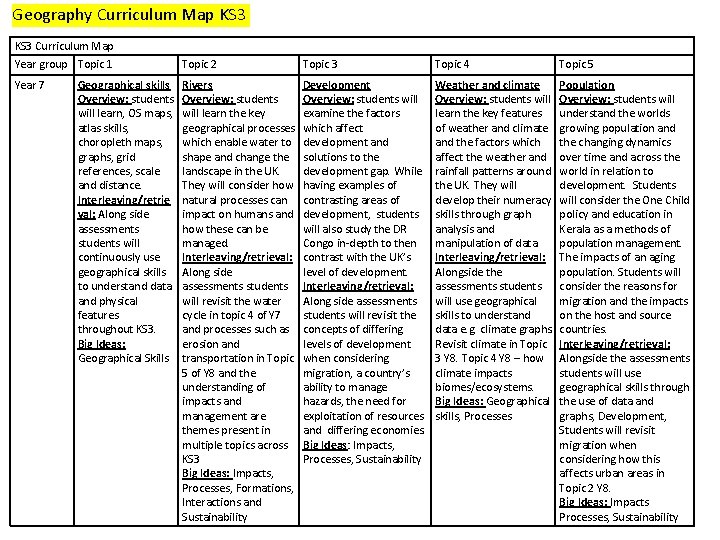
Geography Curriculum Map KS 3 Curriculum Map Year group Topic 1 Topic 2 Topic 3 Topic 4 Topic 5 Year 7 Rivers Overview: students will learn the key geographical processes which enable water to shape and change the landscape in the UK. They will consider how natural processes can impact on humans and how these can be managed. Interleaving/retrieval: Along side assessments students will revisit the water cycle in topic 4 of Y 7 and processes such as erosion and transportation in Topic 5 of Y 8 and the understanding of impacts and management are themes present in multiple topics across KS 3 Big Ideas: Impacts, Processes, Formations, Interactions and Sustainability Development Overview: students will examine the factors which affect development and solutions to the development gap. While having examples of contrasting areas of development, students will also study the DR Congo in-depth to then contrast with the UK’s level of development. Interleaving/retrieval: Along side assessments students will revisit the concepts of differing levels of development when considering migration, a country’s ability to manage hazards, the need for exploitation of resources and differing economies. Big Ideas: Impacts, Processes, Sustainability Weather and climate Overview: students will learn the key features of weather and climate and the factors which affect the weather and rainfall patterns around the UK. They will develop their numeracy skills through graph analysis and manipulation of data. Interleaving/retrieval: Alongside the assessments students will use geographical skills to understand data e. g. climate graphs. Revisit climate in Topic 3 Y 8. Topic 4 Y 8 – how climate impacts biomes/ecosystems. Big Ideas: Geographical skills, Processes Population Overview: students will understand the worlds growing population and the changing dynamics over time and across the world in relation to development. Students will consider the One Child policy and education in Kerala as a methods of population management. The impacts of an aging population. Students will consider the reasons for migration and the impacts on the host and source countries. Interleaving/retrieval: Alongside the assessments students will use geographical skills through the use of data and graphs, Development, Students will revisit migration when considering how this affects urban areas in Topic 2 Y 8. Big Ideas: Impacts Processes, Sustainability Geographical skills Overview: students will learn, OS maps, atlas skills, choropleth maps, graphs, grid references, scale and distance. Interleaving/retrie val: Along side assessments students will continuously use geographical skills to understand data and physical features throughout KS 3. Big Ideas: Geographical Skills
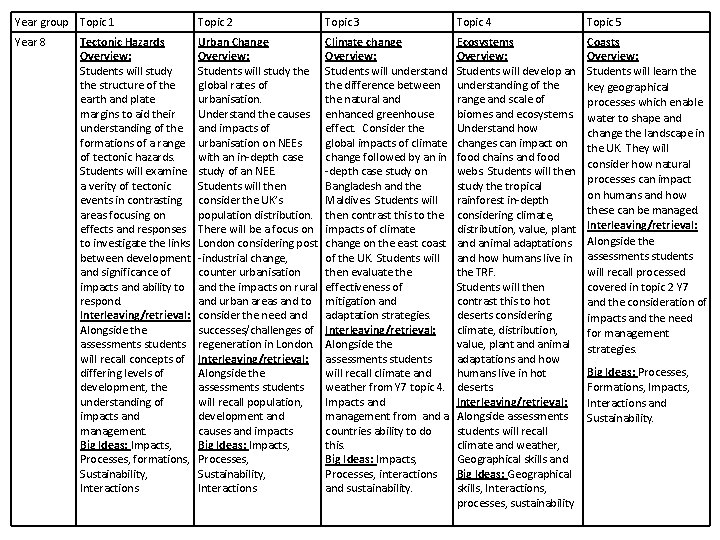
Year group Topic 1 Topic 2 Topic 3 Topic 4 Topic 5 Year 8 Urban Change Overview: Students will study the global rates of urbanisation. Understand the causes and impacts of urbanisation on NEEs with an in-depth case study of an NEE. Students will then consider the UK’s population distribution. There will be a focus on London considering post -industrial change, counter urbanisation and the impacts on rural and urban areas and to consider the need and successes/challenges of regeneration in London. Interleaving/retrieval: Alongside the assessments students will recall population, development and causes and impacts Big Ideas: Impacts, Processes, Sustainability, Interactions Climate change Overview: Students will understand the difference between the natural and enhanced greenhouse effect. Consider the global impacts of climate change followed by an in -depth case study on Bangladesh and the Maldives. Students will then contrast this to the impacts of climate change on the east coast of the UK. Students will then evaluate the effectiveness of mitigation and adaptation strategies. Interleaving/retrieval: Alongside the assessments students will recall climate and weather from Y 7 topic 4. Impacts and management from and a countries ability to do this. Big Ideas: Impacts, Processes, interactions and sustainability. Ecosystems Overview: Students will develop an understanding of the range and scale of biomes and ecosystems. Understand how changes can impact on food chains and food webs. Students will then study the tropical rainforest in-depth considering climate, distribution, value, plant and animal adaptations and how humans live in the TRF. Students will then contrast this to hot deserts considering climate, distribution, value, plant and animal adaptations and how humans live in hot deserts. Interleaving/retrieval: Alongside assessments students will recall climate and weather, Geographical skills and Big Ideas: Geographical skills, Interactions, processes, sustainability Coasts Overview: Students will learn the key geographical processes which enable water to shape and change the landscape in the UK. They will consider how natural processes can impact on humans and how these can be managed. Interleaving/retrieval: Alongside the assessments students will recall processed covered in topic 2 Y 7 and the consideration of impacts and the need for management strategies. Tectonic Hazards Overview: Students will study the structure of the earth and plate margins to aid their understanding of the formations of a range of tectonic hazards. Students will examine a verity of tectonic events in contrasting areas focusing on effects and responses to investigate the links between development and significance of impacts and ability to respond. Interleaving/retrieval: Alongside the assessments students will recall concepts of differing levels of development, the understanding of impacts and management. Big Ideas: Impacts, Processes, formations, Sustainability, Interactions Big Ideas: Processes, Formations, Impacts, Interactions and Sustainability.
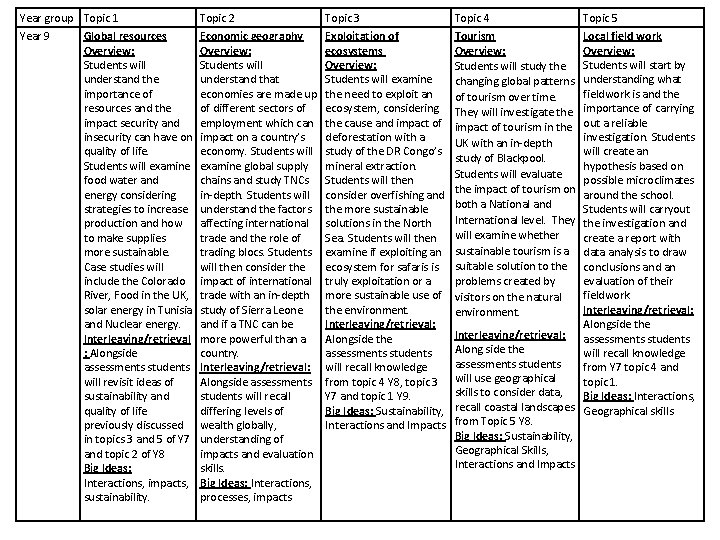
Year group Topic 1 Topic 2 Topic 3 Topic 4 Year 9 Economic geography Overview: Students will understand that economies are made up of different sectors of employment which can impact on a country’s economy. Students will examine global supply chains and study TNCs in-depth. Students will understand the factors affecting international trade and the role of trading blocs. Students will then consider the impact of international trade with an in-depth study of Sierra Leone and if a TNC can be more powerful than a country. Interleaving/retrieval: Alongside assessments students will recall differing levels of wealth globally, understanding of impacts and evaluation skills. Big Ideas: Interactions, processes, impacts Exploitation of ecosystems Overview: Students will examine the need to exploit an ecosystem, considering the cause and impact of deforestation with a study of the DR Congo’s mineral extraction. Students will then consider overfishing and the more sustainable solutions in the North Sea. Students will then examine if exploiting an ecosystem for safaris is truly exploitation or a more sustainable use of the environment. Interleaving/retrieval: Alongside the assessments students will recall knowledge from topic 4 Y 8, topic 3 Y 7 and topic 1 Y 9. Big Ideas: Sustainability, Interactions and Impacts Tourism Overview: Students will study the changing global patterns of tourism over time. They will investigate the impact of tourism in the UK with an in-depth study of Blackpool. Students will evaluate the impact of tourism on both a National and International level. They will examine whether sustainable tourism is a suitable solution to the problems created by visitors on the natural environment. Global resources Overview: Students will understand the importance of resources and the impact security and insecurity can have on quality of life. Students will examine food water and energy considering strategies to increase production and how to make supplies more sustainable. Case studies will include the Colorado River, Food in the UK, solar energy in Tunisia and Nuclear energy. Interleaving/retrieval : Alongside assessments students will revisit ideas of sustainability and quality of life previously discussed in topics 3 and 5 of Y 7 and topic 2 of Y 8 Big Ideas: Interactions, impacts, sustainability. Topic 5 Local field work Overview: Students will start by understanding what fieldwork is and the importance of carrying out a reliable investigation. Students will create an hypothesis based on possible microclimates around the school. Students will carryout the investigation and create a report with data analysis to draw conclusions and an evaluation of their fieldwork. Interleaving/retrieval: Alongside the Interleaving/retrieval: assessments students Along side the will recall knowledge assessments students from Y 7 topic 4 and will use geographical topic 1. skills to consider data, Big Ideas: Interactions, recall coastal landscapes Geographical skills from Topic 5 Y 8. Big Ideas: Sustainability, Geographical Skills, Interactions and Impacts
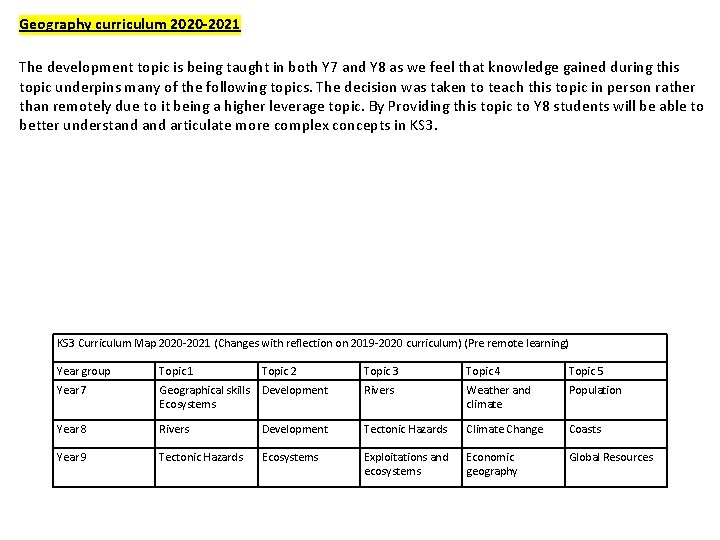
Geography curriculum 2020 -2021 The development topic is being taught in both Y 7 and Y 8 as we feel that knowledge gained during this topic underpins many of the following topics. The decision was taken to teach this topic in person rather than remotely due to it being a higher leverage topic. By Providing this topic to Y 8 students will be able to better understand articulate more complex concepts in KS 3 Curriculum Map 2020 -2021 (Changes with reflection on 2019 -2020 curriculum) (Pre remote learning) Year group Topic 1 Topic 2 Topic 3 Topic 4 Topic 5 Year 7 Geographical skills Ecosystems Development Rivers Weather and climate Population Year 8 Rivers Development Tectonic Hazards Climate Change Coasts Year 9 Tectonic Hazards Ecosystems Exploitations and ecosystems Economic geography Global Resources
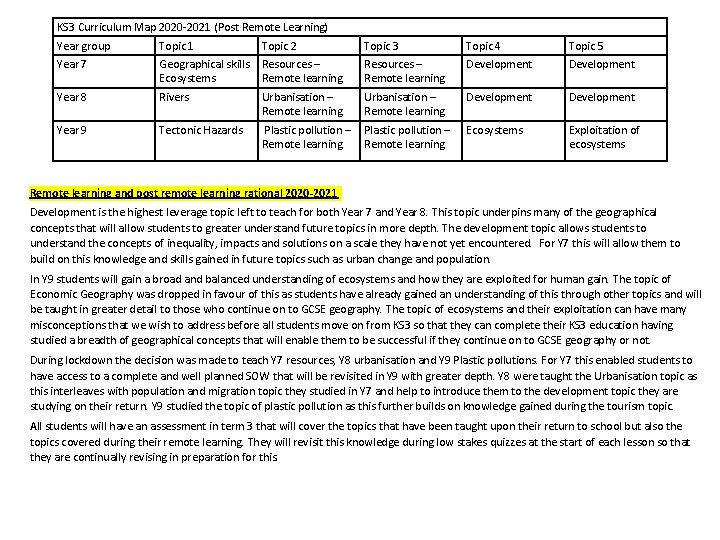
KS 3 Curriculum Map 2020 -2021 (Post Remote Learning) Year group Topic 1 Topic 2 Topic 3 Topic 4 Topic 5 Year 7 Geographical skills Ecosystems Resources – Remote learning Development Year 8 Rivers Urbanisation – Remote learning Development Year 9 Tectonic Hazards Plastic pollution – Remote learning Ecosystems Exploitation of ecosystems Remote learning and post remote learning rational 2020 -2021 Development is the highest leverage topic left to teach for both Year 7 and Year 8. This topic underpins many of the geographical concepts that will allow students to greater understand future topics in more depth. The development topic allows students to understand the concepts of inequality, impacts and solutions on a scale they have not yet encountered. For Y 7 this will allow them to build on this knowledge and skills gained in future topics such as urban change and population. In Y 9 students will gain a broad and balanced understanding of ecosystems and how they are exploited for human gain. The topic of Economic Geography was dropped in favour of this as students have already gained an understanding of this through other topics and will be taught in greater detail to those who continue on to GCSE geography. The topic of ecosystems and their exploitation can have many misconceptions that we wish to address before all students move on from KS 3 so that they can complete their KS 3 education having studied a breadth of geographical concepts that will enable them to be successful if they continue on to GCSE geography or not. During lockdown the decision was made to teach Y 7 resources, Y 8 urbanisation and Y 9 Plastic pollutions. For Y 7 this enabled students to have access to a complete and well planned SOW that will be revisited in Y 9 with greater depth. Y 8 were taught the Urbanisation topic as this interleaves with population and migration topic they studied in Y 7 and help to introduce them to the development topic they are studying on their return. Y 9 studied the topic of plastic pollution as this further builds on knowledge gained during the tourism topic. All students will have an assessment in term 3 that will cover the topics that have been taught upon their return to school but also the topics covered during their remote learning. They will revisit this knowledge during low stakes quizzes at the start of each lesson so that they are continually revising in preparation for this.
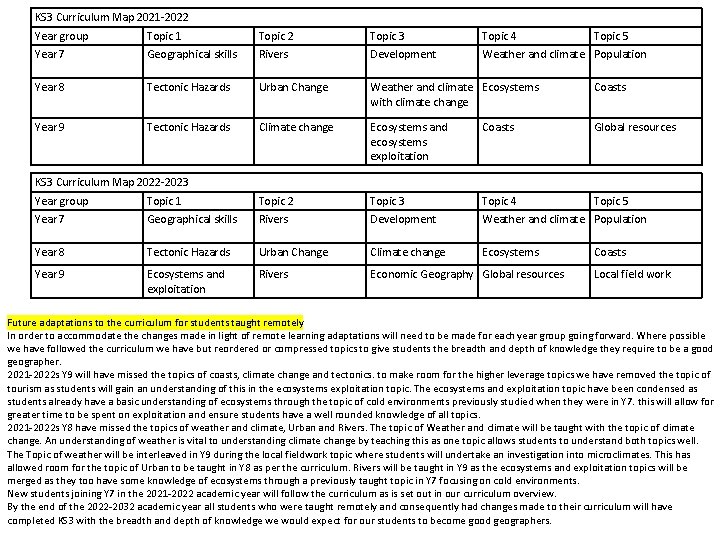
KS 3 Curriculum Map 2021 -2022 Year group Topic 1 Topic 2 Topic 3 Topic 4 Topic 5 Year 7 Geographical skills Rivers Development Weather and climate Population Year 8 Tectonic Hazards Urban Change Weather and climate Ecosystems with climate change Coasts Year 9 Tectonic Hazards Climate change Ecosystems and ecosystems exploitation Coasts Global resources Topic 5 KS 3 Curriculum Map 2022 -2023 Year group Topic 1 Topic 2 Topic 3 Topic 4 Year 7 Geographical skills Rivers Development Weather and climate Population Year 8 Tectonic Hazards Urban Change Climate change Ecosystems Year 9 Ecosystems and exploitation Rivers Economic Geography Global resources Coasts Local field work Future adaptations to the curriculum for students taught remotely In order to accommodate the changes made in light of remote learning adaptations will need to be made for each year group going forward. Where possible we have followed the curriculum we have but reordered or compressed topics to give students the breadth and depth of knowledge they require to be a good geographer. 2021 -2022 s Y 9 will have missed the topics of coasts, climate change and tectonics. to make room for the higher leverage topics we have removed the topic of tourism as students will gain an understanding of this in the ecosystems exploitation topic. The ecosystems and exploitation topic have been condensed as students already have a basic understanding of ecosystems through the topic of cold environments previously studied when they were in Y 7. this will allow for greater time to be spent on exploitation and ensure students have a well rounded knowledge of all topics. 2021 -2022 s Y 8 have missed the topics of weather and climate, Urban and Rivers. The topic of Weather and climate will be taught with the topic of climate change. An understanding of weather is vital to understanding climate change by teaching this as one topic allows students to understand both topics well. The Topic of weather will be interleaved in Y 9 during the local fieldwork topic where students will undertake an investigation into microclimates. This has allowed room for the topic of Urban to be taught in Y 8 as per the curriculum. Rivers will be taught in Y 9 as the ecosystems and exploitation topics will be merged as they too have some knowledge of ecosystems through a previously taught topic in Y 7 focusing on cold environments. New students joining Y 7 in the 2021 -2022 academic year will follow the curriculum as is set out in our curriculum overview. By the end of the 2022 -2032 academic year all students who were taught remotely and consequently had changes made to their curriculum will have completed KS 3 with the breadth and depth of knowledge we would expect for our students to become good geographers.