
Geography Chapter 4 Human Geography People and Places
- Slides: 39
Geography Chapter 4 Human Geography People and Places Geography and the environment help shape human cultures, but humans also use and alter the environment to fulfill their needs. Next Copyright © by Houghton Mifflin Harcourt Publishing Company
Geography Chapter 4 Section-1 The Elements of Culture • Human beings are members of social groups with shared and unique sets of behaviors and attitudes. • Language and religion are two very important aspects of culture. Previous Copyright © by Houghton Mifflin Harcourt Publishing Company Next
Geography Chapter 4 Section-1 The Elements of Culture Defining Culture • Knowledge, attitudes, behaviors shared over generations is culture • Society is a group that shares geographic region, identity, culture • An ethnic group shares language, customs, common heritage Previous Copyright © by Houghton Mifflin Harcourt Publishing Company Next
Geography Chapter 4 Culture Change and Exchange Innovation • Innovation is creating something new with existing resources • Example: weaving baskets from reeds to solve storage problem Diffusion • Spread of ideas, inventions, patterns of behavior called diffusion • Cultural hearth—site of innovation; origin of cultural diffusion • Example: Nile River civilizations in Africa Previous Copyright © by Houghton Mifflin Harcourt Publishing Company Continued… Next
Geography Chapter 4 1 Culture Change and Exchange {continued} Acculturation • Acculturation—society changes because it accepts innovation Previous Copyright © by Houghton Mifflin Harcourt Publishing Company Next
Geography Chapter 4 Language Importance of Language • Enables people within a culture to communicate • Reflects all aspects of culture Language and Identity • Language helps establish cultural identity, unity • Language can also divide people, cause conflict Previous Copyright © by Houghton Mifflin Harcourt Publishing Company Continued… Next
Geography Chapter 4 Language {continued} Language Families • Between 3, 000 and 6, 500 languages spoken worldwide • Similar languages belong to same language family • Dialect—a version of a language, like Southern drawl Language Diffusion • Language can spread via trade routes, migration Previous Copyright © by Houghton Mifflin Harcourt Publishing Company Next
Geography Chapter 4 1 Religion Belief System • Religion—belief in supernatural power that made, maintains universe • Monotheistic faiths believe in one god • Belief in many gods called polytheistic • Animistic, or traditional, faiths believe in divine forces of nature Spread of Religion • Religion spreads through diffusion and conversion • Conversion—some religions try to recruit others to their faith Previous Copyright © by Houghton Mifflin Harcourt Publishing Company Next
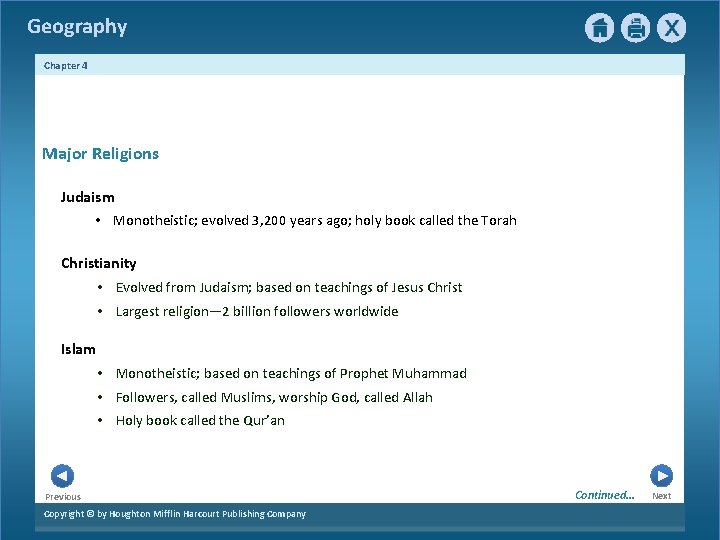
Geography Chapter 4 Major Religions Judaism • Monotheistic; evolved 3, 200 years ago; holy book called the Torah Christianity • Evolved from Judaism; based on teachings of Jesus Christ • Largest religion— 2 billion followers worldwide Islam • Monotheistic; based on teachings of Prophet Muhammad • Followers, called Muslims, worship God, called Allah • Holy book called the Qur’an Previous Copyright © by Houghton Mifflin Harcourt Publishing Company Continued… Next
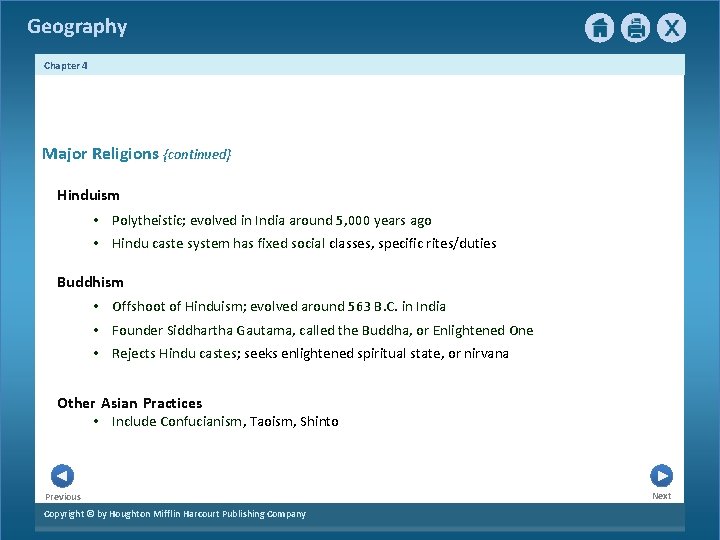
Geography Chapter 4 Major Religions {continued} Hinduism • Polytheistic; evolved in India around 5, 000 years ago • Hindu caste system has fixed social classes, specific rites/duties Buddhism • Offshoot of Hinduism; evolved around 563 B. C. in India • Founder Siddhartha Gautama, called the Buddha, or Enlightened One • Rejects Hindu castes; seeks enlightened spiritual state, or nirvana Other Asian Practices • Include Confucianism, Taoism, Shinto Previous Copyright © by Houghton Mifflin Harcourt Publishing Company Next
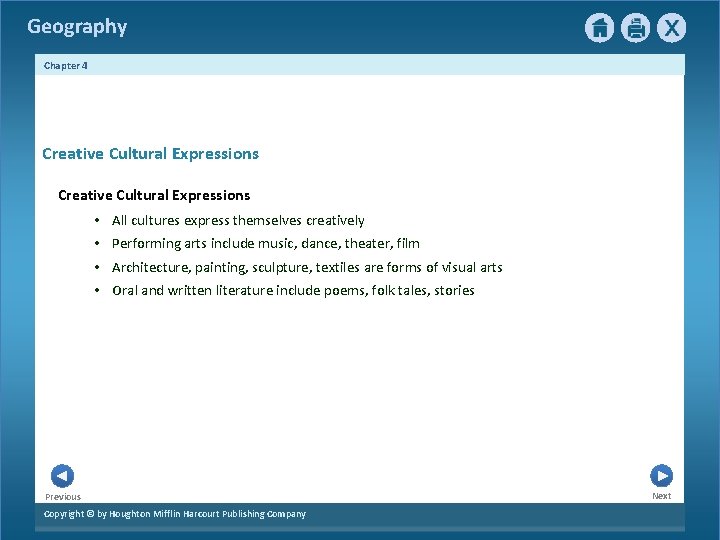
Geography Chapter 4 1 Creative Cultural Expressions • All cultures express themselves creatively • Performing arts include music, dance, theater, film • Architecture, painting, sculpture, textiles are forms of visual arts • Oral and written literature include poems, folk tales, stories Previous Copyright © by Houghton Mifflin Harcourt Publishing Company Next
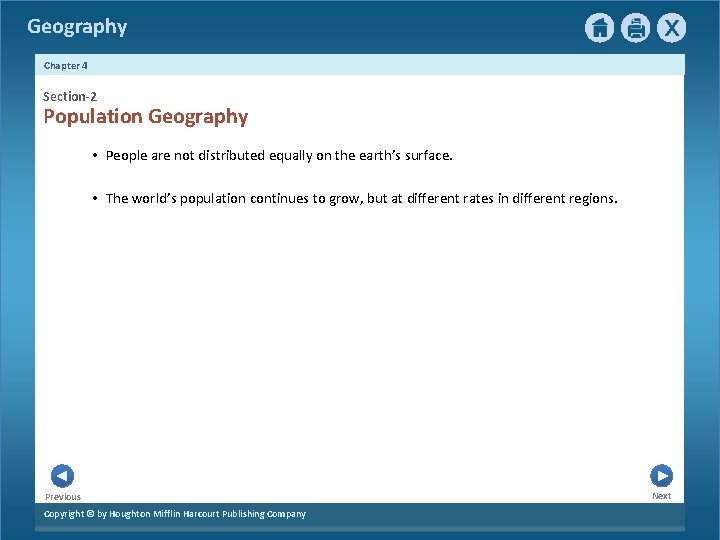
Geography Chapter 4 Section-2 Population Geography • People are not distributed equally on the earth’s surface. • The world’s population continues to grow, but at different rates in different regions. Previous Copyright © by Houghton Mifflin Harcourt Publishing Company Next
Geography Chapter 4 Section-2 Population Geography Worldwide Population Growth Birth and Death Rates • Number of live births per thousand population is the birthrate • Fertility rate—average, lifetime number of children born to a woman • Number of deaths per thousand people is the mortality rate • Infant mortality rate—deaths under age 1 per 1, 000 live births • Population growth rate, or rate of natural increase, figured by: − subtracting the mortality rate from the birthrate − warm summers and cold winters Previous Copyright © by Houghton Mifflin Harcourt Publishing Company Continued… Next
Geography Chapter 4 Worldwide Population Growth {continued} Population Pyramid • A population pyramid shows a population’s sex, age distribution • Enables the study of how events (wars, famines) affect population Previous Copyright © by Houghton Mifflin Harcourt Publishing Company Next
Geography Chapter 4 Population Distribution Habitable Lands • 2/3 of world’s population lives between 20°N and 60°N latitude • Human habitation in this zone: − dense where temperature and precipitation allow agriculture − also dense along coastal areas and in river valleys − more sparse in polar, mountain, desert regions Urban–Rural Mix • More than half of world’s population rural; rapidly becoming urban Previous Copyright © by Houghton Mifflin Harcourt Publishing Company Continued… Next
Geography Chapter 4 Population Distribution {continued} Migration • Reasons for migrating sometimes called push-pull factors • Push factors (drought, war) cause migration from an area • Pull factors (favorable economy, climate) spur migration to an area Previous Copyright © by Houghton Mifflin Harcourt Publishing Company Next
Geography Chapter 4 Estimating Population • Population density is the average number of people living in an area Carrying Capacity • Carrying capacity is the number of organisms an area can support − affected by fertile land, level of technology, economic prosperity Previous Copyright © by Houghton Mifflin Harcourt Publishing Company Next
Geography Chapter 4 Section-3 Political Geography • The world is divided into many political regions. • Local, national, and regional governments control aspects of life within the boundaries of the unit. Previous Copyright © by Houghton Mifflin Harcourt Publishing Company Next
Geography Chapter 4 Section-3 Political Geography Nations of the World Politics and Geography • An independent political unit, a state, or country: − occupies specific territory − controls its internal, external affairs • Nation—unified group with common culture living in a territory • A nation and state occupying same territory is a nation-state Previous Copyright © by Houghton Mifflin Harcourt Publishing Company Continued… Next
Geography Chapter 4 Nations of the World {continued} Types of Government • In a democracy, citizens hold political power • Political power held by a king or queen is a monarchy • In a dictatorship, a group or individual holds all political power • Communism is a governmental and economic system − political, economic power held by government in people’s name Previous Copyright © by Houghton Mifflin Harcourt Publishing Company Next
Geography Chapter 4 Geographic Characteristics of Nations Size • Physical size does not accurately reflect political, economic power Shape • Shape affects governance, transportation, relations with neighbors Location • A landlocked country has no direct outlet to the sea − may limit prosperity, as shipping and trade bring wealth • Hostile neighbors necessitate increased security Previous Copyright © by Houghton Mifflin Harcourt Publishing Company Next
Geography Chapter 4 National Boundaries Natural Boundaries • Formed by rivers, lakes, mountain chains Artificial Boundaries • Fixed line, generally following latitude, longitude: • Example: 49 degrees N latitude separates U. S. from Canada − often formally defined in treaties Previous Copyright © by Houghton Mifflin Harcourt Publishing Company Next
Geography Chapter 4 Regional Political Systems Political Subdivisions • Countries divide into smaller political units like cities, towns • Smaller units combine regionally into counties, states, etc. • Countries may join together to form international units: − examples: United Nations, European Union Previous Copyright © by Houghton Mifflin Harcourt Publishing Company Next
Geography Chapter 4 Section-4 Urban Geography • Nearly half the world’s population lives in urban areas. • Cities fulfill economic, residential, and cultural functions in different ways. Previous Copyright © by Houghton Mifflin Harcourt Publishing Company Next
Geography Chapter 4 Section-4 Urban Geography Growth of Urban Areas Cities • Urban geography is the study of how people use space in cities • Cities are populous centers of business, culture, innovation, change Urban Areas • Urban area develops around a central city; may be surrounded by: − suburbs—border central city, other suburbs − exurbs—have open land between them and central city • Central city plus its suburbs and exurbs called a metropolitan area Previous Copyright © by Houghton Mifflin Harcourt Publishing Company Continued… Next
Geography Chapter 4 Growth of Urban Areas {continued} Urbanization • Urbanization—rise in number of cities, resulting lifestyle changes Previous Copyright © by Houghton Mifflin Harcourt Publishing Company Next
Geography Chapter 4 City Locations Location and Function • Cities are often located near: − good transportation—lakes, rivers, coastline − plentiful natural resources • As a result, cities tend to: − become transportation hubs − specialize in certain economic activities Previous Copyright © by Houghton Mifflin Harcourt Publishing Company Next
Geography Chapter 4 4 Land Use Patterns City Patterns • Basic land use patterns found in all cities: − residential (housing) − industrial (manufacturing) − commercial (retail) • Central business district (CBD)—core area of commercial activity Previous Copyright © by Houghton Mifflin Harcourt Publishing Company Next
Geography Chapter 4 The Functions of Cities A Variety of Functions • Shopping, entertainment, government services • Educational, recreational, and cultural activities • Transportation is essential to accomplish functions Previous Copyright © by Houghton Mifflin Harcourt Publishing Company Next
Geography Chapter 4 Section-5 Economic Geography • Economic activities depend on the resources of the land how people use them. • The level of economic development can be measured in different ways. Previous Copyright © by Houghton Mifflin Harcourt Publishing Company Next
Geography Chapter 4 5 Section-5 Economic Geography Economic Systems Economies • Economy—the production and exchange of goods and services • Economies are local, regional, national, international • Geographers study economic geography by • looking at: − how people in a region support themselves − how economic activity is linked regionally Previous Copyright © by Houghton Mifflin Harcourt Publishing Company Continued… Next
Geography Chapter 4 5 Economic Systems {continued} Types of Economic Systems • Economic system: way people produce and exchange goods, services • Four types of economic systems: − traditional, or barter, economy − command, or planned, economy − market economy, also called capitalism − mixed economy, a combination of command market Previous Copyright © by Houghton Mifflin Harcourt Publishing Company Next
Geography Chapter 4 5 Economic Activities Types of Economic Activity • In subsistence agriculture, food is raised for personal consumption • Raising food to sell to others is called market-oriented agriculture • Cottage industries involve small, home-based industrial production • Large industrial production comes from commercial industries Previous Copyright © by Houghton Mifflin Harcourt Publishing Company Continued… Next
Geography Chapter 4 Economic Activities {continued} Levels of Economic Systems • Four levels of economic activities: − primary involves gathering raw materials for immediate use − secondary adds value to material by changing its form − tertiary involves business or professional services − quaternary provides information, management, research services Previous Copyright © by Houghton Mifflin Harcourt Publishing Company Next
Geography Chapter 4 The Economics of Natural Resources Utilizing Nature’s Bounty • Natural Resources—Earth’s materials that have economic value • Materials become resources when they can be turned into goods Previous Copyright © by Houghton Mifflin Harcourt Publishing Company Continued… Next
Geography Chapter 4 5 The Economics of Natural Resources {continued} Utilizing Nature’s Bounty • Geographers divide natural resources into three types: − renewable resources (trees, seafood) can be replaced naturally − nonrenewable resources (metals, oil, coal) cannot be replaced − inexhaustible resources (sun, wind) are unlimited resources • Natural resources are a major part of world trade Previous Copyright © by Houghton Mifflin Harcourt Publishing Company Next
Geography Chapter 4 Economic Support Systems Infrastructure • Infrastructure—basic support systems to sustain economic growth − power, communications, transportation systems − water, sanitation, and education systems • Communications systems and technology both critical to development Previous Copyright © by Houghton Mifflin Harcourt Publishing Company Next
Geography Chapter 4 Measuring Economic Development Comparing Economies • Per capita income: average earnings person in a political unit GNP and GDP • Gross national product (GNP)—statistic to measure: − total value of goods, services produced by a country, globally • Gross domestic product (GDP)—statistic to measure: − total value of goods and services produced within a country Previous Copyright © by Houghton Mifflin Harcourt Publishing Company Continued… Next
Geography Chapter 4 Measuring Economic Development {continued} Development Levels • Developing nations have low GDP, per capita income • Developed nations have high GDP, per capita income Previous Copyright © by Houghton Mifflin Harcourt Publishing Company Next