
Geography Chapter 11 Answer in complete sentences What
- Slides: 31
Geography Chapter 11 Answer in complete sentences. What are push-pull factors? List some examples. How does the income gap affect Latin America, and what have the countries done to try to reduce the gap? Next Copyright © by Houghton Mifflin Harcourt Publishing Company
Geography Chapter 11 Today’s Issues: Latin America Its colonial past has left Latin America with long-term problems, including environmental crises, political instability, and poverty. Next Copyright © by Houghton Mifflin Harcourt Publishing Company
Geography Chapter 11 Today’s Issues: Latin America SECTION 1 Rain Forest Resources SECTION 2 Giving Citizens a Voice Case Study The Income Gap Previous Copyright © by Houghton Mifflin Harcourt Publishing Company Next
Geography Chapter 11 Section-1 Rain Forest Resources • Special-interest groups make competing demands on the resources of the rain forest. • As the rain forests are destroyed, the quality of life on earth is threatened. Previous Copyright © by Houghton Mifflin Harcourt Publishing Company Next
Geography Chapter 11 Section-1 Rain Forest Resources Rain Forest Land Uses Vanishing Biodiversity • Rain forest has biodiversity—wide range of plant, animal species − 50 million acres of rain forest worldwide destroyed annually Clearing the Rain Forests • Mahogany, cedar harvested, exported from Amazon • Poor native farmers clear rain forest for crops • Poor soil fertility, increased erosion lead to more timber clearing Previous Copyright © by Houghton Mifflin Harcourt Publishing Company Continued… Next
Geography Chapter 11 1 Rain Forest Land Uses {continued} Population Pressures • Over half of Amazon rain forest is in Brazil − growing population: 173 million in 2000, 200 million projected in 2020 Previous Copyright © by Houghton Mifflin Harcourt Publishing Company Next
Geography Chapter 11 1 The Price of Destruction Losing More than Just Trees • Deforestation—cutting down and clearing away trees Environmental Concerns • Rain forests regulate climate: absorb carbon dioxide, produce oxygen • Fewer forests means less carbon dioxide absorbed into space − it builds up in atmosphere, prevents heat from escaping − global warming—atmospheric temperature rises, weather patterns change Previous Copyright © by Houghton Mifflin Harcourt Publishing Company Continued… Next
Geography Chapter 11 The Price of Destruction {continued} Plants and Animals in Danger • Covers 6% of earth’s surface but has 50% of plant, animal species • Researchers are trying to develop medicines from rain forest plants Previous Copyright © by Houghton Mifflin Harcourt Publishing Company Next
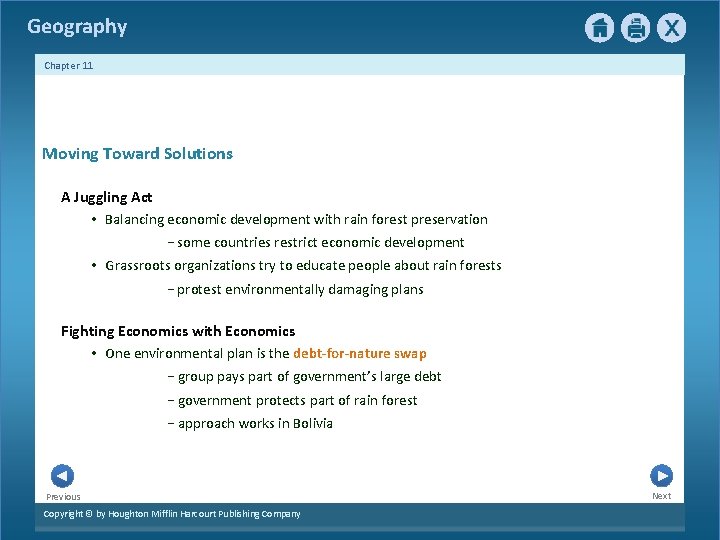
Geography Chapter 11 Moving Toward Solutions A Juggling Act • Balancing economic development with rain forest preservation − some countries restrict economic development • Grassroots organizations try to educate people about rain forests − protest environmentally damaging plans Fighting Economics with Economics • One environmental plan is the debt-for-nature swap − group pays part of government’s large debt − government protects part of rain forest − approach works in Bolivia Previous Copyright © by Houghton Mifflin Harcourt Publishing Company Next
Geography Chapter 11 In complete sentences, write two uses of the rain forest, two effects of deforestation, two solutions discussed yesterday, and two ways the economy factors into deforestation. What is a Brazilian dance that was influenced by Africa? Samba What is a martial art and dance that developed in Brazil from African influence? Capoeira Previous Copyright © by Houghton Mifflin Harcourt Publishing Company Next
Geography Chapter 11 Debt-for-nature-swap represent an innovative funding strategy that provides a long term solution to the problem. Through these agreements, governments are able to write off a proportion of their foreign held debt and instead direct payments into funds to support domestic conservation initiatives. Since 1987, debt-for-nature-swaps have generated over US$1 billion for conservation in developing countries. Previous Copyright © by Houghton Mifflin Harcourt Publishing Company Next
Geography Chapter 11 Debt-for-nature-swaps are enabling governments around the world to protect their lands and waters while ensuring continued social and economic development. These agreements are now being explored as a model through which some of the neediest countries could access resources to respond to the impacts of climate change. Previous Copyright © by Houghton Mifflin Harcourt Publishing Company Next
Geography Chapter 11 Costa Rica may be the first country to meet its international commitment to conserving its lands and waters. This incredible achievement has been made possible by a funding initiative known as Forever Costa Rica which has secured more than US $50 million to strengthen and expand the country’s network of national parks and protected areas. A debt-for-nature-swap worth US$27 million underpinned this deal. Previous Copyright © by Houghton Mifflin Harcourt Publishing Company Next
Geography Chapter 11 Section-2 Giving Citizens a Voice • Despite obstacles, democracy is beginning to succeed in Latin America. • The success of Latin American democracies depends on political, economic, and social reforms. Previous Copyright © by Houghton Mifflin Harcourt Publishing Company Next
Geography Chapter 11 Section-2 2 Giving Citizens a Voice A Struggle to Be Heard The Legacy of Colonialism • Since Spanish conquest in 1500 s, Native Americans ruled by others − under Spain: governors ruled the region, acting on behalf of monarchs • Minority of Spanish colonists still ruled after 1800 s independence • Oligarchy—non-democratic government of the few − press censored, free speech limited, dissent punished − discrimination against those not in Spanish ruling class − elections were rigged Previous Copyright © by Houghton Mifflin Harcourt Publishing Company Continued… Next
Geography Chapter 11 2 A Struggle to Be Heard {continued} The Legacy of Colonialism • If government couldn’t control people, military would seize power − form a junta—harsh government run by generals Previous Copyright © by Houghton Mifflin Harcourt Publishing Company Continued… Next
Geography Chapter 11 A Struggle to Be Heard {continued} The Rule of the Caudillo • Many 20 th-century Latin-American countries ruled by a caudillo − military dictator or political boss, such as Argentina’s Juan Peron − supported by military and wealthy; sometimes even elected Previous Copyright © by Houghton Mifflin Harcourt Publishing Company Continued… Next
Geography Chapter 11 A Struggle to Be Heard {continued} The Rule of the Caudillo • Partido Revolucionario Institucional (PRI) ruled Mexico for 71 years − in English, the Institutional Revolutionary Party − opposition parties legalized, and elections held − fraud and corruption keep PRI in power • Opposition parties make gains in 1997 congressional elections − Vicente Fox becomes first non-PRI president in 2000 Previous Copyright © by Houghton Mifflin Harcourt Publishing Company Next
Geography Chapter 11 Establishing Stable Democracies The Goals of Reform • Establish constitutional government, democracy − freely elected government that respects the law − citizens participate in political affairs − citizens are well-educated and economically secure • Economic stability needed for political stability Previous Copyright © by Houghton Mifflin Harcourt Publishing Company Continued… Next
Geography Chapter 11 2 Establishing Stable Democracies {continued} The Goals of Reform • In 1983 Raul Alfonsín becomes president of Argentina − first free election in decades, but economy was ruined by military rule − to fight inflation (rise in prices) Alfonsín freezes wages, prices − issues new currency to replace peso (which later returned) • Measures work at first, but by 1989 inflation is back − Carlos Menem elected as new president; introduced capitalist reforms − reduces government spending; sells off state industries, utilities Previous Copyright © by Houghton Mifflin Harcourt Publishing Company Continued… Next
Geography Chapter 11 Establishing Stable Democracies {continued} The Goals of Reform • Increase women’s role in politics, involvement in government − Marta Suplicy elected mayor of São Paulo, Brazil, in 2000 Previous Copyright © by Houghton Mifflin Harcourt Publishing Company Continued… Next
Geography Chapter 11 Establishing Stable Democracies {continued} Land Reform • Land reform—break up ruling minority’s large landholdings − take land, economic power from wealthy elite, give to peasant farmers • Mexican land reform begins when Benito Juarez becomes president in 1858 − wanted to redistribute land to break cycle of poverty − further land reform follows Revolution in early 20 th century Previous Copyright © by Houghton Mifflin Harcourt Publishing Company Next
Geography Chapter 11 Activity: In groups, you will designate the following people: President, General, Wealthy land owner, Native American, Farmer, Unemployed Peasant Within your group, you will each write your thoughts about democracy, the future of your country, and where you fit in a democratic society. You have until the end of class. This is due tomorrow. Previous Copyright © by Houghton Mifflin Harcourt Publishing Company Next
Geography Chapter 11 Case Study The Income Gap How can the economic gulf between rich and poor be bridged? BACKGROUND • Income gap—the difference between quality of life for rich and poor • Rio de Janeiro’s mix of wealth, poverty illustrates an income gap • Some people live in swamps, garbage dumps; others live in luxury • The gap is widening in Latin America; solutions have been proposed Previous Copyright © by Houghton Mifflin Harcourt Publishing Company Next
Geography Chapter 11 Case Study The Nature of the Problem Bridging the Gap Between Rich and Poor • Income gap—difference between quality of life of the rich and poor − gap is widening in most Latin American countries • Gap has many causes, including the impact of colonialism • Three ways to understand the issue: moral, economic, political Previous Copyright © by Houghton Mifflin Harcourt Publishing Company Continued… Next
Geography Chapter 11 Case Study The Nature of the Problem {continued} A Moral Issue • How can a caring society justify wealthy few, poor majority? • Catholic Church, other religious faiths see problem as moral − feel narrowing gap is matter of social justice Previous Copyright © by Houghton Mifflin Harcourt Publishing Company Continued… Next
Geography Chapter 11 Case Study The Nature of the Problem {continued} An Economic Dilemma • Most countries have free-market economies, minimal government rules − people have freedom, rewards they need to create wealth • Poor lack skills to fully, equally participate in such an economy − most have little education; can’t read, can’t find jobs − end up doing menial labor − conditions in slums bring disease, crime, short life spans Previous Copyright © by Houghton Mifflin Harcourt Publishing Company Continued… Next
Geography Chapter 11 Case Study The Nature of the Problem {continued} A Political Problem • Poverty creates desperation − people with nothing to lose are willing to take risks − they protest, fight, attempt to overthrow unjust governments, societies Previous Copyright © by Houghton Mifflin Harcourt Publishing Company Continued… Next
Geography Chapter 11 Case Study The Nature of the Problem {continued} A Political Problem • Region has had many bloody rebellions put down by militaries Guatemala − Argentina, Bolivia, Brazil, Colombia, El Salvador, − during civil wars, human rights and dignity are violated − rebels seek economic justice, militaries protect wealthy Previous Copyright © by Houghton Mifflin Harcourt Publishing Company Next
Geography Chapter 11 Case Study Possible Solutions Education, Politics, and Economics • Gap varies by country − 45% of Brazilians live in poverty − income gap is much narrower in Ecuador, Paraguay, Uruguay • Governments hope free-market economies will narrow gap − create economic opportunity, stability for all citizens Previous Copyright © by Houghton Mifflin Harcourt Publishing Company Continued… Next
Geography Chapter 11 Case Study Possible Solutions {continued} Education, Politics, and Economics • Democracy seen as essential for widespread prosperity − provides outlet for protest, opposition − policies can reflect will of people • Important to spend money on education − need literate, well-educated people for complex economy’s new jobs Previous Copyright © by Houghton Mifflin Harcourt Publishing Company Next