
Geography and Language Preservation of Language 2014 Pearson

- Slides: 18
Geography and Language: Preservation of Language © 2014 Pearson Education, Inc.
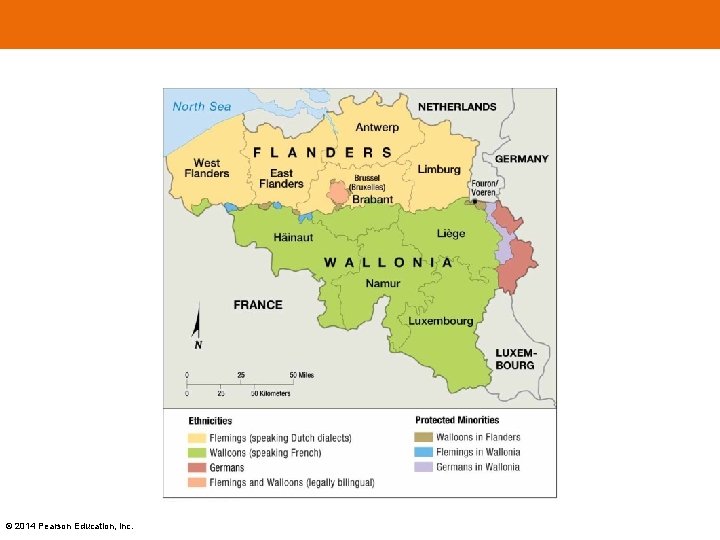
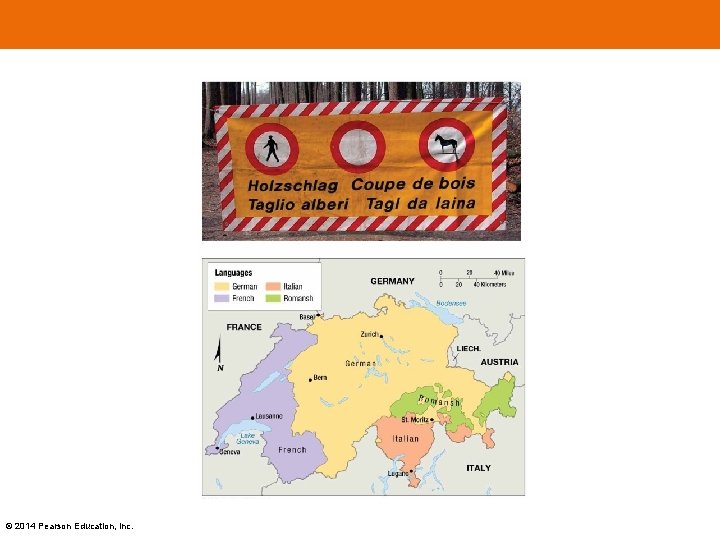
Why Do People Preserve Local Languages? • Language Diversity – Difficulties can arise at the boundary between two languages. • Varying degrees of difficulties – Belgium » Southern Belgians (Walloons) speak French. » Northern Belgians (Flemings) speak Flemish. » Pressure from Flemish speakers led to the division of Belgium into two independent regions with each controlling their own cultural affairs, public health, road construction, and urban development. – Switzerland » Cont’d on next slide. © 2014 Pearson Education, Inc.
© 2014 Pearson Education, Inc.
Why Do People Preserve Local Languages? • Language Diversity – Difficulties can arise at the boundary between two languages. • Varying degrees of difficulties – Switzerland » Peacefully exists with multiple languages. » Switzerland attributes success to decentralized government, in which local authorities hold most of the power, and decisions are frequently made on a local level by voter referenda. » Four official languages—German (65%), French (18%), Italian (10%), and Romansh (1%) © 2014 Pearson Education, Inc.
© 2014 Pearson Education, Inc.
Why Do People Preserve Local Languages? • Isolated Languages – An isolated language is one unrelated to any other and therefore not attached to any language family. • Arise from lack of interaction with speakers of other languages. • Ex. Basque in Europe – Only language currently spoken that survives since the period before the arrival of Indo-European speakers. – First language of 666, 000 people in the Pyrenees Mountains of northern Spain and southwestern France. » Mountain chain serving as a natural barrier to diffusion helped them preserve their language. • Ex. Icelandic – Language has changed less than any other Germanic language. © 2014 Pearson Education, Inc.
Why Do People Preserve Local Languages? • Extinct and Revived Languages – An extinct language is one that is no longer spoken or read in daily activities by anyone in the world. • Presently, 473 languages nearly extinct – – – 46 in Africa 182 in Americas 84 in Asia 9 in Europe 152 in Pacific • Ex. Native Americans – 74 languages extinct in the United States that were once spoken by Native Americans. © 2014 Pearson Education, Inc.
Why Do People Preserve Local Languages? • Preserving Endangered Languages: Celtic – Linguists expect hundreds of languages will become extinct during the twenty-first century. • Only about 300 languages are said to be safe from extinction. – Celtic Language • Significant to English speakers because of its primacy in the British Isles. • Survives only in remote parts of Scotland, Wales, and Ireland, and on the Brittany peninsula of France. • Celtic speakers must work hard to preserve their language in face of diffusion by others who have greater political and economic strength. © 2014 Pearson Education, Inc.
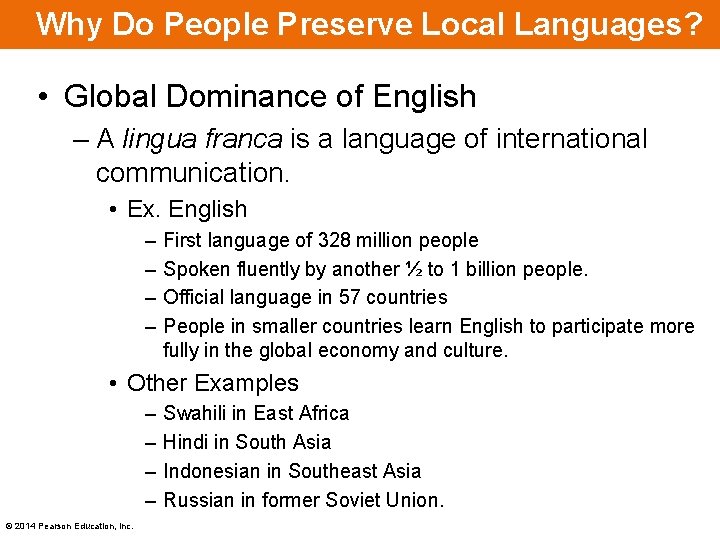
Why Do People Preserve Local Languages? • Global Dominance of English – A lingua franca is a language of international communication. • Ex. English – – First language of 328 million people Spoken fluently by another ½ to 1 billion people. Official language in 57 countries People in smaller countries learn English to participate more fully in the global economy and culture. • Other Examples – – © 2014 Pearson Education, Inc. Swahili in East Africa Hindi in South Asia Indonesian in Southeast Asia Russian in former Soviet Union.
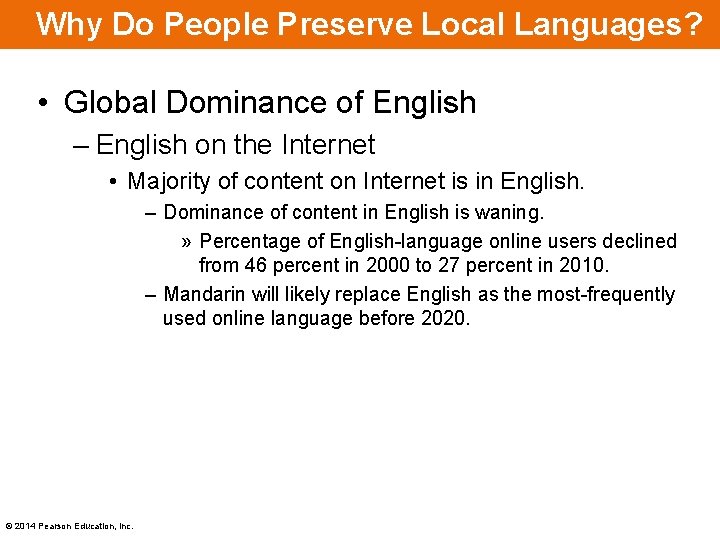
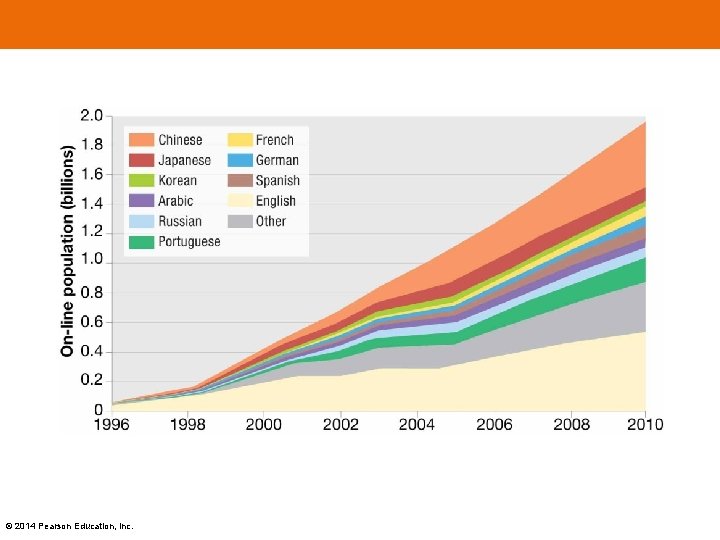
Why Do People Preserve Local Languages? • Global Dominance of English – English on the Internet • Majority of content on Internet is in English. – Dominance of content in English is waning. » Percentage of English-language online users declined from 46 percent in 2000 to 27 percent in 2010. – Mandarin will likely replace English as the most-frequently used online language before 2020. © 2014 Pearson Education, Inc.
© 2014 Pearson Education, Inc.
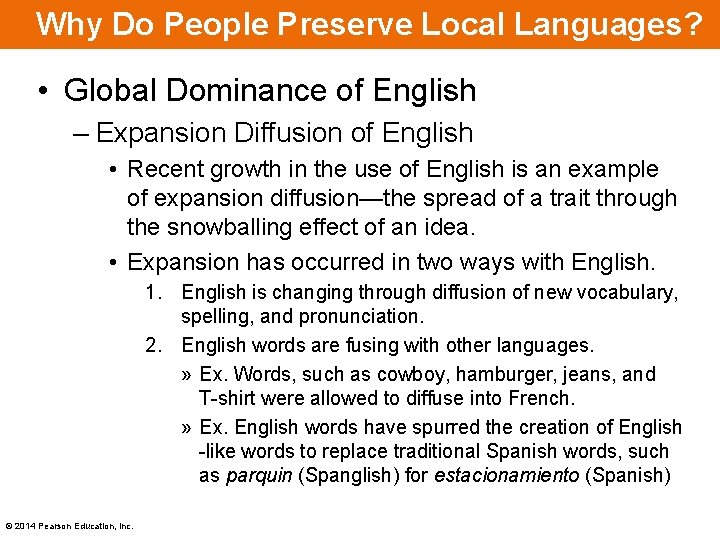
Why Do People Preserve Local Languages? • Global Dominance of English – Expansion Diffusion of English • Recent growth in the use of English is an example of expansion diffusion—the spread of a trait through the snowballing effect of an idea. • Expansion has occurred in two ways with English. 1. English is changing through diffusion of new vocabulary, spelling, and pronunciation. 2. English words are fusing with other languages. » Ex. Words, such as cowboy, hamburger, jeans, and T-shirt were allowed to diffuse into French. » Ex. English words have spurred the creation of English -like words to replace traditional Spanish words, such as parquin (Spanglish) for estacionamiento (Spanish) © 2014 Pearson Education, Inc.
© 2014 Pearson Education, Inc.
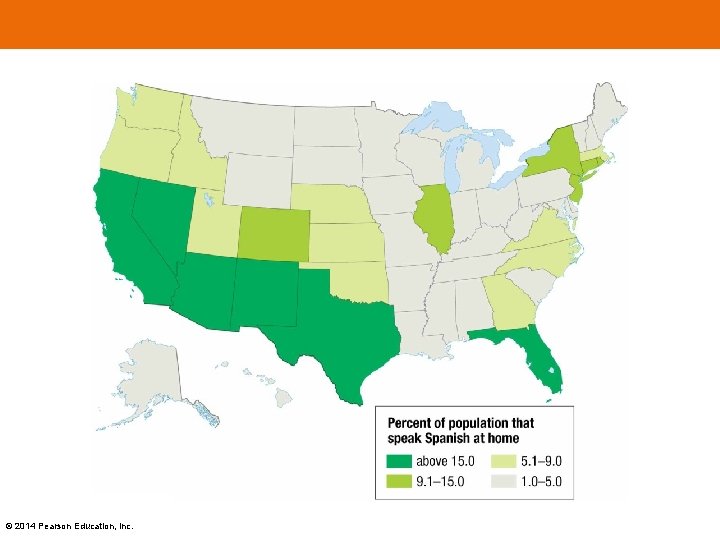
Why Do People Preserve Local Languages? • Spanish and French in the United States and Canada – Spanish • Increasingly important language in recent years in United States because of large-scale immigration from Latin America. – Some communities now issue public notices, government documents, and advertisements in Spanish. – Radio stations and TV now broadcast in Spanish in places where most of the 35 million Spanish speakers live. • In reaction, 30 states and number of localities have laws making English the official language. – Some courts have judged these laws to be unconstitutional restrictions on free speech. © 2014 Pearson Education, Inc.
© 2014 Pearson Education, Inc.
Why Do People Preserve Local Languages? • Spanish and French in the United States and Canada – French • Québec government has made the use of French mandatory in many daily activities. • Québec faces challenges integrating a large number of immigrants from Europe, Asia, and Latin America who don’t speak French. – Immigrants prefer to use English as the lingua franca because of its greater global usage. © 2014 Pearson Education, Inc.
Summary • Languages can be classified as belonging to particular families. Some families are divided into branches and groups. • English is in the Germanic branch of the Indo-European language family. Because nearly ½ of all humans currently speak a language in the same family, English is related to other languages. • Languages vary among places because of the regional influence on language that stems from isolation. © 2014 Pearson Education, Inc.
Summary • People preserve local languages, because a culture’s identity is intimately intertwined with its local language. © 2014 Pearson Education, Inc.