
Geographical Indications Food Safety and GIs Food Safety
- Slides: 19
Geographical Indications, Food Safety, and GIs, Food Safety, and Sustainability Challenges and Opportunities David A. Wirth Boston College Law School 145 th EAAE Seminar “Intellectual Property Rights for Geographical Indications: What is at Stake in the TTIP? ” April 14 -15, 2015 Parma
Paper examines interrelationship amongst: � Geographical indications (GIs); � Substantive food safety standards; and � Non-GI label indications of quality, safety, or sustainability such as “organic, ” “GMO-free, ” and “sustainably produced. ”
Paper attempts to: � Identify the varying purposes of these schemes; � Identify the various sources of policy and law that apply to them; and � Compare their treatment in various contexts, including TTIP and other free trade agreements.
International Protections for Geographic Indications European Union (TTIP negotiating position fact sheet): “The protection of geographical indications matters economically and culturally. ” “Create value for local communities through products that are deeply rooted in tradition, culture and geography. ” “Support rural development and promote new job opportunities in production, processing and other related services. ” “Geographical names with commercial value are exposed to misuse and counterfeiting. ” “Abuse of geographical indications limits access to certain markets and undermines consumer loyalty. ” “Fraudulent use of geographical indications hurts both producers and consumers. ”
United States (letter from 50 Senators): “EU has been using its free trade agreements (FTAs) to persuade its trading partners to impose barriers to U. S. exports under the guise of protection for its geographical indications. ”. . . “EU seeks to. . . impair U. S. competition by imposing restrictions on the use of common food names through TTIP. ” Protection of GIs operate as “a barrier to. . . trade and competition. ” EU seeking in TTIP seeking “gratuitous use of GIs as a protectionist measure. ”
Disparities in domestic regulatory treatment can result in trade disputes: � EU law protects “geographical indications. ” � U. S. law allows producers to protect GIs as trademarks. � Nonetheless, many EU GIs are not protected in the United States, and may not be registerable as trademarks because of their widespread generic use. � Products can be sold in the United States which use GIs protected in Europe, but which were not produced in that region. � E. g. , “Parmigiano Reggiano” under the EU system, “Parmesan” cheese produced in the United States is regularly sold there.
Trade-based theory of intellectual property protection, including GIs (TRIPS) � Unique amongst WTO agreements, establishes affirmative obligations for members to enact identified legal protections for intellectual property. � Reifies intellectual property, such as creative products like motion pictures, by creating goods that can be identified as such in international trade. � Other provisions in trade agreements are typically “negative, ” constrain governmental behavior. � TRIPS treats GIs as intellectual property requiring affirmative governmental protection and mutual recognition.
Doha mandate: � Creation of a multilateral register for wines and spirits. � Extension of the higher level of protection found in article 23 beyond wines and spirits to other products as cheeses and dried meats.
EU goals in TTIP: � “We want the US to improve its system in several important ways. ” � “These include: protecting an agreed list of EU GIs, with rules to stop other producers misusing them; [and] � “Enforcing those rules effectively. ”
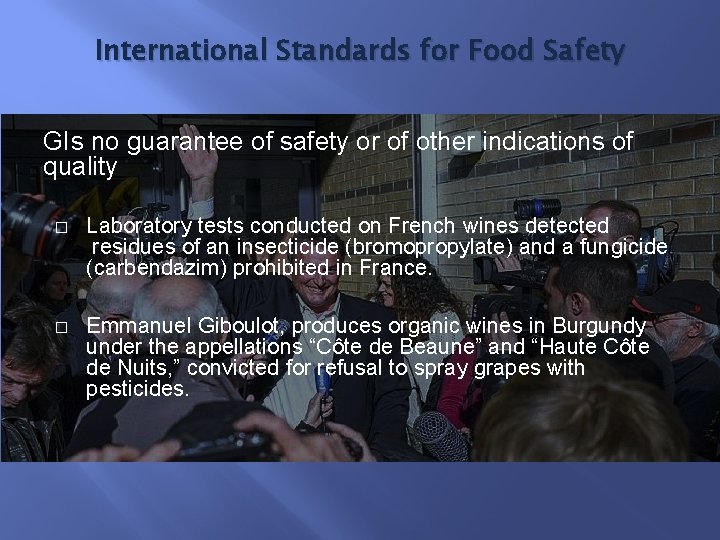
International Standards for Food Safety GIs no guarantee of safety or of other indications of quality � Laboratory tests conducted on French wines detected residues of an insecticide (bromopropylate) and a fungicide (carbendazim) prohibited in France. � Emmanuel Giboulot, produces organic wines in Burgundy under the appellations “Côte de Beaune” and “Haute Côte de Nuits, ” convicted for refusal to spray grapes with pesticides.
Harmonized International Food Safety Standards Codex Alimentarius Intergovernmental Dual function � Protect health � Promote trade Nonbinding, advisory As of 2006: � Evaluated 218 pesticides, establishing 2, 930 maximum residue limitations, � Published 1, 112 food additive provisions for 292 substances
ISO 22000 International federation of standardizing bodies from 163 countries Not an intergovernmental organization Work product: � Voluntary � Adopted standards by consensus Nonbinding, advisory 22000 series “auditable” (subject to verification by accredited private, third-party auditors or certifiers)
Purely private schemes � Global Food Safety Initiative � Global GAP � Concern among developing country exporters about operation as trade barriers, but not disciplined under trade agreements.
Trade-Based Disciplines on Food Safety Standards Trade agreements concerned with abuse of excessively rigorous standards as trade barriers (negative obligations) E. g. , WTO Agreement on the Application of Sanitary and Phytosanitary Standards Codex Standards � Transformed from floor to ceiling � Operate as both sword and shield. Stricter standards subjected to scientific tests WTO disputes � EU beef hormones � EU biotech
Other International Standards for Labeling of Food Proliferation of labels, e. g. , � Organically produced; � Sustainably produced; � Natural or all-natural; � GMO-free; � Antibiotic-free; � Hormone-free or no hormones added; � Free-range or cage-free; � Grass-fed or pasture-raised; and � Humane raised and/or handled
In contrast to food safety standards, little international harmonization Primarily through Codex: � Nutrition Labeling (mandatory to governmentallyestablished standards); � Organically produced foods (optional to governmentally-established standards) � GMOs (optional)
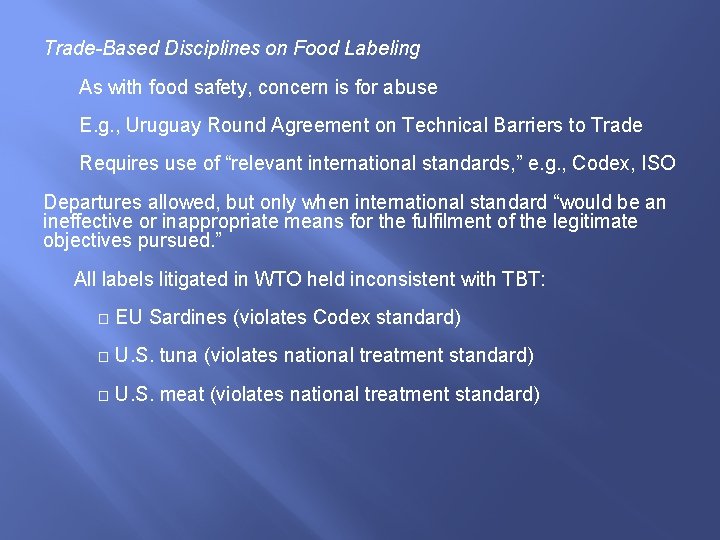
Trade-Based Disciplines on Food Labeling As with food safety, concern is for abuse E. g. , Uruguay Round Agreement on Technical Barriers to Trade Requires use of “relevant international standards, ” e. g. , Codex, ISO Departures allowed, but only when international standard “would be an ineffective or inappropriate means for the fulfilment of the legitimate objectives pursued. ” All labels litigated in WTO held inconsistent with TBT: � EU Sardines (violates Codex standard) � U. S. tuna (violates national treatment standard) � U. S. meat (violates national treatment standard)
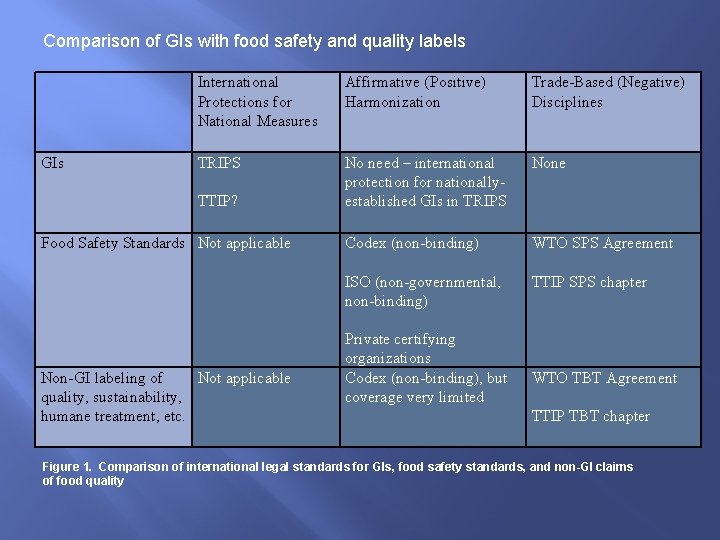
Comparison of GIs with food safety and quality labels GIs International Protections for National Measures Affirmative (Positive) Harmonization Trade-Based (Negative) Disciplines TRIPS No need – international protection for nationallyestablished GIs in TRIPS None Codex (non-binding) WTO SPS Agreement ISO (non-governmental, non-binding) TTIP SPS chapter TTIP? Food Safety Standards Not applicable Non-GI labeling of Not applicable quality, sustainability, humane treatment, etc. Private certifying organizations Codex (non-binding), but coverage very limited WTO TBT Agreement TTIP TBT chapter Figure 1. Comparison of international legal standards for GIs, food safety standards, and non-GI claims of food quality
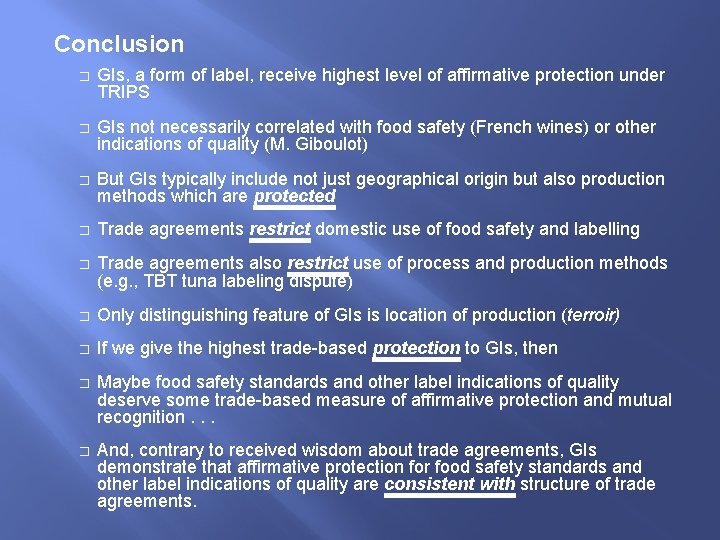
Conclusion � GIs, a form of label, receive highest level of affirmative protection under TRIPS � GIs not necessarily correlated with food safety (French wines) or other indications of quality (M. Giboulot) � But GIs typically include not just geographical origin but also production methods which are protected � Trade agreements restrict domestic use of food safety and labelling � Trade agreements also restrict use of process and production methods (e. g. , TBT tuna labeling dispute) � Only distinguishing feature of GIs is location of production (terroir) � If we give the highest trade-based protection to GIs, then � Maybe food safety standards and other label indications of quality deserve some trade-based measure of affirmative protection and mutual recognition. . . � And, contrary to received wisdom about trade agreements, GIs demonstrate that affirmative protection for food safety standards and other label indications of quality are consistent with structure of trade agreements.