
Geographical Controls of Weather and Climate Latitude Continentality
- Slides: 14
Geographical Controls of Weather and Climate • • Latitude Continentality Altitude Topography – Terrain dimensions – Relief – Slope and aspect
Latitude • Net radiation and temperature decrease as latitude increases • Elevation of treeline/snowline decreases poleward • Belt of alpine vegetation and permanent snow and ice are lower on mountains at high latitude versus the tropics
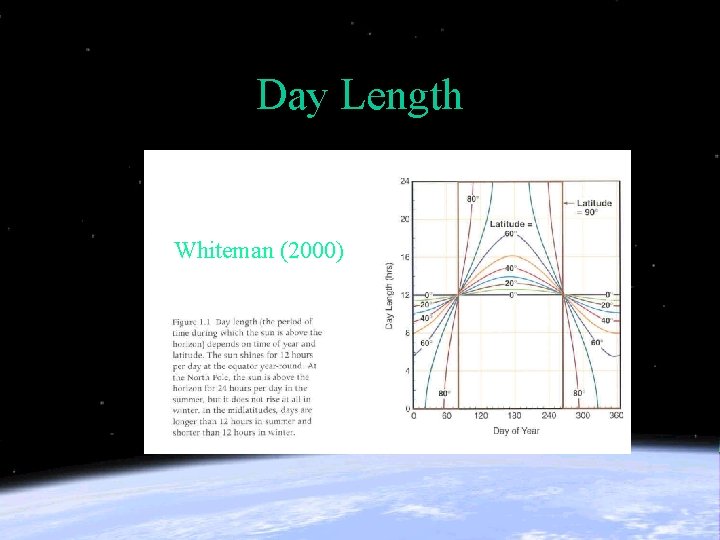
Day Length Whiteman (2000)
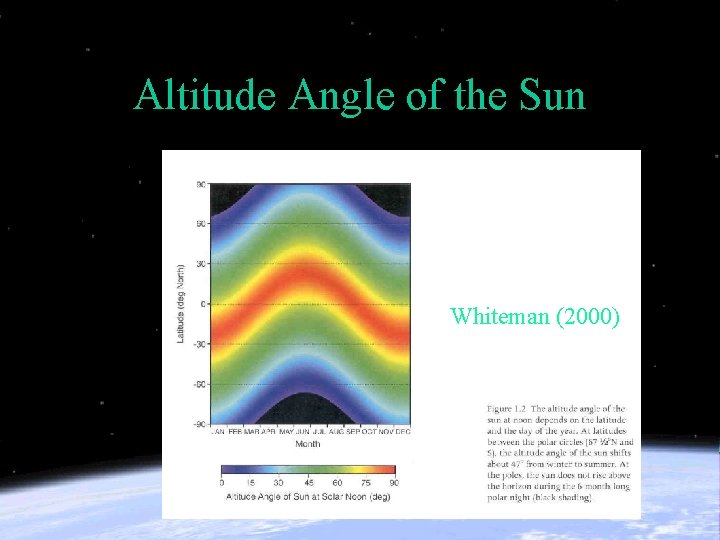
Altitude Angle of the Sun Whiteman (2000)
Continentality • Arises from differences in heat capacity and heat conduction of soils vs. water – Water able to store more heat – Soils less • Degree of continentality expressed by annual range of mean monthly temperature
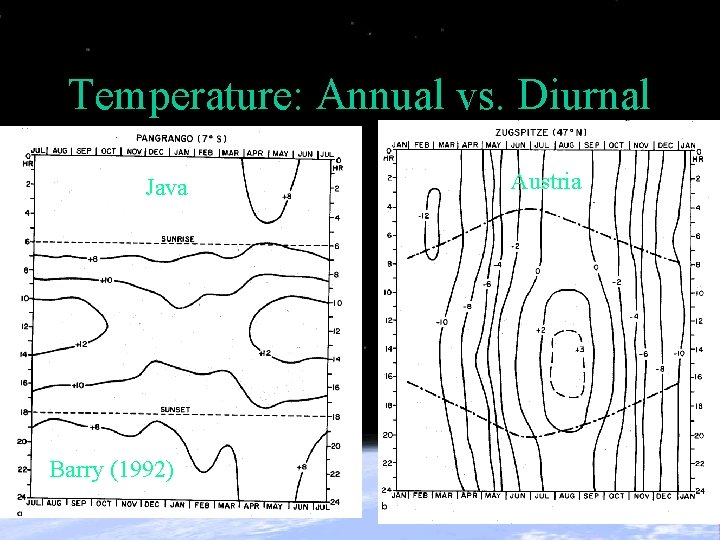
Temperature: Annual vs. Diurnal Java Barry (1992) Austria
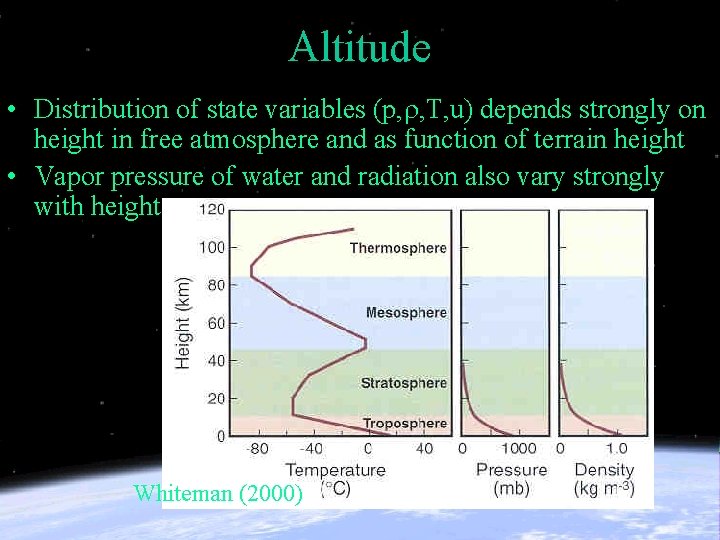
Altitude • Distribution of state variables (p, r, T, u) depends strongly on height in free atmosphere and as function of terrain height • Vapor pressure of water and radiation also vary strongly with height Whiteman (2000)
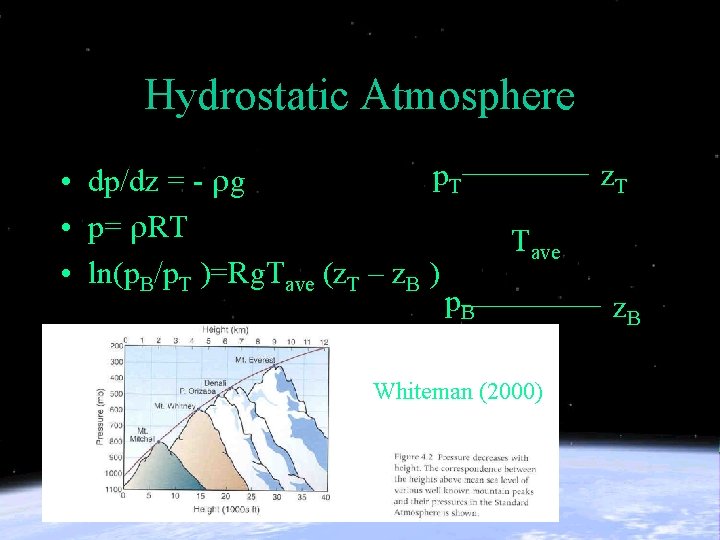
Hydrostatic Atmosphere p. T • dp/dz = - rg • p= r. RT • ln(p. B/p. T )=Rg. Tave (z. T – z. B ) p. B z. T Tave Whiteman (2000) z. B
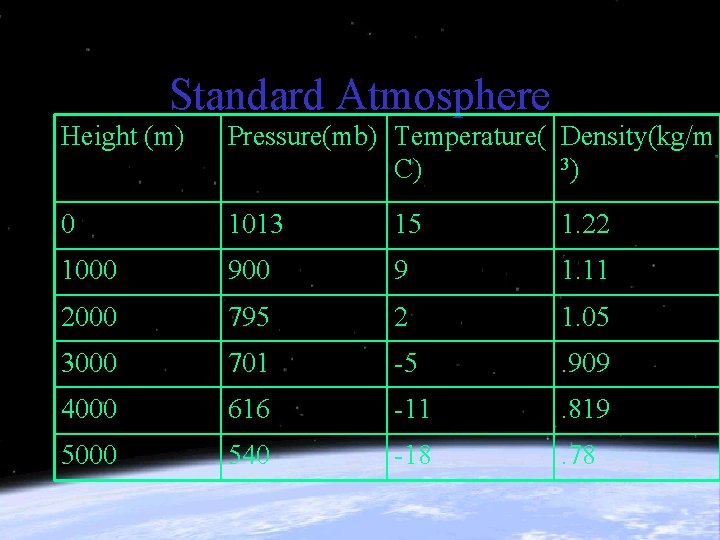
Standard Atmosphere Height (m) Pressure(mb) Temperature( Density(kg/m 3) C) 0 1013 15 1. 22 1000 9 1. 11 2000 795 2 1. 05 3000 701 -5 . 909 4000 616 -11 . 819 5000 540 -18 . 78
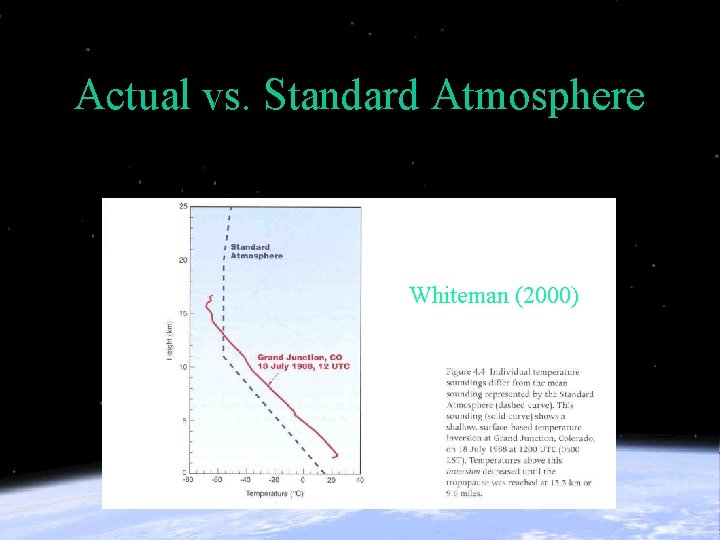
Actual vs. Standard Atmosphere Whiteman (2000)
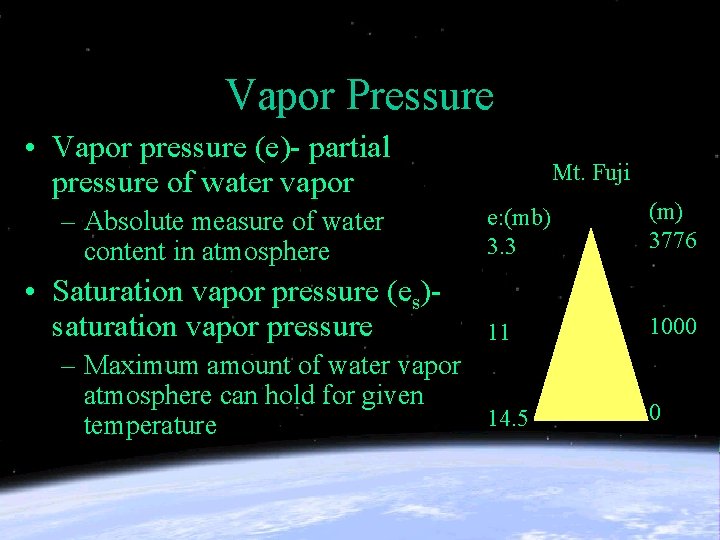
Vapor Pressure • Vapor pressure (e)- partial pressure of water vapor – Absolute measure of water content in atmosphere • Saturation vapor pressure (es)saturation vapor pressure Mt. Fuji e: (mb) 3. 3 (m) 3776 11 1000 – Maximum amount of water vapor atmosphere can hold for given 14. 5 temperature 0
Impacts of Vapor Pressure • Higher vapor pressure reduces transmission of IR • Refracts/absorbs solar radiation • Flux of water vapor proportional to (es –e); so, for given temperature, lower vapor pressure increases evaporation • Compared to free air, vapor pressure is higher usually near mountain – Reduces transmission of IR, which may increase temperature – Lowers condensation level – lowers drying power, i. e. , ability to transfer water from clothing/plants into atmosphere
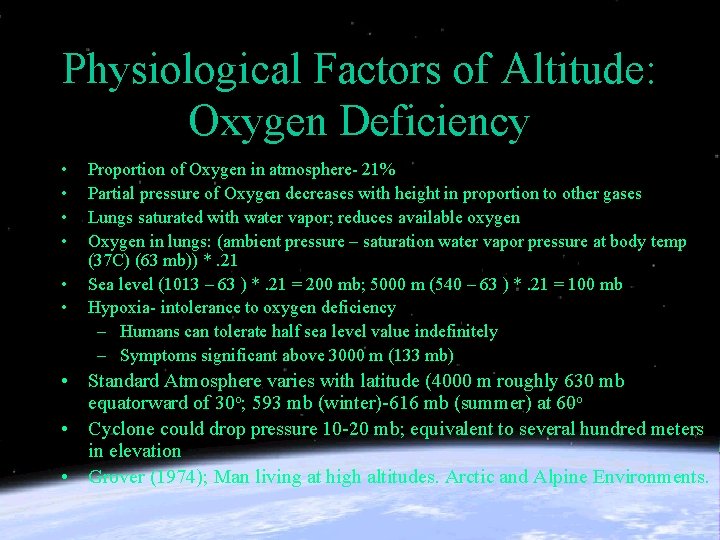
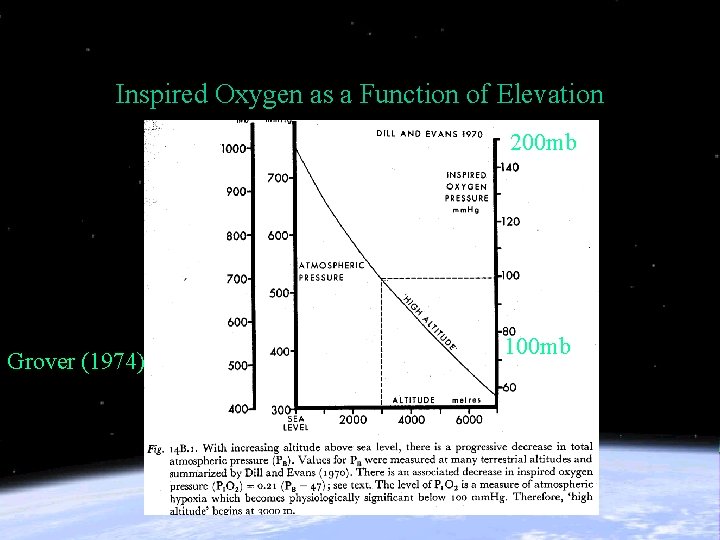
Physiological Factors of Altitude: Oxygen Deficiency • • • Proportion of Oxygen in atmosphere- 21% Partial pressure of Oxygen decreases with height in proportion to other gases Lungs saturated with water vapor; reduces available oxygen Oxygen in lungs: (ambient pressure – saturation water vapor pressure at body temp (37 C) (63 mb)) *. 21 Sea level (1013 – 63 ) *. 21 = 200 mb; 5000 m (540 – 63 ) *. 21 = 100 mb Hypoxia- intolerance to oxygen deficiency – Humans can tolerate half sea level value indefinitely – Symptoms significant above 3000 m (133 mb) • Standard Atmosphere varies with latitude (4000 m roughly 630 mb equatorward of 30 o; 593 mb (winter)-616 mb (summer) at 60 o • Cyclone could drop pressure 10 -20 mb; equivalent to several hundred meters in elevation • Grover (1974); Man living at high altitudes. Arctic and Alpine Environments.
Inspired Oxygen as a Function of Elevation 200 mb Grover (1974) 100 mb