
Geographic Information System SPATIAL DATA MODELING Understand the
- Slides: 16
Geographic Information System SPATIAL DATA MODELING
• Understand the spatial objects and instances • Understand the spatial relationship • Understand the basic of spatial query Objectives
v Spatial Taxonomy: § multitude of descriptions available to organize space. § Topology models homeo-morphic relationships, e. g. overlap § Graphs models connectivity, Shortest-Path v Spatial data models § rules to identify identifiable objects and properties of space § Object model helps manage identifiable things, e. g. mountains, cities, land-parcels etc. § Field model helps manage continuous and amorphous phenomenon, e. g. wetlands, satellite imagery, snowfall etc. Taxonomy & Data Models
v A collection of concepts to describe: § structure of a database § data relationships § data semantics § data constraints v Data Model Operations: operations for specifying database retrievals and updates. Data Models
v Without lose of generality, assume 2 -D and GIS application, two basic things need to be represented: § Objects in space: cities, forests, or rivers modeling single objects § Space: say something about every point in space (e. g. , partition of a country into districts) modeling spatially related collections of objects Modeling (objects)
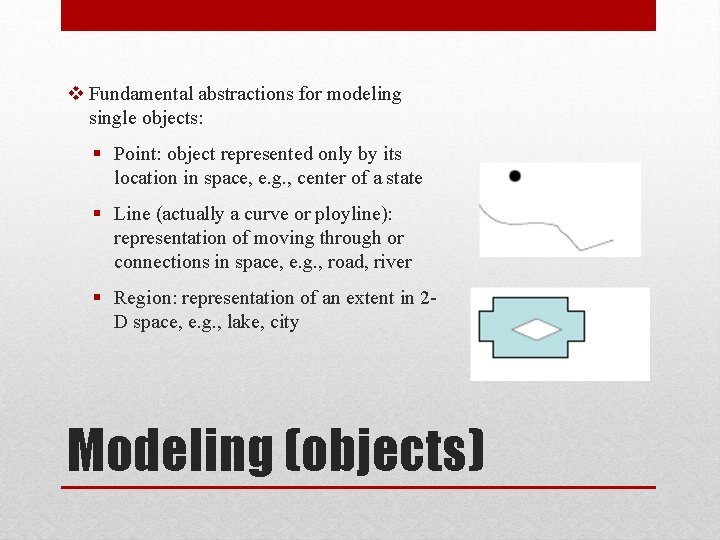
v Fundamental abstractions for modeling single objects: § Point: object represented only by its location in space, e. g. , center of a state § Line (actually a curve or ployline): representation of moving through or connections in space, e. g. , road, river § Region: representation of an extent in 2 D space, e. g. , lake, city Modeling (objects)
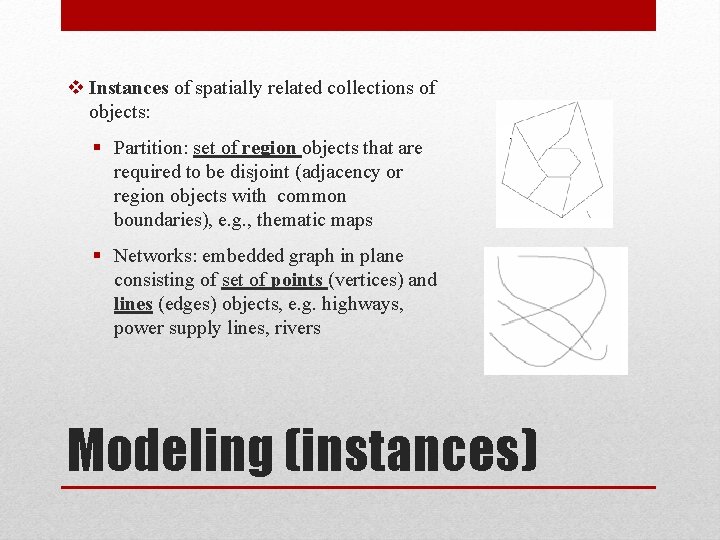
v Instances of spatially related collections of objects: § Partition: set of region objects that are required to be disjoint (adjacency or region objects with common boundaries), e. g. , thematic maps § Networks: embedded graph in plane consisting of set of points (vertices) and lines (edges) objects, e. g. highways, power supply lines, rivers Modeling (instances)
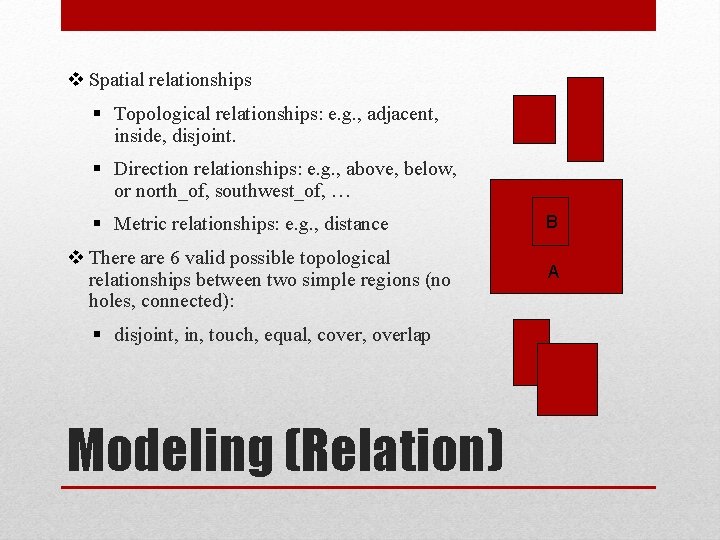
v Spatial relationships § Topological relationships: e. g. , adjacent, inside, disjoint. § Direction relationships: e. g. , above, below, or north_of, southwest_of, … § Metric relationships: e. g. , distance v There are 6 valid possible topological relationships between two simple regions (no holes, connected): § disjoint, in, touch, equal, cover, overlap Modeling (Relation) B A
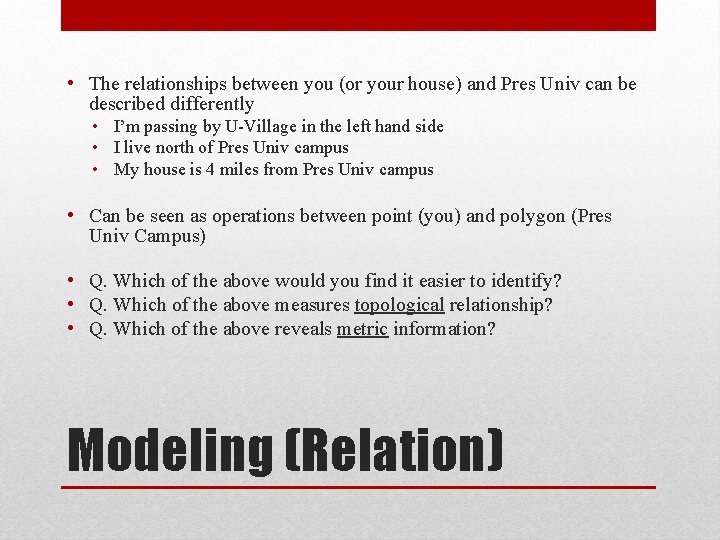
• The relationships between you (or your house) and Pres Univ can be described differently • I’m passing by U-Village in the left hand side • I live north of Pres Univ campus • My house is 4 miles from Pres Univ campus • Can be seen as operations between point (you) and polygon (Pres Univ Campus) • Q. Which of the above would you find it easier to identify? • Q. Which of the above measures topological relationship? • Q. Which of the above reveals metric information? Modeling (Relation)
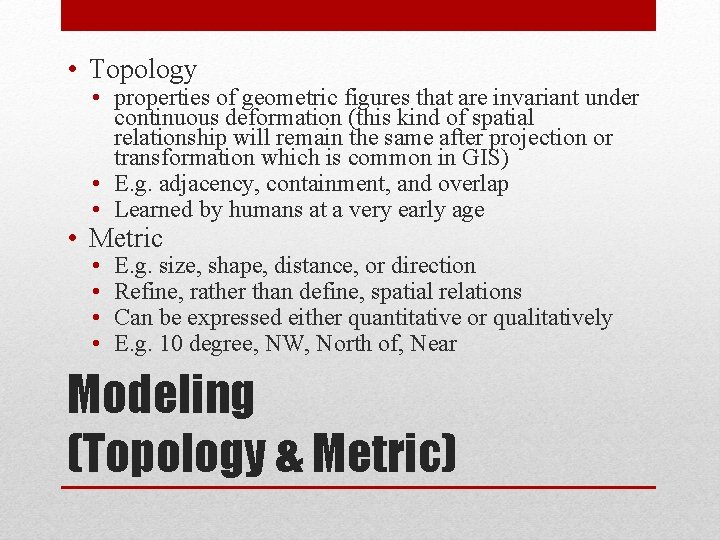
• Topology • properties of geometric figures that are invariant under continuous deformation (this kind of spatial relationship will remain the same after projection or transformation which is common in GIS) • E. g. adjacency, containment, and overlap • Learned by humans at a very early age • Metric • • E. g. size, shape, distance, or direction Refine, rather than define, spatial relations Can be expressed either quantitative or qualitatively E. g. 10 degree, NW, North of, Near Modeling (Topology & Metric)
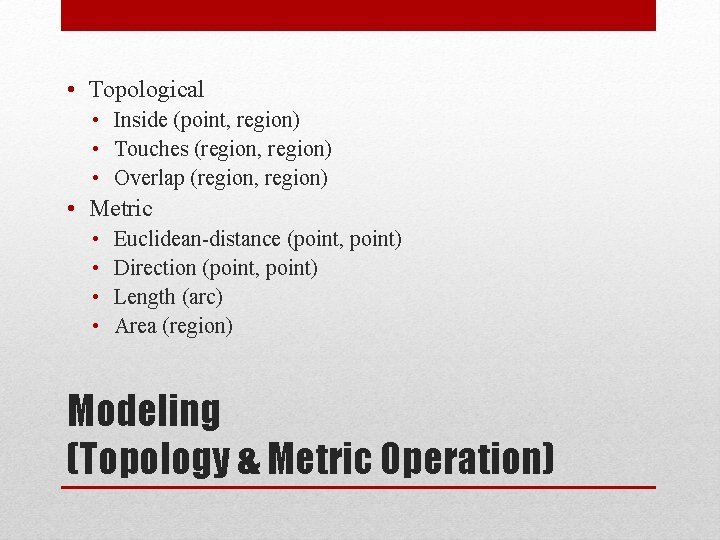
• Topological • Inside (point, region) • Touches (region, region) • Overlap (region, region) • Metric • • Euclidean-distance (point, point) Direction (point, point) Length (arc) Area (region) Modeling (Topology & Metric Operation)
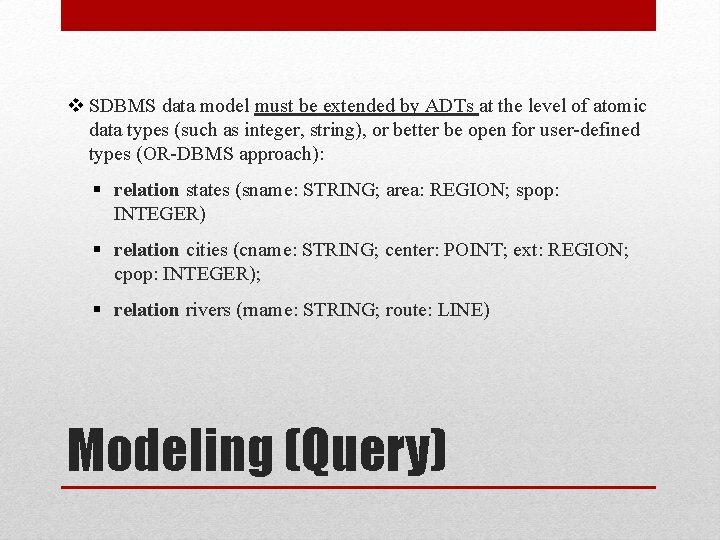
v SDBMS data model must be extended by ADTs at the level of atomic data types (such as integer, string), or better be open for user-defined types (OR-DBMS approach): § relation states (sname: STRING; area: REGION; spop: INTEGER) § relation cities (cname: STRING; center: POINT; ext: REGION; cpop: INTEGER); § relation rivers (rname: STRING; route: LINE) Modeling (Query)
v Spatial query language § Spatial data types, e. g. point, linestring, polygon, … § Spatial operations, e. g. overlap, distance, nearest neighbor, … § Callable from a query language (e. g. SQL 3) of underlying DBMS • SELECT S. name • FROM Senator S • WHERE S. district. Area() < 300 Modeling (Query)
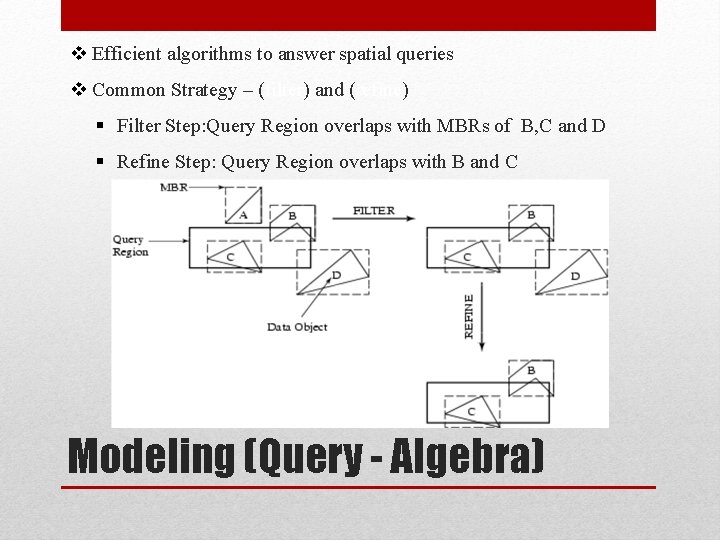
v Efficient algorithms to answer spatial queries v Common Strategy – (filter) and (refine) § Filter Step: Query Region overlaps with MBRs of B, C and D § Refine Step: Query Region overlaps with B and C Modeling (Query - Algebra)
Fundamental spatial algebra operations: v Spatial selection: returning those objects satisfying a spatial predicate with the query object § “All cities in Taiwan” SELECT sname FROM cities c WHERE c. center inside Taiwan. area § “All rivers intersecting a query window” SELECT * FROM rivers r WHERE r. route intersects Window § “All big cities no more than 50 Kms from Taichung” SELECT cname FROM cities c WHERE dist(c. center, Taichung. center) and c. pop > 500 (conjunction with other predicates and query optimization) Modeling (Query) < 100
v Spatial join: A join which compares any two joined objects based on a predicate on their spatial attribute values. § “For each river pass through Taichung, find all cities within less than 50 Kms. ” SELECT r. rname, c. cname, FROM rivers r, cities c WHERE r. route intersects Taichung. area and dist(r. route, c. area) < 50 Km Modeling (Query)