
Geographic Information System A geographic information system GIS
- Slides: 5
Geographic Information System A geographic information system (GIS) is a computer-based software and hardware system for obtaining, managing and analysing spatial data. • GIS offer powerful tools for adding spatial perspectives to: – Planning – Research – Technology transfer – Impact assessment
Geographic Information System • But they have major drawbacks for developing countries : - High costs of software - High costs of hardware - Needs for specialized training These constraints to effective use of GIS lead CIRAD to develop a tool for the spatial analysis and representation of PROMISE crop modeling results. This tool will allow the user to display on a map the input data for the model as well as the outputs from the model.
Geographic Information System With this tool we can manage spatial data : - Display (pan, zoom in, zoom out) - Thematic analysis (classification, …) - Queries and graphic selections (data extraction) - Data exportation - Layout and Printing - NO scale limits
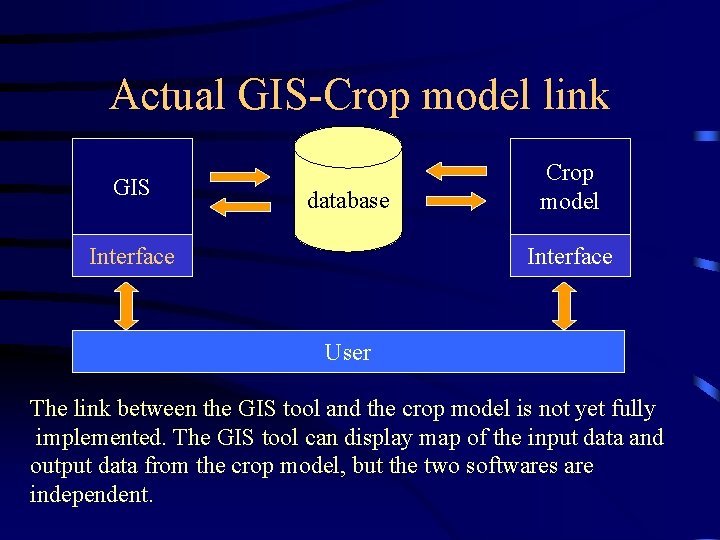
Actual GIS-Crop model link GIS database Interface Crop model Interface User The link between the GIS tool and the crop model is not yet fully implemented. The GIS tool can display map of the input data and output data from the crop model, but the two softwares are independent.
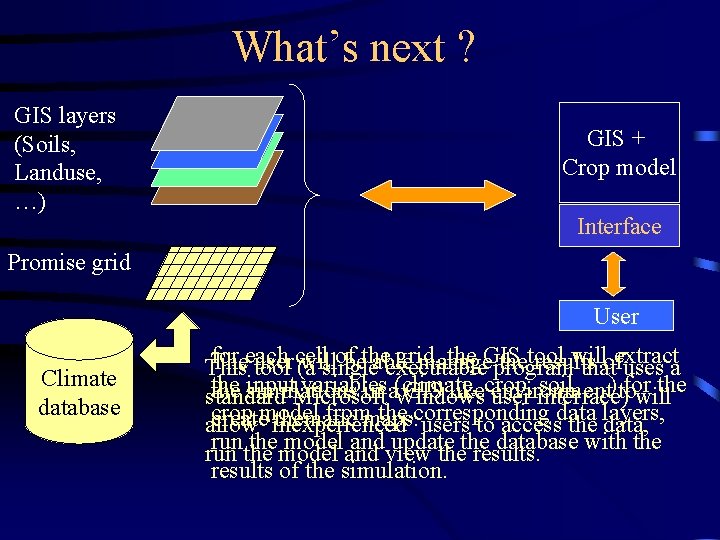
What’s next ? GIS layers (Soils, Landuse, …) GIS + Crop model Interface Promise grid User Climate database for ofbethe grid, the GIS will Theeach usercell will able manage thetool results ofextract This tool (a single executable program that uses a the variables (climate, soil, …) to for the input simulations in a. Windows GIS likecrop, environment standard Microsoft user interface) will crop frommaps. the corresponding createmodel thematic allow ‘inexperienced’ users to accessdata the layers, data, runthe themodeland andview update database with the run thethe results of the simulation.