
Geographers Toolkit Introduction to Mapping Skills Geography of
- Slides: 22
Geographer’s Toolkit (Introduction to Mapping Skills) Geography of Canada Mr. Hartley, Malvern Collegiate
Geographer’s Toolkit 1. Parts of a Map – Map Symbols – Mapping Your Location 2. Types of Maps
What is a Map? • A map is a representation of the Earth’s features drawn on a flat surface. • Maps use symbols and colours to represent features of an area, simplifying the real world.
Map Labelling & Colouring • Cartography is the art of drawing accurate, easily readable, attractive maps. • Labels – Should be neatly printed – Should be spelled correctly – Should be parallel to the base of the map (except for natural features such as rivers and mountain ranges) – A dot should be used to locate cities, with the name of the city as close to the dot as possible.
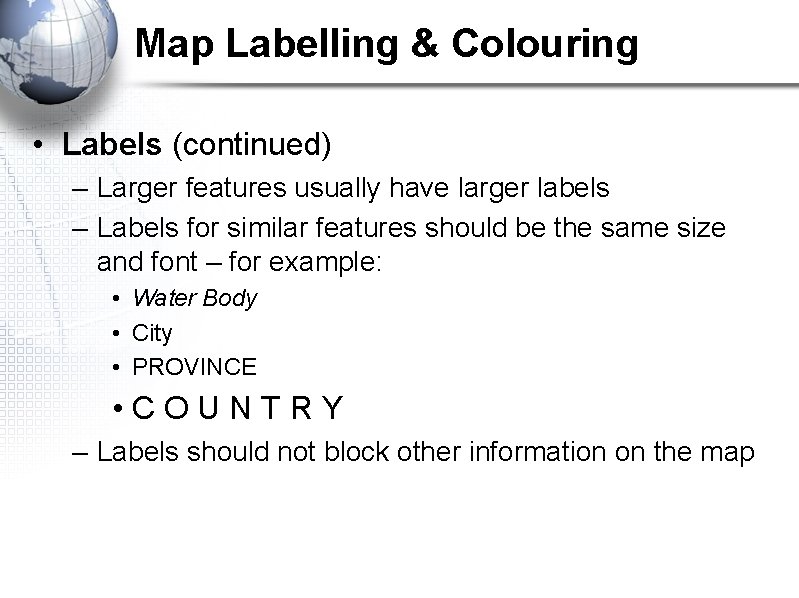
Map Labelling & Colouring • Labels (continued) – Larger features usually have larger labels – Labels for similar features should be the same size and font – for example: • Water Body • City • PROVINCE • COUNTRY – Labels should not block other information on the map
Map Labelling & Colouring • Colouring – Maps should be properly colour coded to show the different areas on the map – Use solid colours only, not shading patterns – White or black are not acceptable shading colours – Grey should be used for areas not important to the map – Blue should only be used for water bodies *Remember these points for your assignment next class!
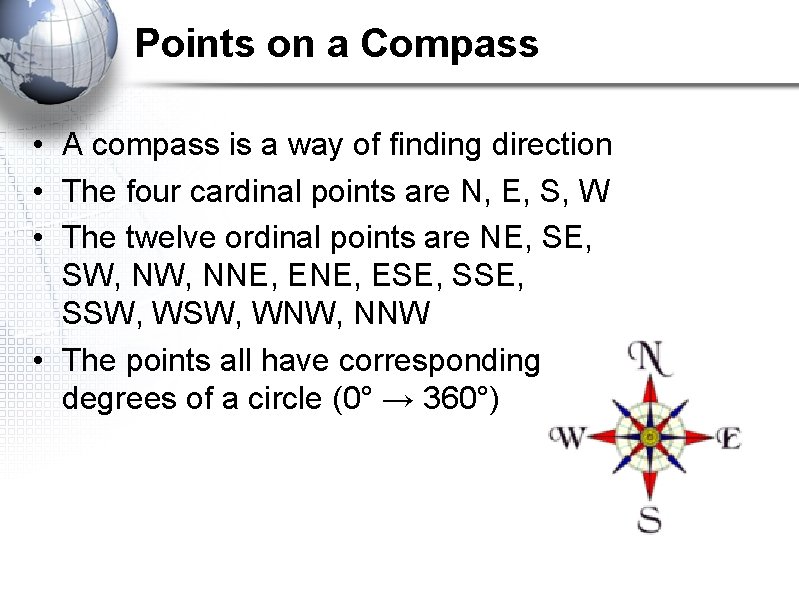
Points on a Compass • A compass is a way of finding direction • The four cardinal points are N, E, S, W • The twelve ordinal points are NE, SW, NNE, ESE, SSW, WNW, NNW • The points all have corresponding degrees of a circle (0° → 360°)
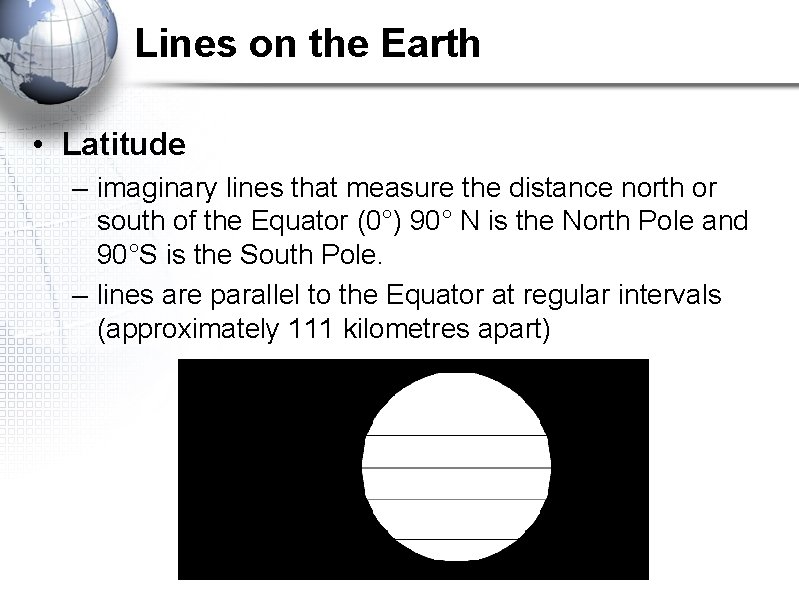
Lines on the Earth • Latitude – imaginary lines that measure the distance north or south of the Equator (0°) 90° N is the North Pole and 90°S is the South Pole. – lines are parallel to the Equator at regular intervals (approximately 111 kilometres apart)
Lines on the Earth • Longitude – imaginary lines that measure the distance east or west of the Prime Meridian (0°). – all lines begin and end at the poles and therefore are not at a fixed distance apart. – the Prime Meridian (0°) was arbitrarily chosen at a point that runs through Greenwich, England. – the International Date Line (180°) is the opposite of the Prime Meridian. So you can travel 180° East and 180° West
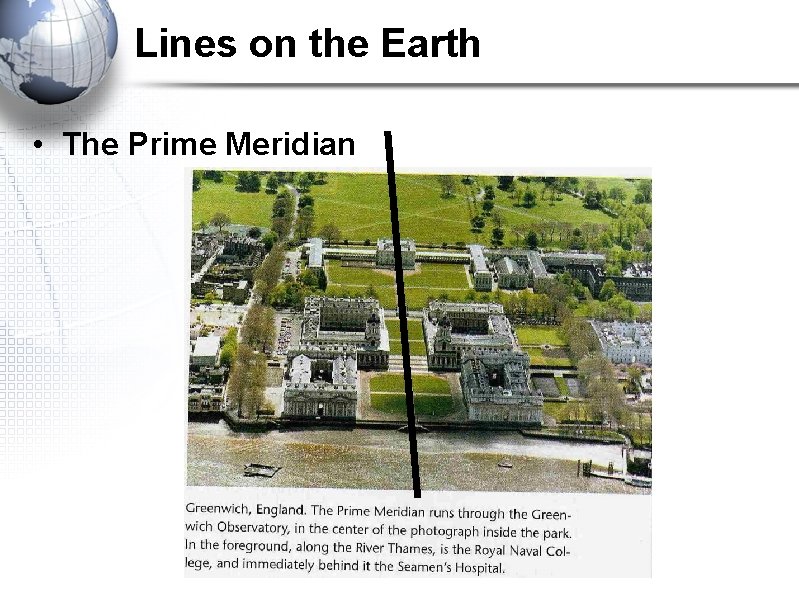
Lines on the Earth • The Prime Meridian
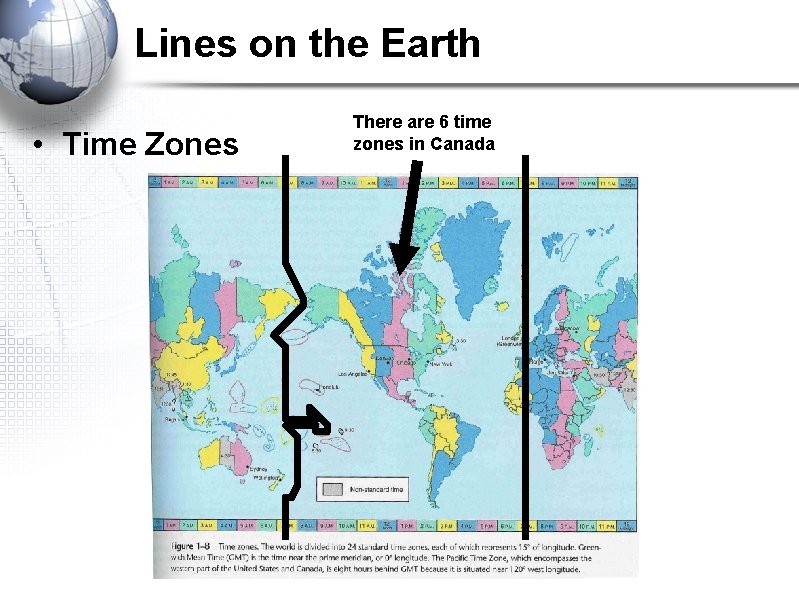
Lines on the Earth • Time Zones There are 6 time zones in Canada
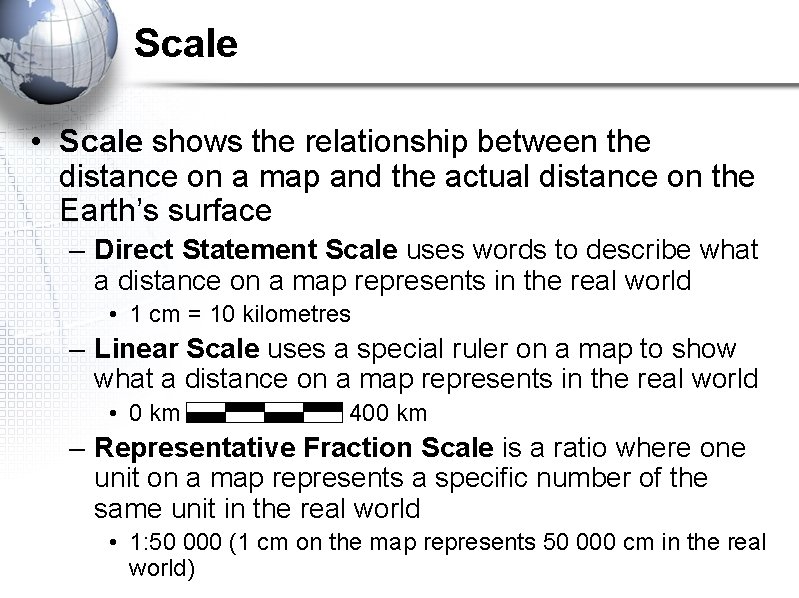
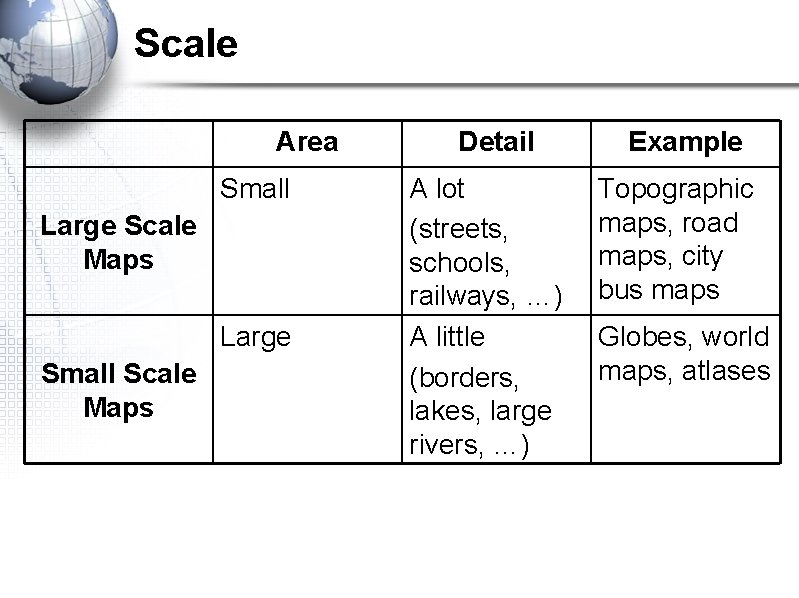
Scale • Scale shows the relationship between the distance on a map and the actual distance on the Earth’s surface – Direct Statement Scale uses words to describe what a distance on a map represents in the real world • 1 cm = 10 kilometres – Linear Scale uses a special ruler on a map to show what a distance on a map represents in the real world • 0 km 400 km – Representative Fraction Scale is a ratio where one unit on a map represents a specific number of the same unit in the real world • 1: 50 000 (1 cm on the map represents 50 000 cm in the real world)
Scale Area Small Large Scale Maps Large Small Scale Maps Detail A lot (streets, schools, railways, …) A little (borders, lakes, large rivers, …) Example Topographic maps, road maps, city bus maps Globes, world maps, atlases
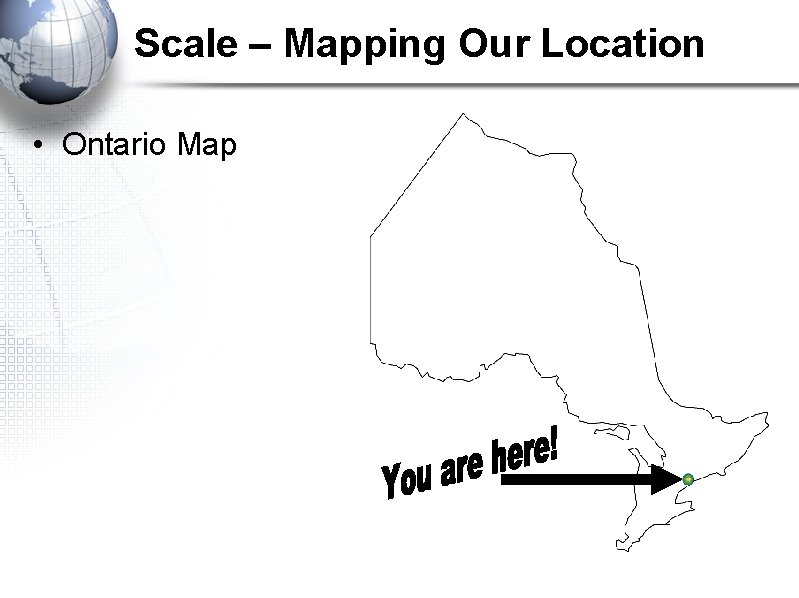
Scale – Mapping Our Location • Ontario Map
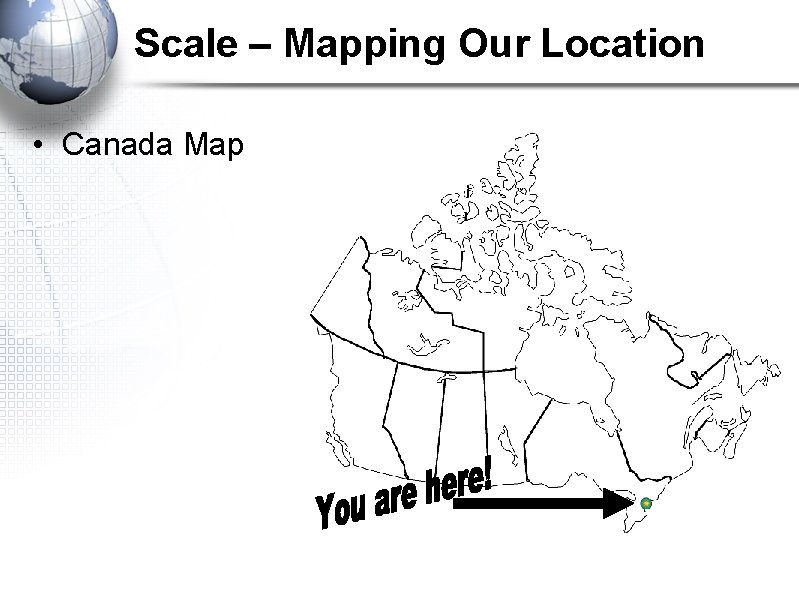
Scale – Mapping Our Location • Canada Map
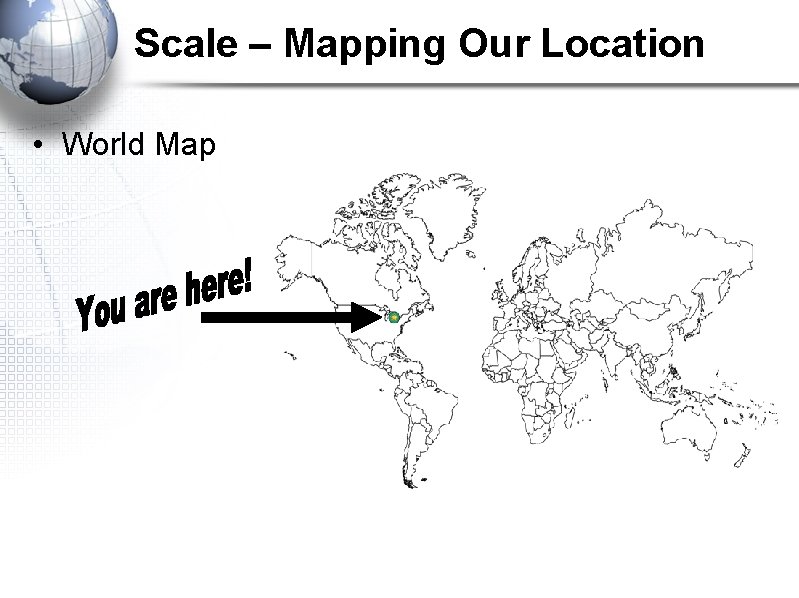
Scale – Mapping Our Location • World Map
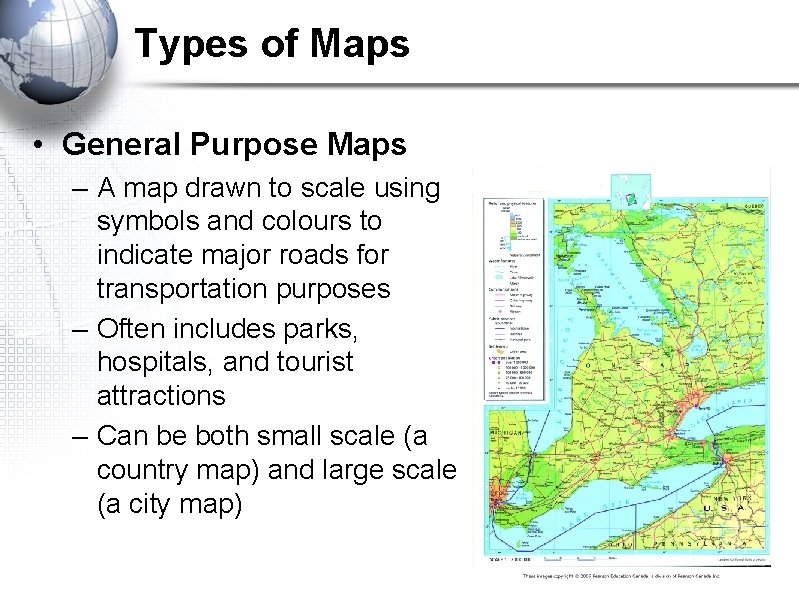
Types of Maps • General Purpose Maps – A map drawn to scale using symbols and colours to indicate major roads for transportation purposes – Often includes parks, hospitals, and tourist attractions – Can be both small scale (a country map) and large scale (a city map)
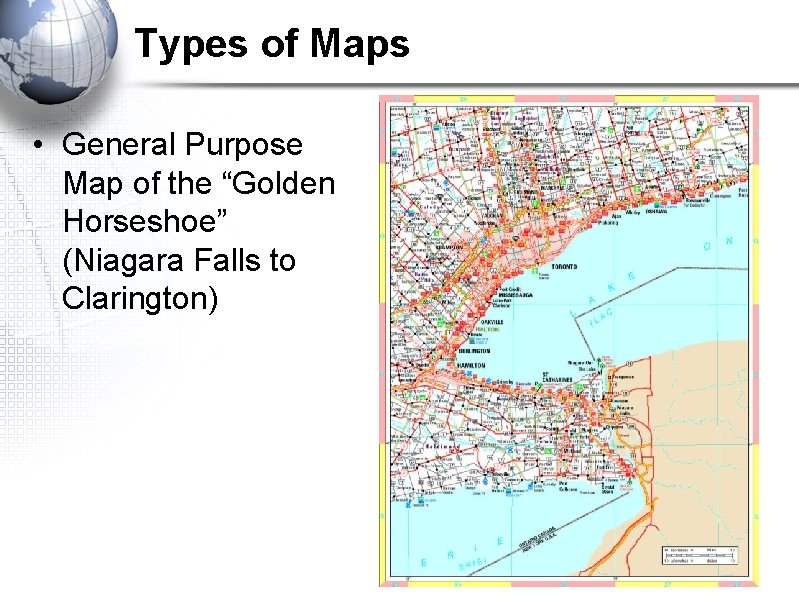
Types of Maps • General Purpose Map of the “Golden Horseshoe” (Niagara Falls to Clarington)
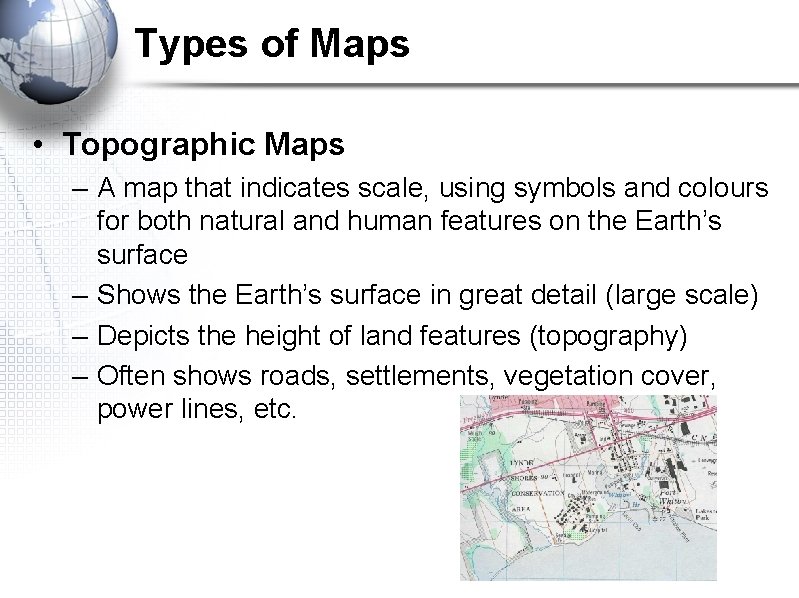
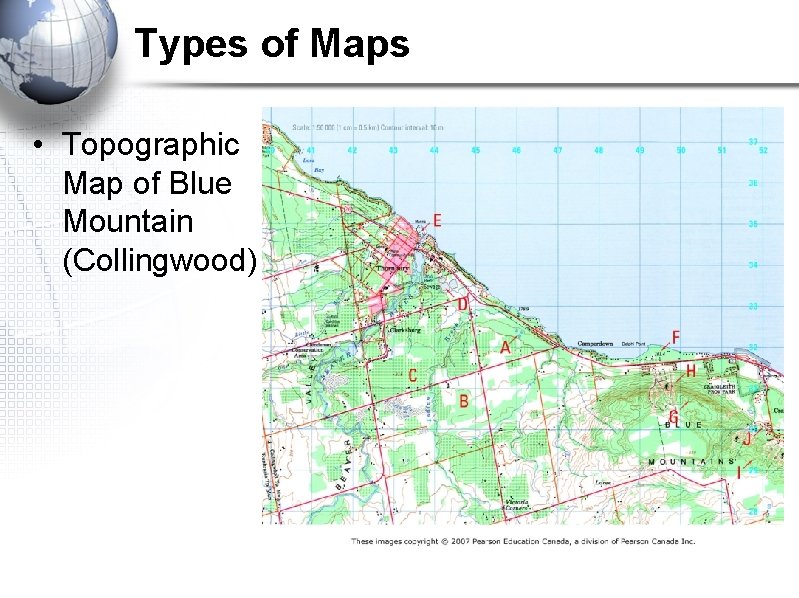
Types of Maps • Topographic Maps – A map that indicates scale, using symbols and colours for both natural and human features on the Earth’s surface – Shows the Earth’s surface in great detail (large scale) – Depicts the height of land features (topography) – Often shows roads, settlements, vegetation cover, power lines, etc.
Types of Maps • Topographic Map of Blue Mountain (Collingwood)
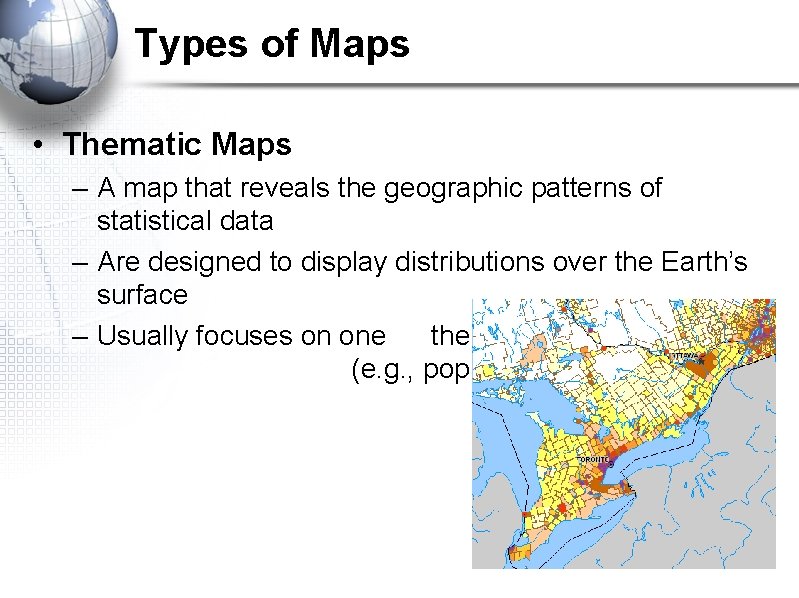
Types of Maps • Thematic Maps – A map that reveals the geographic patterns of statistical data – Are designed to display distributions over the Earth’s surface – Usually focuses on one theme or topic (e. g. , population distribution)
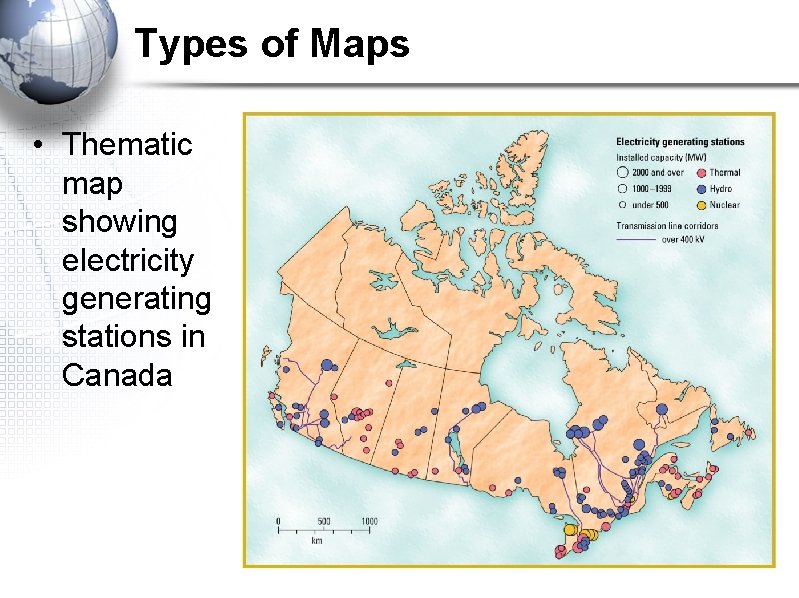
Types of Maps • Thematic map showing electricity generating stations in Canada