
GEOGPHYS 182 Remember A difference in electric potential
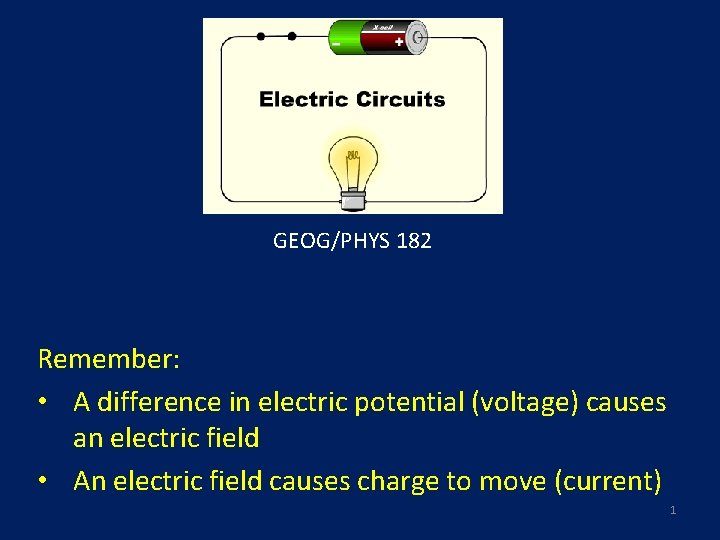
GEOG/PHYS 182 Remember: • A difference in electric potential (voltage) causes an electric field • An electric field causes charge to move (current) 1
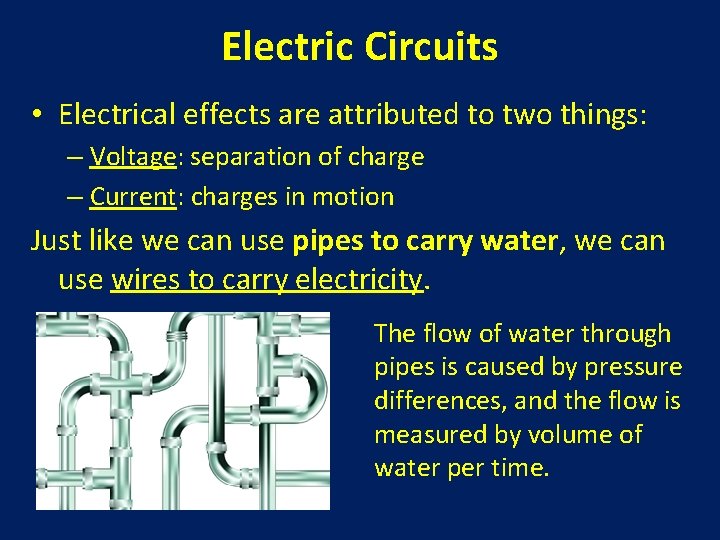
Electric Circuits • Electrical effects are attributed to two things: – Voltage: separation of charge – Current: charges in motion Just like we can use pipes to carry water, we can use wires to carry electricity. The flow of water through pipes is caused by pressure differences, and the flow is measured by volume of water per time.
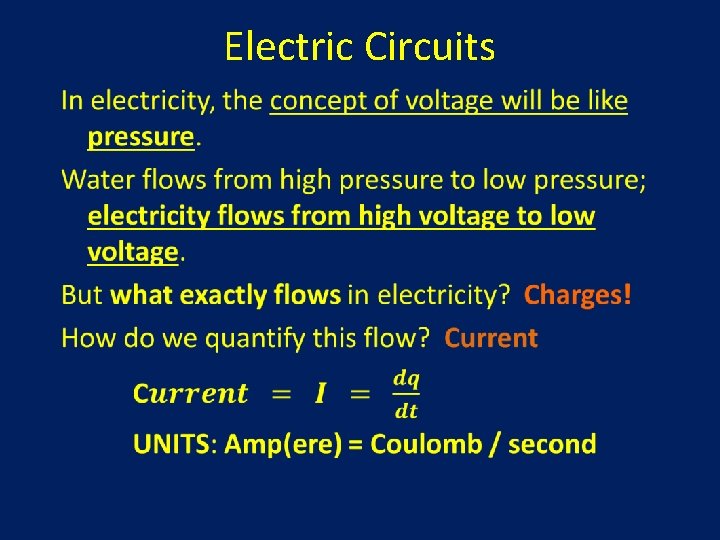
Electric Circuits •

Voltage Sources: batteries and power supplies A battery or power supply supplies voltage. This is analogous to what a pump does in a water system. Because of the “pumping” nature of voltage sources, we need to have a complete circuit before we have a current.
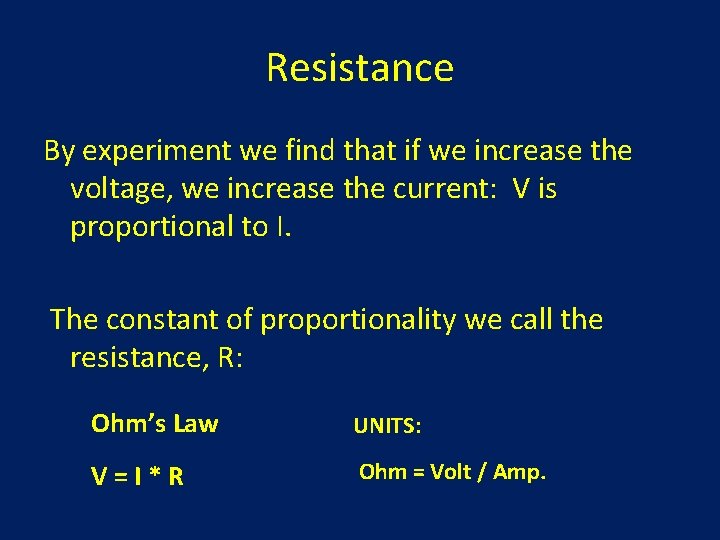
Resistance By experiment we find that if we increase the voltage, we increase the current: V is proportional to I. The constant of proportionality we call the resistance, R: Ohm’s Law UNITS: V=I*R Ohm = Volt / Amp.

Electrical Power is associated with the flow of charge where P = the power in watts V = the voltage in volts I = the current in amperes We also have Ohm’s Law: V = I*R So we can write the following equations for power: P = I 2*R P = V 2/R P = I*V

Example When using batteries, the battery keeps the voltage constant. Each D cell battery supplies 1. 5 volts, so four D cell batteries in series (one after the other) will supply a constant 6 volts. When used with four D cell batteries, a light bulb is designed to use 5 Watts of power. What is the resistance of the light bulb? What is the current flowing through the bulb?
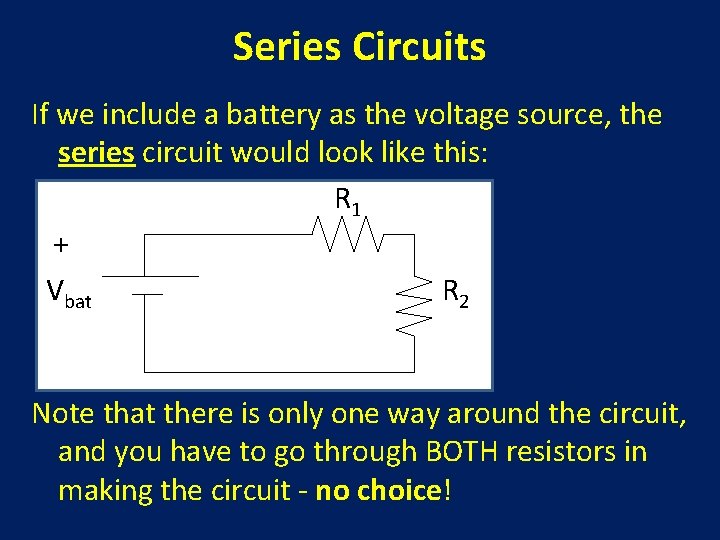
Series Circuits If we include a battery as the voltage source, the series circuit would look like this: R 1 + Vbat R 2 Note that there is only one way around the circuit, and you have to go through BOTH resistors in making the circuit - no choice!
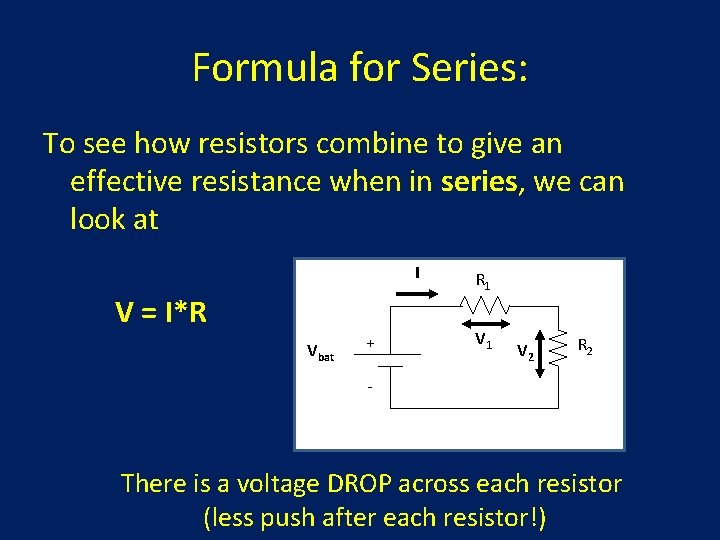
Formula for Series: To see how resistors combine to give an effective resistance when in series, we can look at I V = I*R Vbat + R 1 V 2 R 2 - There is a voltage DROP across each resistor (less push after each resistor!)
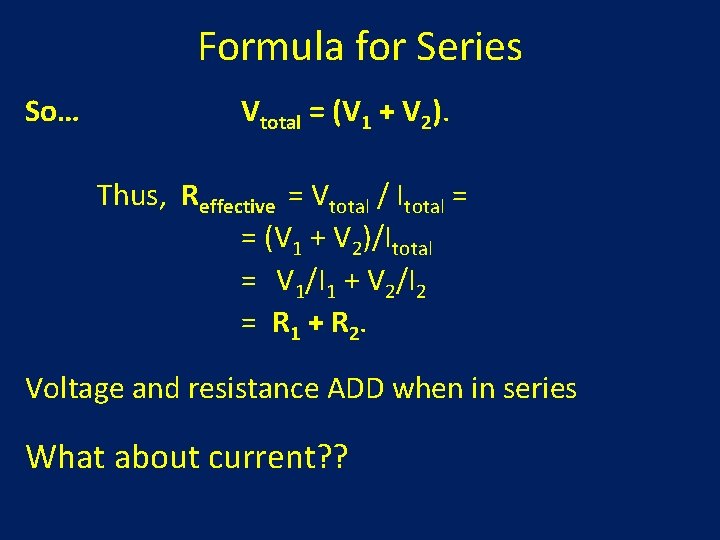
Formula for Series So… Vtotal = (V 1 + V 2). Thus, Reffective = Vtotal / Itotal = = (V 1 + V 2)/Itotal = V 1/I 1 + V 2/I 2 = R 1 + R 2. Voltage and resistance ADD when in series What about current? ?
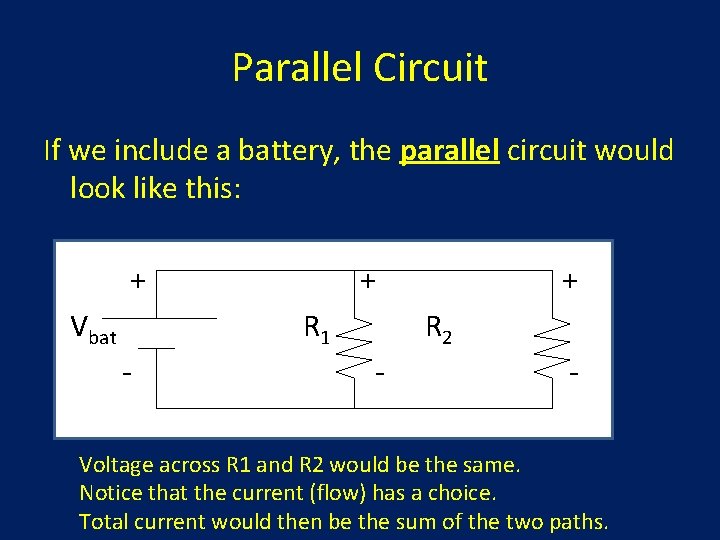
Parallel Circuit If we include a battery, the parallel circuit would look like this: + Vbat + R 1 - + R 2 - - Voltage across R 1 and R 2 would be the same. Notice that the current (flow) has a choice. Total current would then be the sum of the two paths.
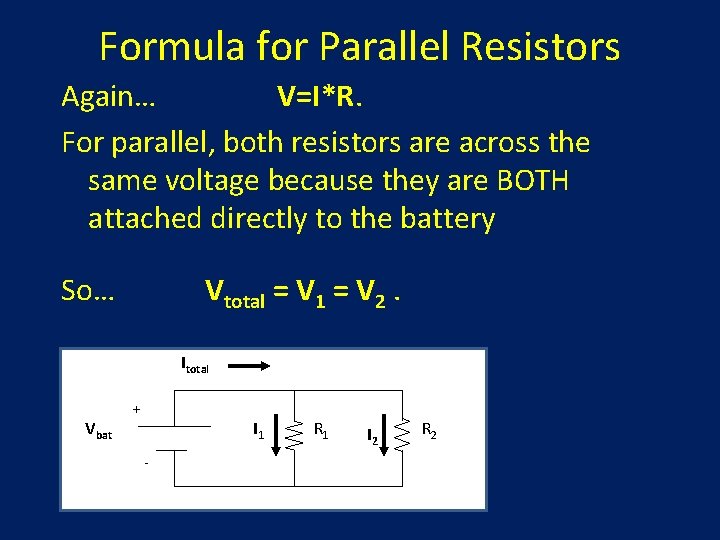
Formula for Parallel Resistors Again… V=I*R. For parallel, both resistors are across the same voltage because they are BOTH attached directly to the battery So… Vtotal = V 1 = V 2. Itotal + Vbat I 1 - R 1 I 2 R 2
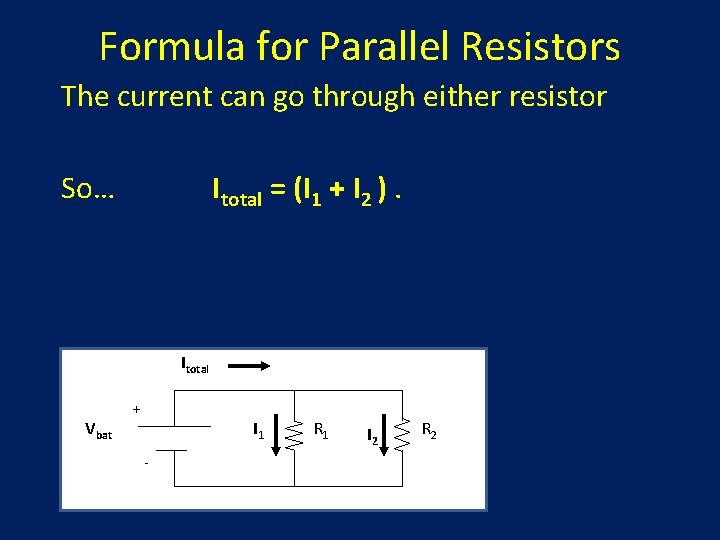
Formula for Parallel Resistors The current can go through either resistor So… Itotal = (I 1 + I 2 ). Itotal + Vbat I 1 - R 1 I 2 R 2
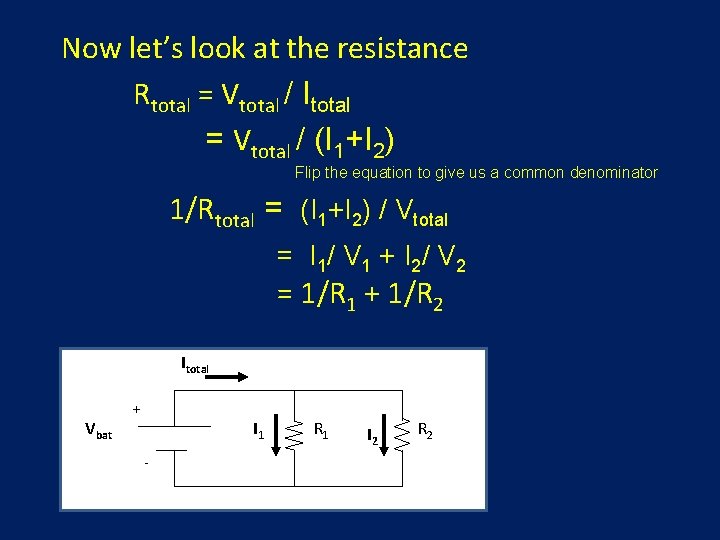
Now let’s look at the resistance Rtotal = Vtotal / Itotal = Vtotal / (I 1+I 2) Flip the equation to give us a common denominator 1/Rtotal = (I 1+I 2) / Vtotal = I 1/ V 1 + I 2/ V 2 = 1/R 1 + 1/R 2 Itotal + Vbat I 1 - R 1 I 2 R 2
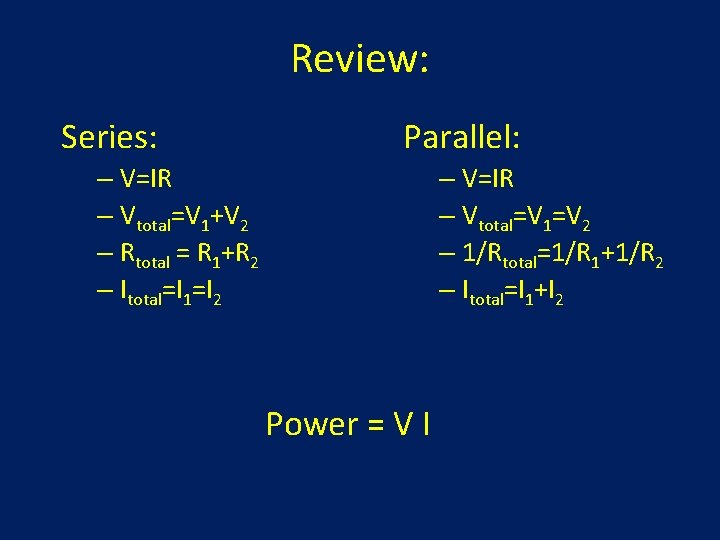
Review: Series: Parallel: – V=IR – Vtotal=V 1+V 2 – Rtotal = R 1+R 2 – Itotal=I 1=I 2 – V=IR – Vtotal=V 1=V 2 – 1/Rtotal=1/R 1+1/R 2 – Itotal=I 1+I 2 Power = V I
- Slides: 15