
GEOG 1230 Analytical Skills in Geography Lecture Structure

- Slides: 26
GEOG 1230 Analytical Skills in Geography
Lecture Structure • • • Introduction Course aim Course objectives Key skills Syllabus Timetable Assessment Contact details Next time
Introduction • Course convener: Tim James • Other Lecturers: Pippa Chapman and Steve Carver (BSc) Paul Chatterton and Graham Clarke (BA) • Course material available at: http: //www. geog. leeds. ac. uk/courses/level 1/geog 12 30/
Course Aim To introduce the student to the elements of research design through a series of lectures, worksheets, field work and practical classes.
Course Objectives • On completion of the course, each student should be able: • to execute and report on geographical research (i. e. research design, methodology, analysis and results and critical analysis); • to understand the range of data sources, and techniques for its analysis;
Course Objectives • to undertake basic research methods in either physical or human geography; and • to use Information Technology (IT) (i. e. statistical software, remote sensing and GIS) understand the range of data sources, and techniques for its analysis;
Transferable Skills • • Knowledge and understanding Cognitive skills Practical/professional skills Key skills Great points for the all-important CV! Keep them in mind!
Transferable Skills • Knowledge and understanding • The theory and application of quantitative, visualisation and other spatial techniques across a wide range of geographical contexts.
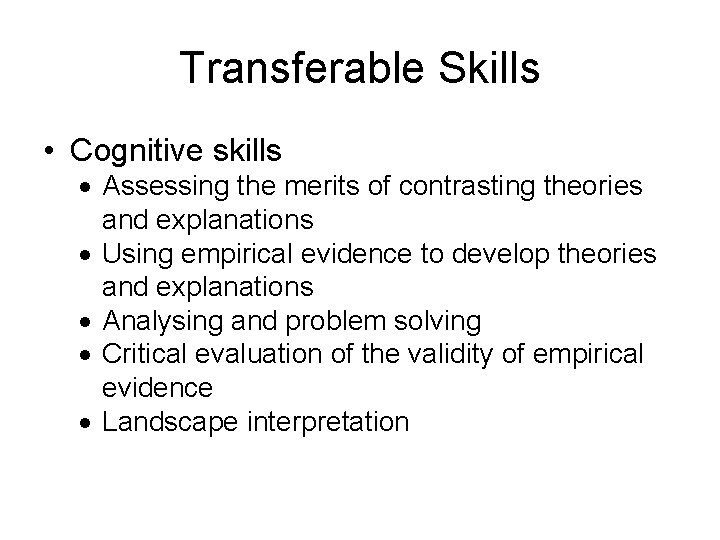
Transferable Skills • Cognitive skills · Assessing the merits of contrasting theories and explanations · Using empirical evidence to develop theories and explanations · Analysing and problem solving · Critical evaluation of the validity of empirical evidence · Landscape interpretation
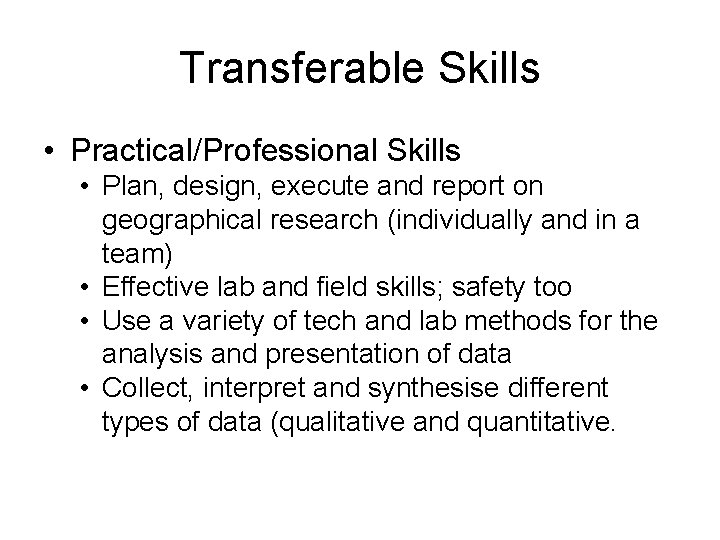
Transferable Skills • Practical/Professional Skills • Plan, design, execute and report on geographical research (individually and in a team) • Effective lab and field skills; safety too • Use a variety of tech and lab methods for the analysis and presentation of data • Collect, interpret and synthesise different types of data (qualitative and quantitative.
Transferable Skills • Key Skills • Apply numerical and computational skills to geographic information • Use info technology effectively (i. e. spreadsheets, database and word processors, internet, email etc…) • Work as part of a team and recognise and respect the viewpoints of others • Time management and work organisation
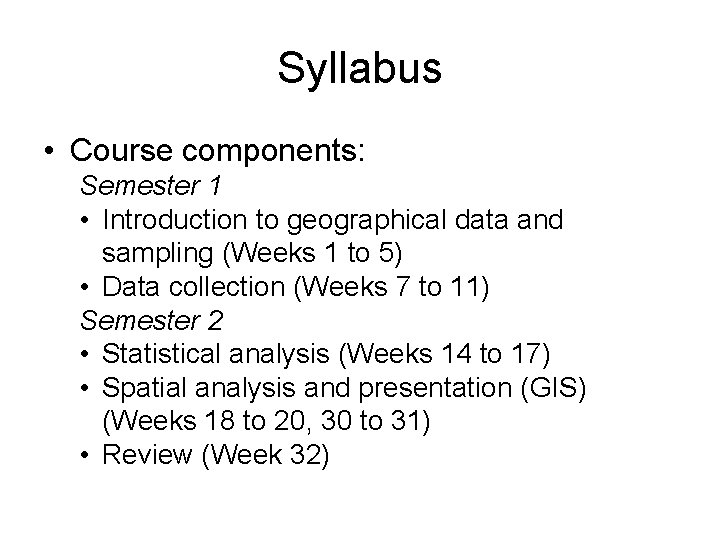
Syllabus • Course components: Semester 1 • Introduction to geographical data and sampling (Weeks 1 to 5) • Data collection (Weeks 7 to 11) Semester 2 • Statistical analysis (Weeks 14 to 17) • Spatial analysis and presentation (GIS) (Weeks 18 to 20, 30 to 31) • Review (Week 32)
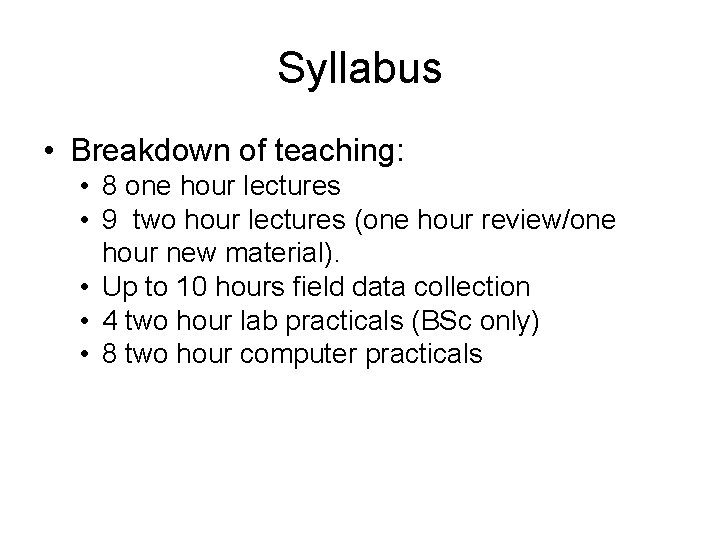
Syllabus • Breakdown of teaching: • 8 one hour lectures • 9 two hour lectures (one hour review/one hour new material). • Up to 10 hours field data collection • 4 two hour lab practicals (BSc only) • 8 two hour computer practicals
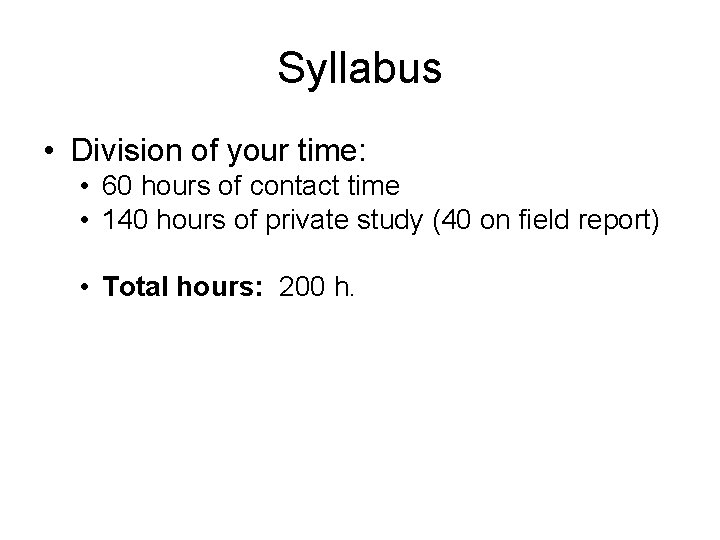
Syllabus • Division of your time: • 60 hours of contact time • 140 hours of private study (40 on field report) • Total hours: 200 h.
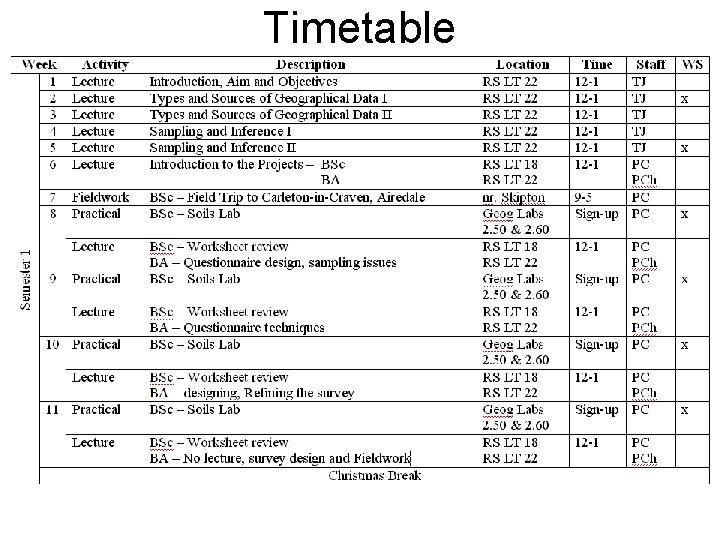
Timetable
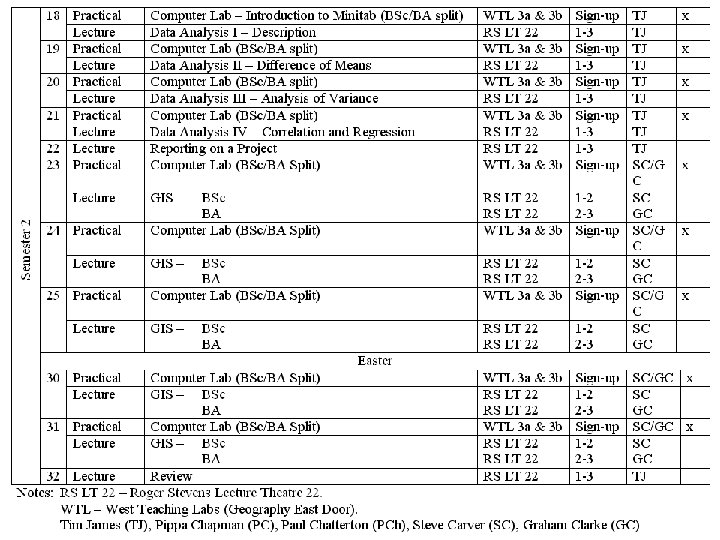
Timetable
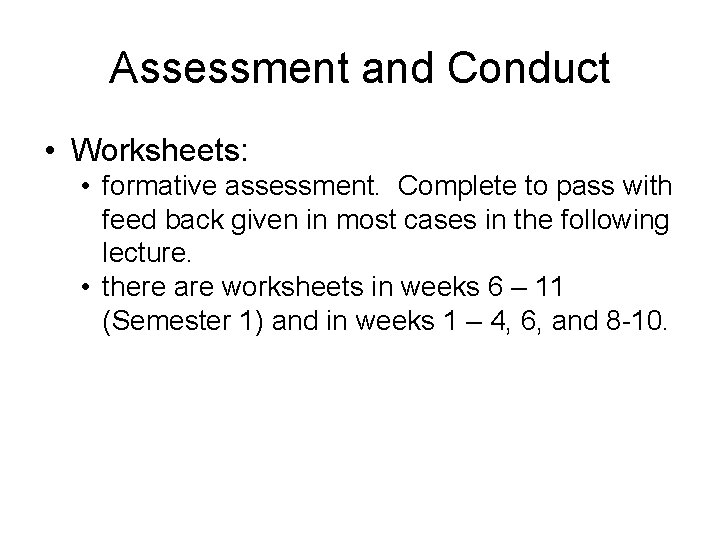
Assessment and Conduct • Worksheets: • formative assessment. Complete to pass with feed back given in most cases in the following lecture. • there are worksheets in weeks 6 – 11 (Semester 1) and in weeks 1 – 4, 6, and 8 -10.
Assessment and Conduct • Worksheets • format will be defined week by week • will be assessed as pass/no serious attempt (NSA) • students who receive NRA will be required to justify themselves. • to be handed into the labelled box (marked GEOG 1230) in basement by 1600 on due date.
Assessment and Conduct • Field report (100%) • The integrating report based around either the BA or the BSc project. • Should not exceed 2000 words. • Typed up in 12 point text with at least 1. 5 line spacing. • Diagrams, figures and tables are a bonus where required.
Assessment and Conduct • Field report (100%) • Staple in top left corner. Do not bind. • Submitted to reception by 2 pm on May 14 th, 2004. Be sure to obtain a receipt. • Note: • Attendance at the revision lectures is imperative for a good field report mark.
Assessment and Conduct Important Notes • You must compete all components of this course to receive credits for this module • Group work: all members of the group take responsibility. • University rules apply to all submitted work with respect to late submission, plagiarism and selfplagiarism etc…
Assessment and Conduct Important Notes • New university policy on lateness: 5% per day NOT per working day • University rules apply to all submitted work with respect to late submission, plagiarism and selfplagiarism etc…
Readings • Core text: • Jones, A. , Duck, R. , Reed, R. and Weyers, J. , (2000). Practical skills in Environmental Science, Prentice Hall, Harlow: 290 pp. (available on 7 day loan, EBL) • Geographical Data: • Walford, N. , (2002). Geographical Data: Characteristics and Sources, Wiley, Chichester: 274 pp. • Scientific Method: • Hay, I. (2000). Qualitative Research Methods in Human Geography. Oxford University Press, Oxford: 222 pp. (7 day loan, EBL) • Limb, M. and Dwyer, C. , (2001). Qualitative Methodologies for Geographers: Issues and Debates, Arnold, London: 303 pp. (7 day loan, EBL)
Readings • Bradbury, I. K. , Boyle, J. , and Morse, A. (2002). Scientific Principles for Physical Geographers, Prentice Hall, Harlow: 301 pp. • Haines-Young, R. and Petch, J. (1986). Physical Geography: Its Nature and Methods, Harper & Row: London: 230 pp. (7 and 3 day loan, EBL) • Statistics: • Rowntree, D. , (1991). Statistics Without Tears: an Introduction for Non-Mathematicians, Penguin, London: 195 pp. • Ebdon, D. (1985). Statistics in Geography, Blackwell, Oxford: 232 pp. (7 day loan, EBL) • Matthews, J. A. (1981). Quantitative and Statistical Approaches in Geography: a Practical Manual, Pergamon, Oxford: 204 pp.
Contact Info • Office: G 22 East Building (behind GLT) School of Geography 0113 343 6811 t. james@geog. leeds. ac. uk (email anytime) • Office hours: Fridays 1300 – 1600 (Drop in) or email to set up an appt.
Next Week • Types and sources of geographical data • Readings • Have a look through: Walford, N. , (2002). Geographical Data: Characteristics and Sources, Wiley, Chichester: 274 pp.