
Geodesic Saliency Using Background Priors Yichen Wei Fang

Geodesic Saliency Using Background Priors Yichen Wei, Fang Wen, Wangjiang Zhu, Jian Sun Visual Computing Group Microsoft Research Asia
Saliency detection is useful • Find whatever attracts visual interest – a built-in ability in human vision system • Important computer vision tasks 1. Image summarization, cropping… 2. Object (instance) matching, retrieval… 3. Object (class) detection, recognition…
What exactly is saliency? • Subjective, ambiguous and task dependent 1. traditionally, where a human looks 2. recently, where the salient object is • Categorization of methodology – top down: integrate domain knowledge – bottom up: biological observations / rules / priors
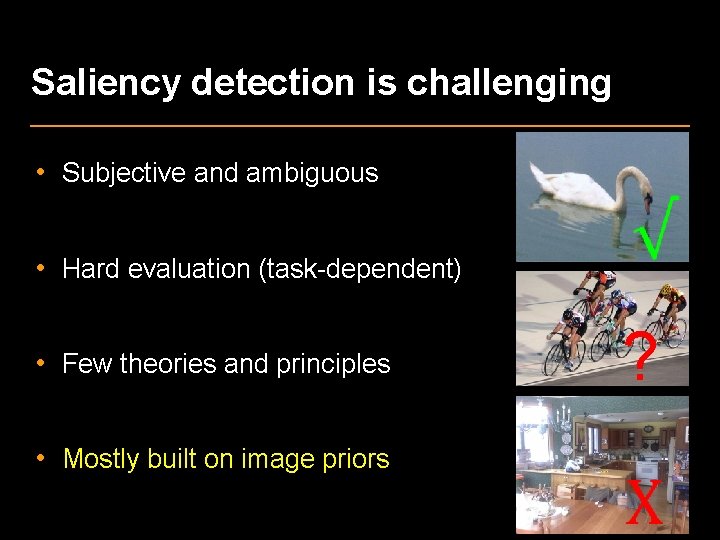
Saliency detection is challenging • Subjective and ambiguous • Hard evaluation (task-dependent) • Few theories and principles • Mostly built on image priors ?
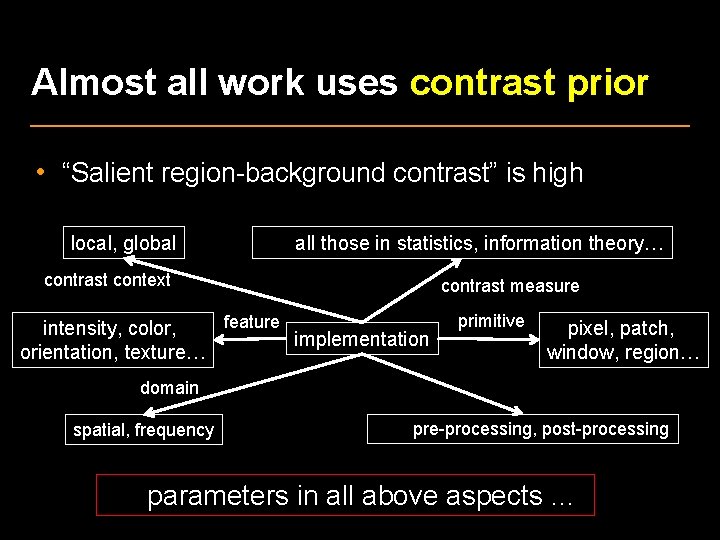
Almost all work uses contrast prior • “Salient region-background contrast” is high local, global all those in statistics, information theory… contrast context contrast measure feature intensity, color, implementation orientation, texture… primitive pixel, patch, window, region… domain spatial, frequency pre-processing, post-processing parameters in all above aspects …
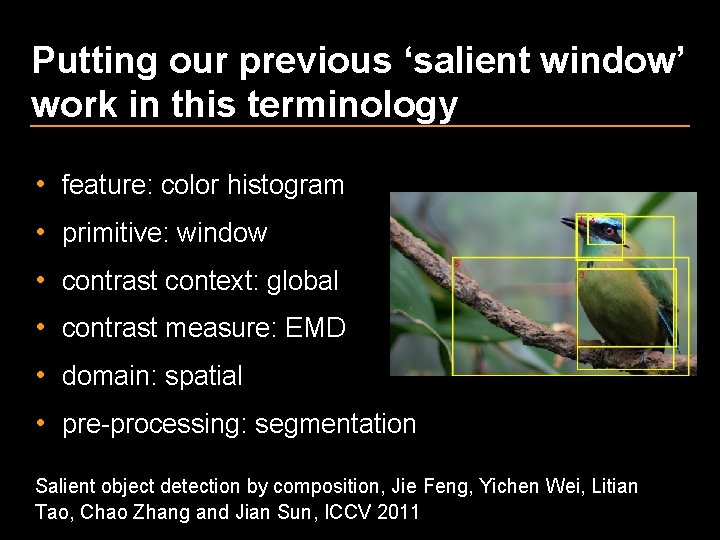
Putting our previous ‘salient window’ work in this terminology • feature: color histogram • primitive: window • contrast context: global • contrast measure: EMD • domain: spatial • pre-processing: segmentation Salient object detection by composition, Jie Feng, Yichen Wei, Litian Tao, Chao Zhang and Jian Sun, ICCV 2011
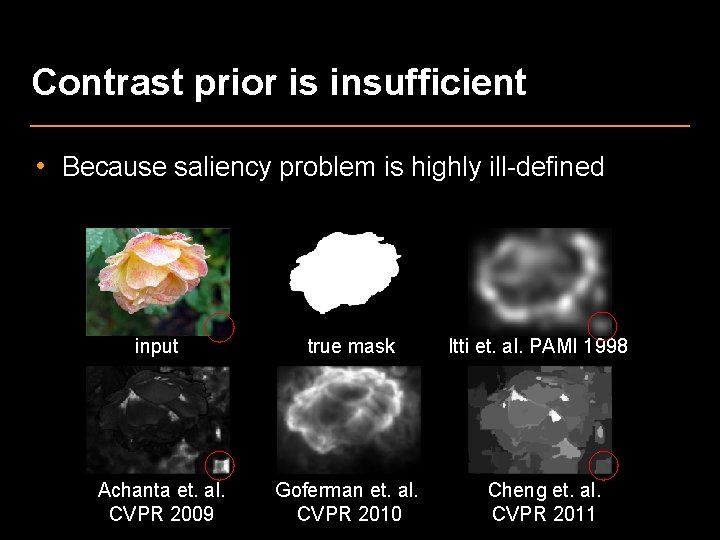
Contrast prior is insufficient • Because saliency problem is highly ill-defined input true mask Achanta et. al. CVPR 2009 Goferman et. al. CVPR 2010 Itti et. al. PAMI 1998 Cheng et. al. CVPR 2011
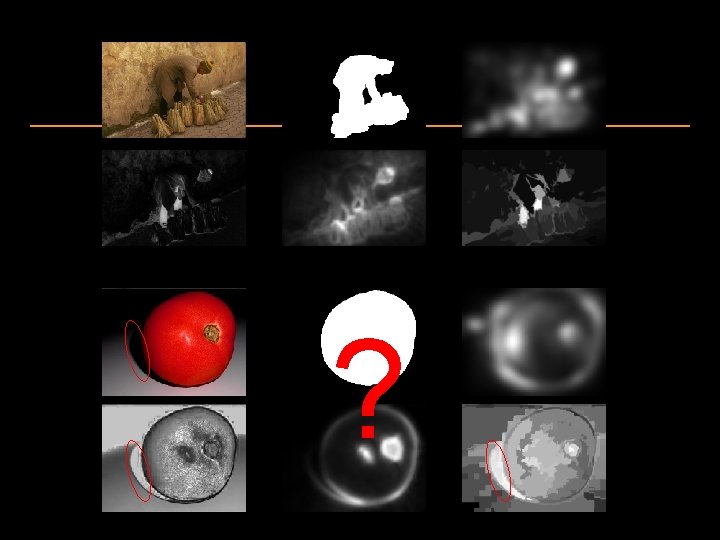
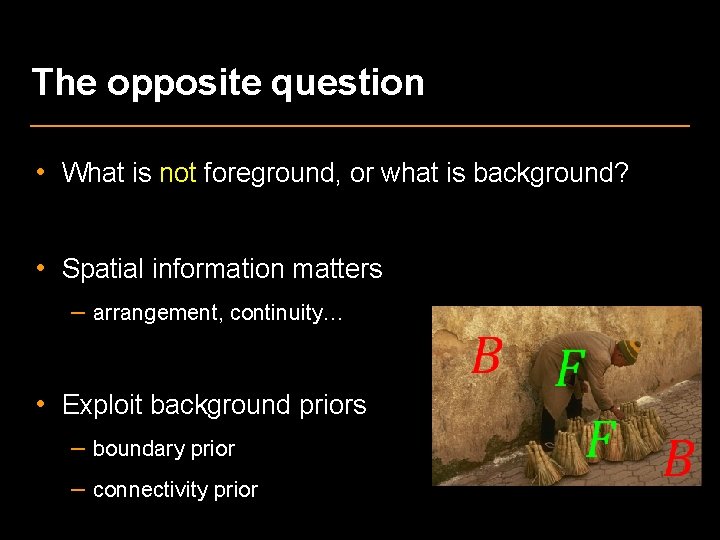
The opposite question • What is not foreground, or what is background? • Spatial information matters – arrangement, continuity… • Exploit background priors – boundary prior – connectivity prior
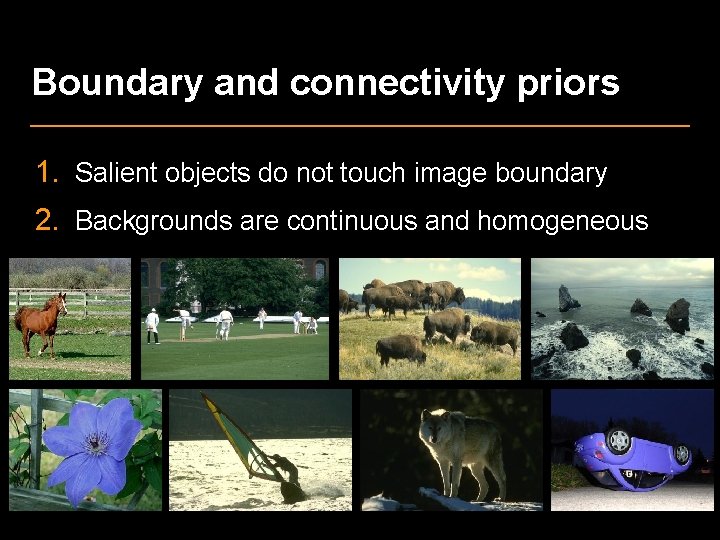
Boundary and connectivity priors 1. Salient objects do not touch image boundary 2. Backgrounds are continuous and homogeneous
1. Boundary prior • Salient objects do not touch image boundary – a rule in photography – more general than previous ‘image center bias’ – exceptions, e. g. , people cropped at image bottom
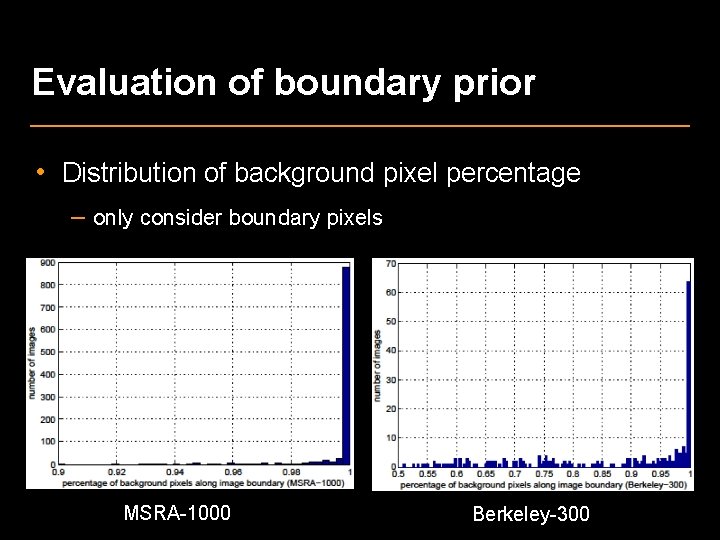
Evaluation of boundary prior • Distribution of background pixel percentage – only consider boundary pixels MSRA-1000 Berkeley-300
2. Connectivity prior • Backgrounds are continuous and homogeneous – common characteristics of natural images – background patches are easily connected to each other – connection is piecewise (e. g. , sky and grass do not connect)
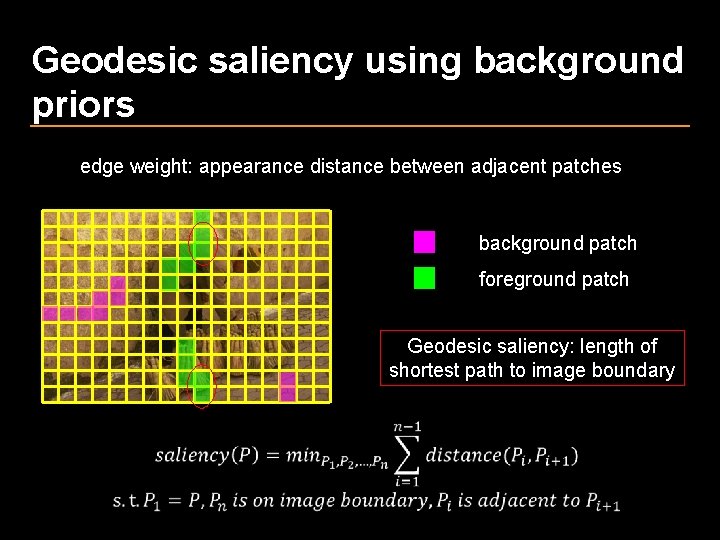
Geodesic saliency using background priors edge weight: appearance distance between adjacent patches background patch foreground patch Geodesic saliency: length of shortest path to image boundary
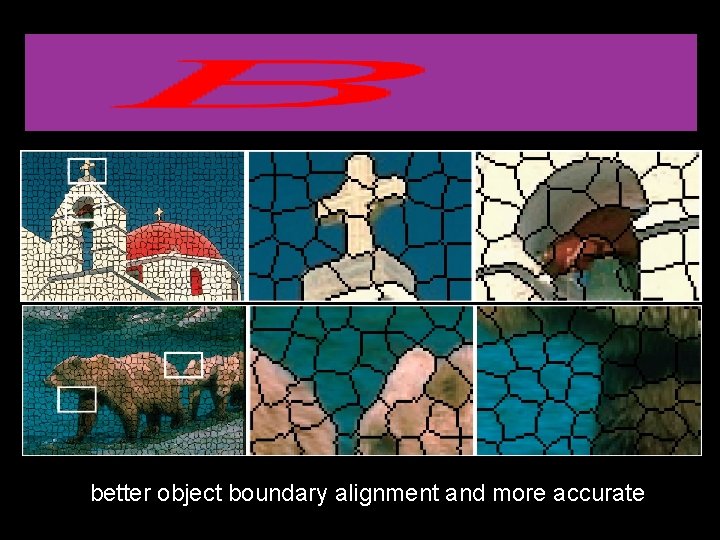
better object boundary alignment and more accurate
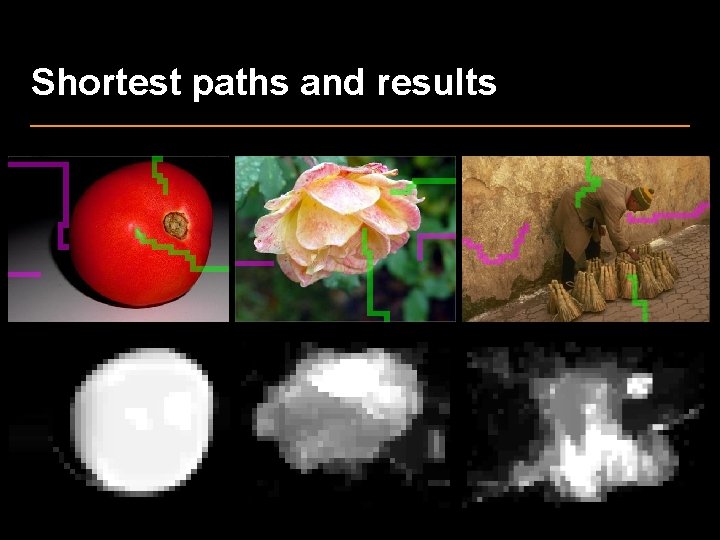
Shortest paths and results
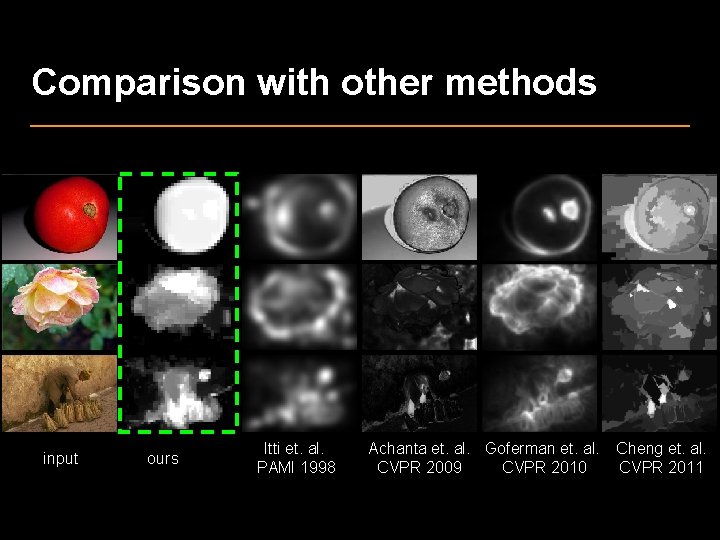
Comparison with other methods input ours Itti et. al. PAMI 1998 Achanta et. al. Goferman et. al. CVPR 2009 CVPR 2010 Cheng et. al. CVPR 2011
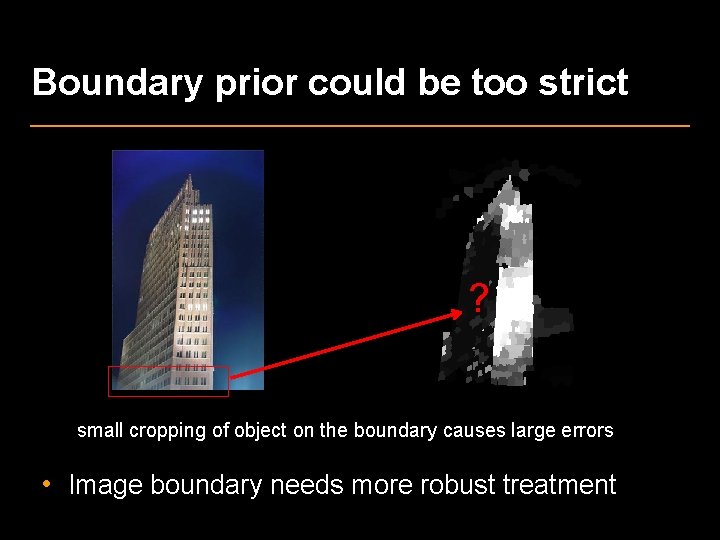
Boundary prior could be too strict ? small cropping of object on the boundary causes large errors • Image boundary needs more robust treatment
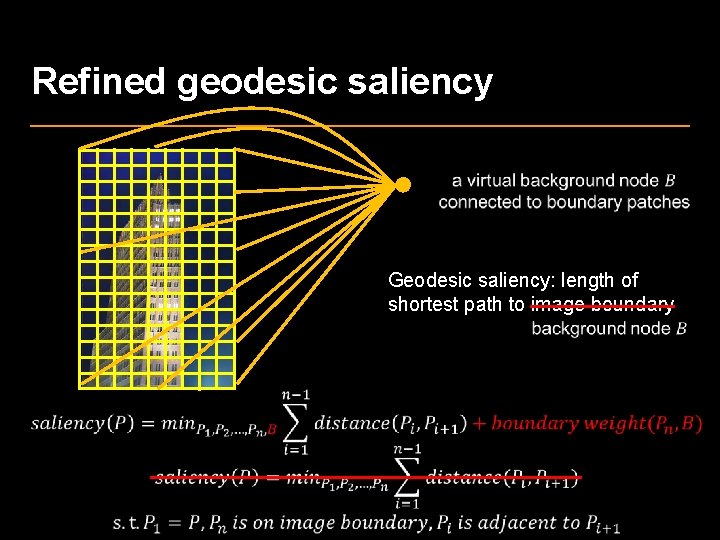
Refined geodesic saliency Geodesic saliency: length of shortest path to image boundary
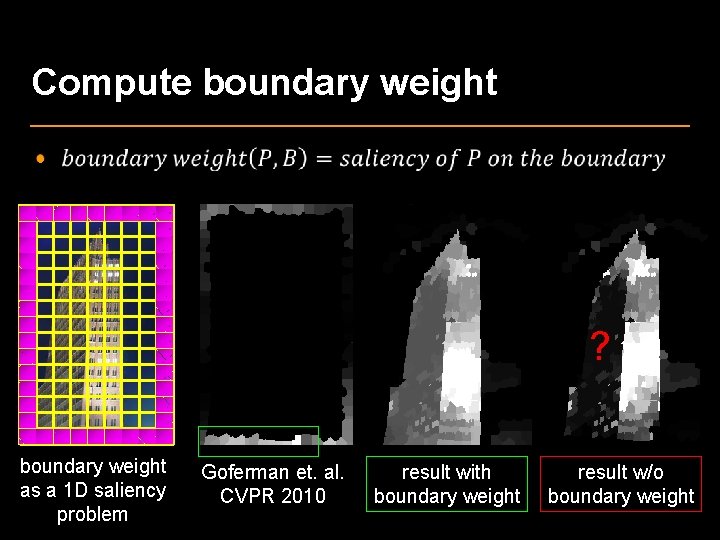
Compute boundary weight • ? boundary weight as a 1 D saliency problem Goferman et. al. CVPR 2010 result with boundary weight result w/o boundary weight
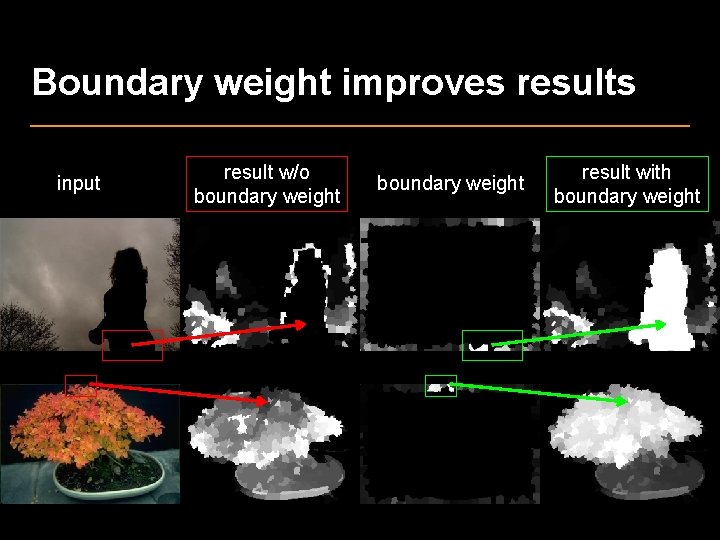
Boundary weight improves results input result w/o boundary weight result with boundary weight
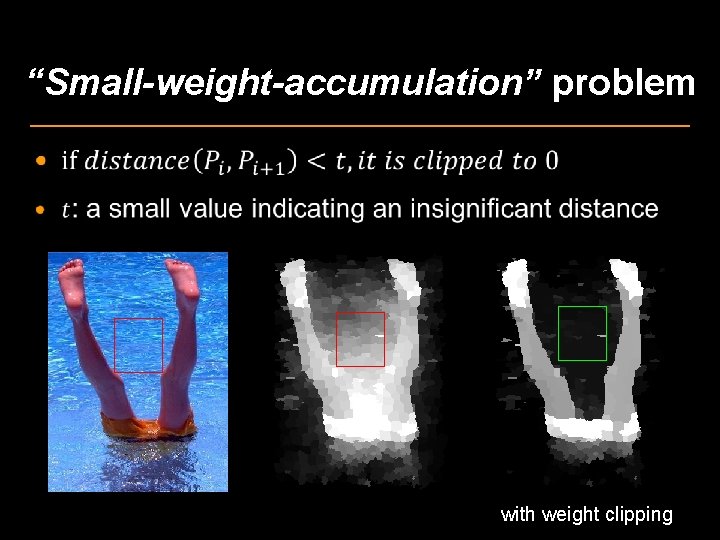
“Small-weight-accumulation” problem • with weight clipping
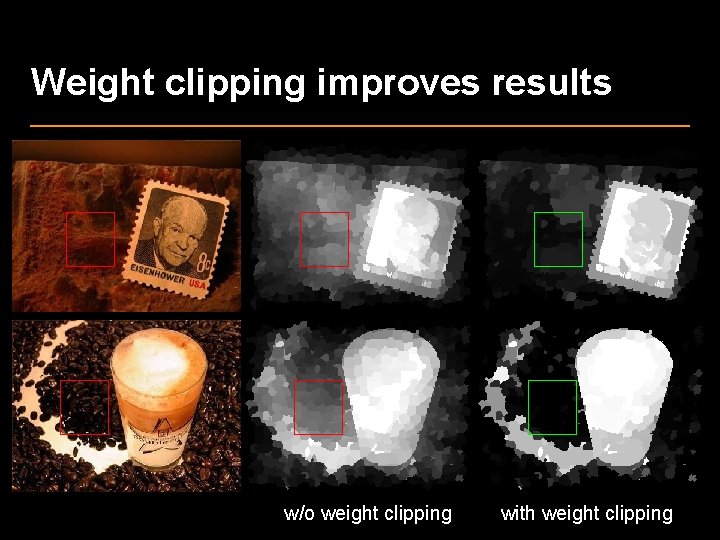
Weight clipping improves results w/o weight clipping with weight clipping
Advantages of geodesic saliency • Effective combination of three priors – moderate usage of contrast prior – complementary to other algorithms • Easy interpretation – just one parameter: patch size (fixed as 1/40 image size) • Super fast (2 ms, 400 x 400 image, regular patches)
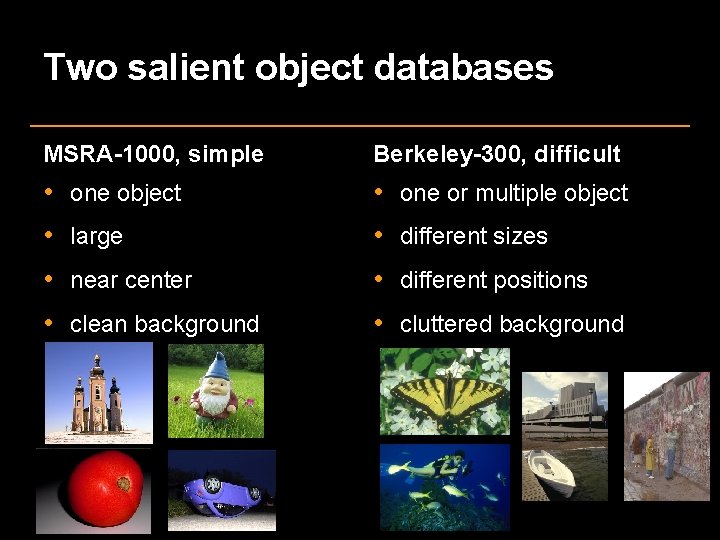
Two salient object databases MSRA-1000, simple Berkeley-300, difficult • one object • one or multiple object • large • different sizes • near center • different positions • clean background • cluttered background
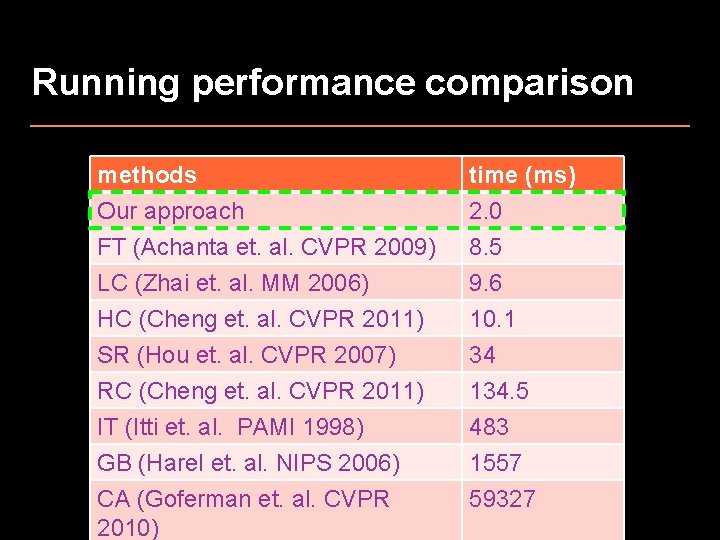
Running performance comparison methods Our approach FT (Achanta et. al. CVPR 2009) LC (Zhai et. al. MM 2006) time (ms) 2. 0 8. 5 9. 6 HC (Cheng et. al. CVPR 2011) SR (Hou et. al. CVPR 2007) RC (Cheng et. al. CVPR 2011) IT (Itti et. al. PAMI 1998) GB (Harel et. al. NIPS 2006) CA (Goferman et. al. CVPR 2010) 10. 1 34 134. 5 483 1557 59327
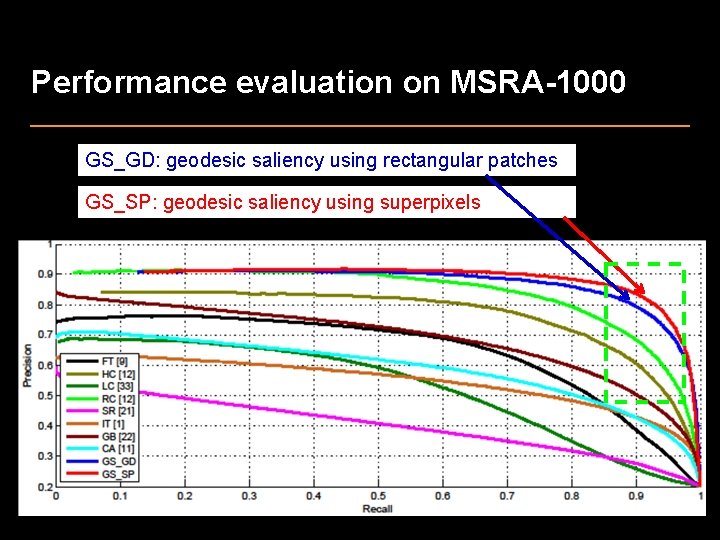
Performance evaluation on MSRA-1000 GS_GD: geodesic saliency using rectangular patches GS_SP: geodesic saliency using superpixels
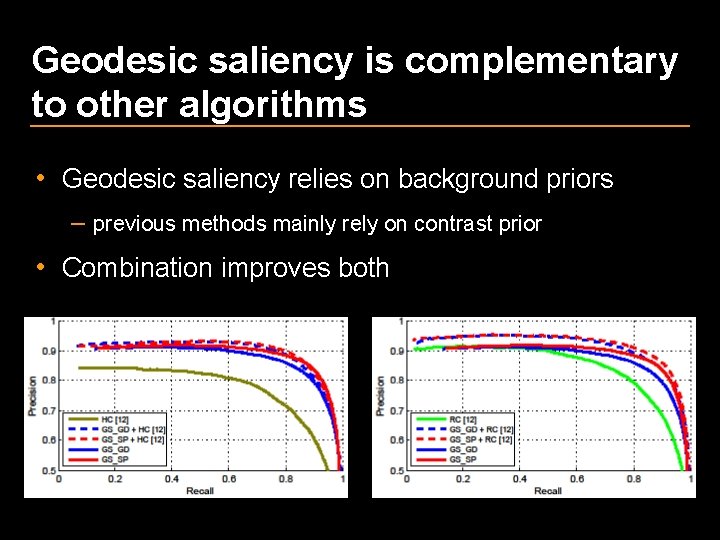
Geodesic saliency is complementary to other algorithms • Geodesic saliency relies on background priors – previous methods mainly rely on contrast prior • Combination improves both
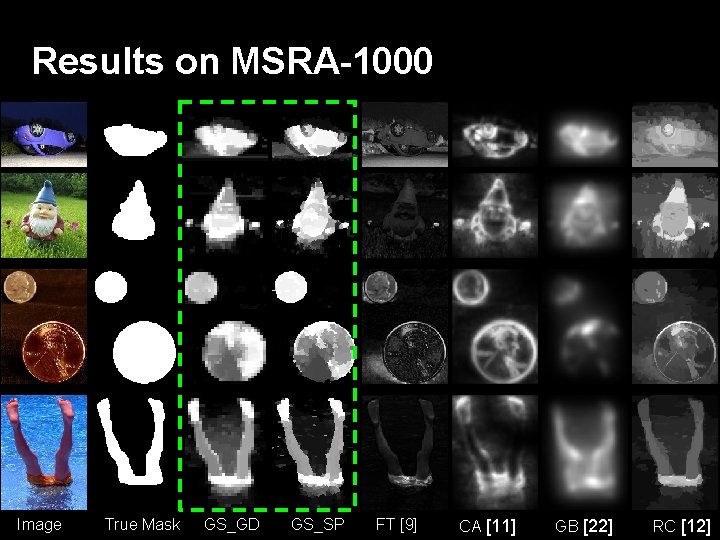
Results on MSRA-1000 Image True Mask GS_GD GS_SP FT [9] CA [11] GB [22] RC [12]
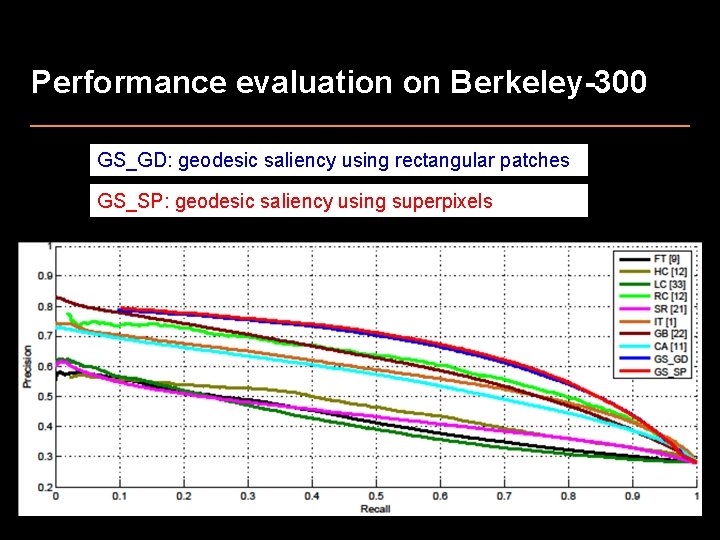
Performance evaluation on Berkeley-300 GS_GD: geodesic saliency using rectangular patches GS_SP: geodesic saliency using superpixels
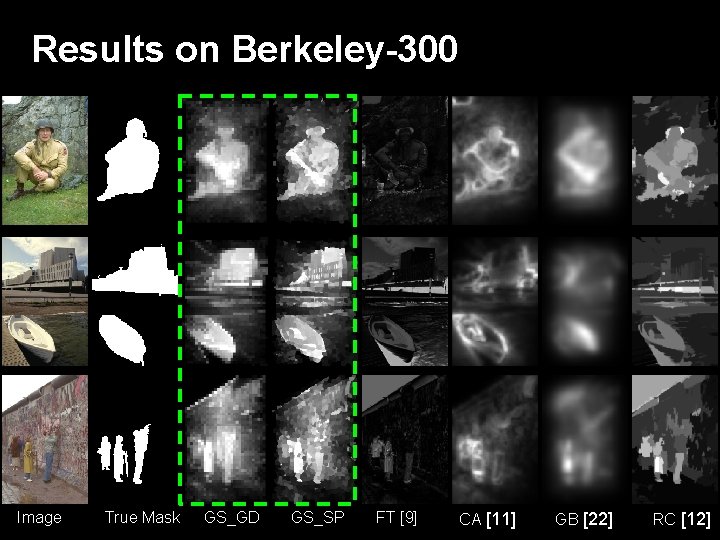
Results on Berkeley-300 Image True Mask GS_GD GS_SP FT [9] CA [11] GB [22] RC [12]
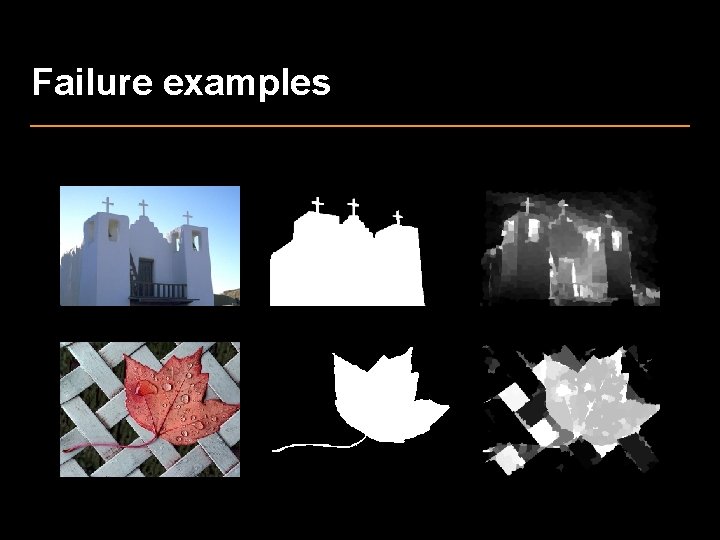
Failure examples
Summary of geodesic saliency • Better usage of background priors • State-of-the-art in both accuracy and efficiency • Complementary to other methods
- Slides: 33