
GEOCENTRIC vs HELIOCENTRIC Age of Enlightenment A cultural


- Slides: 23
GEOCENTRIC vs. HELIOCENTRIC
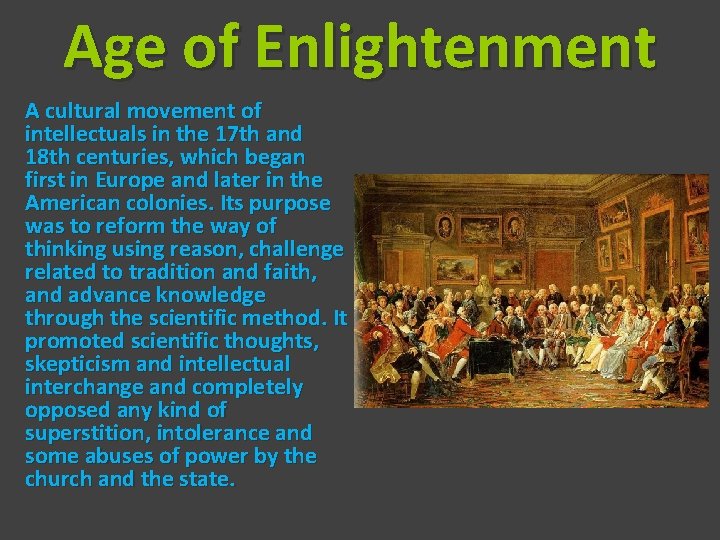
Age of Enlightenment A cultural movement of intellectuals in the 17 th and 18 th centuries, which began first in Europe and later in the American colonies. Its purpose was to reform the way of thinking using reason, challenge related to tradition and faith, and advance knowledge through the scientific method. It promoted scientific thoughts, skepticism and intellectual interchange and completely opposed any kind of superstition, intolerance and some abuses of power by the church and the state.
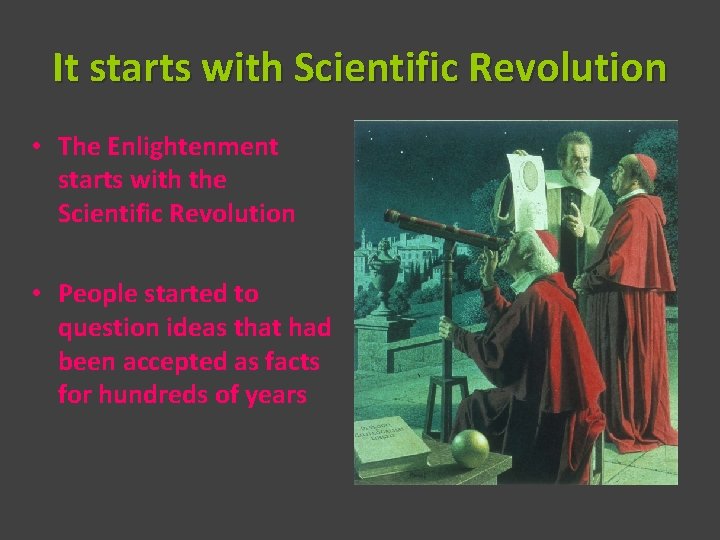
It starts with Scientific Revolution • The Enlightenment starts with the Scientific Revolution • People started to question ideas that had been accepted as facts for hundreds of years
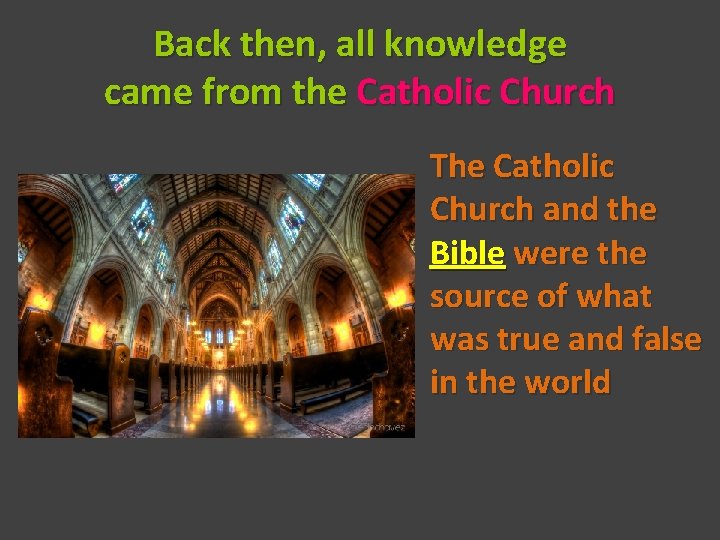
Back then, all knowledge came from the Catholic Church The Catholic Church and the Bible were the source of what was true and false in the world
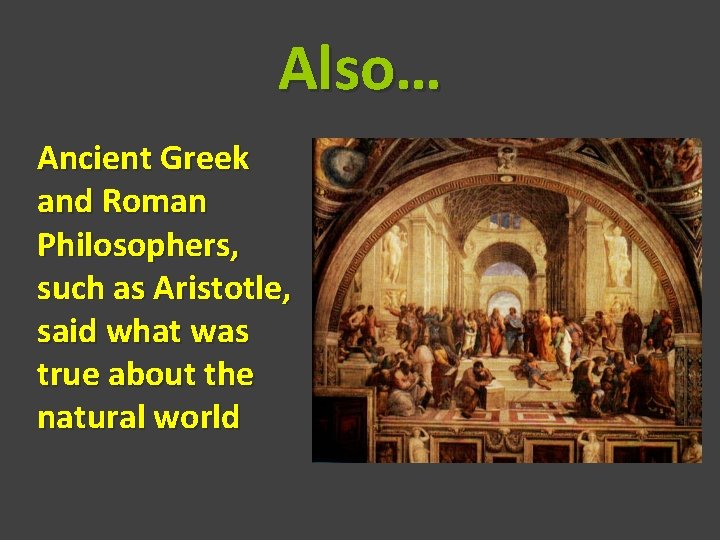
Also… Ancient Greek and Roman Philosophers, such as Aristotle, said what was true about the natural world
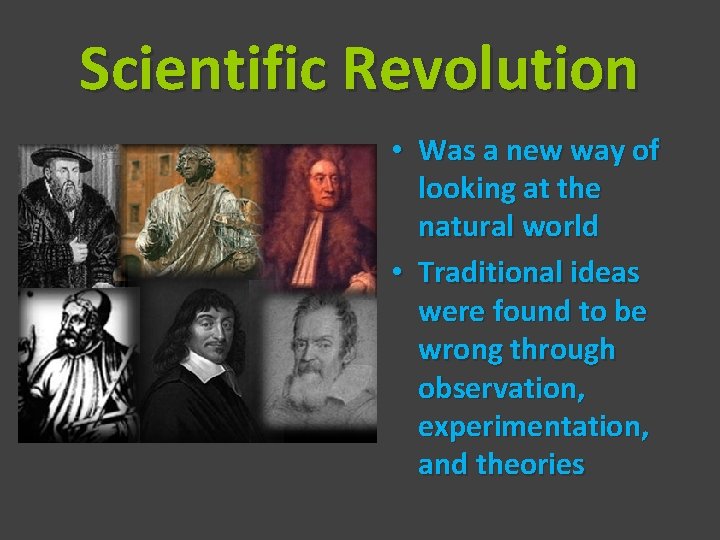
Scientific Revolution • Was a new way of looking at the natural world • Traditional ideas were found to be wrong through observation, experimentation, and theories
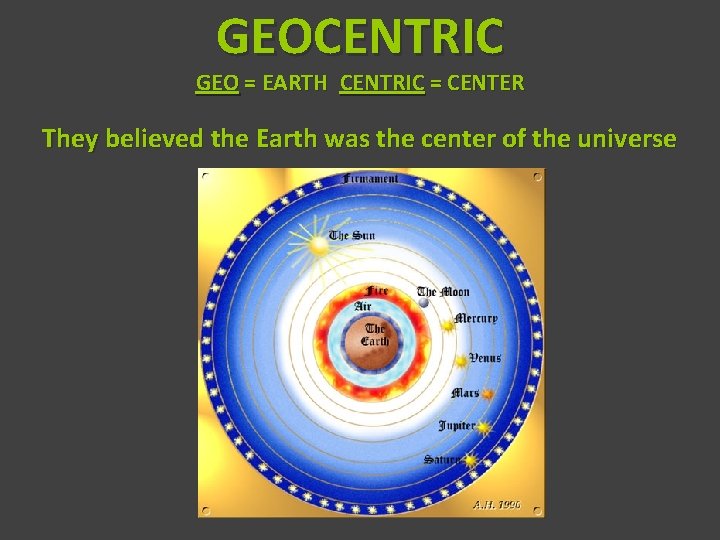
GEOCENTRIC GEO = EARTH CENTRIC = CENTER They believed the Earth was the center of the universe
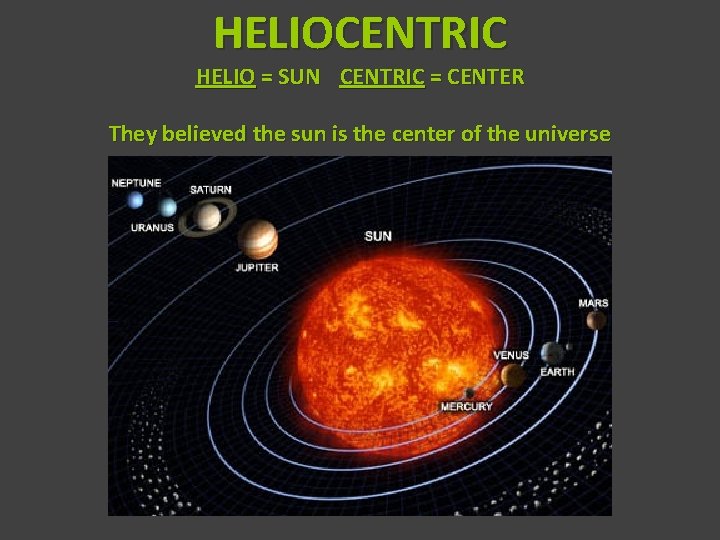
HELIOCENTRIC HELIO = SUN CENTRIC = CENTER They believed the sun is the center of the universe
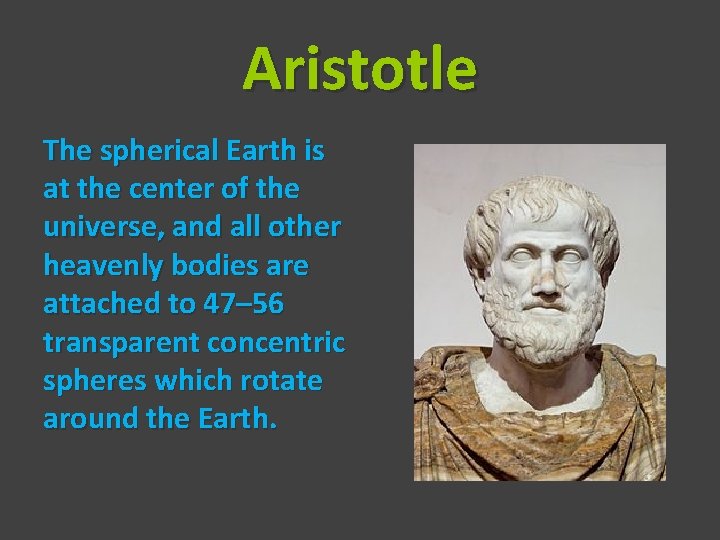
Aristotle The spherical Earth is at the center of the universe, and all other heavenly bodies are attached to 47– 56 transparent concentric spheres which rotate around the Earth.
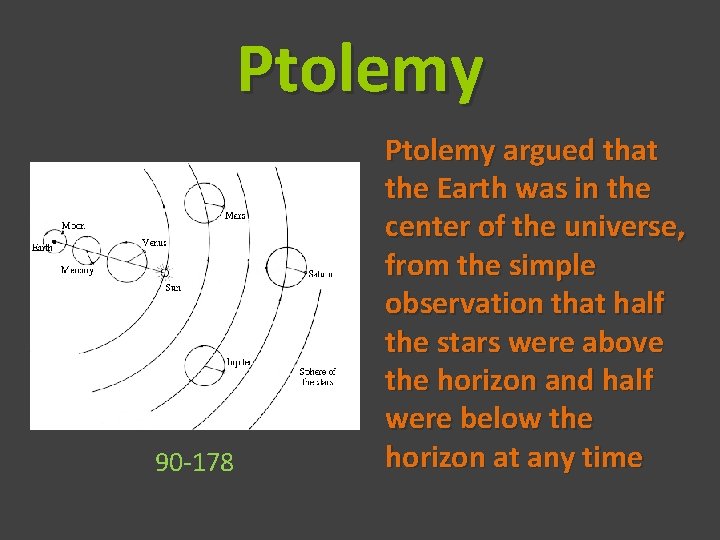
Ptolemy 90 -178 Ptolemy argued that the Earth was in the center of the universe, from the simple observation that half the stars were above the horizon and half were below the horizon at any time
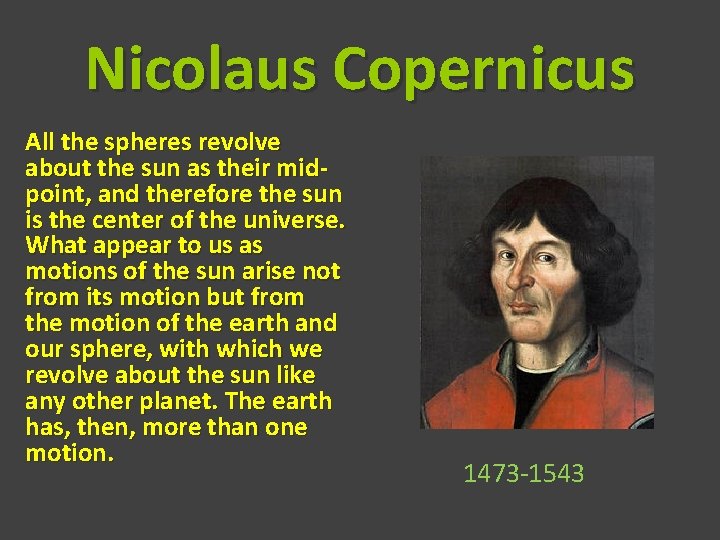
Nicolaus Copernicus All the spheres revolve about the sun as their midpoint, and therefore the sun is the center of the universe. What appear to us as motions of the sun arise not from its motion but from the motion of the earth and our sphere, with which we revolve about the sun like any other planet. The earth has, then, more than one motion. 1473 -1543
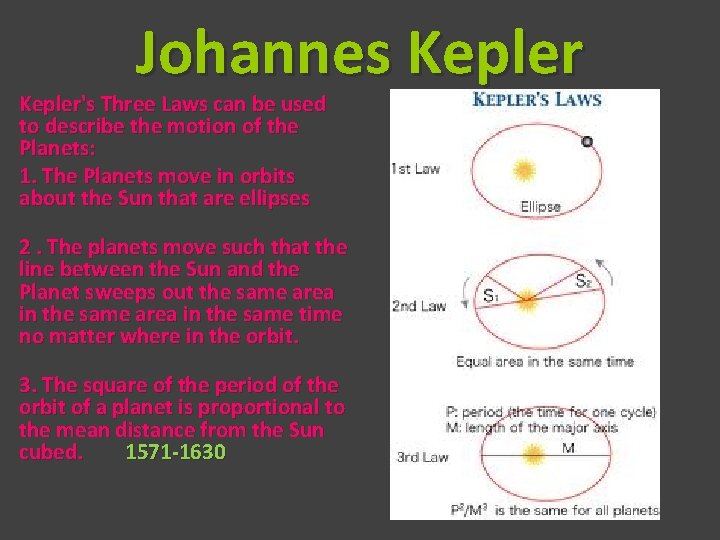
Johannes Kepler's Three Laws can be used to describe the motion of the Planets: 1. The Planets move in orbits about the Sun that are ellipses 2. The planets move such that the line between the Sun and the Planet sweeps out the same area in the same time no matter where in the orbit. 3. The square of the period of the orbit of a planet is proportional to the mean distance from the Sun cubed. 1571 -1630
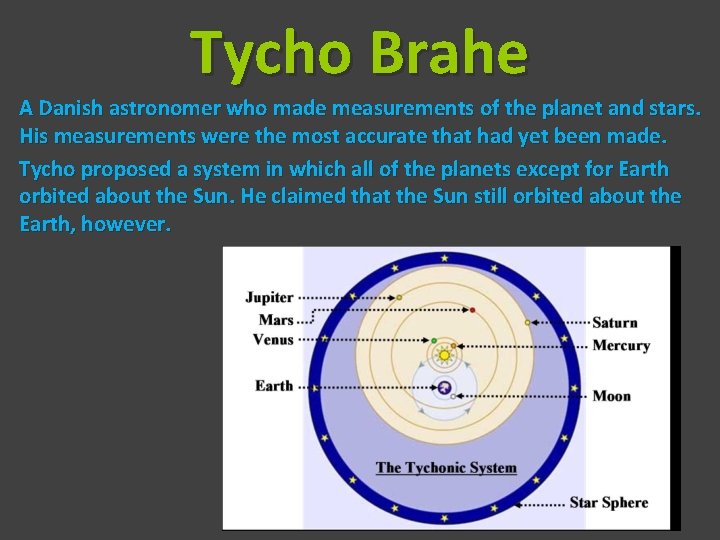
Tycho Brahe A Danish astronomer who made measurements of the planet and stars. His measurements were the most accurate that had yet been made. Tycho proposed a system in which all of the planets except for Earth orbited about the Sun. He claimed that the Sun still orbited about the Earth, however.
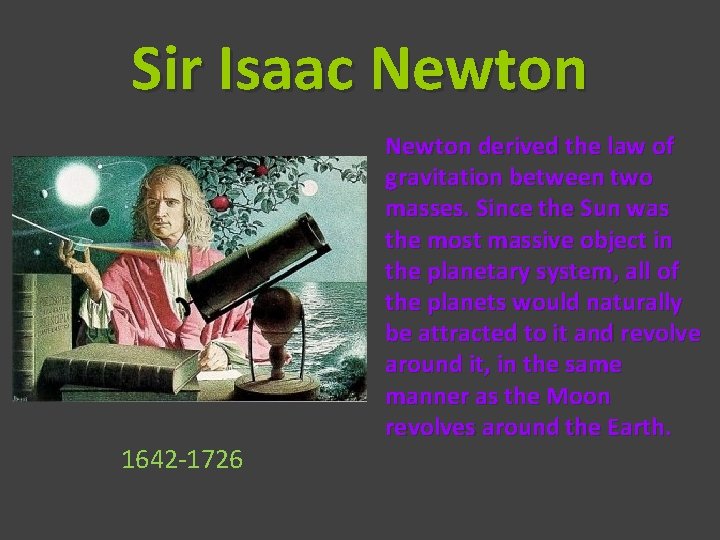
Sir Isaac Newton 1642 -1726 Newton derived the law of gravitation between two masses. Since the Sun was the most massive object in the planetary system, all of the planets would naturally be attracted to it and revolve around it, in the same manner as the Moon revolves around the Earth.
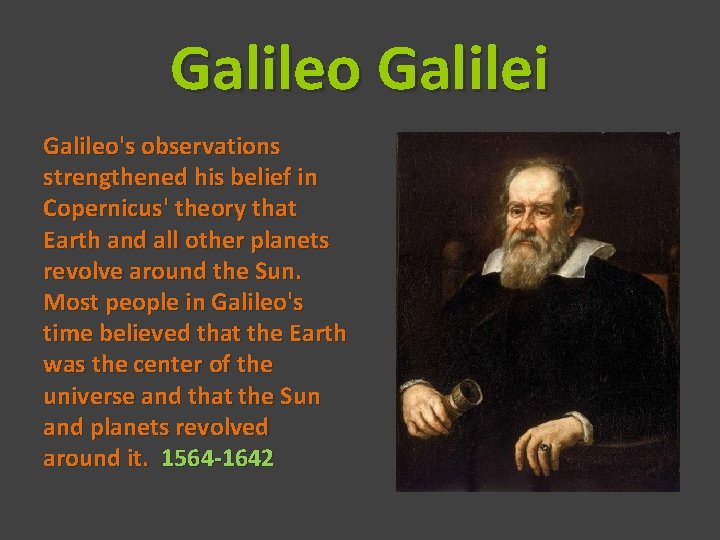
Galileo Galilei Galileo's observations strengthened his belief in Copernicus' theory that Earth and all other planets revolve around the Sun. Most people in Galileo's time believed that the Earth was the center of the universe and that the Sun and planets revolved around it. 1564 -1642
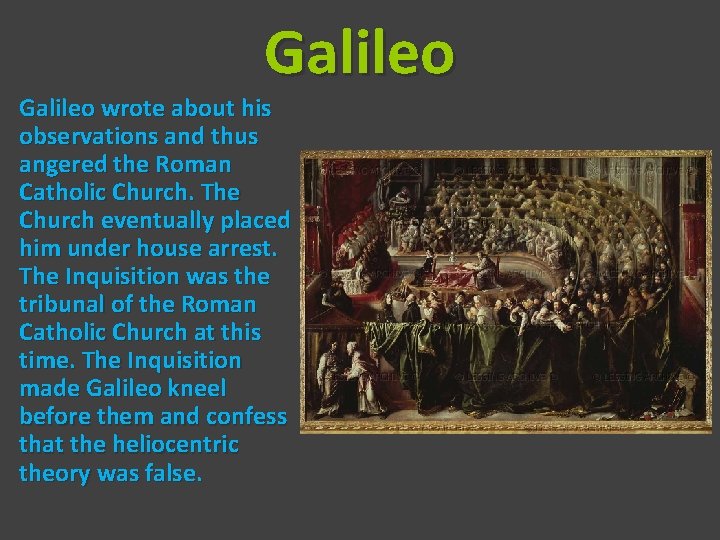
Galileo wrote about his observations and thus angered the Roman Catholic Church. The Church eventually placed him under house arrest. The Inquisition was the tribunal of the Roman Catholic Church at this time. The Inquisition made Galileo kneel before them and confess that the heliocentric theory was false.
Galileo was right all along In 1992, the Roman Catholic Church finally repealed the ruling of the Inquisition against Galileo. The Church gave a pardon to Galileo and admitted that the heliocentric theory was correct. This pardon came 350 years after Galileo's death.
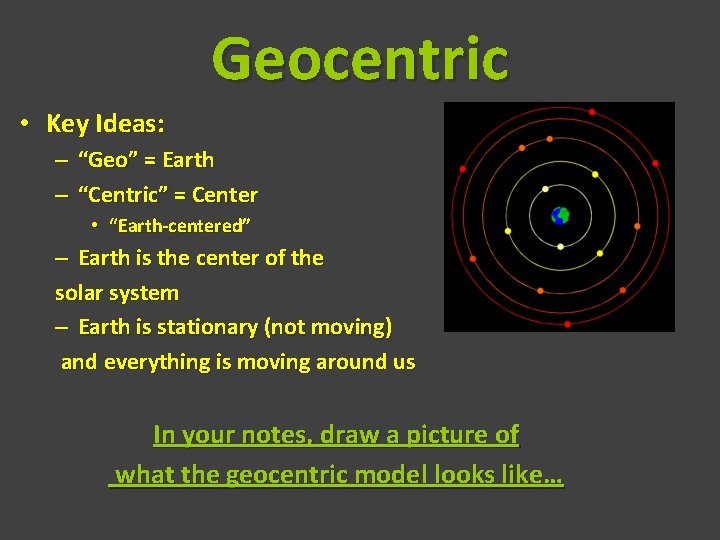
Geocentric • Key Ideas: – “Geo” = Earth – “Centric” = Center • “Earth-centered” – Earth is the center of the solar system – Earth is stationary (not moving) and everything is moving around us In your notes, draw a picture of what the geocentric model looks like…
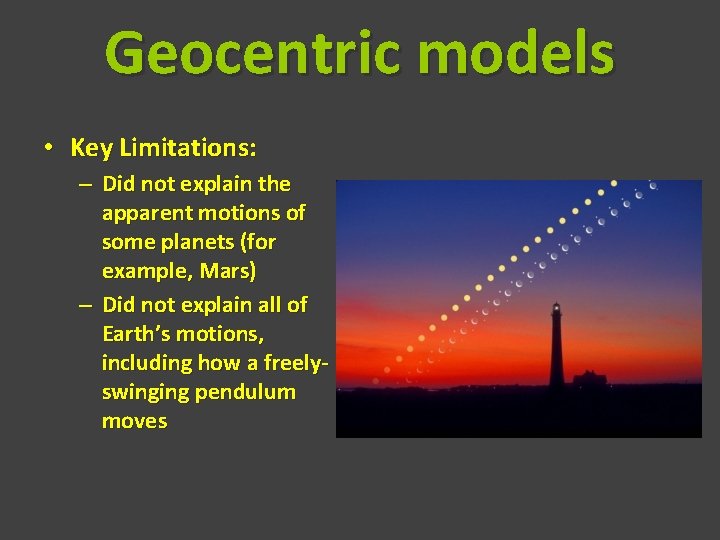
Geocentric models • Key Limitations: – Did not explain the apparent motions of some planets (for example, Mars) – Did not explain all of Earth’s motions, including how a freelyswinging pendulum moves
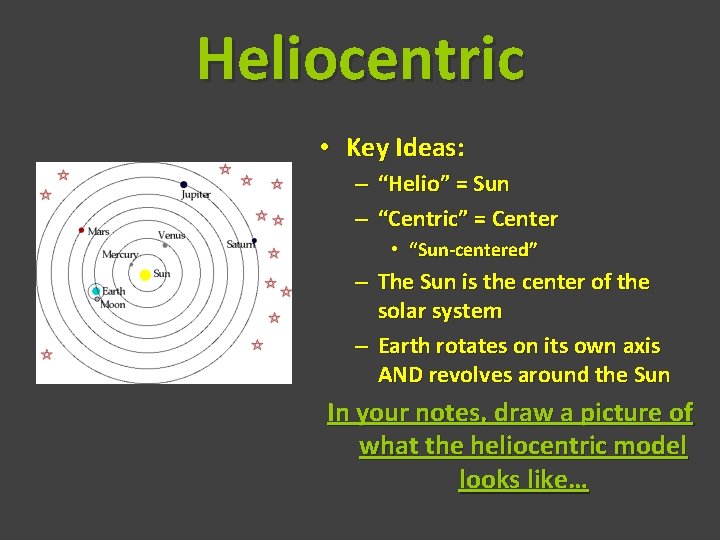
Heliocentric • Key Ideas: – “Helio” = Sun – “Centric” = Center • “Sun-centered” – The Sun is the center of the solar system – Earth rotates on its own axis AND revolves around the Sun In your notes, draw a picture of what the heliocentric model looks like…
Heliocentric models Key Limitations: The early models used circular orbits did not explain the apparent motions of planets (BUT… once elliptical orbits and planets’ orbital speeds were added to the model, the planets’ apparent motions could be explained and even predicted!)