
GEO Biodiversity Observation Network and its contribution to

GEO Biodiversity Observation Network and its contribution to global biodiversity observations Bob Scholes 1 and Rob Jongman 2 1. GEO BON chair Council for Scientific and Industrial Research, South Africa 2. GEOBON SC; Aterra, Wageingen UR
Group on Earth Observations Biodiversity Observation Network A global partnership to promote the collection, sharing, management, analysis and & reporting of data relating to the status of the world’s biodiversity, across all taxa and domains, for all aspects of biodiversity at the gene, species and ecosystem levels Members of the network include most major international biodiversity-oriented organisations (such as IUCN, GBIF, Diversitas, UNEP-WCMC, UN-CBD), space agencies, regional sub-networks (Asia-Pacific, Arctic, Japan)
What does GEO BON do? GEO BON adds value to on-going biodiversity observation by: • Providing a global, scientifically robust framework for observations on the detection of biodiversity change (GBIF, GTOS, UNEP-WCMC, UNESCO-MAB, IUCN etc. ) • Coordinating the data gathering and the delivery of information through establishing standards and interoperability • Providing a set of innovative and relevant global products • Advocating long term continuity of data supply (moving observations from the experimental to operational spheres) and data sharing
What does GEO BON do? • Provide a global, scientifically robust framework for observations relating to the detection of biodiversity change • Through partnerships, help coordinate data gathering and the delivery of information according to user needs • Advocate long term continuity of data supply • Stimulate the development of a set of innovative and relevant global products
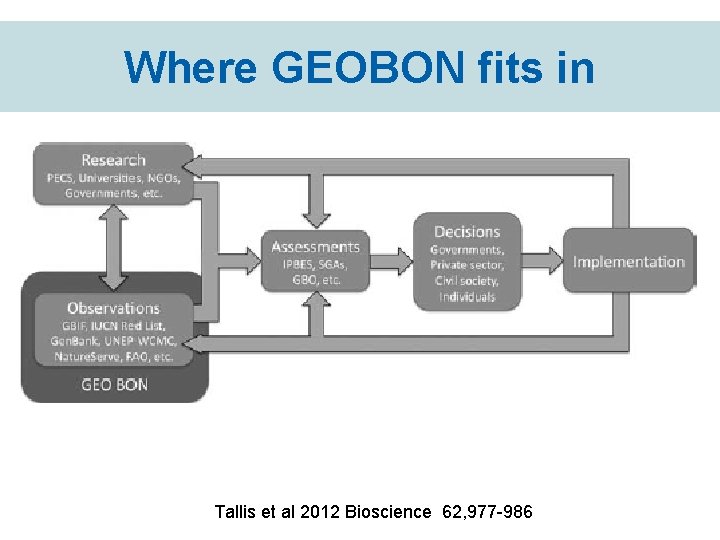
Where GEOBON fits in Tallis et al 2012 Bioscience 62, 977 -986
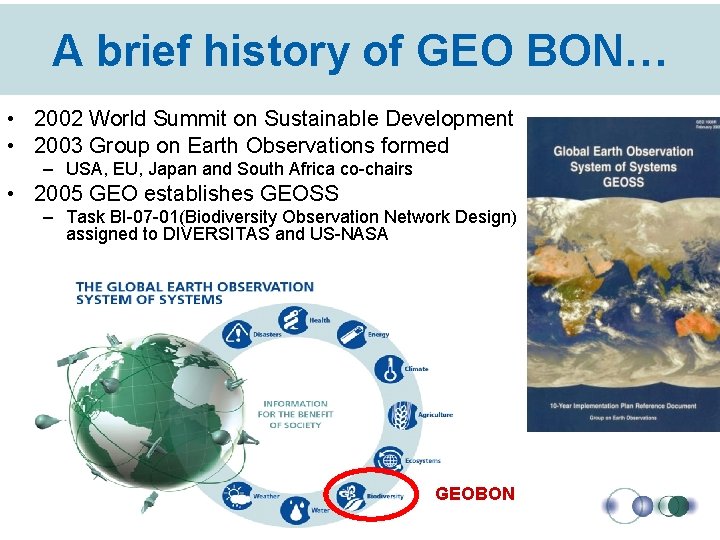
A brief history of GEO BON… • 2002 World Summit on Sustainable Development • 2003 Group on Earth Observations formed – USA, EU, Japan and South Africa co-chairs • 2005 GEO establishes GEOSS – Task BI-07 -01(Biodiversity Observation Network Design) assigned to DIVERSITAS and US-NASA GEOBON
…brief history, continued • 2006 User Needs workshop, Geneva 23 -25 Oct • 2008 Interim committee convened 14 -16 Jan • GEO BON concept document produced • Potsdam meeting of stakeholders • 2008 GEO Ministerial in Budapest approves concept • 2009 GEO BON Steering Group meets, June • 2010 Working Groups draft Implementation Plan Asilomar, February (presented at SBSTTA 14) • 2010 Tasked by Convention on Biological Diversity to assess adequacy of observation systems for 2020 targets
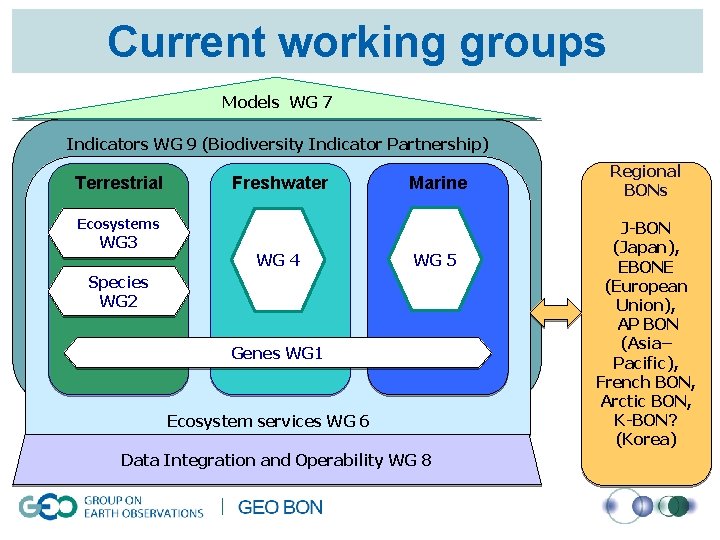
Current working groups Models WG 7 Indicators WG 9 (Biodiversity Indicator Partnership) Terrestrial Freshwater Marine Ecosystems WG 3 WG 4 WG 5 Species WG 2 Genes WG 1 Ecosystem services WG 6 Data Integration and Operability WG 8 Regional BONs J-BON (Japan), EBONE (European Union), AP BON (Asia– Pacific), French BON, Arctic BON, K-BON? (Korea)
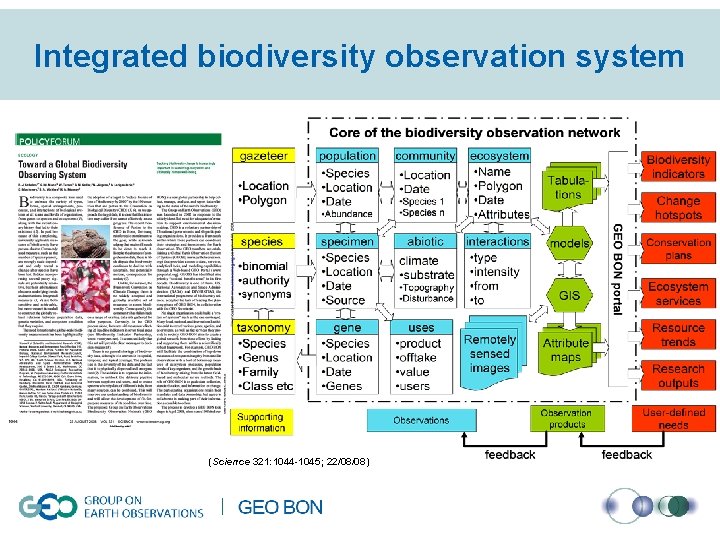
Integrated biodiversity observation system (Science 321: 1044 -1045; 22/08/08)
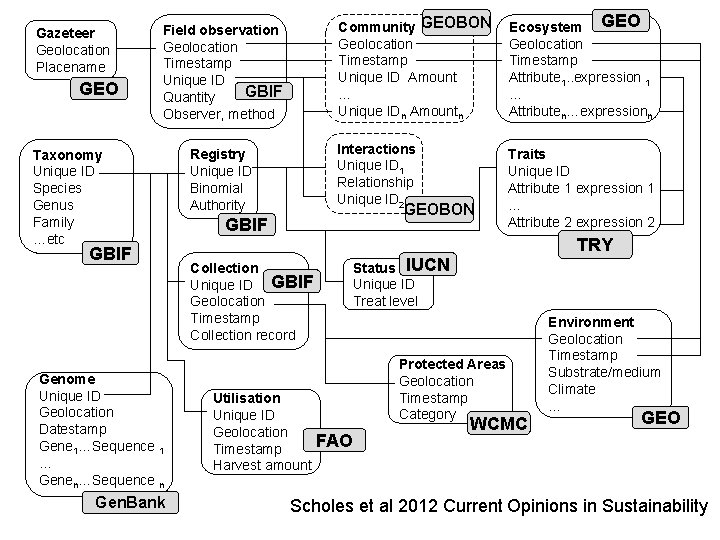
Gazeteer Geolocation Placename GEO Field observation Geolocation Timestamp Unique ID GBIF Quantity Observer, method Taxonomy Unique ID Species Genus Family …etc GBIF Genome Unique ID Geolocation Datestamp Gene 1…Sequence 1 … Genen…Sequence n Gen. Bank Registry Unique ID Binomial Authority Community GEOBON Geolocation Timestamp Unique ID Amount … Unique IDn Amountn Ecosystem GEO Geolocation Timestamp Attribute 1. . expression 1 … Attributen…expressionn Interactions Unique ID 1 Relationship Unique ID 2 Traits Unique ID Attribute 1 expression 1 … Attribute 2 expression 2 GEOBON GBIF Collection Unique ID GBIF Geolocation Timestamp Collection record TRY Status IUCN Unique ID Treat level Utilisation Unique ID Geolocation FAO Timestamp Harvest amount Protected Areas Geolocation Timestamp Category WCMC Environment Geolocation Timestamp Substrate/medium Climate … GEO Scholes et al 2012 Current Opinions in Sustainability
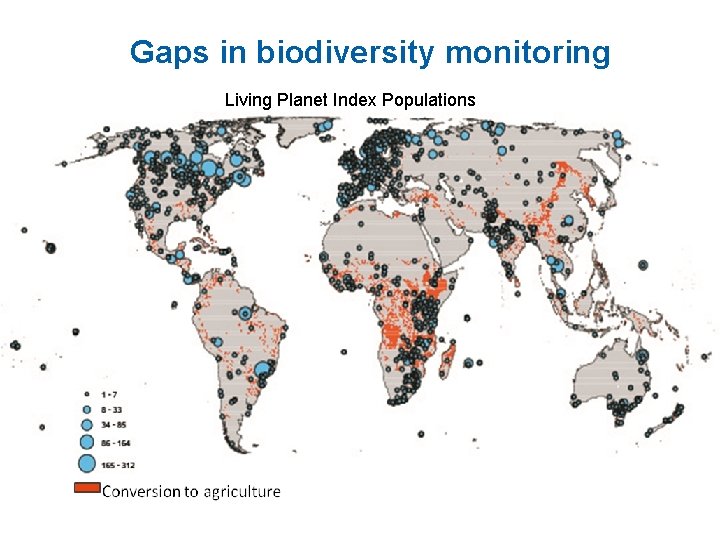
Gaps in biodiversity monitoring Living Planet Index Populations
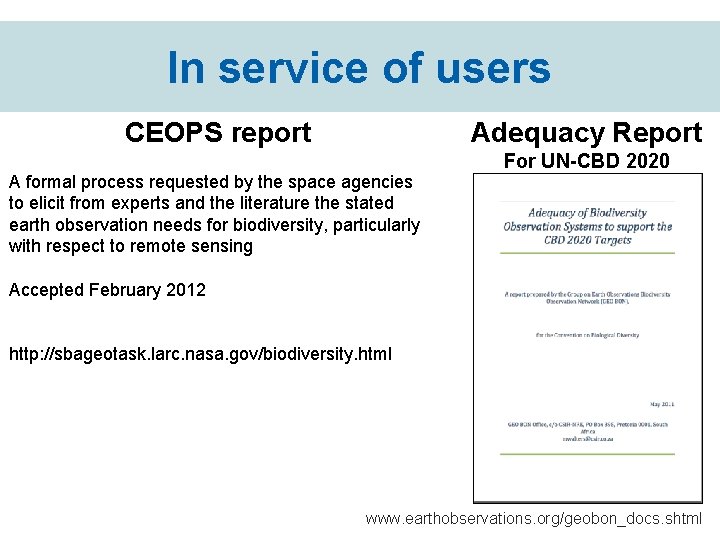
In service of users CEOPS report Adequacy Report A formal process requested by the space agencies to elicit from experts and the literature the stated earth observation needs for biodiversity, particularly with respect to remote sensing For UN-CBD 2020 Accepted February 2012 http: //sbageotask. larc. nasa. gov/biodiversity. html www. earthobservations. org/geobon_docs. shtml
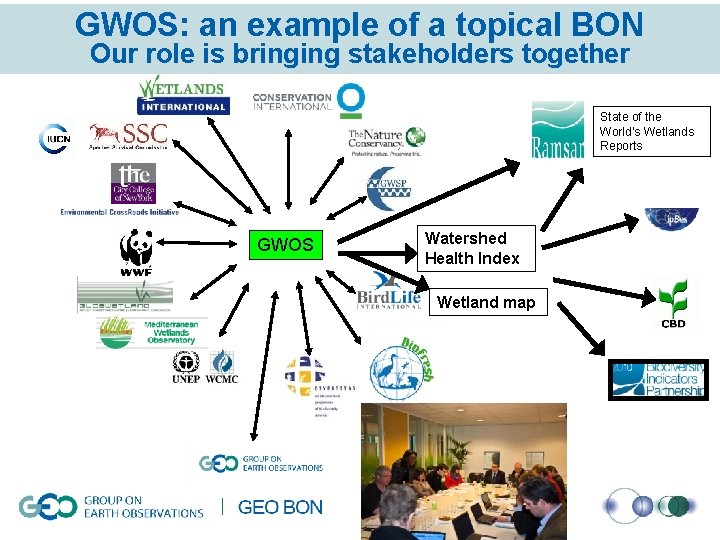
GWOS: an example of a topical BON Our role is bringing stakeholders together State of the World’s Wetlands Reports GWOS Watershed Health Index Wetland map
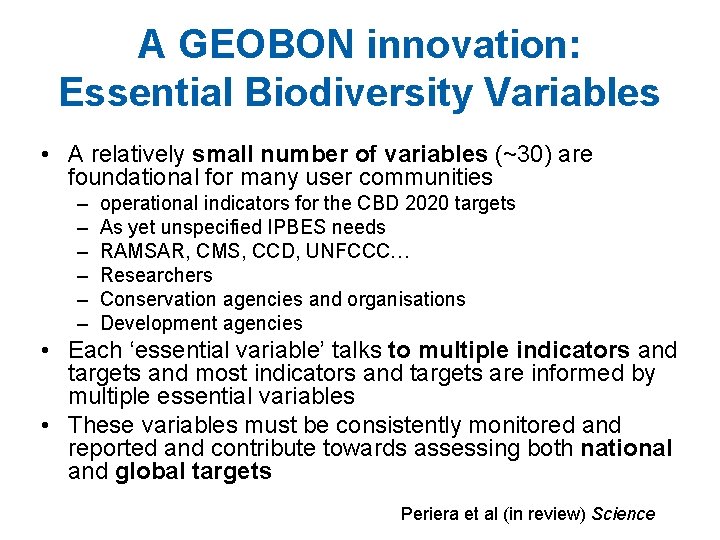
A GEOBON innovation: Essential Biodiversity Variables • A relatively small number of variables (~30) are foundational for many user communities – – – operational indicators for the CBD 2020 targets As yet unspecified IPBES needs RAMSAR, CMS, CCD, UNFCCC… Researchers Conservation agencies and organisations Development agencies • Each ‘essential variable’ talks to multiple indicators and targets and most indicators and targets are informed by multiple essential variables • These variables must be consistently monitored and reported and contribute towards assessing both national and global targets Periera et al (in review) Science
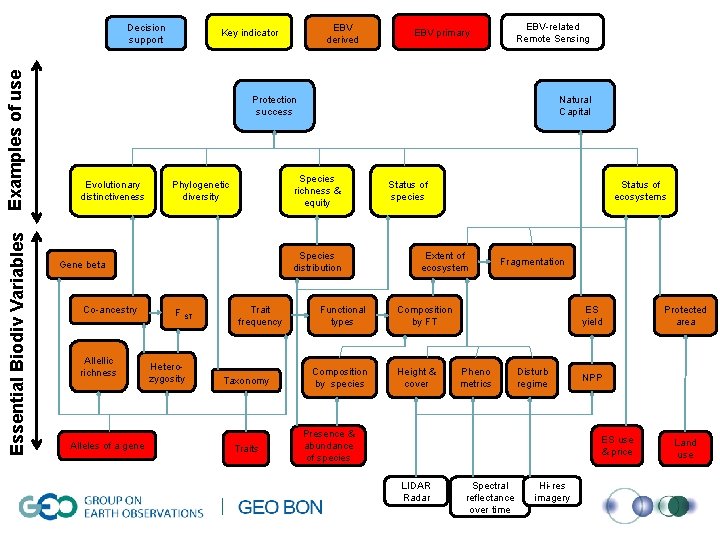
Essential Biodiv Variables Examples of use Decision support EBV derived Key indicator EBV-related Remote Sensing EBV primary Protection success Evolutionary distinctiveness Species richness & equity Phylogenetic diversity Species distribution Gene beta Co-ancestry Allellic richness Alleles of a gene Natural Capital F ST Heterozygosity Trait frequency Taxonomy Traits Functional types Composition by species Status of ecosystems Extent of ecosystem Fragmentation Composition by FT Height & cover ES yield Pheno metrics Disturb regime Presence & abundance of species NPP ES use & price LIDAR Radar Spectral reflectance over time Hi-res imagery Protected area Land use
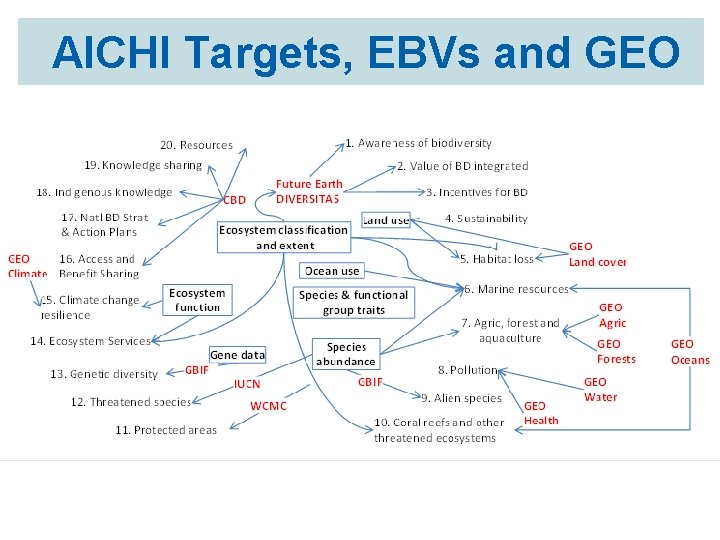
AICHI Targets, EBVs and GEO
The GEOBON Handbook • Book-length manual, due 2013, on networking, data collection, sharing and analysis in the biodiversity area • Helps meet our harmonisation & interoperability mandate • In demand from countries, regional and topical BONs
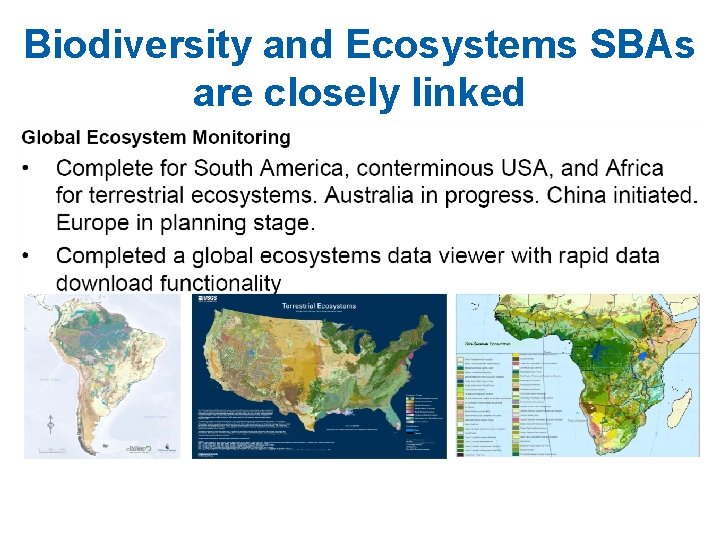
Biodiversity and Ecosystems SBAs are closely linked
What GEOBON needs • A concerted effort to implement the plan by 2015 – Global Biodiversity Observation Initiative – Support by countries for data sharing and gap filling • Within their own territory • Shared international efforts – Much tighter integration within GEO between Biodiversity, Ecosystems, Agriculture (GLAM), Global Forest Observation Initiative, climate and Water SBAs
http: //www. earthobservations. org/geobon. shtml bscholes@csir. co. za rob. jongman@wur. edu. nl gsarantakos@geosec. org
- Slides: 20