
GEO 56690 Geodynamics 11 Jan 2019 Last Time

- Slides: 7
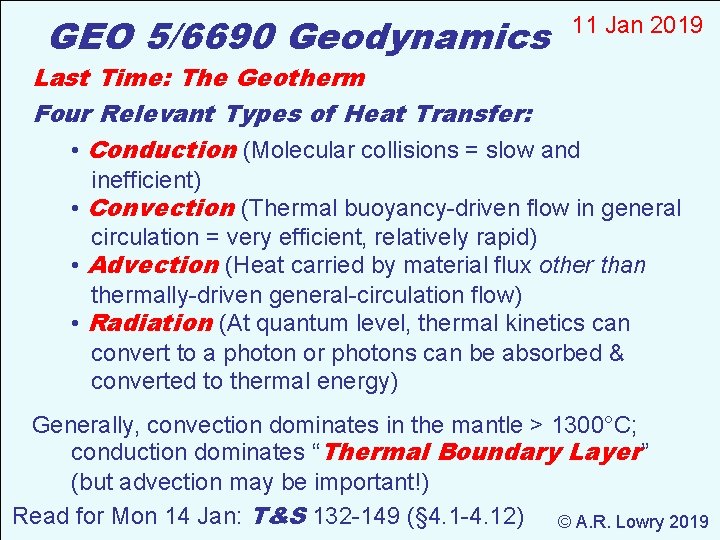
GEO 5/6690 Geodynamics 11 Jan 2019 Last Time: The Geotherm Four Relevant Types of Heat Transfer: • Conduction (Molecular collisions = slow and inefficient) • Convection (Thermal buoyancy-driven flow in general circulation = very efficient, relatively rapid) • Advection (Heat carried by material flux other than thermally-driven general-circulation flow) • Radiation (At quantum level, thermal kinetics can convert to a photon or photons can be absorbed & converted to thermal energy) Generally, convection dominates in the mantle > 1300°C; conduction dominates “Thermal Boundary Layer” (but advection may be important!) Read for Mon 14 Jan: T&S 132 -149 (§ 4. 1 -4. 12) © A. R. Lowry 2019
First Journal Article Reading: For Friday Jan 18: Furlong & Chapman, Ann. Rev. Earth Planet. Sci. 41, 385 -410 (2013).
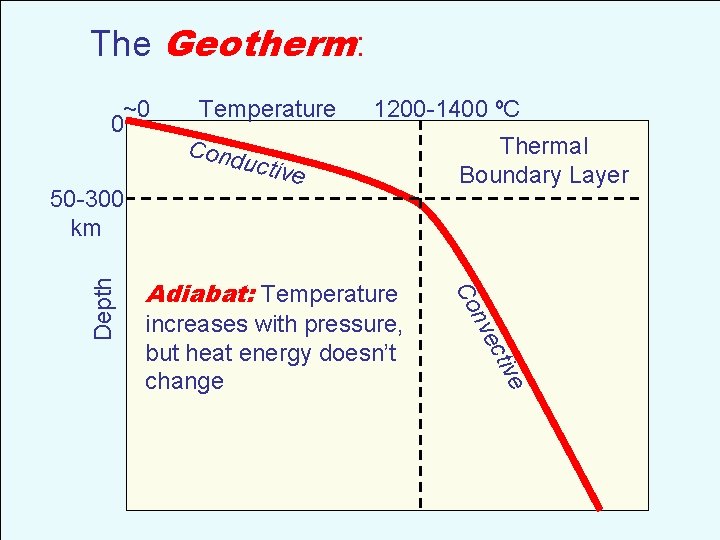
The Geotherm: ~0 0 1200 -1400 ºC Cond u ctive Adiabat: Temperature tive ec nv increases with pressure, but heat energy doesn’t change Thermal Boundary Layer Co Depth 50 -300 km Temperature
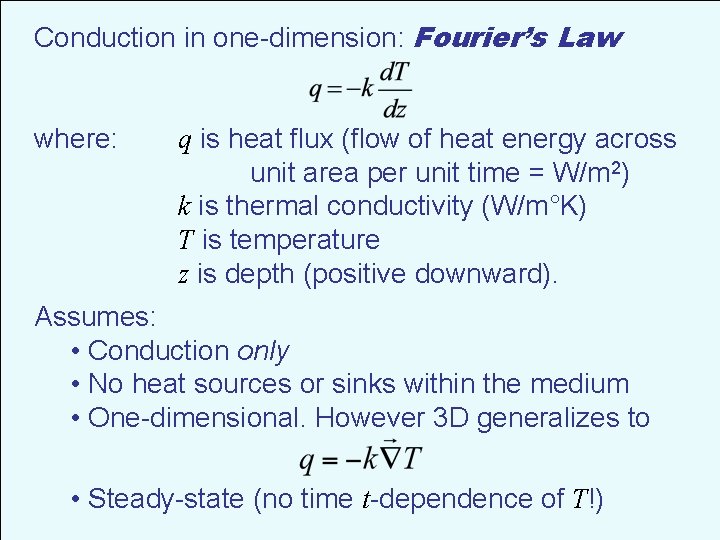
Conduction in one-dimension: Fourier’s Law where: q is heat flux (flow of heat energy across unit area per unit time = W/m 2) k is thermal conductivity (W/m°K) T is temperature z is depth (positive downward). Assumes: • Conduction only • No heat sources or sinks within the medium • One-dimensional. However 3 D generalizes to • Steady-state (no time t-dependence of T!)
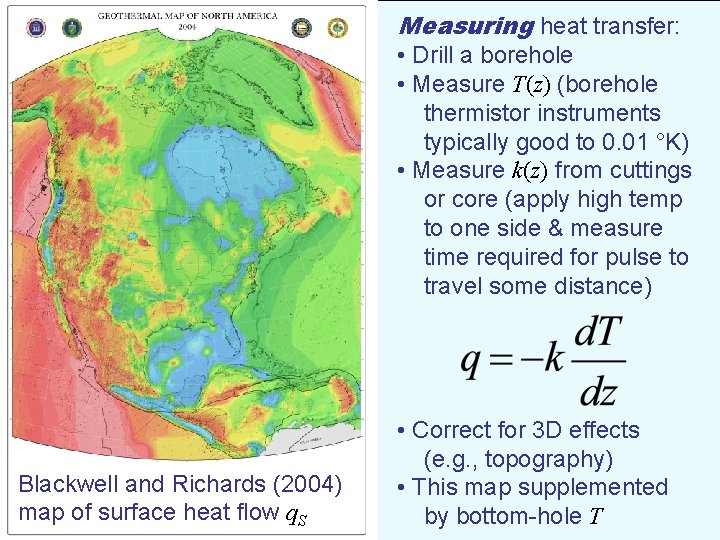
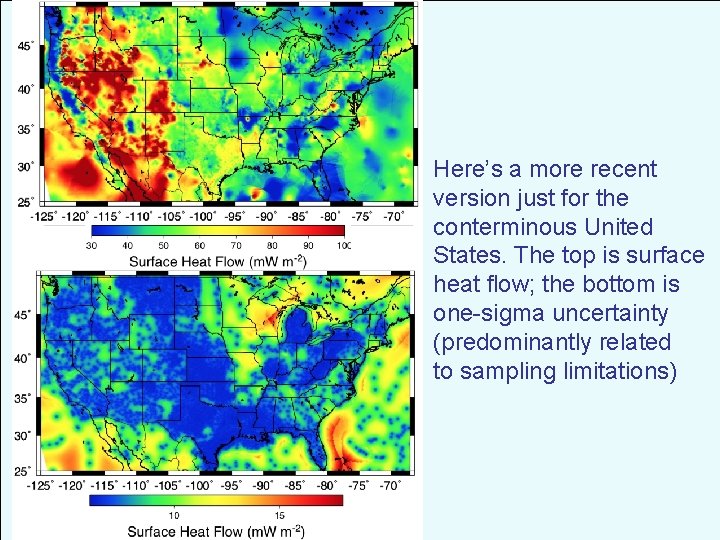
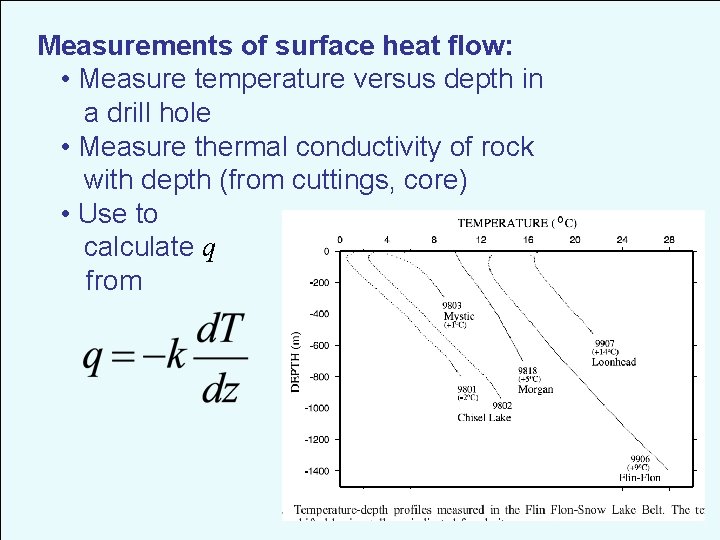
Measuring heat transfer: • Drill a borehole • Measure T(z) (borehole thermistor instruments typically good to 0. 01 °K) • Measure k(z) from cuttings or core (apply high temp to one side & measure time required for pulse to travel some distance) Blackwell and Richards (2004) map of surface heat flow q. S • Correct for 3 D effects (e. g. , topography) • This map supplemented by bottom-hole T
Here’s a more recent version just for the conterminous United States. The top is surface heat flow; the bottom is one-sigma uncertainty (predominantly related to sampling limitations)
Measurements of surface heat flow: • Measure temperature versus depth in a drill hole • Measure thermal conductivity of rock with depth (from cuttings, core) • Use to calculate q from