
Gentle Introduction to Infinite Gaussian Mixture Modeling with

- Slides: 31
Gentle Introduction to Infinite Gaussian Mixture Modeling … with an application in neuroscience By Frank Wood Rasmussen, NIPS 1999 Frank Wood - fwood@cs. brown. edu
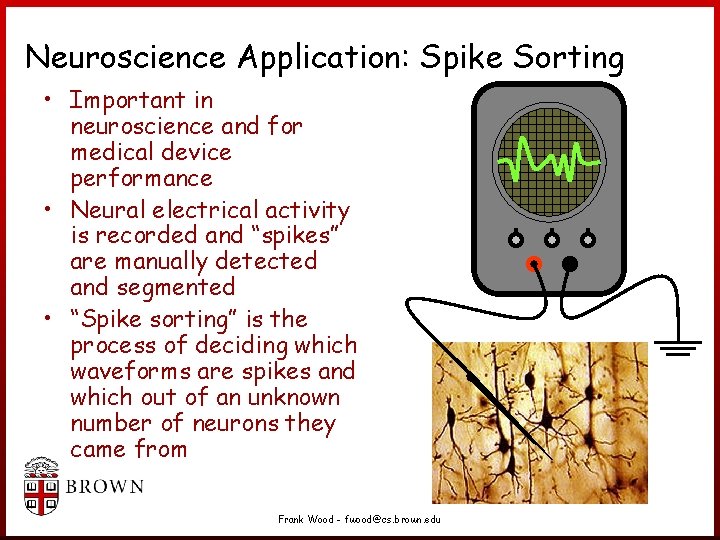
Neuroscience Application: Spike Sorting • Important in neuroscience and for medical device performance • Neural electrical activity is recorded and “spikes” are manually detected and segmented • “Spike sorting” is the process of deciding which waveforms are spikes and which out of an unknown number of neurons they came from Frank Wood - fwood@cs. brown. edu
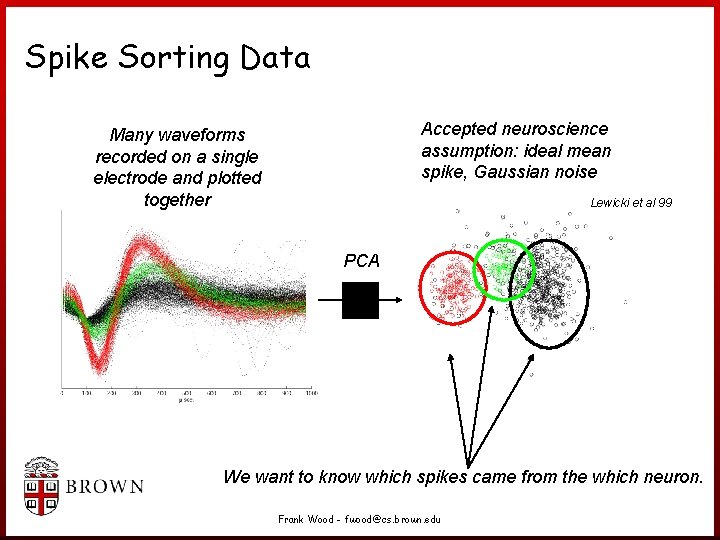
Spike Sorting Data Accepted neuroscience assumption: ideal mean spike, Gaussian noise Many waveforms recorded on a single electrode and plotted together Lewicki et al 99 PCA We want to know which spikes came from the which neuron. Frank Wood - fwood@cs. brown. edu
Important Questions • Did these two spikes come from the same neuron? – Did these two data points come from the same hidden class? • How many neurons are there? – How many hidden classes are there? • Which spikes came from which neurons? – What model best explains the data? Frank Wood - fwood@cs. brown. edu
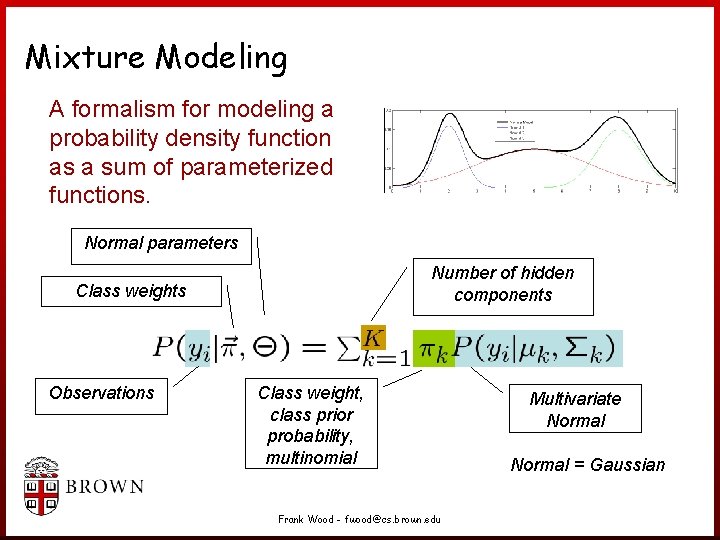
Mixture Modeling A formalism for modeling a probability density function as a sum of parameterized functions. Normal parameters Number of hidden components Class weights Observations Class weight, class prior probability, multinomial Frank Wood - fwood@cs. brown. edu Multivariate Normal = Gaussian
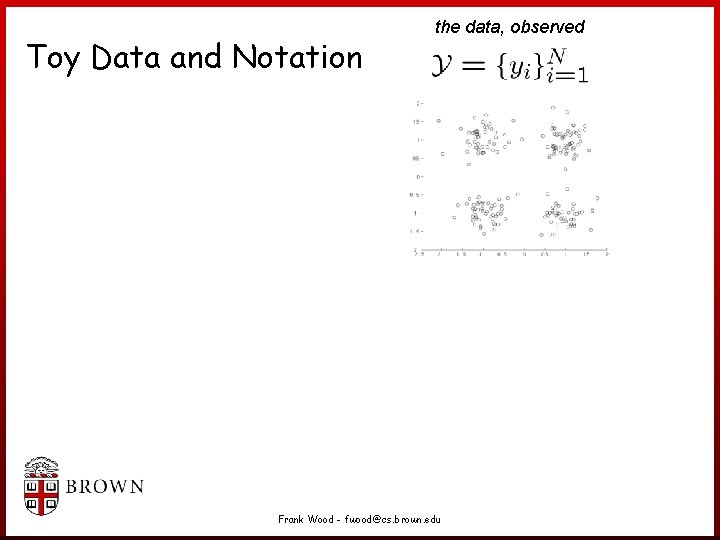
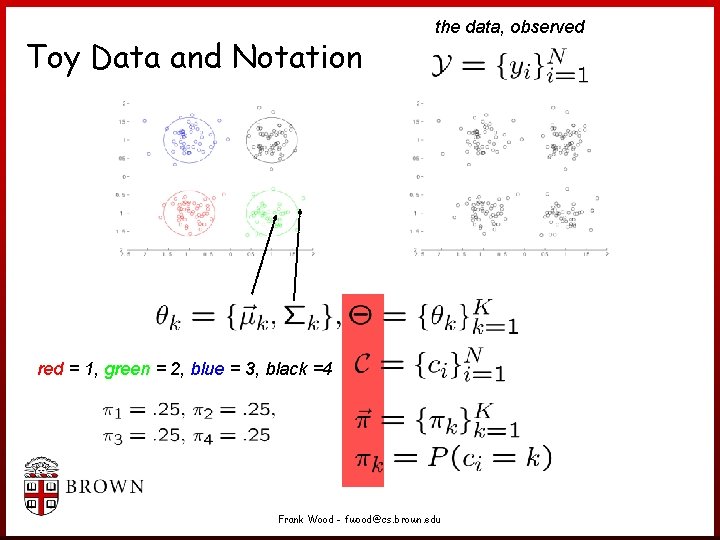
Toy Data and Notation the data, observed Frank Wood - fwood@cs. brown. edu
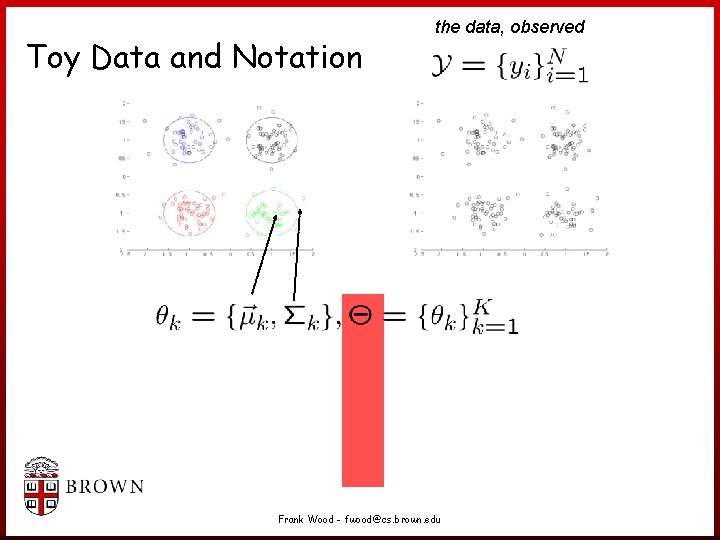
Toy Data and Notation the data, observed Frank Wood - fwood@cs. brown. edu
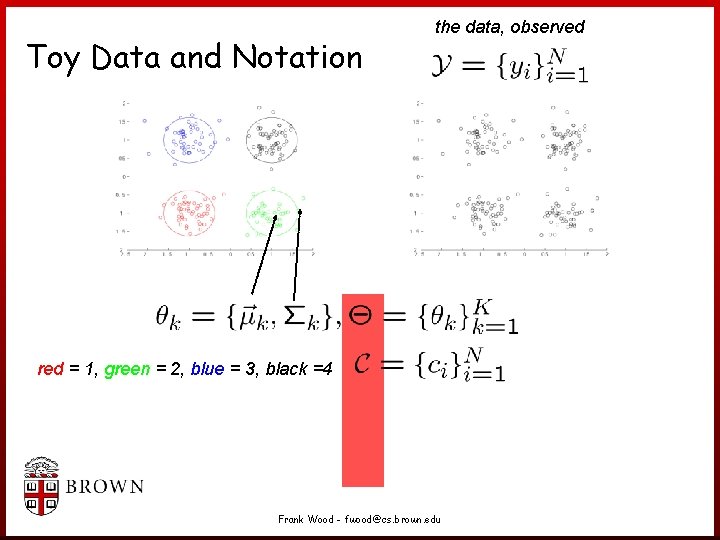
Toy Data and Notation the data, observed red = 1, green = 2, blue = 3, black =4 Frank Wood - fwood@cs. brown. edu
Toy Data and Notation the data, observed red = 1, green = 2, blue = 3, black =4 Frank Wood - fwood@cs. brown. edu
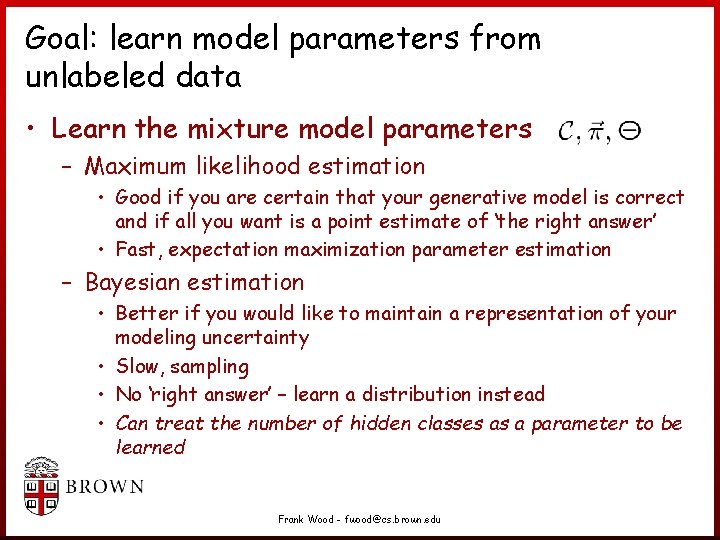
Goal: learn model parameters from unlabeled data • Learn the mixture model parameters – Maximum likelihood estimation • Good if you are certain that your generative model is correct and if all you want is a point estimate of ‘the right answer’ • Fast, expectation maximization parameter estimation – Bayesian estimation • Better if you would like to maintain a representation of your modeling uncertainty • Slow, sampling • No ‘right answer’ – learn a distribution instead • Can treat the number of hidden classes as a parameter to be learned Frank Wood - fwood@cs. brown. edu
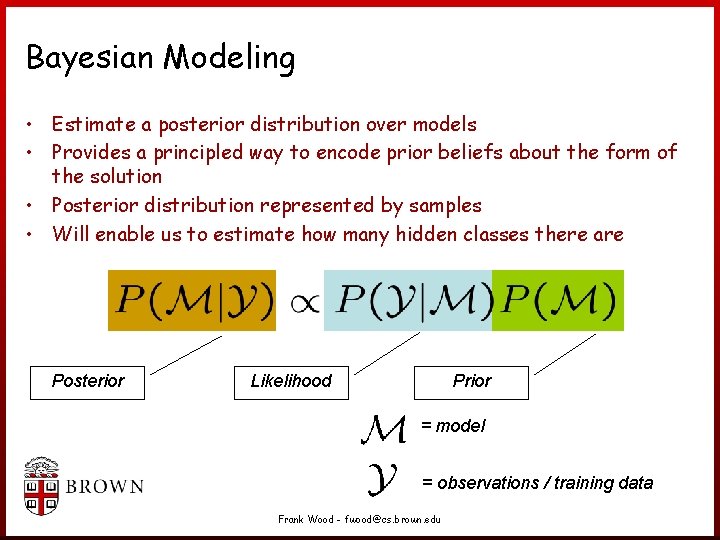
Bayesian Modeling • Estimate a posterior distribution over models • Provides a principled way to encode prior beliefs about the form of the solution • Posterior distribution represented by samples • Will enable us to estimate how many hidden classes there are Posterior Likelihood Prior = model = observations / training data Frank Wood - fwood@cs. brown. edu
What we need: • Priors for the model parameters • Sampler – To draw samples from the posterior distribution Frank Wood - fwood@cs. brown. edu
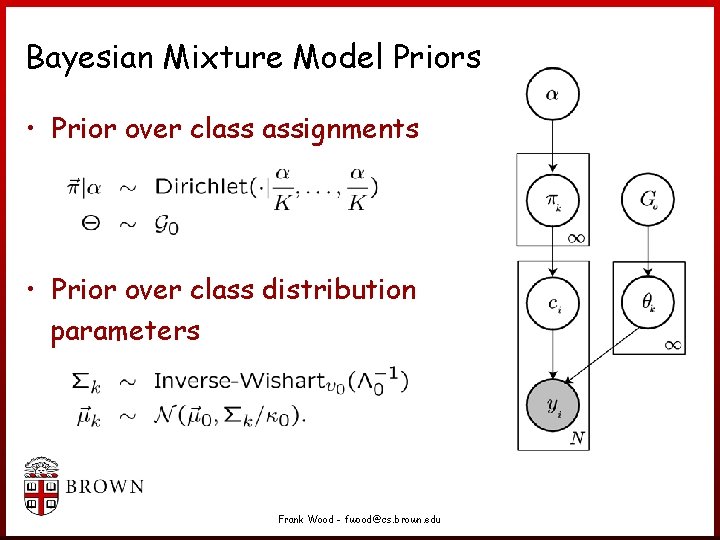
Priors for the model parameters • Prior over class assignments – Class assignments are Multinomial, we will choose a conjugate Dirichlet prior. This allows us to specify a priori how likely we think each class will be. • Prior over class distribution parameters – Class distributions are multivariate Normal. We will choose conjugate Normal*Inverse-Wishart priors. These let us specify a priori where and how broad we think each mixture density should be. Frank Wood - fwood@cs. brown. edu
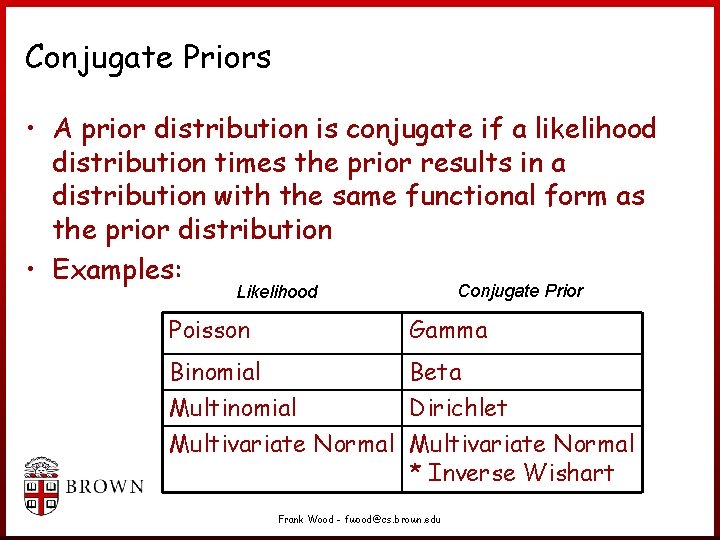
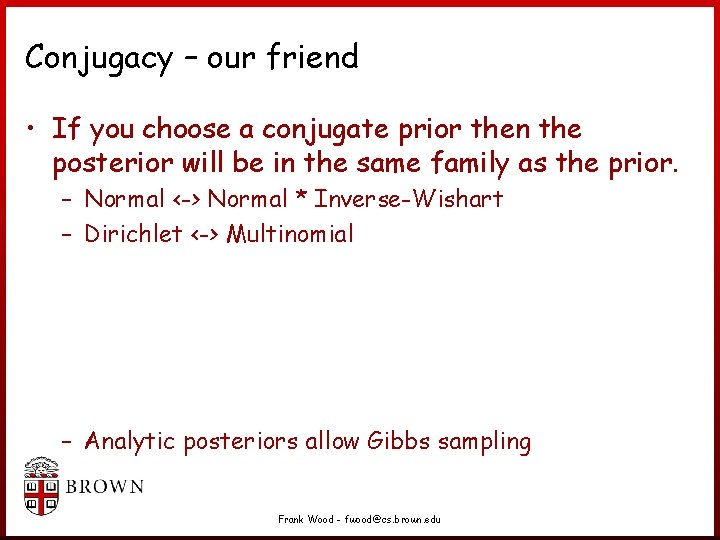
Conjugate Priors • A prior distribution is conjugate if a likelihood distribution times the prior results in a distribution with the same functional form as the prior distribution • Examples: Conjugate Prior Likelihood Poisson Gamma Binomial Beta Multinomial Dirichlet Multivariate Normal * Inverse Wishart Frank Wood - fwood@cs. brown. edu
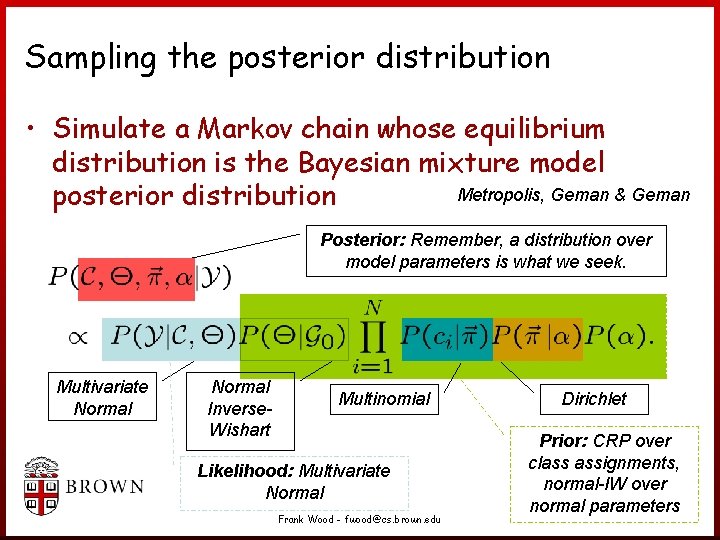
Sampling the posterior distribution • Simulate a Markov chain whose equilibrium distribution is the Bayesian mixture model Metropolis, Geman & Geman posterior distribution Posterior: Remember, a distribution over model parameters is what we seek. Multivariate Normal Inverse. Wishart Multinomial Likelihood: Multivariate Normal Frank Wood - fwood@cs. brown. edu Dirichlet Prior: CRP over class assignments, normal-IW over normal parameters
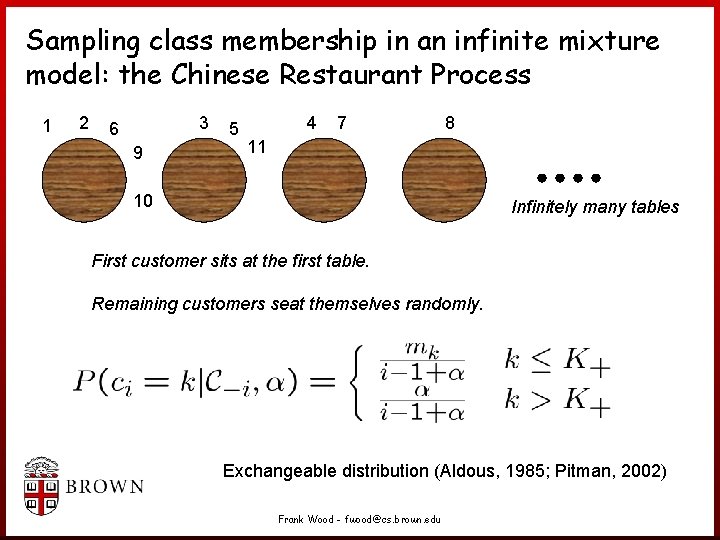
But what about the infinite part? – Properly parameterized, a posterior formed from a Multinomial Dirichlet conjugate pair is well behaved as the number of hidden classes approaches infinity. – This results in a model with an infinite number of hidden causes, but one that only a finite number are causal w. r. t. our finite dataset. – The Chinese Restaurant Process is one process that generates samples from such a model. • A hyperparameter (prior) will remain that allows us to specify our a priori belief about how many hidden classes cause our finite data. Frank Wood - fwood@cs. brown. edu
Sampling class membership in an infinite mixture model: the Chinese Restaurant Process 1 2 3 6 9 5 4 7 8 11 10 Infinitely many tables First customer sits at the first table. Remaining customers seat themselves randomly. Exchangeable distribution (Aldous, 1985; Pitman, 2002) Frank Wood - fwood@cs. brown. edu
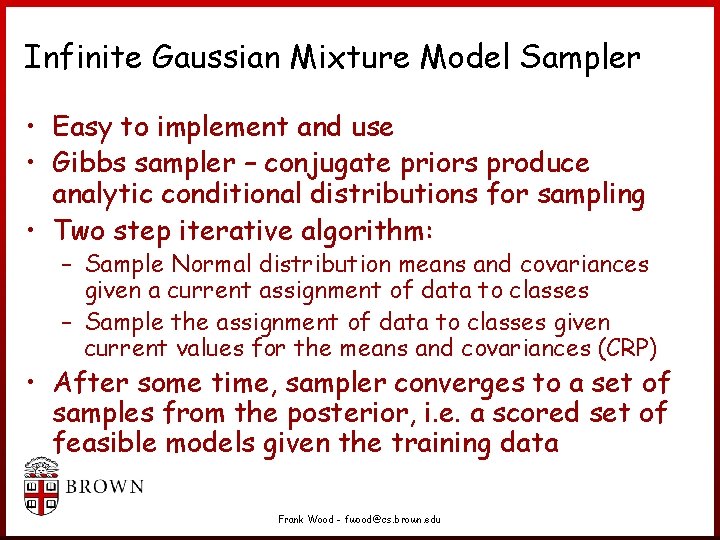
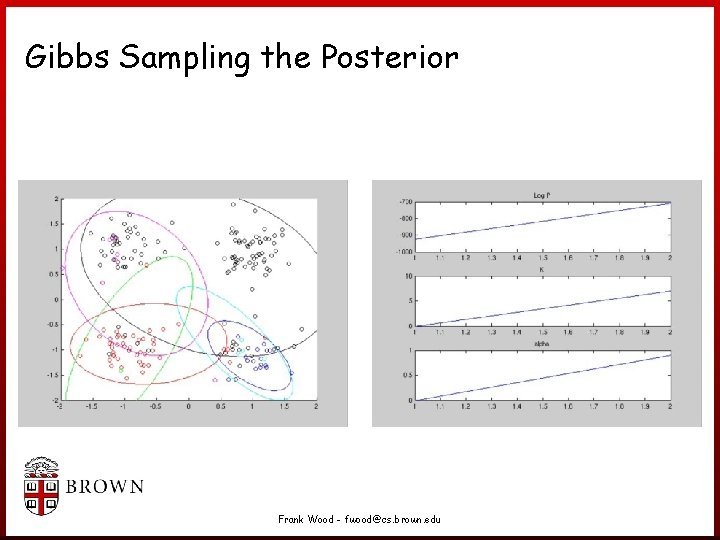
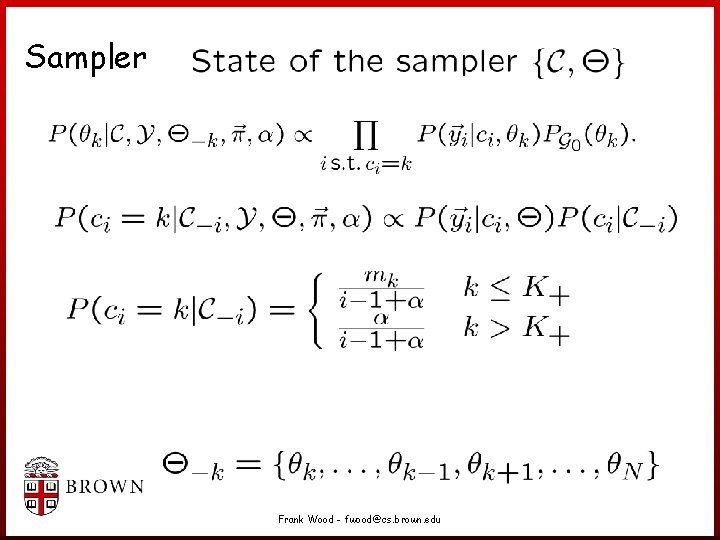
Infinite Gaussian Mixture Model Sampler • Easy to implement and use • Gibbs sampler – conjugate priors produce analytic conditional distributions for sampling • Two step iterative algorithm: – Sample Normal distribution means and covariances given a current assignment of data to classes – Sample the assignment of data to classes given current values for the means and covariances (CRP) • After some time, sampler converges to a set of samples from the posterior, i. e. a scored set of feasible models given the training data Frank Wood - fwood@cs. brown. edu
Gibbs Sampling the Posterior Frank Wood - fwood@cs. brown. edu
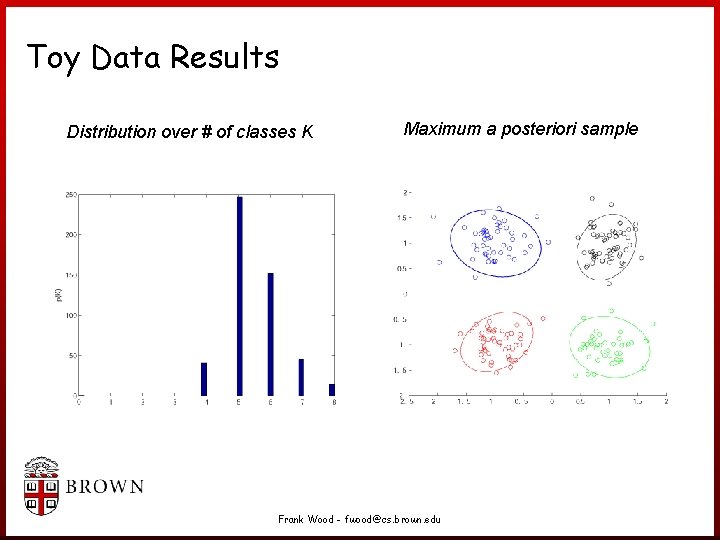
Toy Data Results Distribution over # of classes K Maximum a posteriori sample Frank Wood - fwood@cs. brown. edu
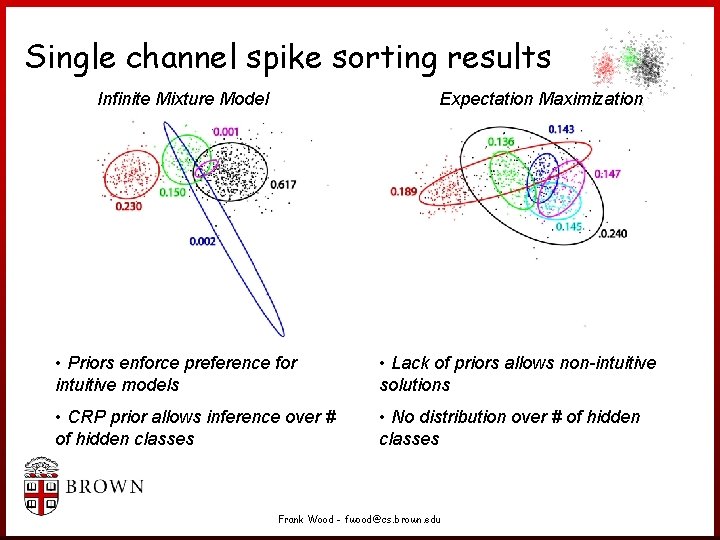
Single channel spike sorting results Infinite Mixture Model Expectation Maximization • Priors enforce preference for intuitive models • Lack of priors allows non-intuitive solutions • CRP prior allows inference over # of hidden classes • No distribution over # of hidden classes Frank Wood - fwood@cs. brown. edu
Conclusions • Bayesian mixture modeling is principled way to add prior information into the modeling process • IMM / CRP is a way estimate the number of hidden classes • Infinite Gaussian mixture modeling is good for automatic spike sorting Future Work • Particle filtering for online spike sorting Frank Wood - fwood@cs. brown. edu
Thank you This work was supported by NIH-NINDS R 01 NS 50967 -01 as part of the NSF/NIH Collaborative Research in Computational Neuroscience Program. IGMM Software available at http: //www. cs. brown. edu/~fwood/code. html Thanks to Michael Black, Tom Griffiths, Sharon Goldwater, and the Brown University machine learning reading group. Frank Wood - fwood@cs. brown. edu
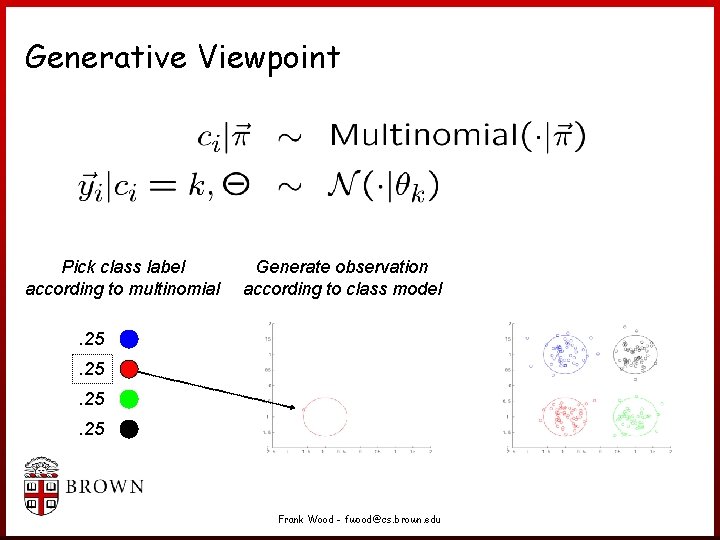
Generative Viewpoint Pick class label according to multinomial Generate observation according to class model . 25. 25 Frank Wood - fwood@cs. brown. edu
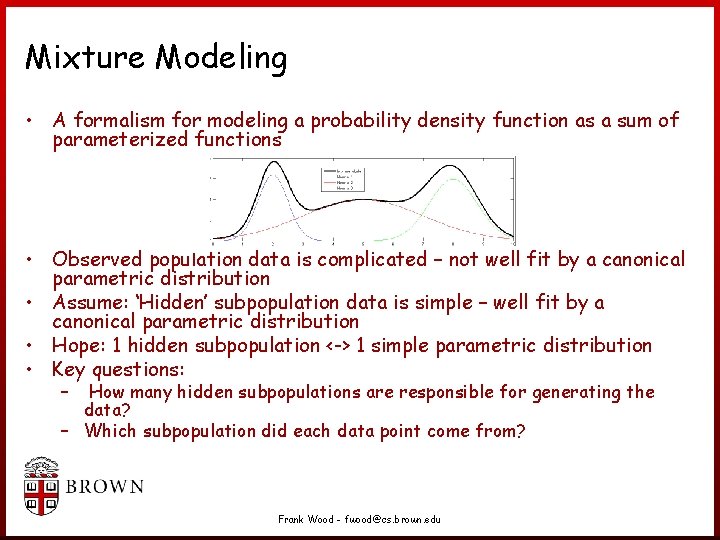
Mixture Modeling • A formalism for modeling a probability density function as a sum of parameterized functions 1 D MIXTURE MODEL PLOT HERE • Observed population data is complicated – not well fit by a canonical parametric distribution • Assume: ‘Hidden’ subpopulation data is simple – well fit by a canonical parametric distribution • Hope: 1 hidden subpopulation <-> 1 simple parametric distribution • Key questions: – How many hidden subpopulations are responsible for generating the data? – Which subpopulation did each data point come from? Frank Wood - fwood@cs. brown. edu
Limiting Behavior of Uniform Dirichlet Prior Frank Wood - fwood@cs. brown. edu
Bayesian Mixture Model Priors • Prior over class assignments • Prior over class distribution parameters Frank Wood - fwood@cs. brown. edu
Conjugacy – our friend • If you choose a conjugate prior then the posterior will be in the same family as the prior. – Normal <-> Normal * Inverse-Wishart – Dirichlet <-> Multinomial – Analytic posteriors allow Gibbs sampling Frank Wood - fwood@cs. brown. edu
Sampler Frank Wood - fwood@cs. brown. edu
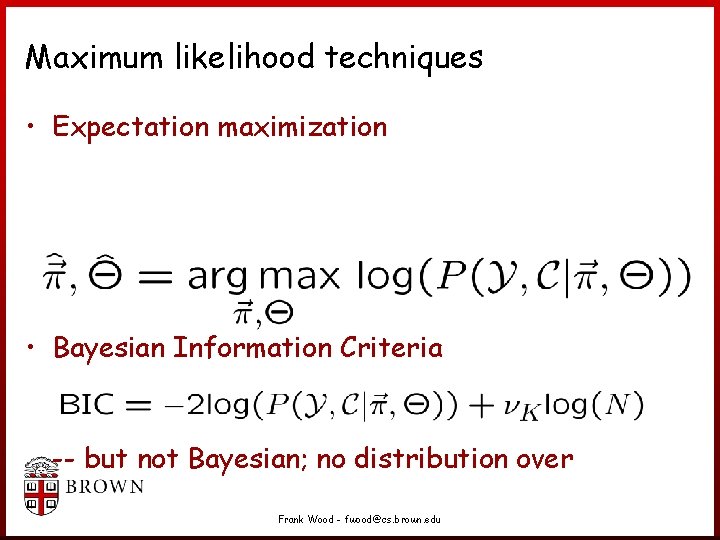
Maximum likelihood techniques • Expectation maximization • Bayesian Information Criteria -- but not Bayesian; no distribution over Frank Wood - fwood@cs. brown. edu
Example applications • Modeling network packet traffic – Network applications’ performance dependent on distribution of incoming packets – Want a population model to build a fancy scheduler – Potentially multiple heterogeneous applications generating packet traffic – How many types of applications are generating packets? • Clustering sensor data (robotics, sensor networks) – Robot encounters multiple types of physical environments (doors, walls, hallways, etc. ) – How many types of environments are there? – How do we tell what type of space we are in? Frank Wood - fwood@cs. brown. edu