
Genre Terms for Literature in LCGFT Lori Robare
Genre Terms for Literature in LCGFT Lori Robare OLA Conference, Bend April 21, 2016
What we’ll cover • Brief background on • LCGFT • MARC coding for genre terms in bibliographic records • Genre terms for literature in LCGFT • Library of Congress documentation and practices • New vocabulary and MARC fields: Demographic group terms
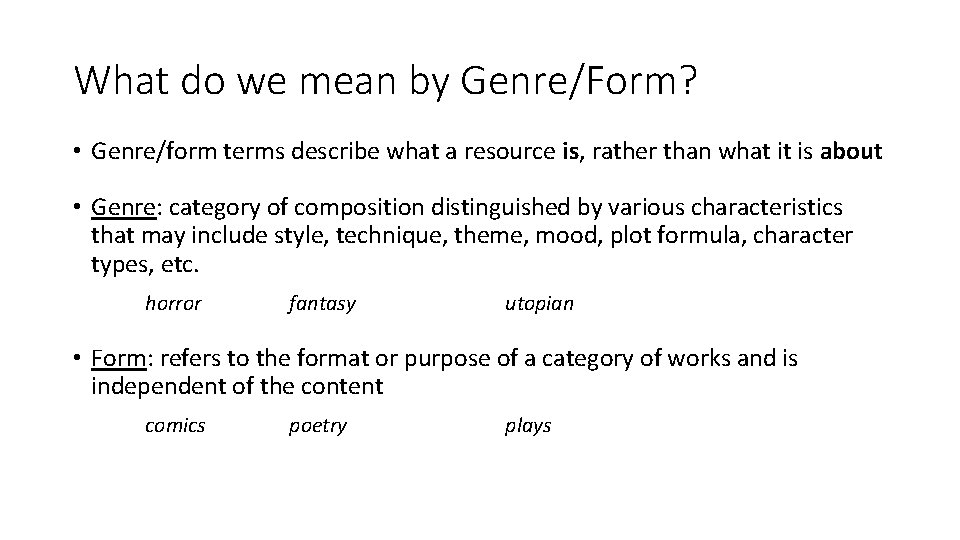
What do we mean by Genre/Form? • Genre/form terms describe what a resource is, rather than what it is about • Genre: category of composition distinguished by various characteristics that may include style, technique, theme, mood, plot formula, character types, etc. horror fantasy utopian • Form: refers to the format or purpose of a category of works and is independent of the content comics poetry plays
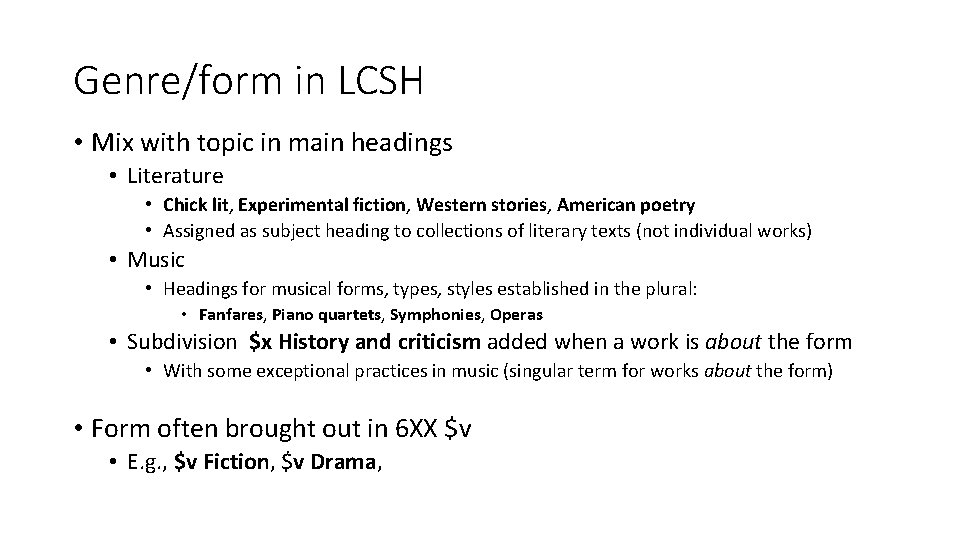
Genre/form in LCSH • Mix with topic in main headings • Literature • Chick lit, Experimental fiction, Western stories, American poetry • Assigned as subject heading to collections of literary texts (not individual works) • Music • Headings for musical forms, types, styles established in the plural: • Fanfares, Piano quartets, Symphonies, Operas • Subdivision $x History and criticism added when a work is about the form • With some exceptional practices in music (singular term for works about the form) • Form often brought out in 6 XX $v • E. g. , $v Fiction, $v Drama,
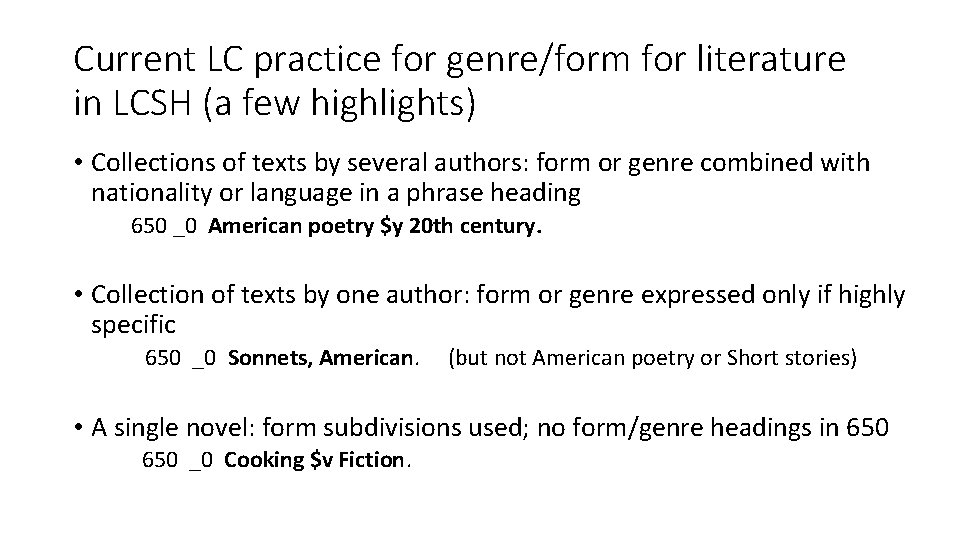
Current LC practice for genre/form for literature in LCSH (a few highlights) • Collections of texts by several authors: form or genre combined with nationality or language in a phrase heading 650 _0 American poetry $y 20 th century. • Collection of texts by one author: form or genre expressed only if highly specific 650 _0 Sonnets, American. (but not American poetry or Short stories) • A single novel: form subdivisions used; no form/genre headings in 650 _0 Cooking $v Fiction.
LCGFT • Library of Congress Genre/Form Terms for Library and Archival Materials • Thesaurus developed by LC, beginning in 2007 • First considered part of LCSH, now a stand-alone vocabulary • Genres and forms broadly defined as categories of resources that share known conventions • May describe the purpose, structure, content, and/or themes of resources • Genre/form terms describing content and themes most frequently refer to creative works and denote common rhetorical devices (plot, setting, character types, etc. )
LC’s genre projects: completed • Moving images (films, television programs, video recordings) • First terms approved in 2007 • Application first documented in Subject Headings Manual (SHM) H 1913 • Radio programs, other recorded sound • Small project, based on LC’s Radio Form/Genre Guide (RADFG) • First terms approved in 2008; application first documented in SHM H 1969. 5 • Cartographic materials • Undertaken with LC’s Geography and Maps Division • First terms approved 2010 • First project to precipitate changes to LCSH policy: cancellation of form subdivisions
LC’s genre projects: completed • Cookbooks • Very small project! (3 terms) • Guidance in SHM H 1475 • Law • First project in which LC collaborated with another organization, American Association of Law Libraries • Added to LCGFT in November 2010 • Administrative regulations, Constitutions, Municipal ordinances, Statutes and codes • Music • LC partnership with Music Library Association • Work has been underway for several years
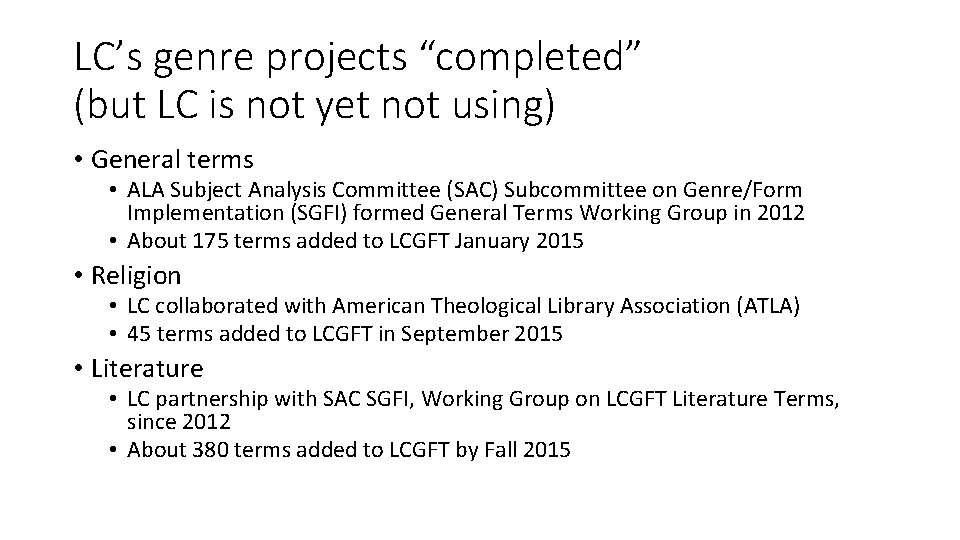
LC’s genre projects “completed” (but LC is not yet not using) • General terms • ALA Subject Analysis Committee (SAC) Subcommittee on Genre/Form Implementation (SGFI) formed General Terms Working Group in 2012 • About 175 terms added to LCGFT January 2015 • Religion • LC collaborated with American Theological Library Association (ATLA) • 45 terms added to LCGFT in September 2015 • Literature • LC partnership with SAC SGFI, Working Group on LCGFT Literature Terms, since 2012 • About 380 terms added to LCGFT by Fall 2015
The lone genre project still in process • Art • LC collaborating with Art Libraries Society of North America (ARLIS/NA) • Began in 2014 • Goal: list of proposed terms ready for LC after 2016 ARLIS/NA conference
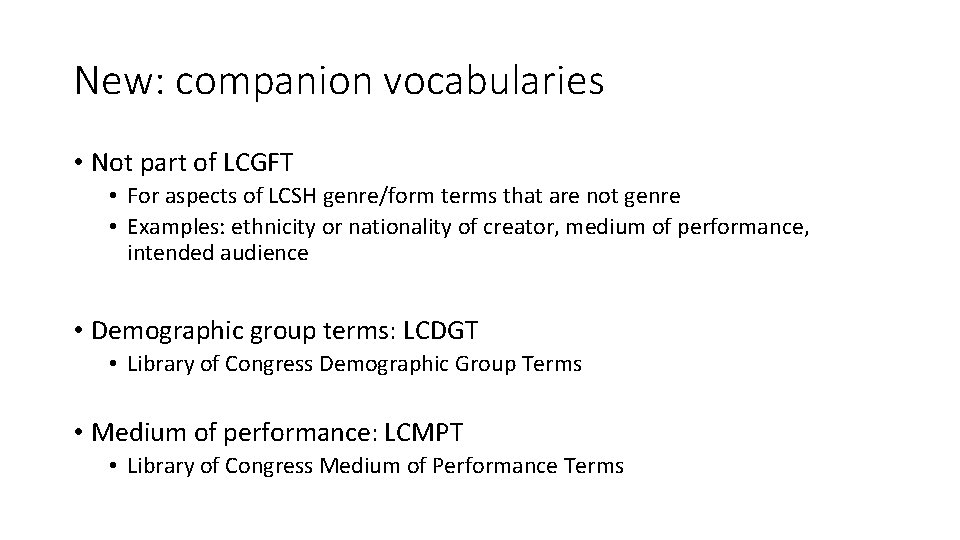
New: companion vocabularies • Not part of LCGFT • For aspects of LCSH genre/form terms that are not genre • Examples: ethnicity or nationality of creator, medium of performance, intended audience • Demographic group terms: LCDGT • Library of Congress Demographic Group Terms • Medium of performance: LCMPT • Library of Congress Medium of Performance Terms
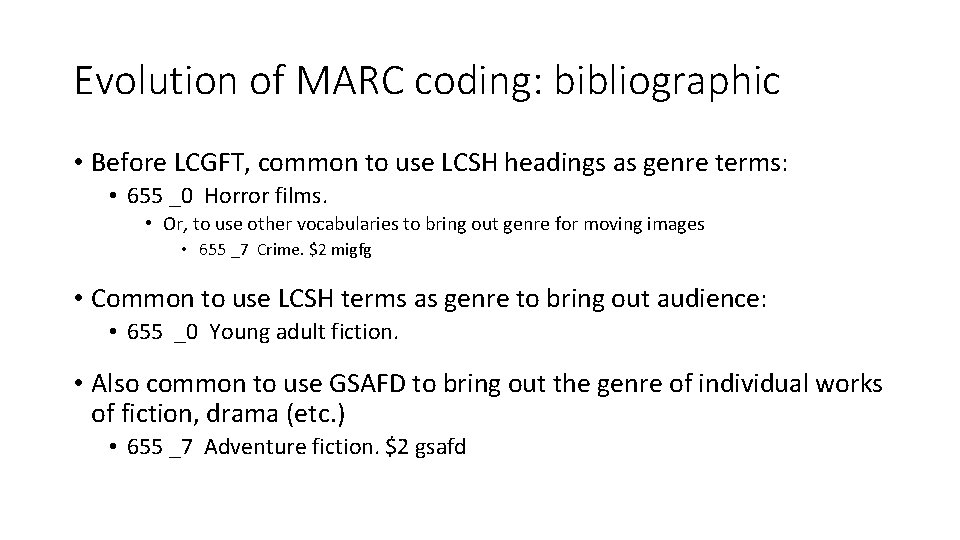
Evolution of MARC coding: bibliographic • Before LCGFT, common to use LCSH headings as genre terms: • 655 _0 Horror films. • Or, to use other vocabularies to bring out genre for moving images • 655 _7 Crime. $2 migfg • Common to use LCSH terms as genre to bring out audience: • 655 _0 Young adult fiction. • Also common to use GSAFD to bring out the genre of individual works of fiction, drama (etc. ) • 655 _7 Adventure fiction. $2 gsafd
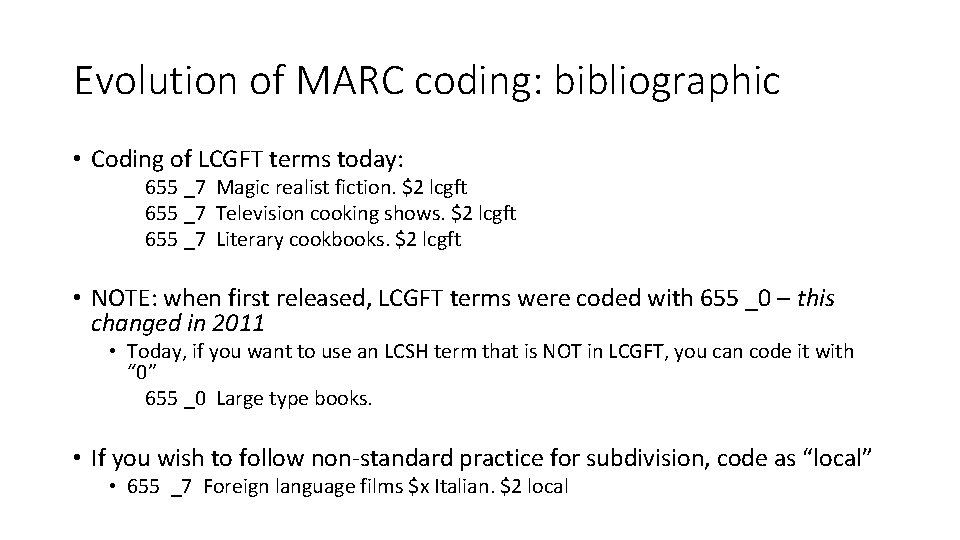
Evolution of MARC coding: bibliographic • Coding of LCGFT terms today: 655 _7 Magic realist fiction. $2 lcgft 655 _7 Television cooking shows. $2 lcgft 655 _7 Literary cookbooks. $2 lcgft • NOTE: when first released, LCGFT terms were coded with 655 _0 – this changed in 2011 • Today, if you want to use an LCSH term that is NOT in LCGFT, you can code it with “ 0” 655 _0 Large type books. • If you wish to follow non-standard practice for subdivision, code as “local” • 655 _7 Foreign language films $x Italian. $2 local
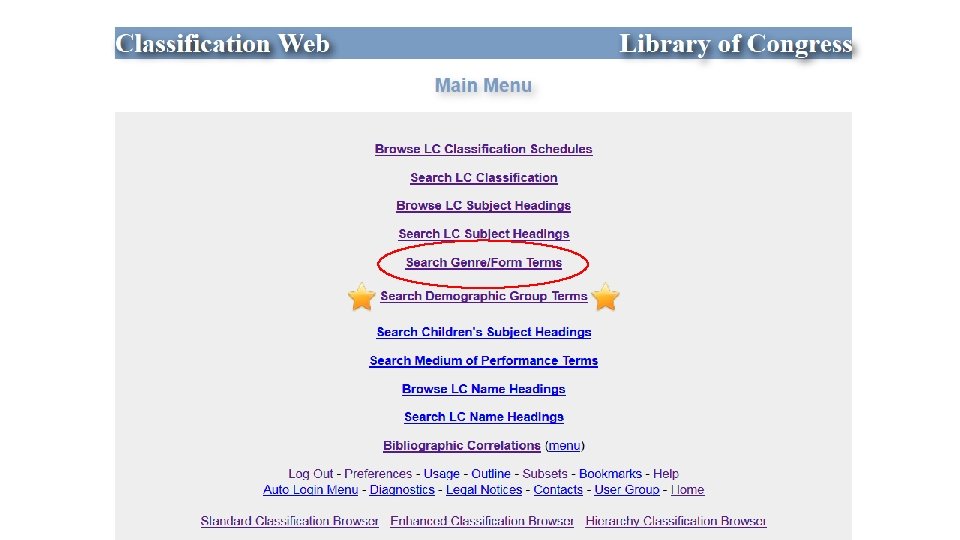
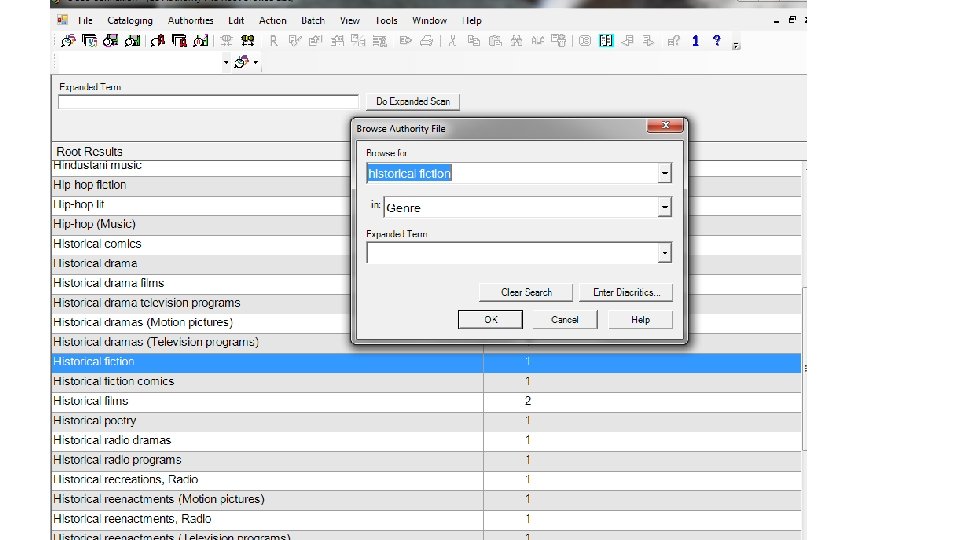
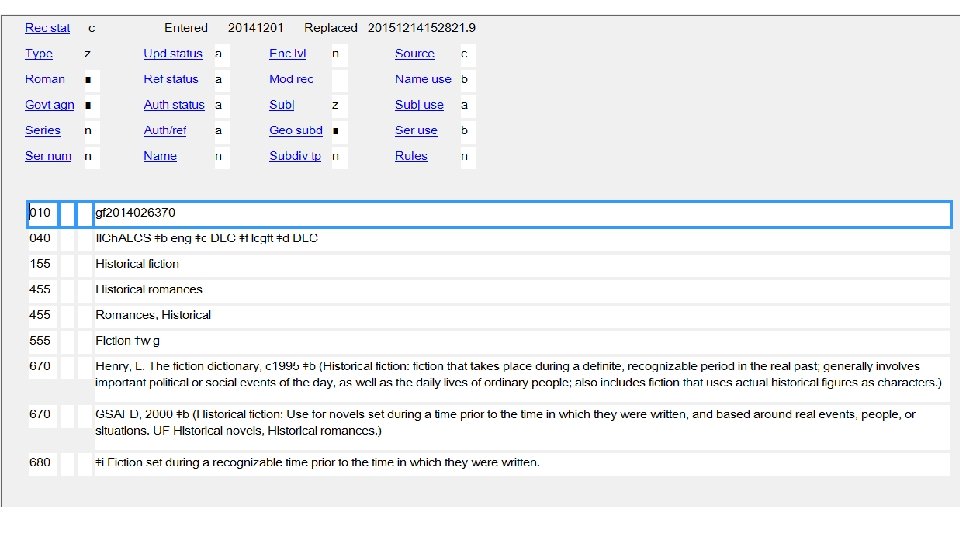
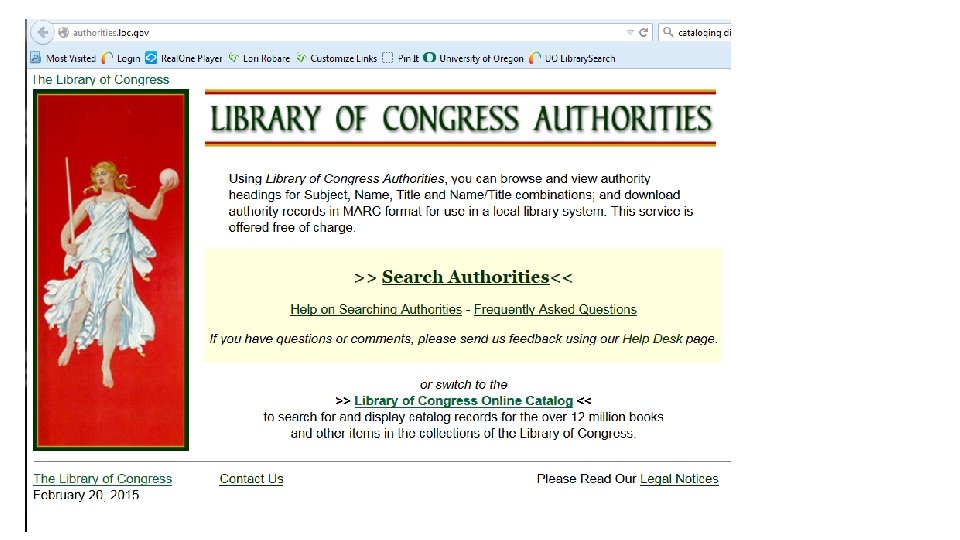
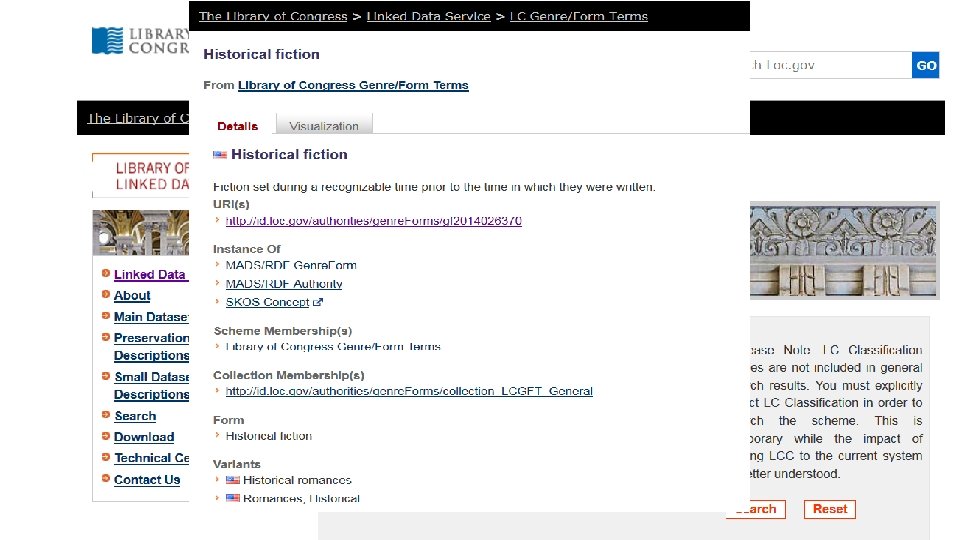
Where to find LCGFT terms • Classification Web • Used to be special section in LCSH “Big Red Books” (no longer in print) • Authority records in Connexion • Library of Congress Authorities (http: //authorities. loc. gov/) • LC Linked Data Service (id. loc. gov)
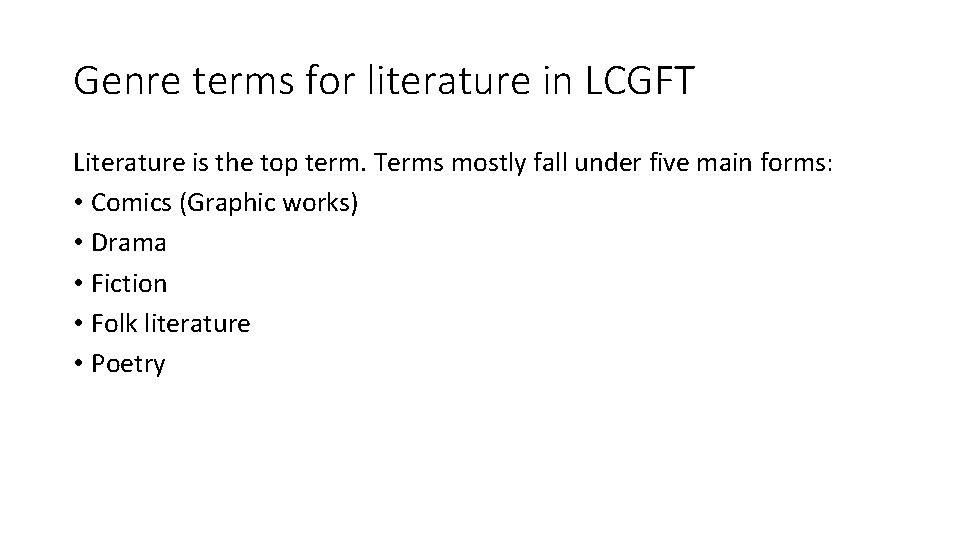
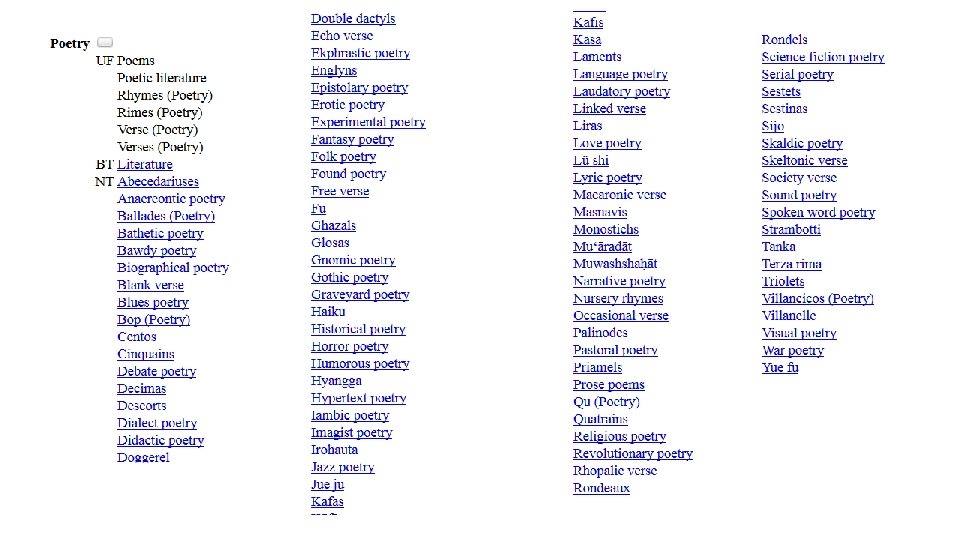
Genre terms for literature in LCGFT Literature is the top term. Terms mostly fall under five main forms: • Comics (Graphic works) • Drama • Fiction • Folk literature • Poetry
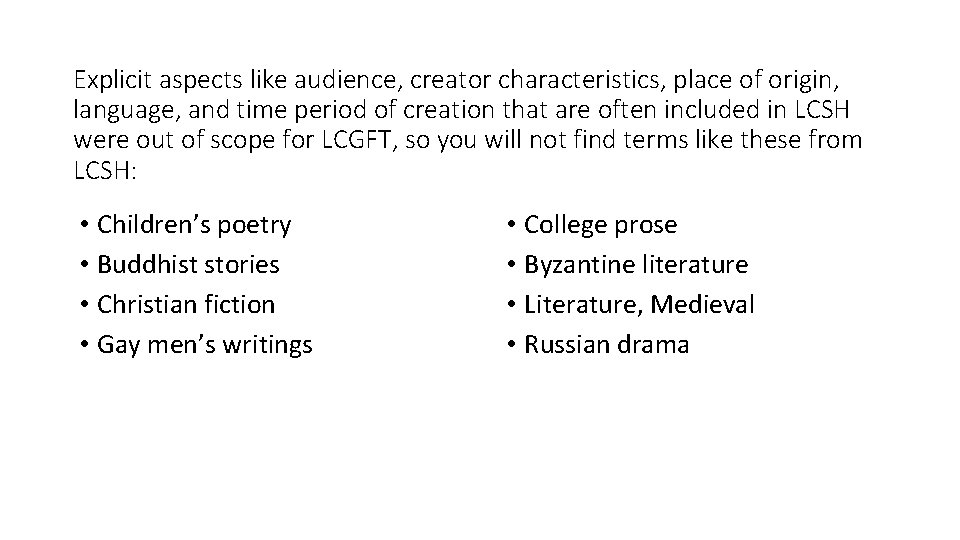
Explicit aspects like audience, creator characteristics, place of origin, language, and time period of creation that are often included in LCSH were out of scope for LCGFT, so you will not find terms like these from LCSH: • Children’s poetry • Buddhist stories • Christian fiction • Gay men’s writings • College prose • Byzantine literature • Literature, Medieval • Russian drama
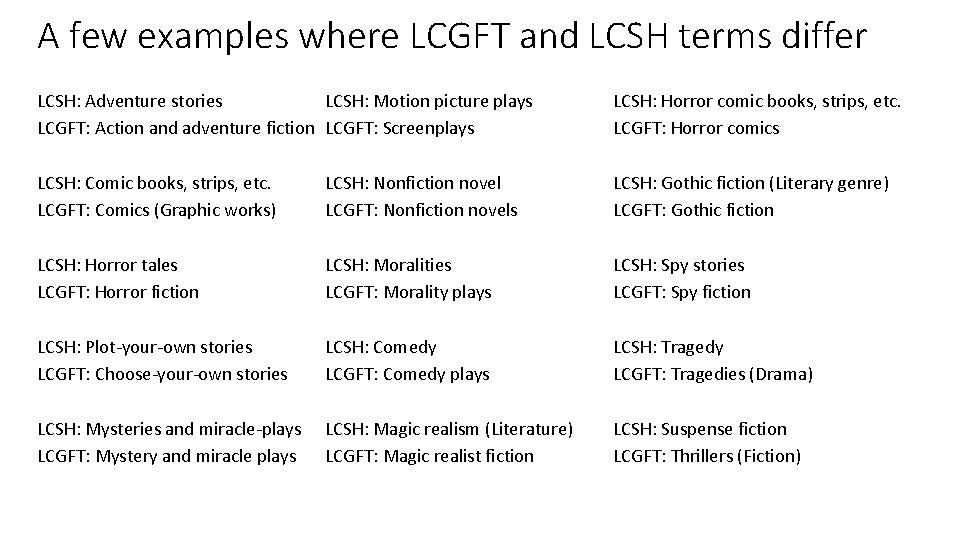
A few examples where LCGFT and LCSH terms differ LCSH: Adventure stories LCSH: Motion picture plays LCGFT: Action and adventure fiction LCGFT: Screenplays LCSH: Horror comic books, strips, etc. LCGFT: Horror comics LCSH: Comic books, strips, etc. LCGFT: Comics (Graphic works) LCSH: Nonfiction novel LCGFT: Nonfiction novels LCSH: Gothic fiction (Literary genre) LCGFT: Gothic fiction LCSH: Horror tales LCGFT: Horror fiction LCSH: Moralities LCGFT: Morality plays LCSH: Spy stories LCGFT: Spy fiction LCSH: Plot-your-own stories LCGFT: Choose-your-own stories LCSH: Comedy LCGFT: Comedy plays LCSH: Tragedy LCGFT: Tragedies (Drama) LCSH: Mysteries and miracle-plays LCGFT: Mystery and miracle plays LCSH: Magic realism (Literature) LCGFT: Magic realist fiction LCSH: Suspense fiction LCGFT: Thrillers (Fiction)
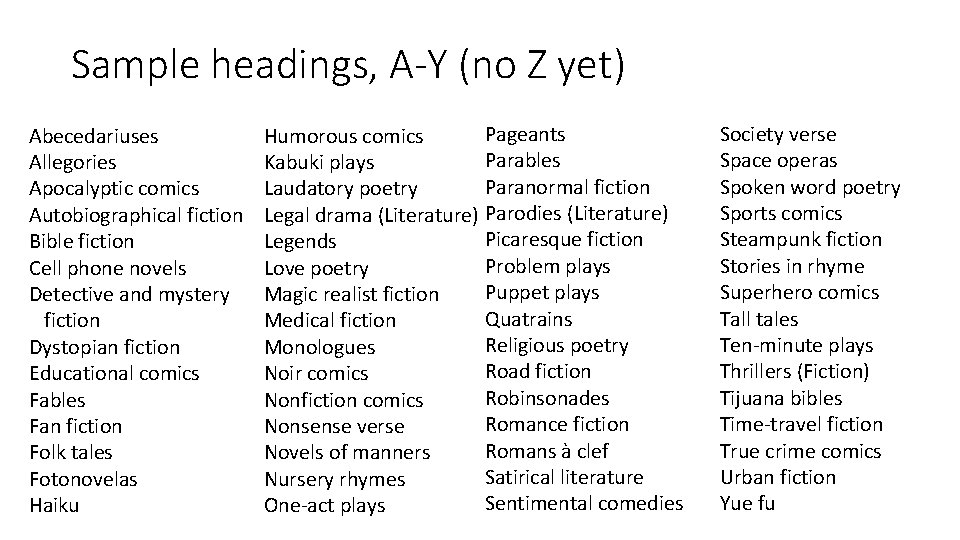
Sample headings, A-Y (no Z yet) Abecedariuses Allegories Apocalyptic comics Autobiographical fiction Bible fiction Cell phone novels Detective and mystery fiction Dystopian fiction Educational comics Fables Fan fiction Folk tales Fotonovelas Haiku Pageants Humorous comics Parables Kabuki plays Paranormal fiction Laudatory poetry Legal drama (Literature) Parodies (Literature) Picaresque fiction Legends Problem plays Love poetry Puppet plays Magic realist fiction Quatrains Medical fiction Religious poetry Monologues Road fiction Noir comics Robinsonades Nonfiction comics Romance fiction Nonsense verse Romans à clef Novels of manners Satirical literature Nursery rhymes Sentimental comedies One-act plays Society verse Space operas Spoken word poetry Sports comics Steampunk fiction Stories in rhyme Superhero comics Tall tales Ten-minute plays Thrillers (Fiction) Tijuana bibles Time-travel fiction True crime comics Urban fiction Yue fu
Changes in Practice • For the time being, LC recommends assigning subjects as you do now, according to policies in the Subject Headings Manual • In addition, assign LCGFT literature terms both to individual works and compilations • Consider also adding audience and creator/contributor aspects in 385 and 386 • New vocabulary, Library of Congress Demographic Group Terms (LCDGT) is recommended, but other vocabularies may be used
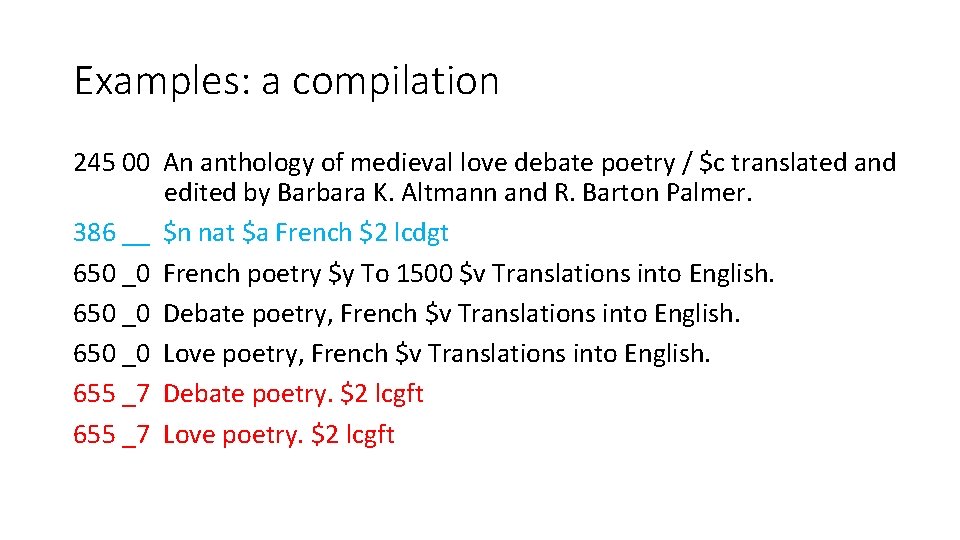
Examples: a compilation 245 00 An anthology of medieval love debate poetry / $c translated and edited by Barbara K. Altmann and R. Barton Palmer. 386 __ $n nat $a French $2 lcdgt 650 _0 French poetry $y To 1500 $v Translations into English. 650 _0 Debate poetry, French $v Translations into English. 650 _0 Love poetry, French $v Translations into English. 655 _7 Debate poetry. $2 lcgft 655 _7 Love poetry. $2 lcgft
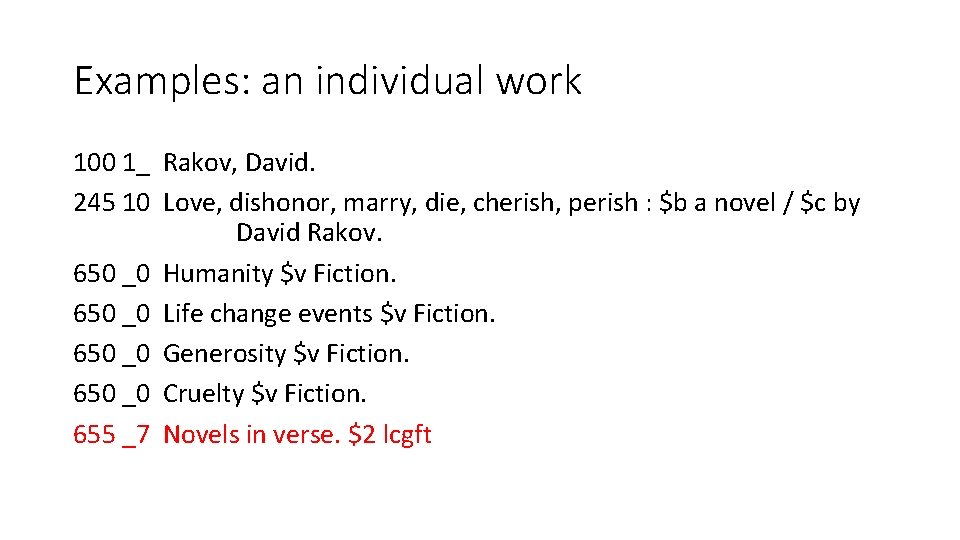
Examples: an individual work 100 1_ Rakov, David. 245 10 Love, dishonor, marry, die, cherish, perish : $b a novel / $c by David Rakov. 650 _0 Humanity $v Fiction. 650 _0 Life change events $v Fiction. 650 _0 Generosity $v Fiction. 650 _0 Cruelty $v Fiction. 655 _7 Novels in verse. $2 lcgft
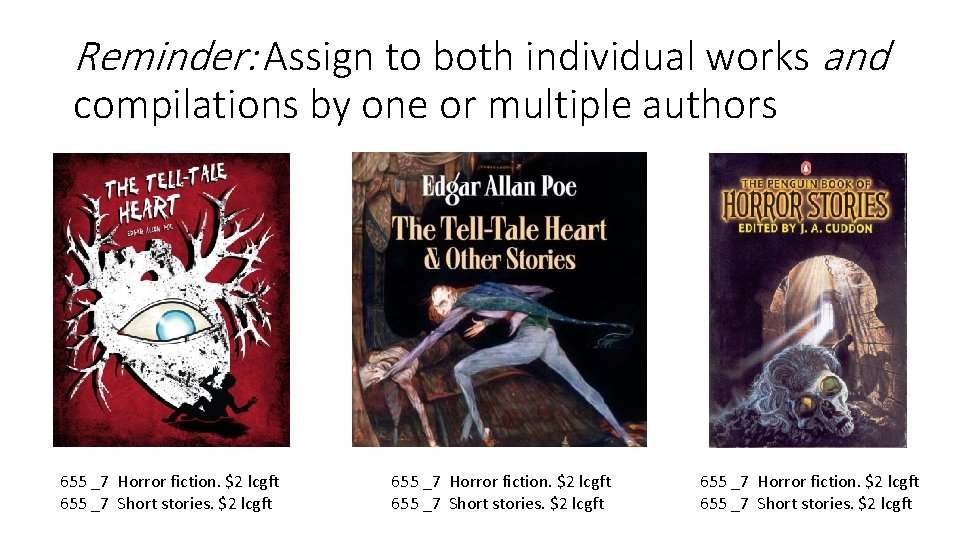
Reminder: Assign to both individual works and compilations by one or multiple authors 655 _7 Horror fiction. $2 lcgft 655 _7 Short stories. $2 lcgft
LC practice and documentation • As of January 2016, LC had not yet decided when it will implement the “general, ” religion, and literature genre/form terms • Catalogers should continue to assign subject headings according to policies in the SHM, along with the new genre/form terms • Example, for a collection of poetry: 245 10 Technically, it’s not my fault : $b concrete poems / $c by John Grandits. 650 _0 Concrete poetry, American. 655 _7 Concrete poetry. $2 lcgft
Draft Policies for Assignment of LCGFT Terms • LC Policy and Standards Division (PSD) has published a draft genre/form terms manual (similar to the Subject Headings Manual) • Includes guidelines and instructions for assigning genre/form terms and proposing new ones • Instruction sheets are numbered beginning with “J” • Available at: http: //www. loc. gov/aba/publications/Free. LCGFT/freelcgft. html • Comments on the draft are accepted through May 31, 2016
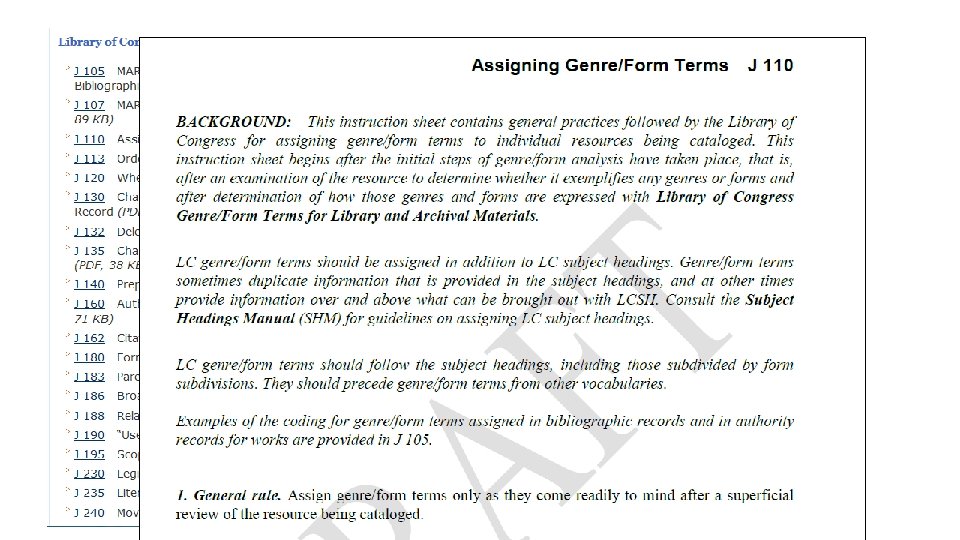
Draft Policies for Assignment of LCGFT Terms • Assigning Genre/Form Terms (J 110) • Assign genre/form terms only as they come readily to mind after a superficial review of the resource being cataloged • Assign genre/form terms that describe the resource as a whole • LC genre/form terms should be assigned in addition to LC subject headings • LC genre/form terms should follow the subject headings and precede genre/form terms from other vocabularies
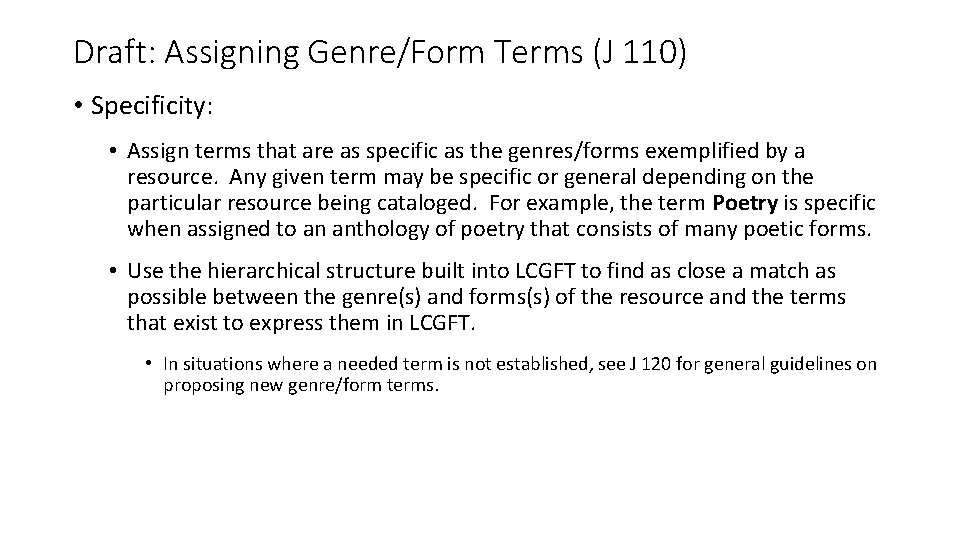
Draft: Assigning Genre/Form Terms (J 110) • Specificity: • Assign terms that are as specific as the genres/forms exemplified by a resource. Any given term may be specific or general depending on the particular resource being cataloged. For example, the term Poetry is specific when assigned to an anthology of poetry that consists of many poetic forms. • Use the hierarchical structure built into LCGFT to find as close a match as possible between the genre(s) and forms(s) of the resource and the terms that exist to express them in LCGFT. • In situations where a needed term is not established, see J 120 for general guidelines on proposing new genre/form terms.
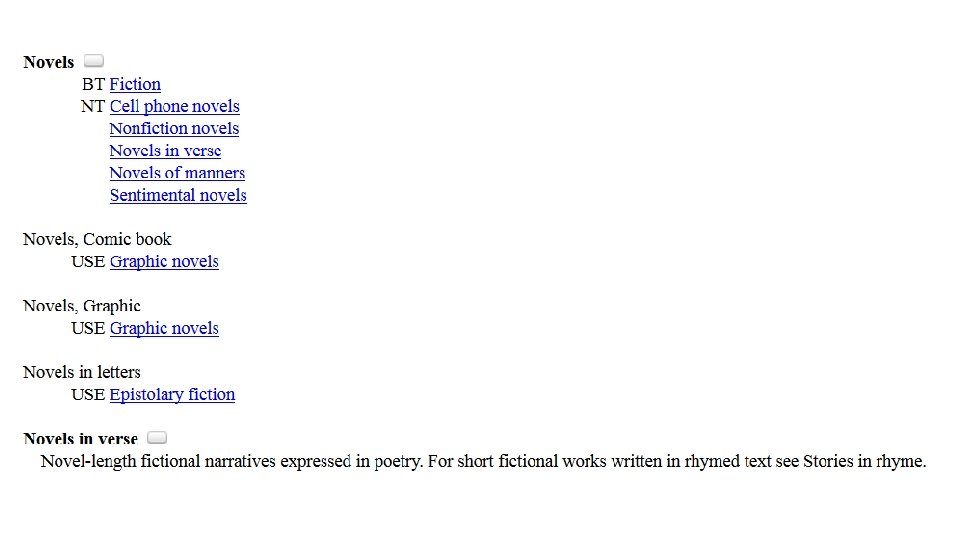
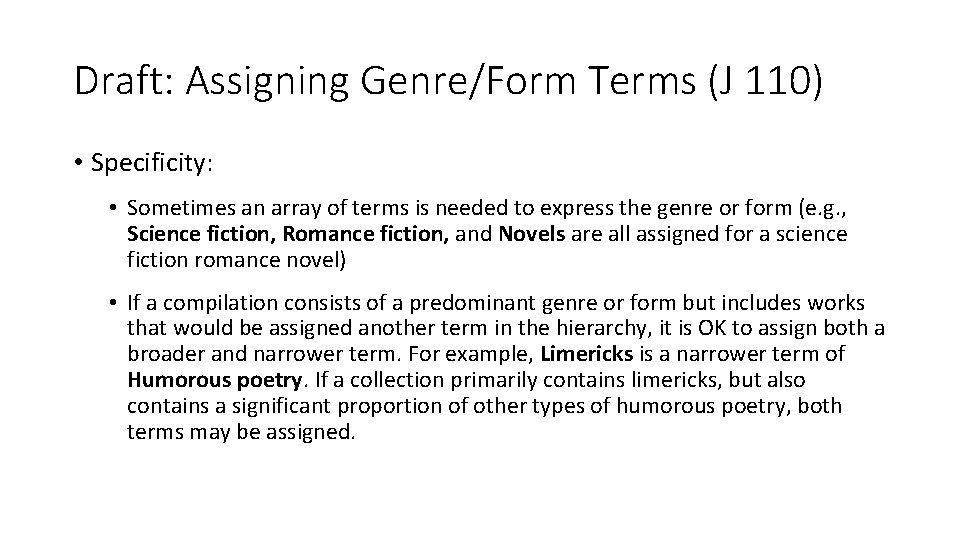
Draft: Assigning Genre/Form Terms (J 110) • Specificity: • Sometimes an array of terms is needed to express the genre or form (e. g. , Science fiction, Romance fiction, and Novels are all assigned for a science fiction romance novel) • If a compilation consists of a predominant genre or form but includes works that would be assigned another term in the hierarchy, it is OK to assign both a broader and narrower term. For example, Limericks is a narrower term of Humorous poetry. If a collection primarily contains limericks, but also contains a significant proportion of other types of humorous poetry, both terms may be assigned.
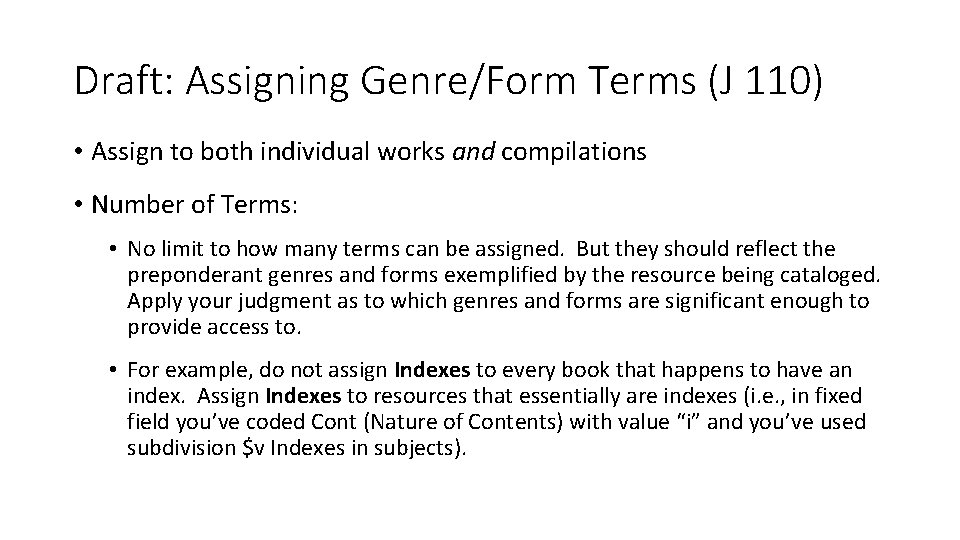
Draft: Assigning Genre/Form Terms (J 110) • Assign to both individual works and compilations • Number of Terms: • No limit to how many terms can be assigned. But they should reflect the preponderant genres and forms exemplified by the resource being cataloged. Apply your judgment as to which genres and forms are significant enough to provide access to. • For example, do not assign Indexes to every book that happens to have an index. Assign Indexes to resources that essentially are indexes (i. e. , in fixed field you’ve coded Cont (Nature of Contents) with value “i” and you’ve used subdivision $v Indexes in subjects).
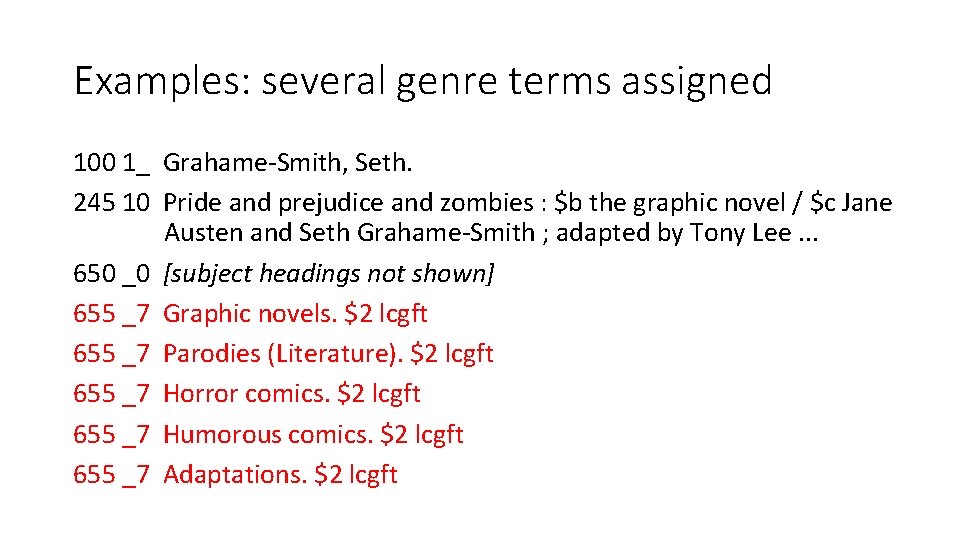
Examples: several genre terms assigned 100 1_ Grahame-Smith, Seth. 245 10 Pride and prejudice and zombies : $b the graphic novel / $c Jane Austen and Seth Grahame-Smith ; adapted by Tony Lee. . . 650 _0 [subject headings not shown] 655 _7 Graphic novels. $2 lcgft 655 _7 Parodies (Literature). $2 lcgft 655 _7 Horror comics. $2 lcgft 655 _7 Humorous comics. $2 lcgft 655 _7 Adaptations. $2 lcgft
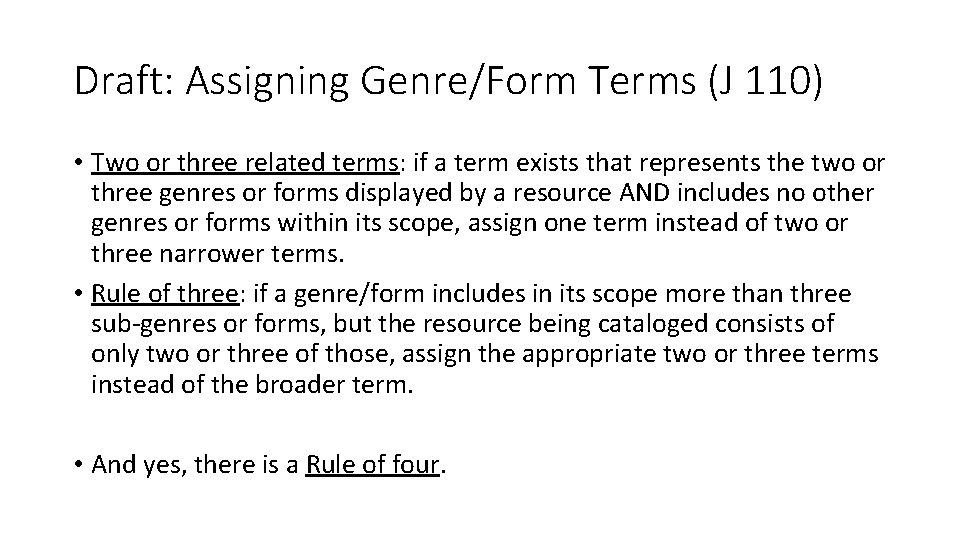
Draft: Assigning Genre/Form Terms (J 110) • Two or three related terms: if a term exists that represents the two or three genres or forms displayed by a resource AND includes no other genres or forms within its scope, assign one term instead of two or three narrower terms. • Rule of three: if a genre/form includes in its scope more than three sub-genres or forms, but the resource being cataloged consists of only two or three of those, assign the appropriate two or three terms instead of the broader term. • And yes, there is a Rule of four.
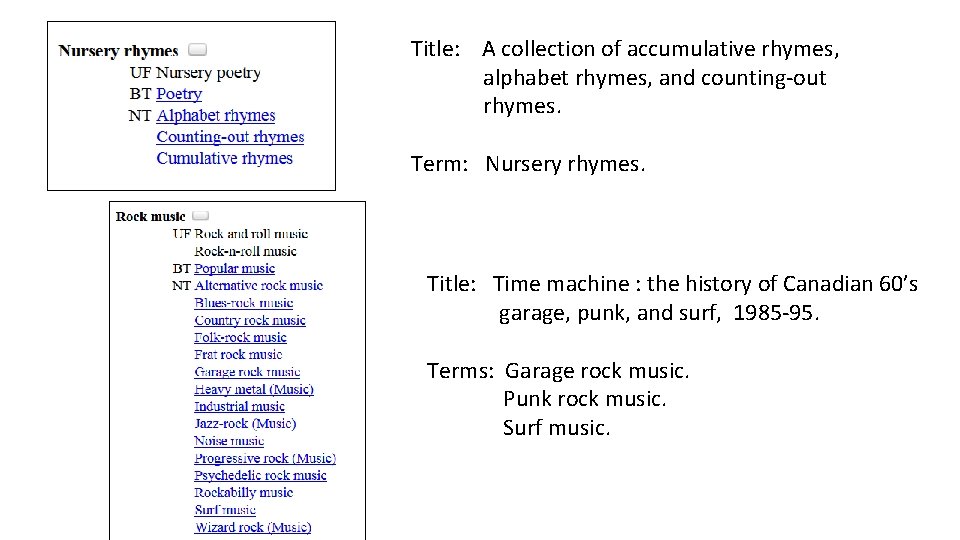
Title: A collection of accumulative rhymes, alphabet rhymes, and counting-out rhymes. Term: Nursery rhymes. Title: Time machine : the history of Canadian 60’s garage, punk, and surf, 1985 -95. Terms: Garage rock music. Punk rock music. Surf music.
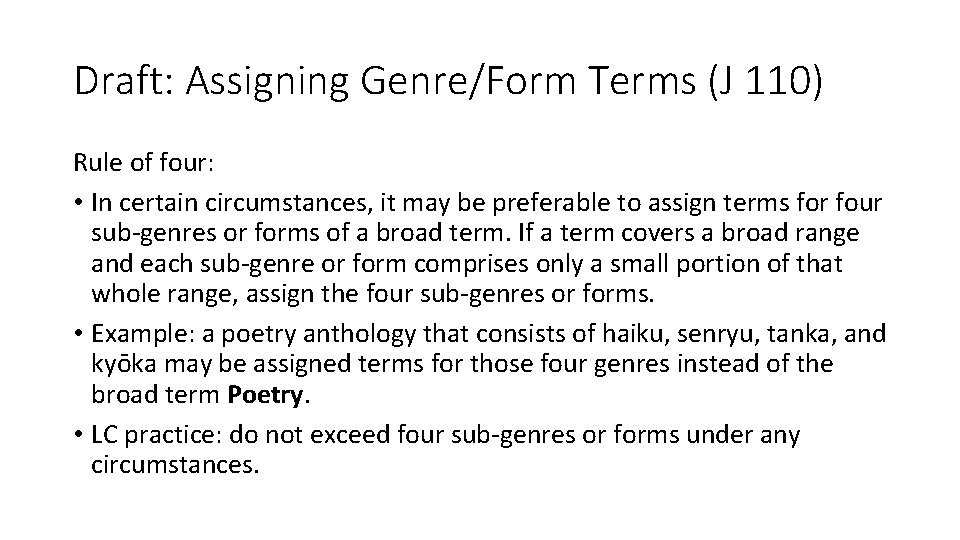
Draft: Assigning Genre/Form Terms (J 110) Rule of four: • In certain circumstances, it may be preferable to assign terms for four sub-genres or forms of a broad term. If a term covers a broad range and each sub-genre or form comprises only a small portion of that whole range, assign the four sub-genres or forms. • Example: a poetry anthology that consists of haiku, senryu, tanka, and kyōka may be assigned terms for those four genres instead of the broad term Poetry. • LC practice: do not exceed four sub-genres or forms under any circumstances.
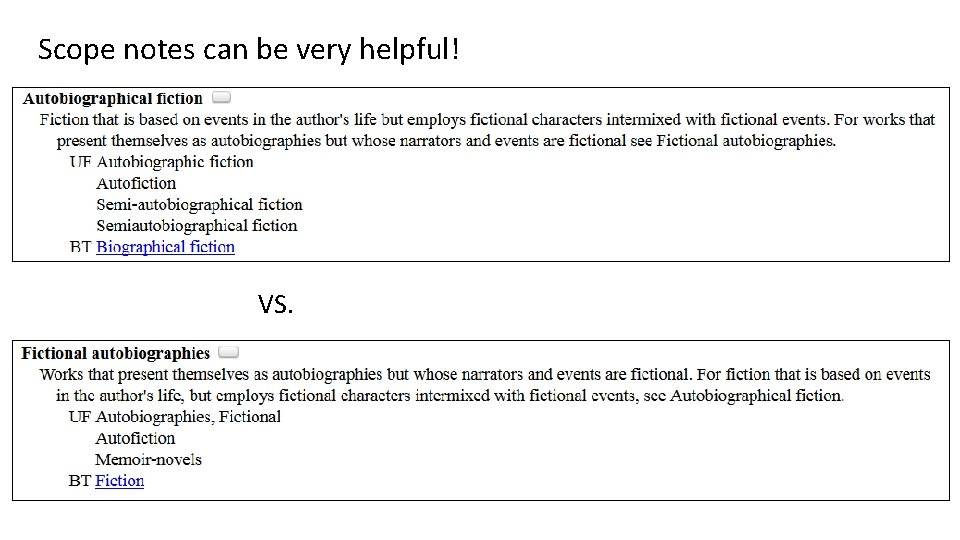
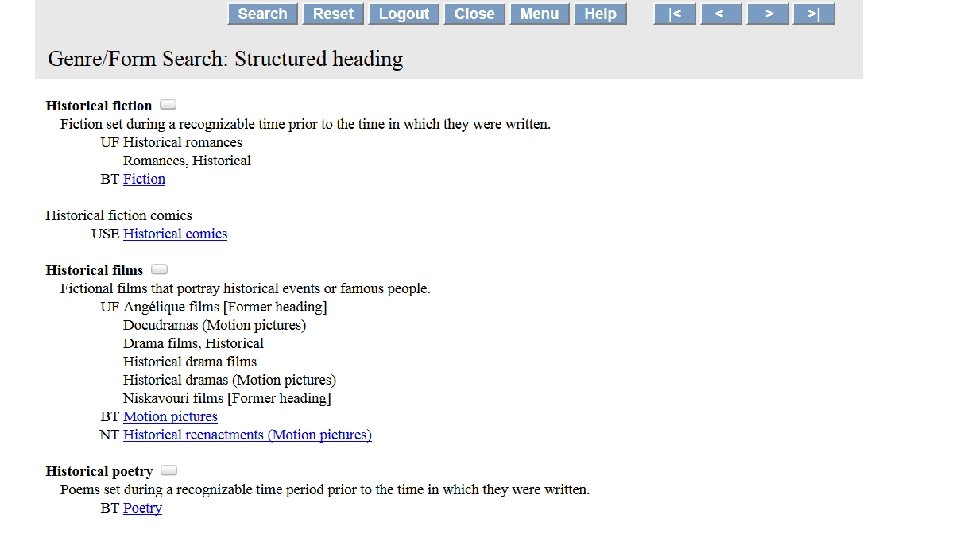
Scope notes can be very helpful! VS.
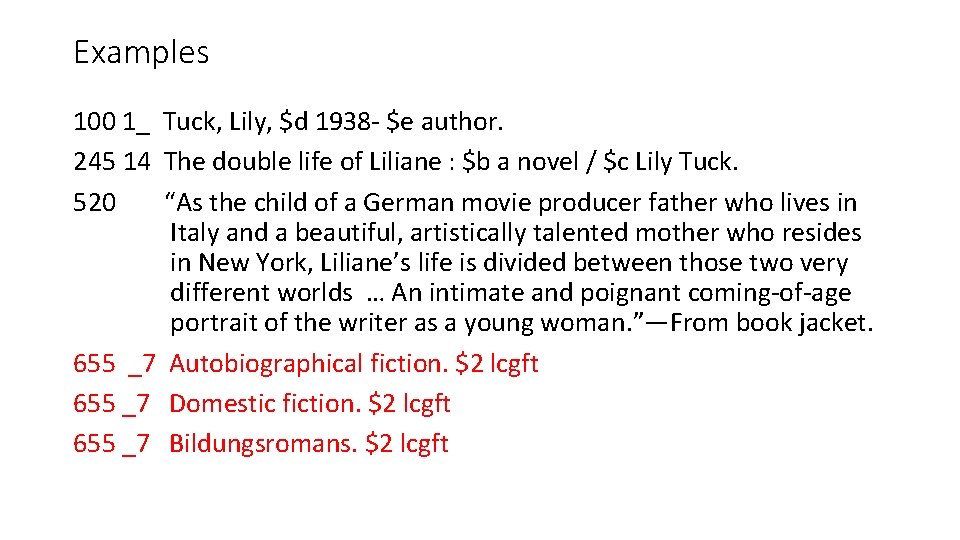
Examples 100 1_ Tuck, Lily, $d 1938 - $e author. 245 14 The double life of Liliane : $b a novel / $c Lily Tuck. 520 “As the child of a German movie producer father who lives in Italy and a beautiful, artistically talented mother who resides in New York, Liliane’s life is divided between those two very different worlds … An intimate and poignant coming-of-age portrait of the writer as a young woman. ”—From book jacket. 655 _7 Autobiographical fiction. $2 lcgft 655 _7 Domestic fiction. $2 lcgft 655 _7 Bildungsromans. $2 lcgft
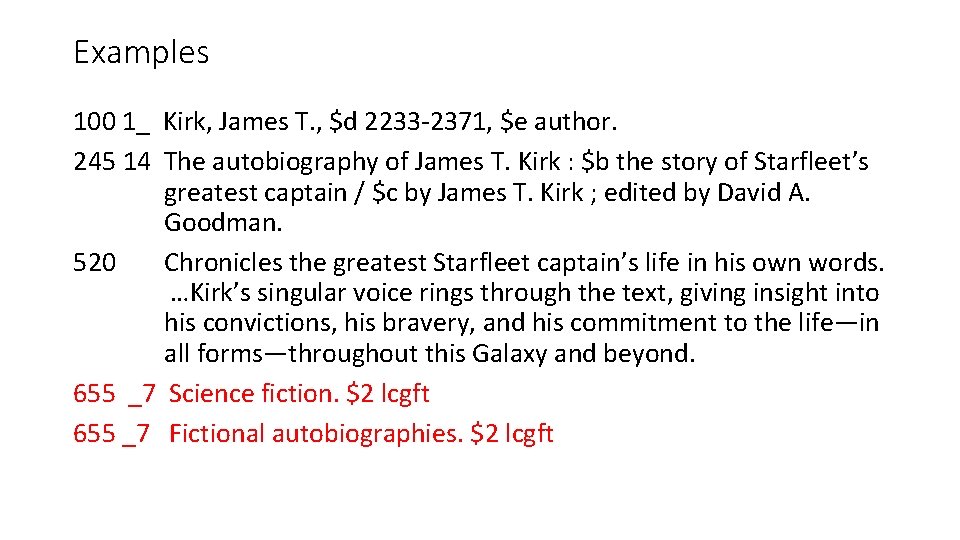
Examples 100 1_ Kirk, James T. , $d 2233 -2371, $e author. 245 14 The autobiography of James T. Kirk : $b the story of Starfleet’s greatest captain / $c by James T. Kirk ; edited by David A. Goodman. 520 Chronicles the greatest Starfleet captain’s life in his own words. …Kirk’s singular voice rings through the text, giving insight into his convictions, his bravery, and his commitment to the life—in all forms—throughout this Galaxy and beyond. 655 _7 Science fiction. $2 lcgft 655 _7 Fictional autobiographies. $2 lcgft
Draft Policies for Literature (J 235) Fiction • In addition to terms assigned according to J 110, assign a term that indicates the length of the resource when it is readily apparent (e. g. , Novels; Novellas; Short stories; Flash fiction). Example: Title: The secret of the old clock / Carolyn Keene. Terms: Detective and mystery fiction. Novels.
Draft Policies for Literature (J 235) Poetry • The general guideline to assign genre/form terms only as they come readily to mind after a superficial review is particularly important for poetry. Rely chiefly on the title, introduction, cover information, etc. , to determine whether the poetry is of a specific genre or form. If not, assign the term Poetry. Title: Term: For you with love / compiled by Kay Anne Carson. Love poetry. Title: Term: Half of the world in light : new and selected poems / Juan Felipe Herrera. Poetry.
Draft Policies for Literature (J 235) Poetry (continued) • If the genre or form of a poem or collection of poetry is known to the cataloger due to the cataloger’s academic or cultural background, etc. , one or more genre/form terms may be assigned to represent the genre or form. Examples: Title: Term: The Odyssey / Homer. Epic poetry. Title: Term: The rape of the lock / Alexander Pope. Mock-heroic poetry.
Draft Policy: Order of Terms (J 113) • If the classification number reflects a genre or form, put that term first • If there is a predominant genre or form, assign the term that represents that genre or form as the first term. If the predominant genre or form cannot be represented by a single term, assign as the first group of terms those that, taken together, express the predominant form. For example, for a biographical dictionary, assign both Biographies and Dictionaries. The order doesn’t matter unless the first bullet above applies.
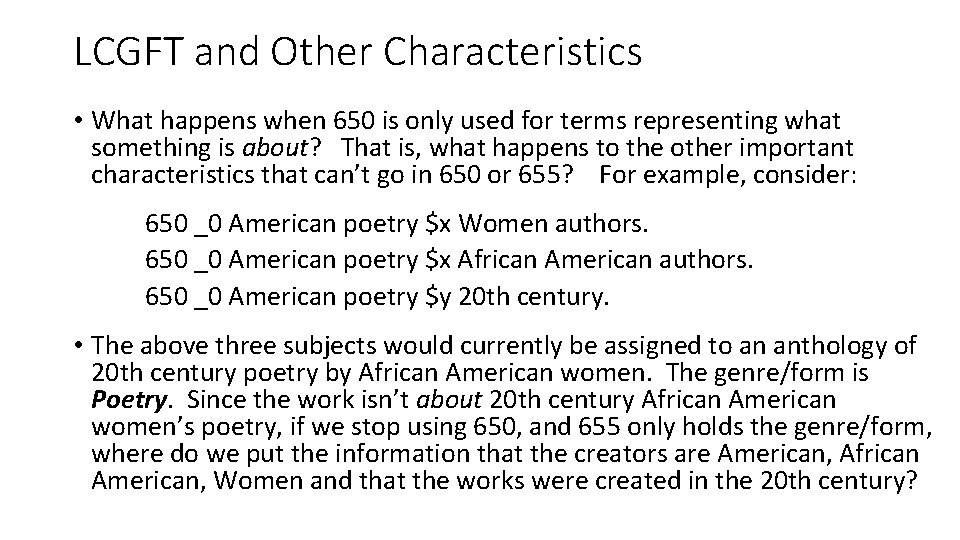
LCGFT and Other Characteristics • What happens when 650 is only used for terms representing what something is about? That is, what happens to the other important characteristics that can’t go in 650 or 655? For example, consider: 650 _0 American poetry $x Women authors. 650 _0 American poetry $x African American authors. 650 _0 American poetry $y 20 th century. • The above three subjects would currently be assigned to an anthology of 20 th century poetry by African American women. The genre/form is Poetry. Since the work isn’t about 20 th century African American women’s poetry, if we stop using 650, and 655 only holds the genre/form, where do we put the information that the creators are American, African American, Women and that the works were created in the 20 th century?
LCDGT: LC Demographic Group Terms • Purpose: to describe • Creators of, and contributors to, resources • Intended audiences of resources • Status • Pilot Phase 3 • Includes about 800 terms and a draft manual for application • Draft Demographic Group Terms Manual: http: //www. loc. gov/aba/publications/Free. LCDGT/freelcdgt. html • Comments accepted through May 31, 2016 • Vocabulary also available in Classification Web • Following slides with color background are courtesy of Janis Young, LC
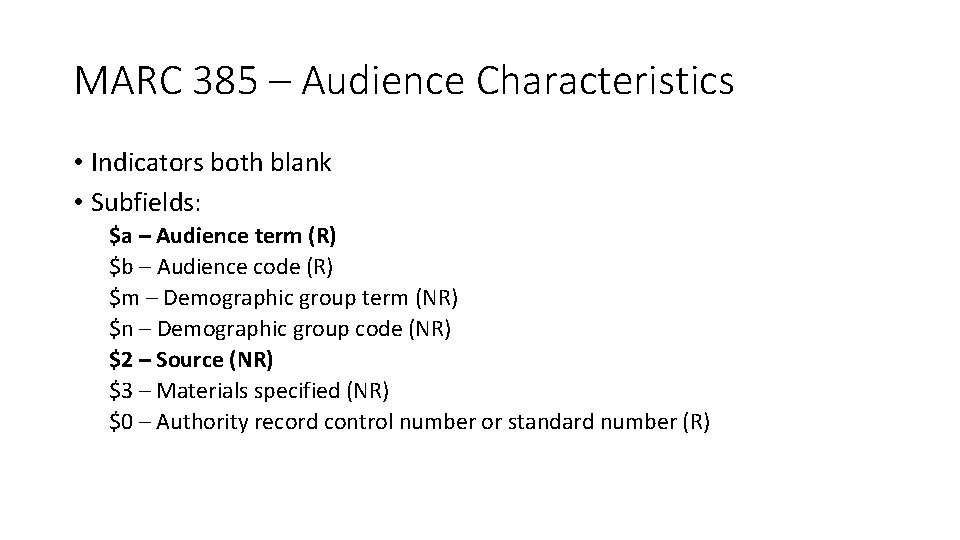
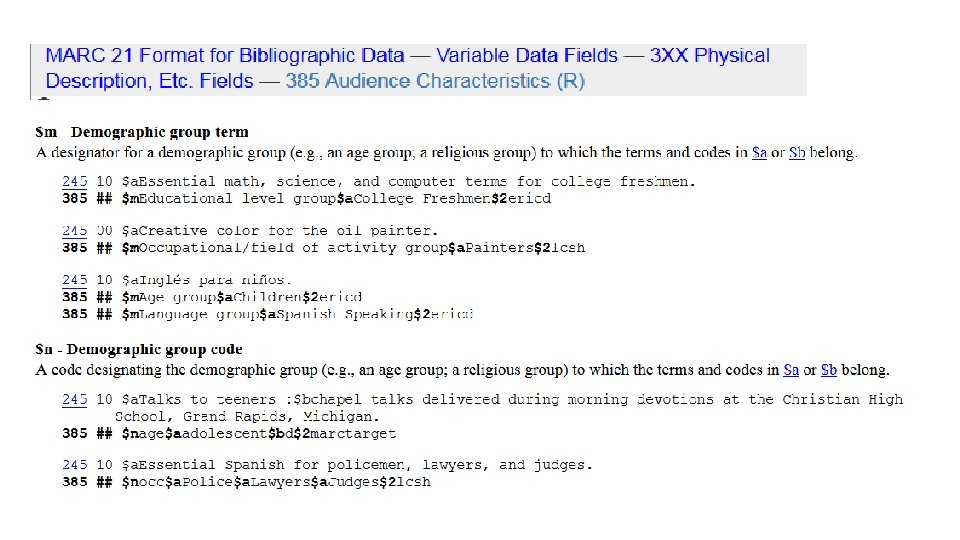
MARC 385 – Audience Characteristics • Indicators both blank • Subfields: $a – Audience term (R) $b – Audience code (R) $m – Demographic group term (NR) $n – Demographic group code (NR) $2 – Source (NR) $3 – Materials specified (NR) $0 – Authority record control number or standard number (R)
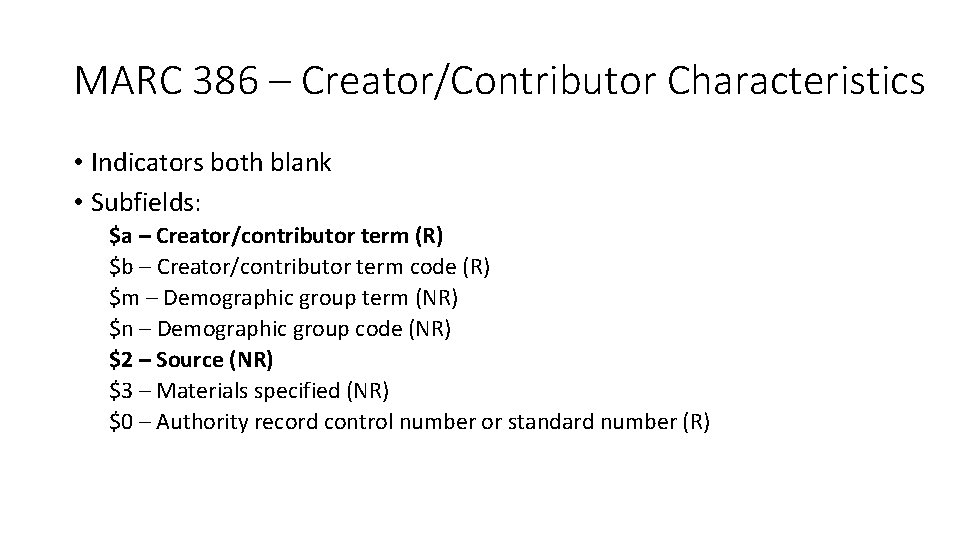
MARC 386 – Creator/Contributor Characteristics • Indicators both blank • Subfields: $a – Creator/contributor term (R) $b – Creator/contributor term code (R) $m – Demographic group term (NR) $n – Demographic group code (NR) $2 – Source (NR) $3 – Materials specified (NR) $0 – Authority record control number or standard number (R)
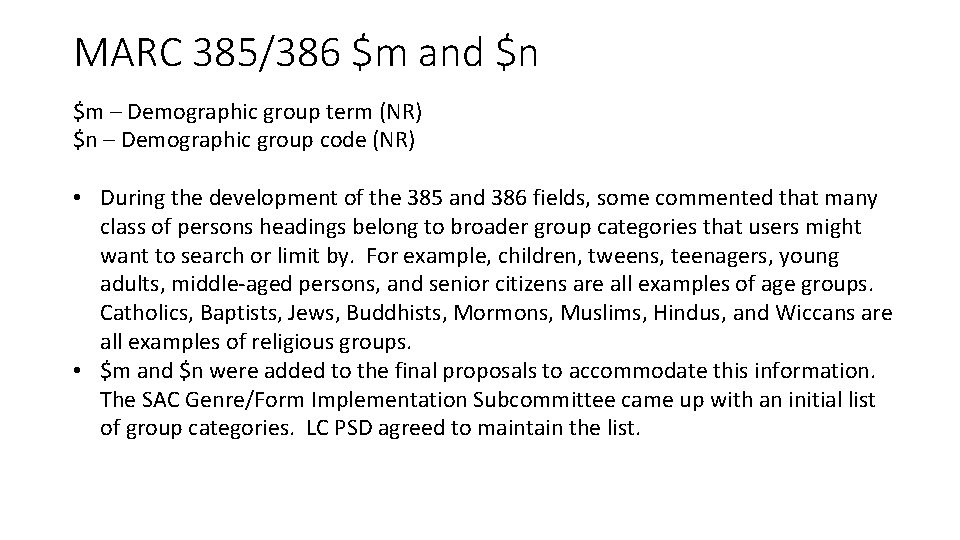
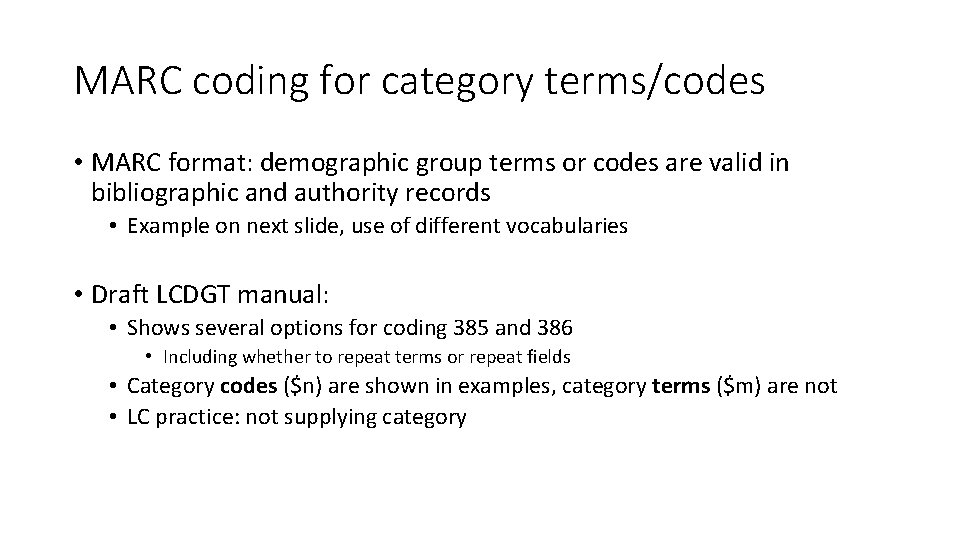
MARC 385/386 $m and $n $m – Demographic group term (NR) $n – Demographic group code (NR) • During the development of the 385 and 386 fields, some commented that many class of persons headings belong to broader group categories that users might want to search or limit by. For example, children, tweens, teenagers, young adults, middle-aged persons, and senior citizens are all examples of age groups. Catholics, Baptists, Jews, Buddhists, Mormons, Muslims, Hindus, and Wiccans are all examples of religious groups. • $m and $n were added to the final proposals to accommodate this information. The SAC Genre/Form Implementation Subcommittee came up with an initial list of group categories. LC PSD agreed to maintain the list.
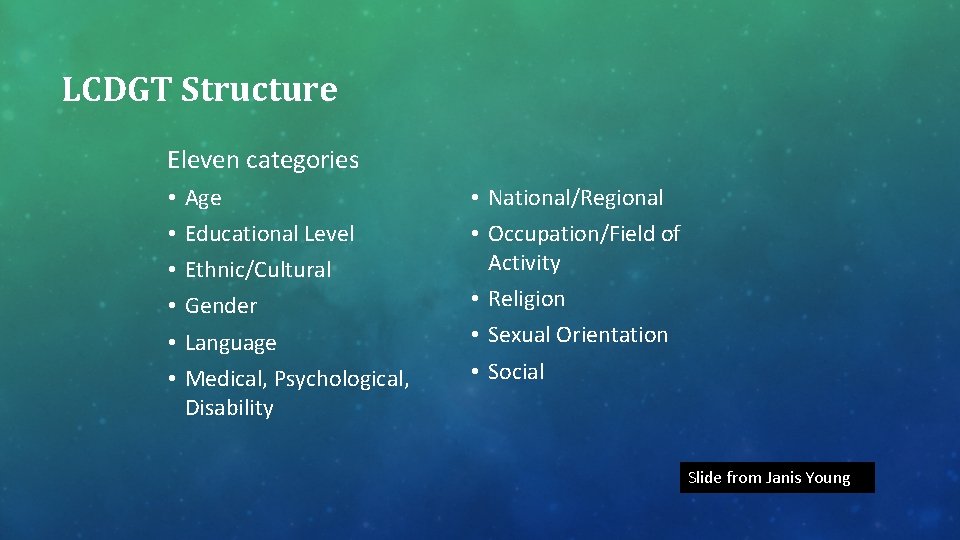
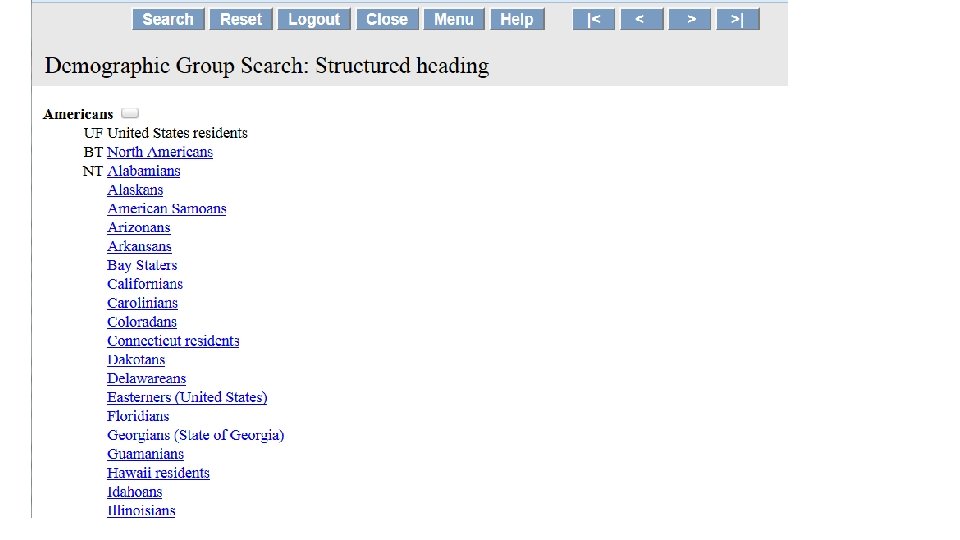
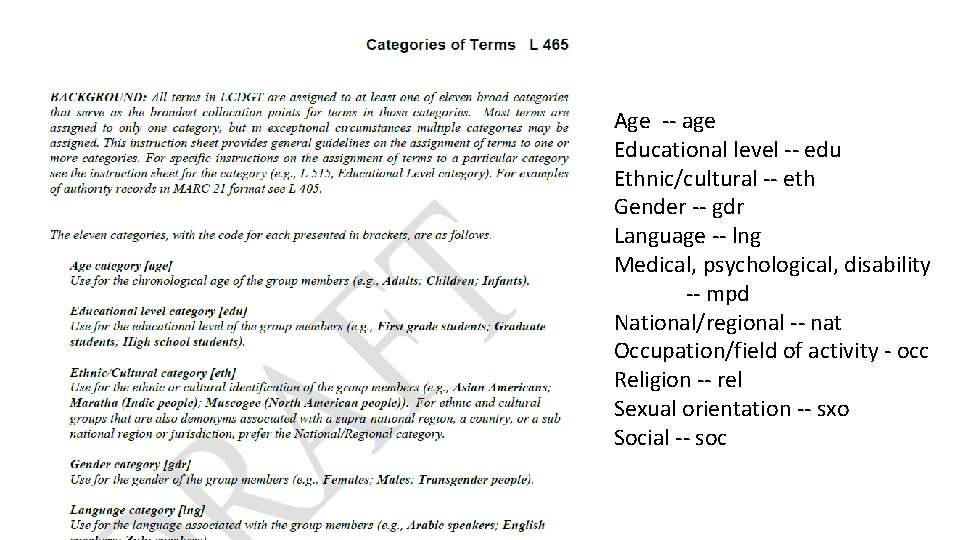
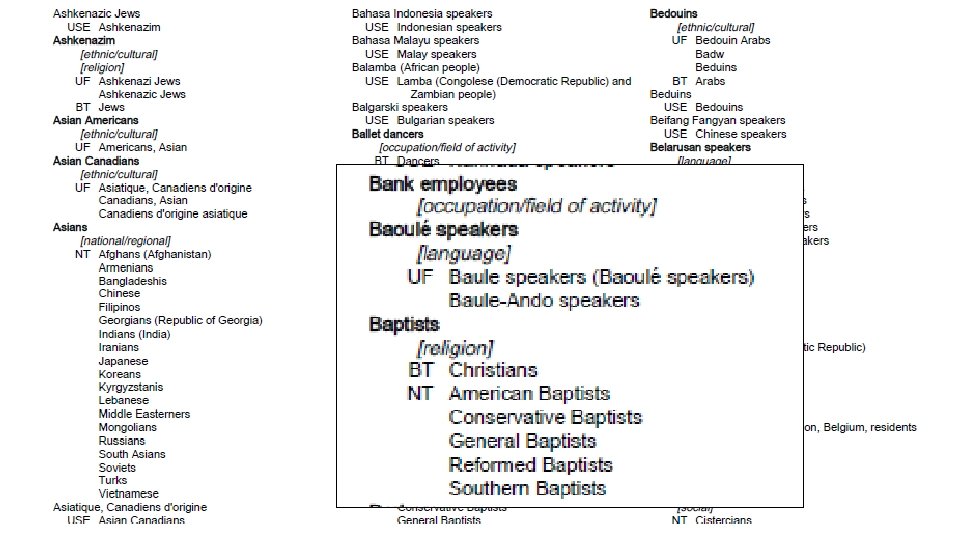
LCDGT Structure Eleven categories • • • Age Educational Level Ethnic/Cultural Gender Language Medical, Psychological, Disability • National/Regional • Occupation/Field of Activity • Religion • Sexual Orientation • Social 55 Slide from Janis Young
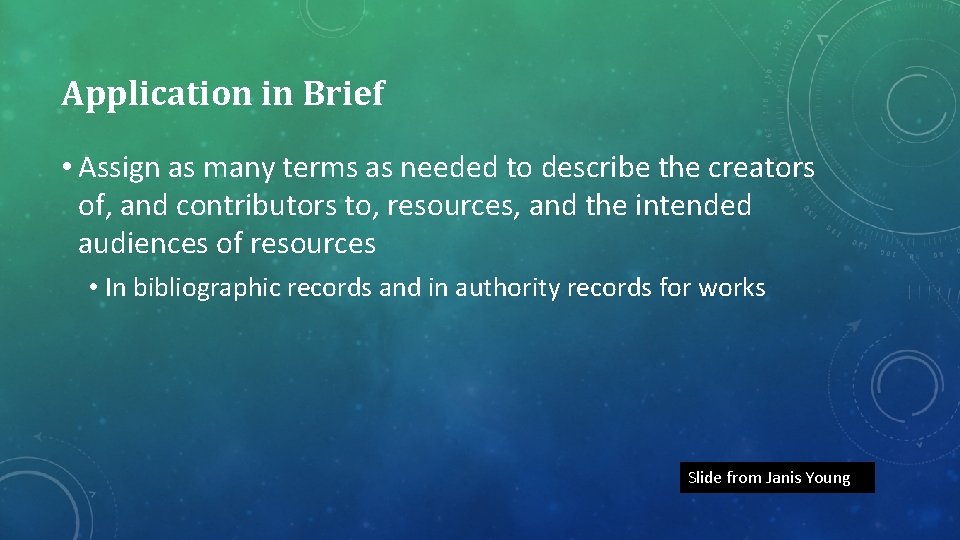
Application in Brief • Assign as many terms as needed to describe the creators of, and contributors to, resources, and the intended audiences of resources • In bibliographic records and in authority records for works 56 Slide from Janis Young
Application in Brief • Creators/contributors • Self-identification is key • Prefer affirmative statements rather than relying on gendered pronouns or photographs • “In case of doubt, leave it out. ” 57 Slide from Janis Young
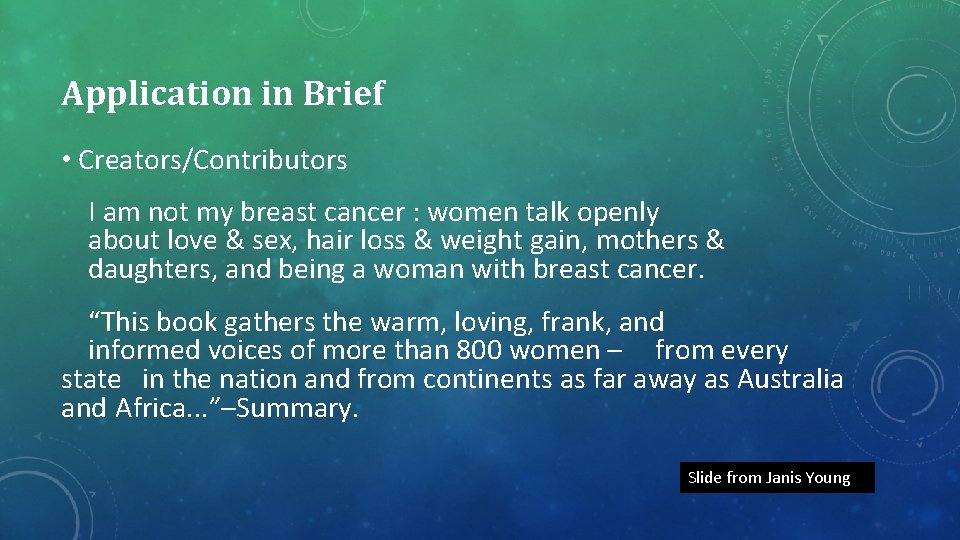
Application in Brief • Creators/Contributors I am not my breast cancer : women talk openly about love & sex, hair loss & weight gain, mothers & daughters, and being a woman with breast cancer. “This book gathers the warm, loving, frank, and informed voices of more than 800 women – from every state in the nation and from continents as far away as Australia and Africa. . . ”–Summary. 58 Slide from Janis Young
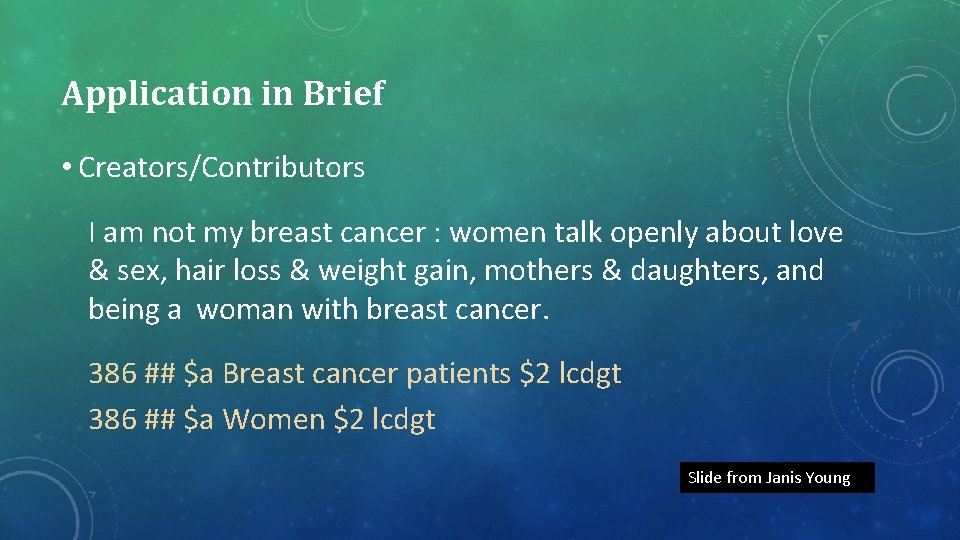
Application in Brief • Creators/Contributors I am not my breast cancer : women talk openly about love & sex, hair loss & weight gain, mothers & daughters, and being a woman with breast cancer. 386 ## $a Breast cancer patients $2 lcdgt 386 ## $a Women $2 lcdgt 59 Slide from Janis Young
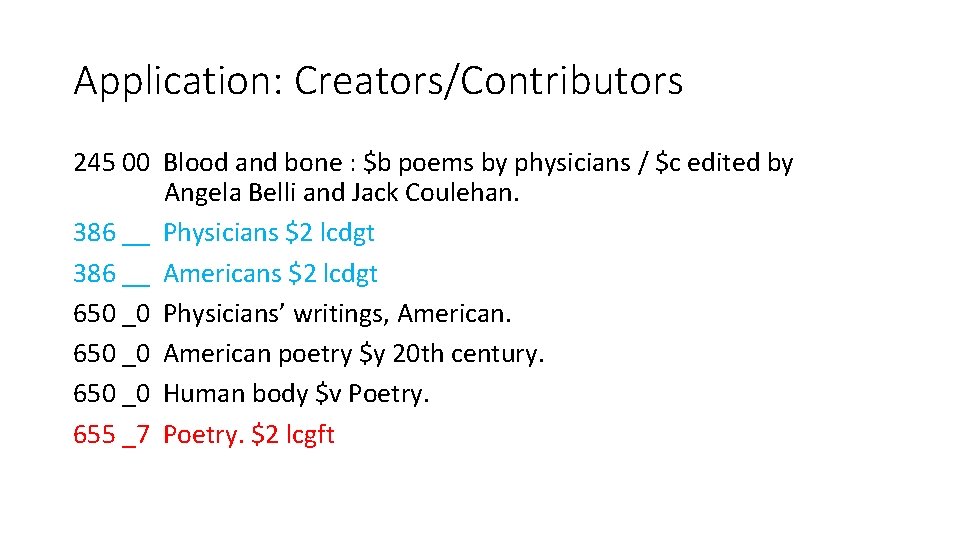
Application: Creators/Contributors 245 00 Blood and bone : $b poems by physicians / $c edited by Angela Belli and Jack Coulehan. 386 __ Physicians $2 lcdgt 386 __ Americans $2 lcdgt 650 _0 Physicians’ writings, American. 650 _0 American poetry $y 20 th century. 650 _0 Human body $v Poetry. 655 _7 Poetry. $2 lcgft
Application in Brief • Audiences • Explicit: statements in the title, introduction, etc. • Implicit: an audience that comes readily to mind after a superficial review of the resource • Should be assigned with caution • “In case of doubt, leave it out. ” 61 Slide from Janis Young
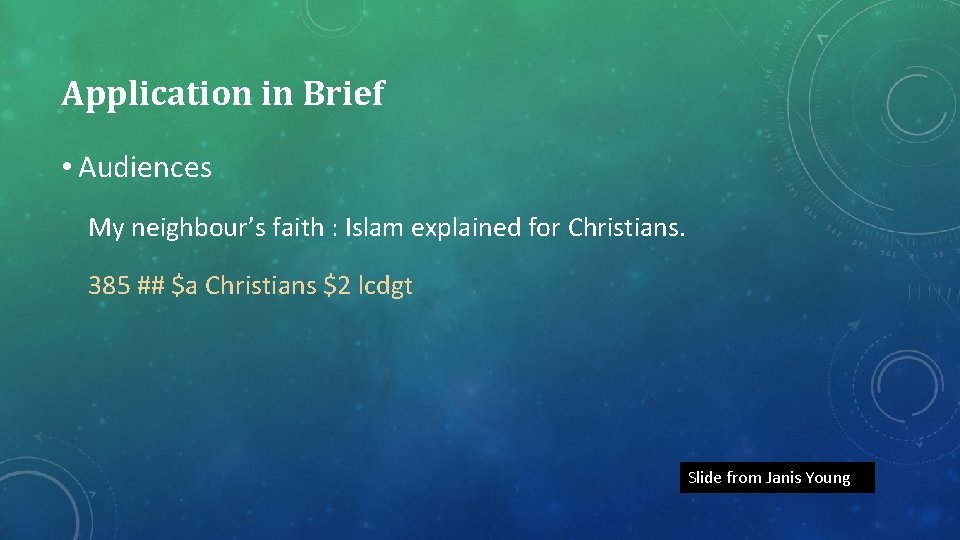
Application in Brief • Audiences My neighbour’s faith : Islam explained for Christians. 385 ## $a Christians $2 lcdgt 62 Slide from Janis Young
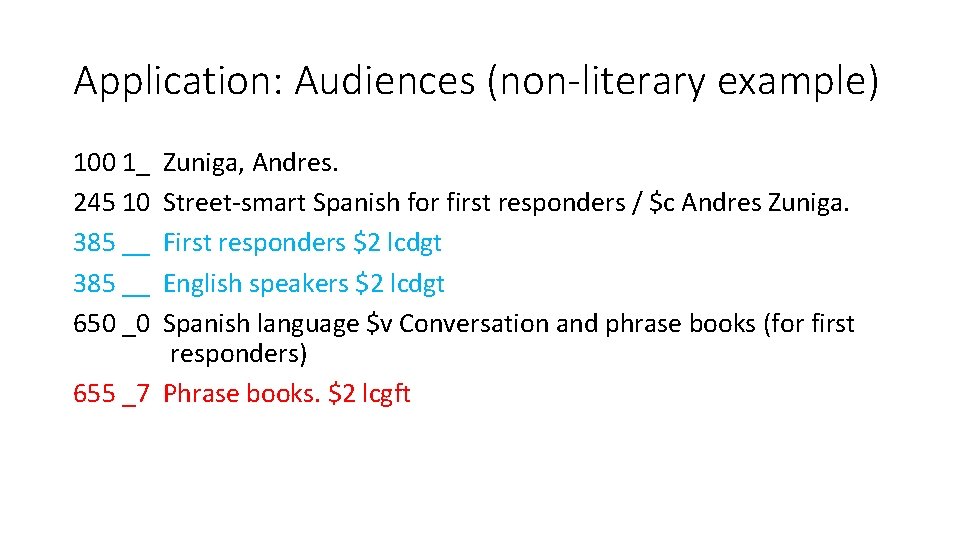
Application: Audiences (non-literary example) 100 1_ 245 10 385 __ 650 _0 Zuniga, Andres. Street-smart Spanish for first responders / $c Andres Zuniga. First responders $2 lcdgt English speakers $2 lcdgt Spanish language $v Conversation and phrase books (for first responders) 655 _7 Phrase books. $2 lcgft
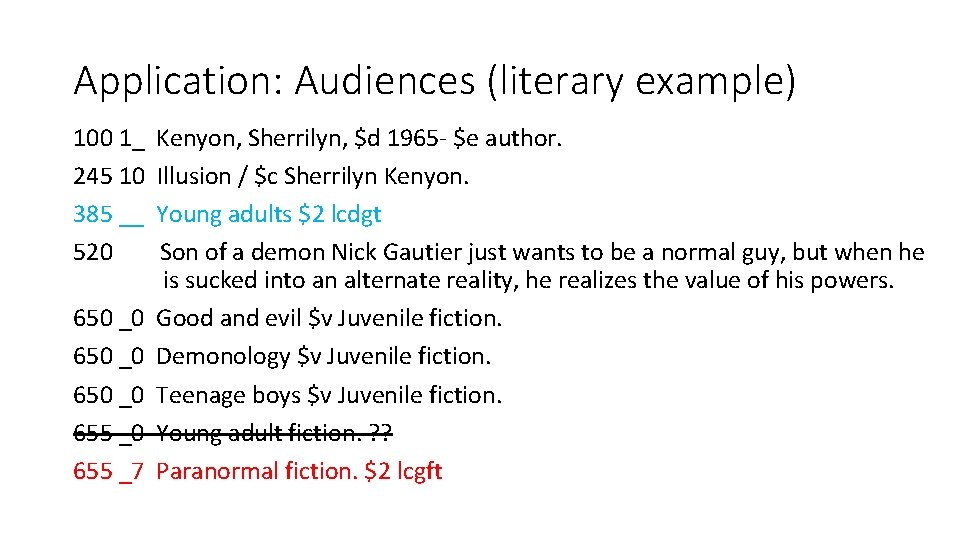
Application: Audiences (literary example) 100 1_ 245 10 385 __ 520 650 _0 655 _7 Kenyon, Sherrilyn, $d 1965 - $e author. Illusion / $c Sherrilyn Kenyon. Young adults $2 lcdgt Son of a demon Nick Gautier just wants to be a normal guy, but when he is sucked into an alternate reality, he realizes the value of his powers. Good and evil $v Juvenile fiction. Demonology $v Juvenile fiction. Teenage boys $v Juvenile fiction. Young adult fiction. ? ? Paranormal fiction. $2 lcgft
Age -- age Educational level -- edu Ethnic/cultural -- eth Gender -- gdr Language -- lng Medical, psychological, disability -- mpd National/regional -- nat Occupation/field of activity - occ Religion -- rel Sexual orientation -- sxo Social -- soc
http: //www. loc. gov/standards/valuelist/lcdgt. html
MARC coding for category terms/codes • MARC format: demographic group terms or codes are valid in bibliographic and authority records • Example on next slide, use of different vocabularies • Draft LCDGT manual: • Shows several options for coding 385 and 386 • Including whether to repeat terms or repeat fields • Category codes ($n) are shown in examples, category terms ($m) are not • LC practice: not supplying category
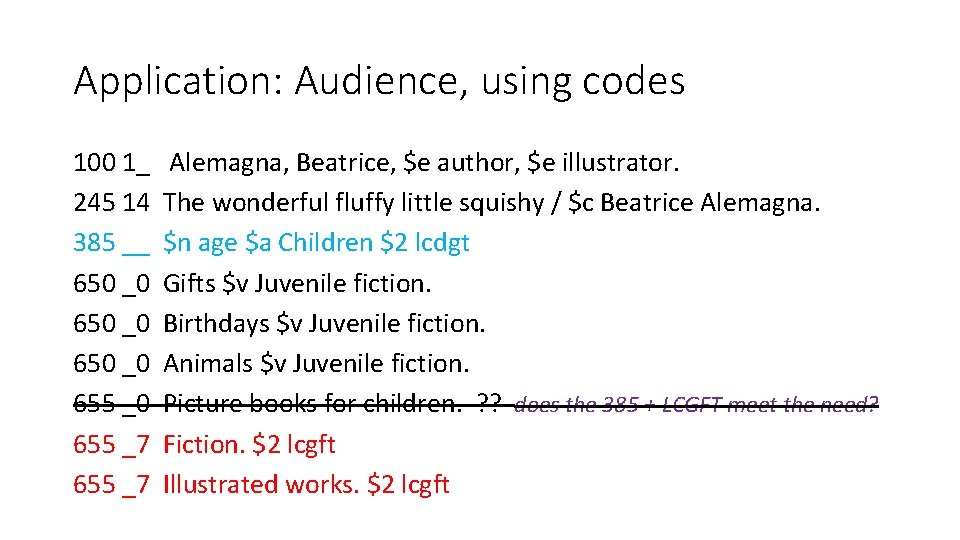
Application: Audience, using codes 100 1_ 245 14 385 __ 650 _0 655 _7 Alemagna, Beatrice, $e author, $e illustrator. The wonderful fluffy little squishy / $c Beatrice Alemagna. $n age $a Children $2 lcdgt Gifts $v Juvenile fiction. Birthdays $v Juvenile fiction. Animals $v Juvenile fiction. Picture books for children. ? ? does the 385 + LCGFT meet the need? Fiction. $2 lcgft Illustrated works. $2 lcgft
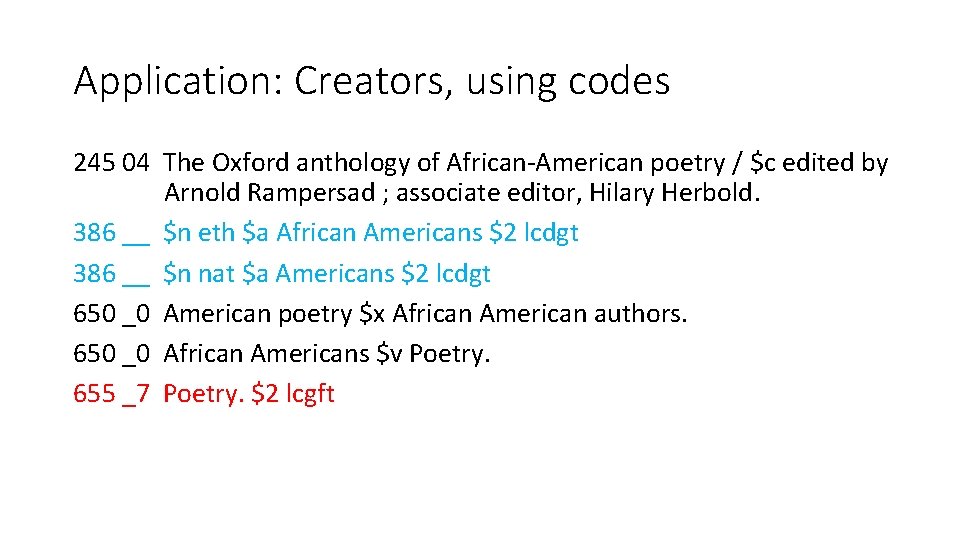
Application: Creators, using codes 245 04 The Oxford anthology of African-American poetry / $c edited by Arnold Rampersad ; associate editor, Hilary Herbold. 386 __ $n eth $a African Americans $2 lcdgt 386 __ $n nat $a Americans $2 lcdgt 650 _0 American poetry $x African American authors. 650 _0 African Americans $v Poetry. 655 _7 Poetry. $2 lcgft
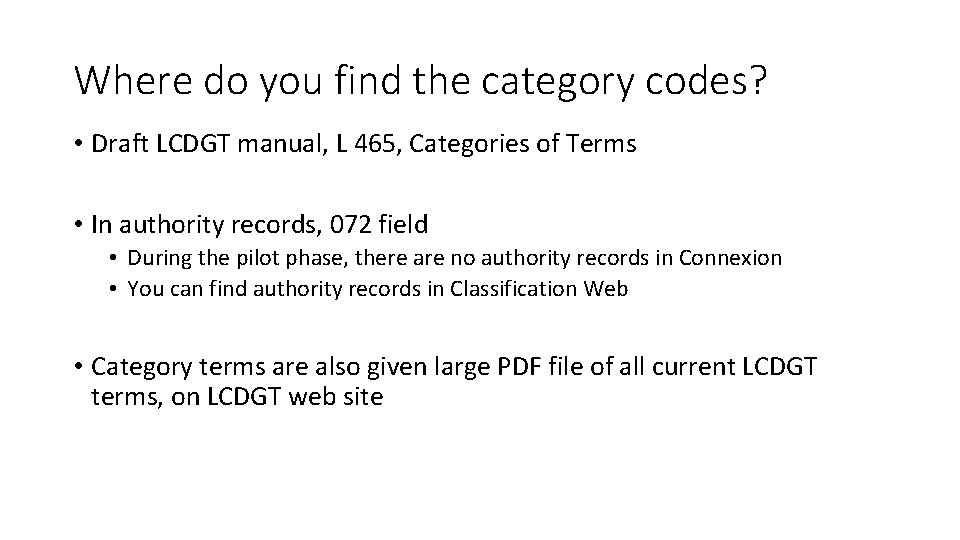
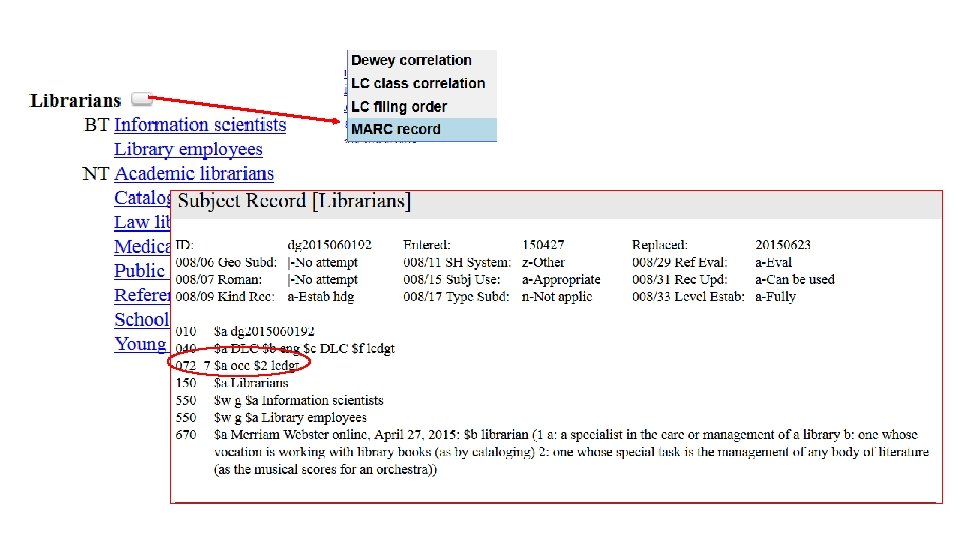
Where do you find the category codes? • Draft LCDGT manual, L 465, Categories of Terms • In authority records, 072 field • During the pilot phase, there are no authority records in Connexion • You can find authority records in Classification Web • Category terms are also given large PDF file of all current LCDGT terms, on LCDGT web site
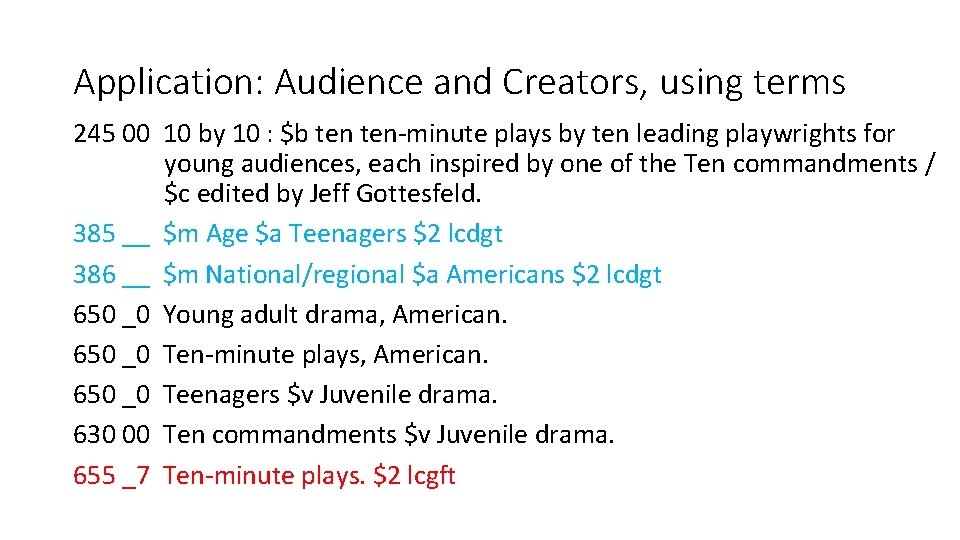
Application: Audience and Creators, using terms 245 00 10 by 10 : $b ten-minute plays by ten leading playwrights for young audiences, each inspired by one of the Ten commandments / $c edited by Jeff Gottesfeld. 385 __ $m Age $a Teenagers $2 lcdgt 386 __ $m National/regional $a Americans $2 lcdgt 650 _0 Young adult drama, American. 650 _0 Ten-minute plays, American. 650 _0 Teenagers $v Juvenile drama. 630 00 Ten commandments $v Juvenile drama. 655 _7 Ten-minute plays. $2 lcgft
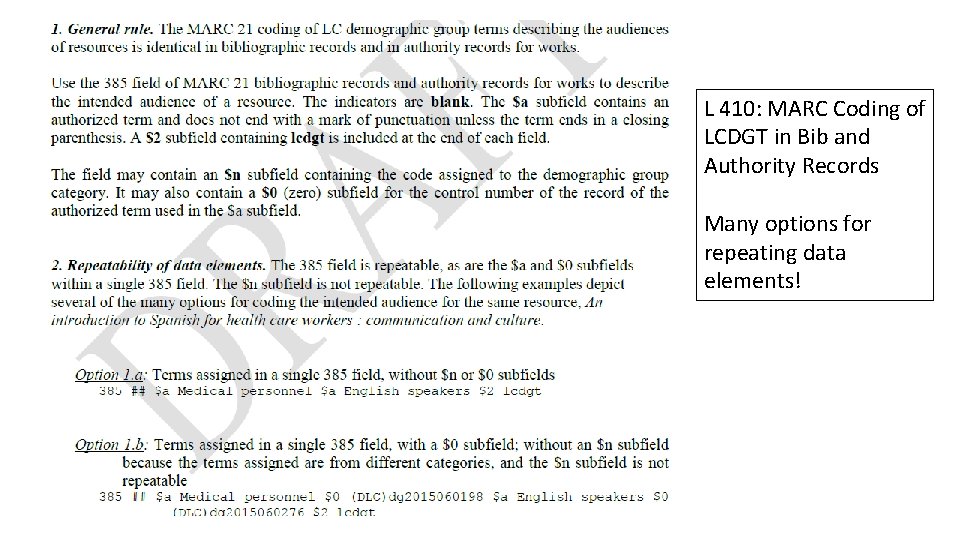
L 410: MARC Coding of LCDGT in Bib and Authority Records Many options for repeating data elements!
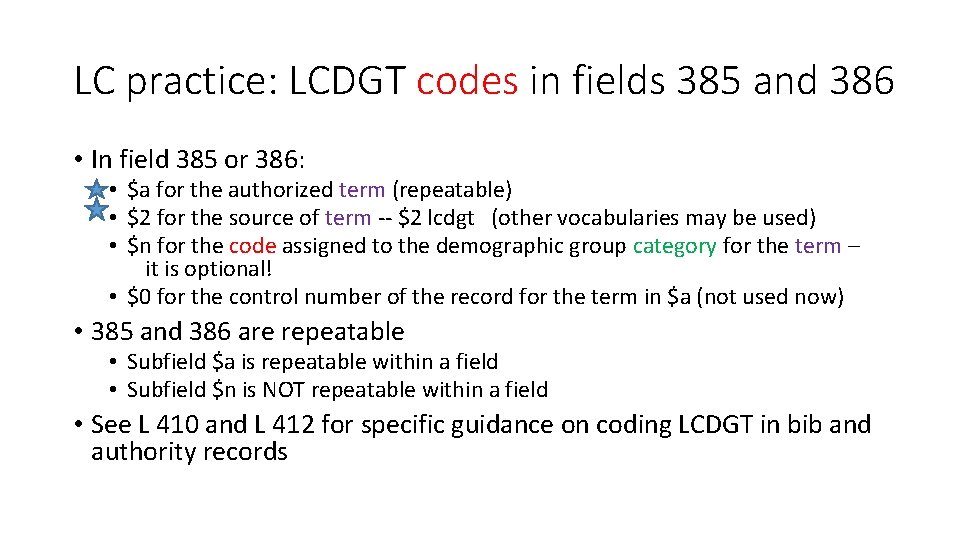
LC practice: LCDGT codes in fields 385 and 386 • In field 385 or 386: • $a for the authorized term (repeatable) • $2 for the source of term -- $2 lcdgt (other vocabularies may be used) • $n for the code assigned to the demographic group category for the term – it is optional! • $0 for the control number of the record for the term in $a (not used now) • 385 and 386 are repeatable • Subfield $a is repeatable within a field • Subfield $n is NOT repeatable within a field • See L 410 and L 412 for specific guidance on coding LCDGT in bib and authority records
What to do about $n? Include it or not? • There is no PCC policy or best practice at this point • Manual shows examples with and without $n • Also many options for repeating data elements • OK to repeat $a within one 385/386 with no $n • If adding $n, must have separate 385 s or 386 s for each category • LC practice: • Terms assigned in multiple 385 or 386 fields, without $n
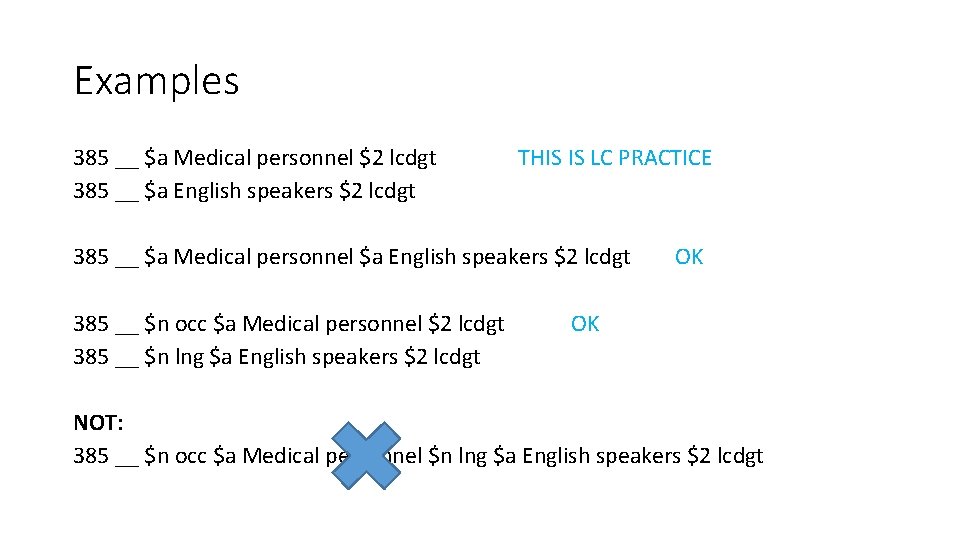
Examples 385 __ $a Medical personnel $2 lcdgt 385 __ $a English speakers $2 lcdgt THIS IS LC PRACTICE 385 __ $a Medical personnel $a English speakers $2 lcdgt 385 __ $n occ $a Medical personnel $2 lcdgt 385 __ $n lng $a English speakers $2 lcdgt OK OK NOT: 385 __ $n occ $a Medical personnel $n lng $a English speakers $2 lcdgt
LCDGT vocabulary: conundrums • Several problems have arisen in the development of the vocabulary • Some have to do with cultural assumptions and U. S. perspective • Students in elementary, junior high, middle school • Students in other educational systems? • Demonyms (terms for residents of specific places) raise many issues • Phase 1 of pilot: terms for residents of continents, regions, countries, firstlevel administrative subdivisions (e. g. , states, provinces) but no lower • North Americans; Oregonians but not Portlanders • Europeans; French but not Parisians • In principle, demonyms for local places should be in scope
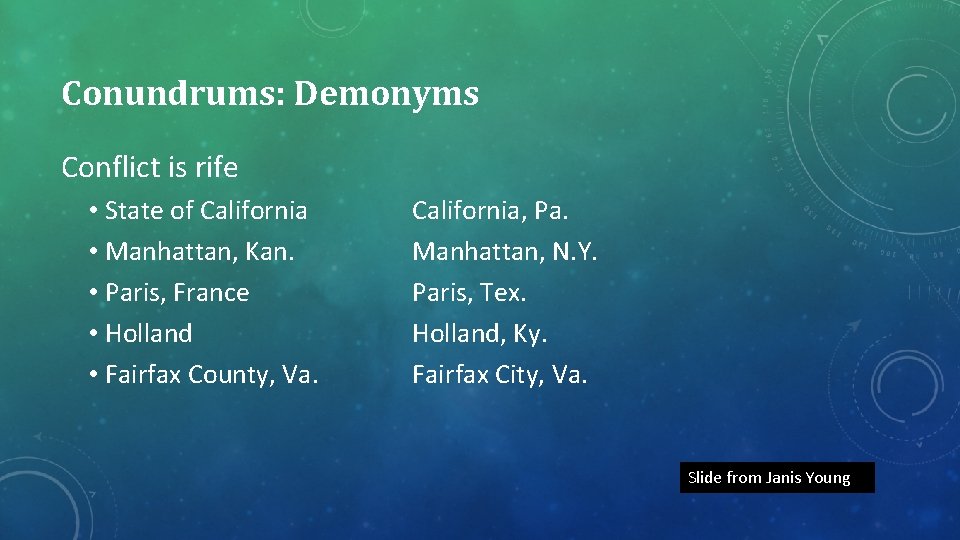
Conundrums: Demonyms Conflict is rife • State of California • Manhattan, Kan. • Paris, France • Holland • Fairfax County, Va. California, Pa. Manhattan, N. Y. Paris, Tex. Holland, Ky. Fairfax City, Va. 80 Slide from Janis Young
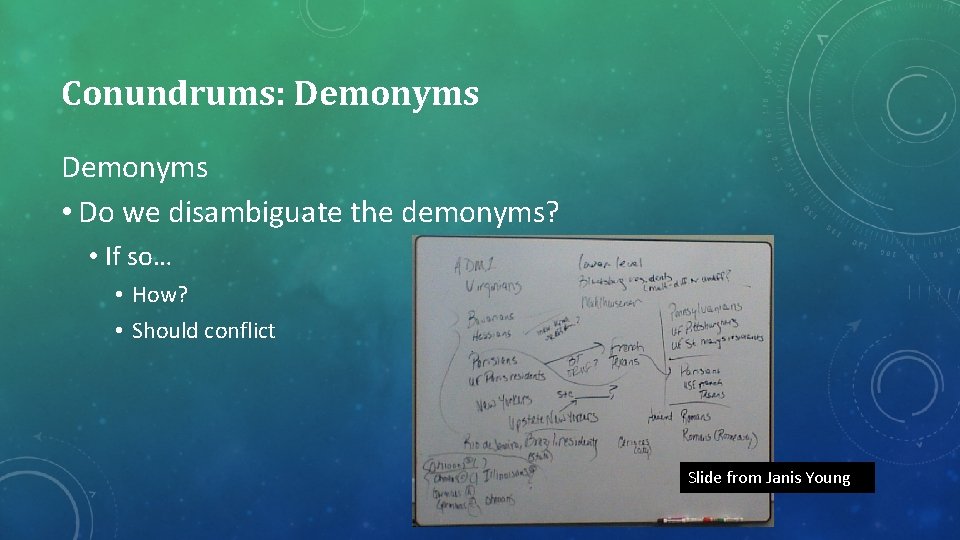
Conundrums: Demonyms • Do we disambiguate the demonyms? • If so… • How? • Should conflict be absolute? 81 Slide from Janis Young
Conundrums: Demonyms • Qualify all terms below the country level? Californians (California, Ky. ) Californians (California, Pa. ) Californians (State of California) Brandenburgers (Brandenburg, State of Brandenburg, Germany) Brandenburgers (Brandenburg, State of Hesse, Germany) Brandenburgers (State of Brandenburg, Germany) 82 Slide from Janis Young
Conundrums: Demonyms • “Thought experiment” on our website • Comments appreciated through January 30, 2016 to jayo@loc. gov http: //www. loc. gov/catdir/cpso/lcdgt-demonyms. pdf 83 Slide from Janis Young
Other Characteristics Related to Genre/Form • Audience Characteristics – various fields including new 385 • Creator/Contributor Characteristics – various fields including new 386 • Language – fixed field Lang (008/35 -37), 041, 546, 600 -651 • Time Period of Creation – 046 $k/$l and $o/$p, and new 388 (not yet implemented in OCLC) • Place of Creation/Origin – new 370 (not yet implemented in OCLC), 751 • Medium of Performance – 382
Summary • Assign LCGFT in field 655 in addition to whatever subject headings you assign in 600 -651. • Consider joining SACO if you think you might want to make proposals for additional terms to include in LCGFT or LCDGT • For now, if using LCSH, continue to follow existing policies found in the Subject Headings Manual • Consider adding 385 for audience and 386 for creator/contributor characteristics, using LCDGT or another vocabulary • LCDGT is still in pilot phase so some adjustments may happen before it is final • Useful to at least think about when you would assign terms and what you would assign
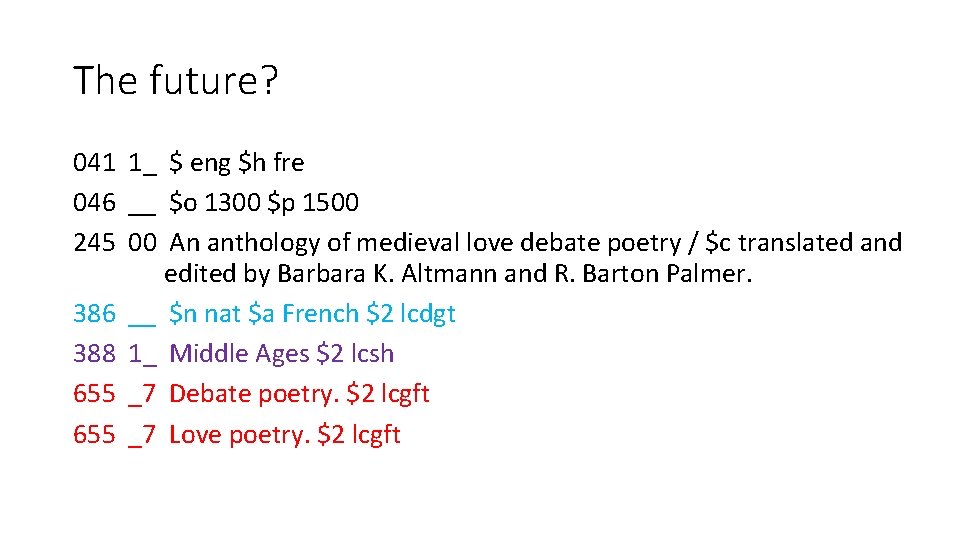
The future? 041 1_ $ eng $h fre 046 __ $o 1300 $p 1500 245 00 An anthology of medieval love debate poetry / $c translated and edited by Barbara K. Altmann and R. Barton Palmer. 386 __ $n nat $a French $2 lcdgt 388 1_ Middle Ages $2 lcsh 655 _7 Debate poetry. $2 lcgft 655 _7 Love poetry. $2 lcgft
Resources: Spreadsheet to help transition from GSAFD to LCGFT • Compiled by Cathy Lamoureaux, Carnegie Library of Pittsburgh • Available at http: //1 drv. ms/1 Hwv. MOh • Alphabetical lists of LCGFT terms by heading and by category (drama, fiction, poetry, etc. ) • GSAFD to LCGFT comparison • LCSH to LCGFT comparison
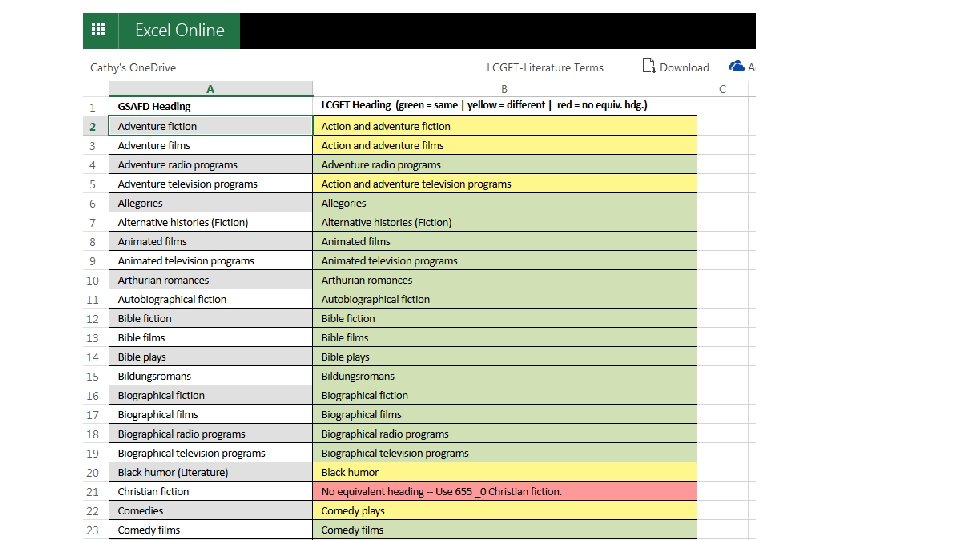
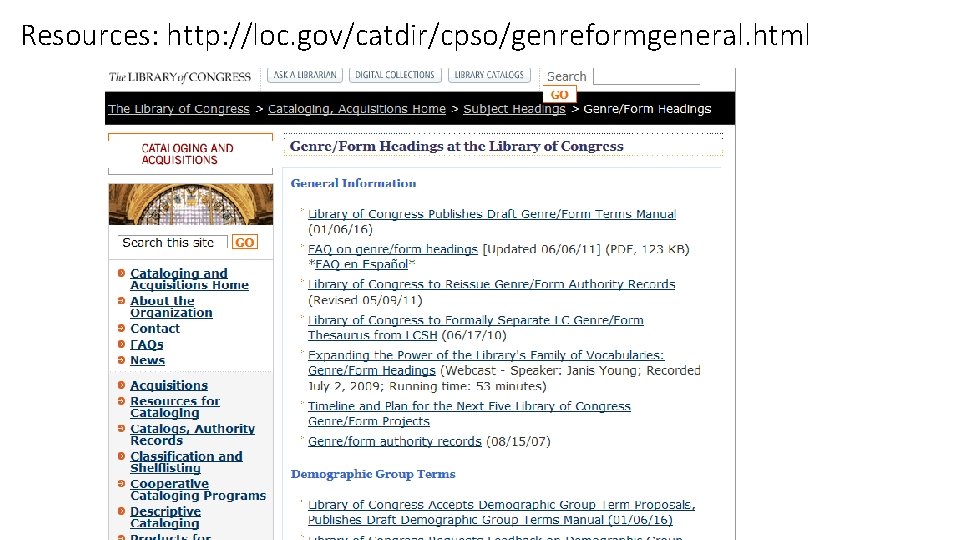
Resources: http: //loc. gov/catdir/cpso/genreformgeneral. html
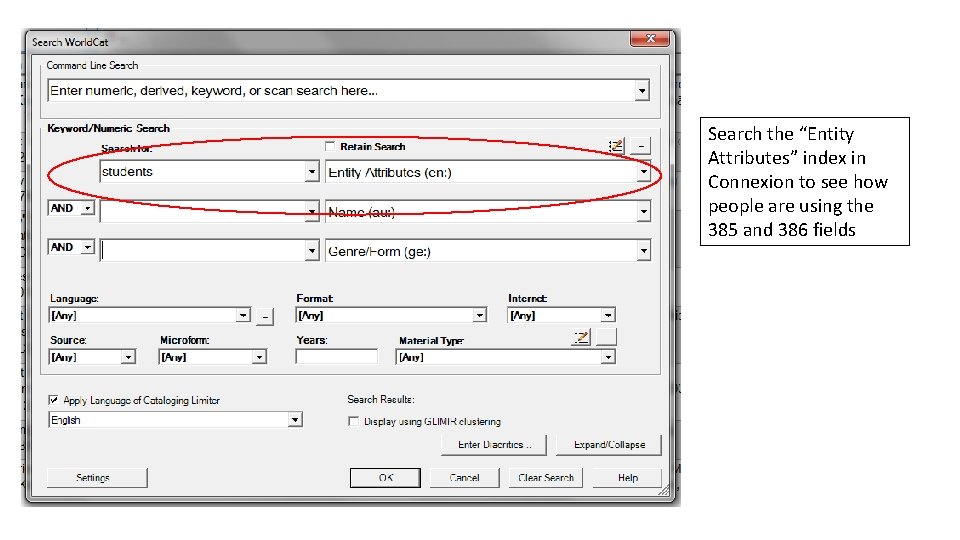
Search the “Entity Attributes” index in Connexion to see how people are using the 385 and 386 fields
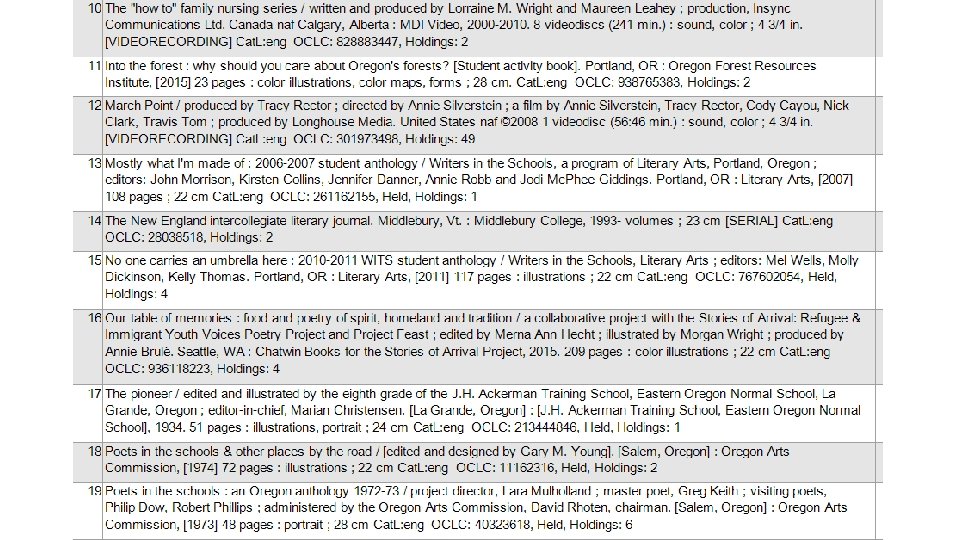
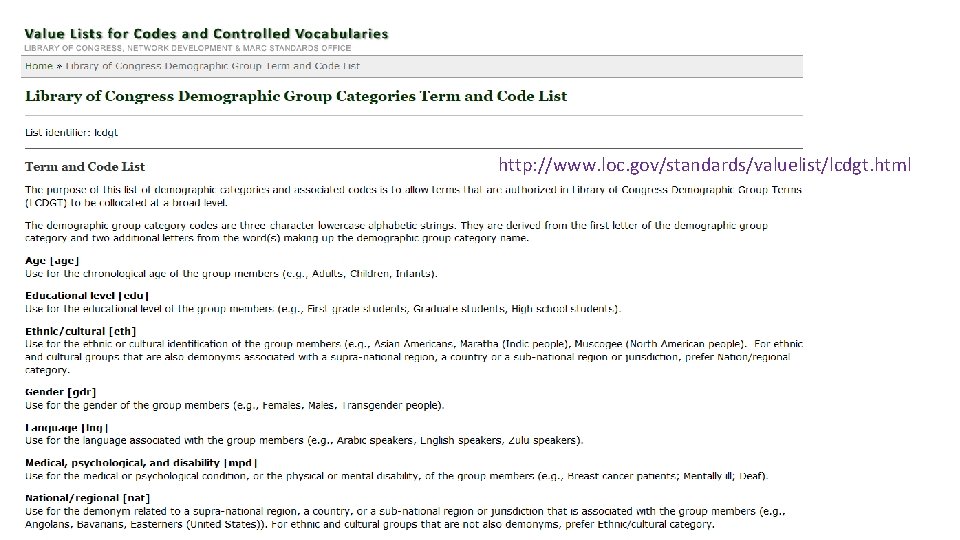
Resources • Draft Genre/Form Terms Manual http: //www. loc. gov/aba/publications/Free. LCGFT/freelcgft. html • LCDGT information, including draft manual http: //loc. gov/catdir/cpso/lcdgt-acceptance-manual. html • LC Demographic Group Categories Term and Code List http: //www. loc. gov/standards/valuelist/lcdgt. html
Thank you! And thanks to Adam Schiff (University of Washington) and Janis Young (Library of Congress) for the use of some slides lrobare@uoregon. edu
- Slides: 93