
Genomewide Identification of Craniofacial Transcriptional Enhancers Axel Visel

- Slides: 19
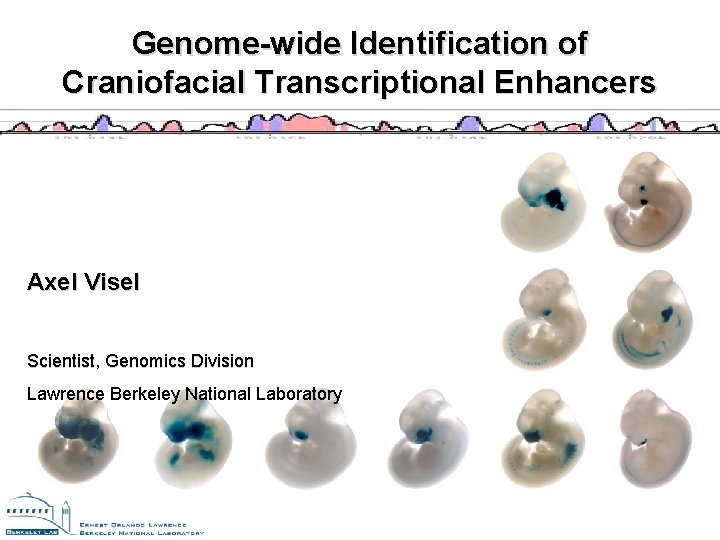
Genome-wide Identification of Craniofacial Transcriptional Enhancers Axel Visel Scientist, Genomics Division Lawrence Berkeley National Laboratory
3 Face. Base 1 2 Distant-Acting Finding Developmental – Contributions Enhancers Face/Palate and Outline Enhancers Expectations Why are they important? Data and fromreagents preliminary Ch. IP-seq and transgenic How can we find them in the genome (and determine mouse studies Interactions their function)?
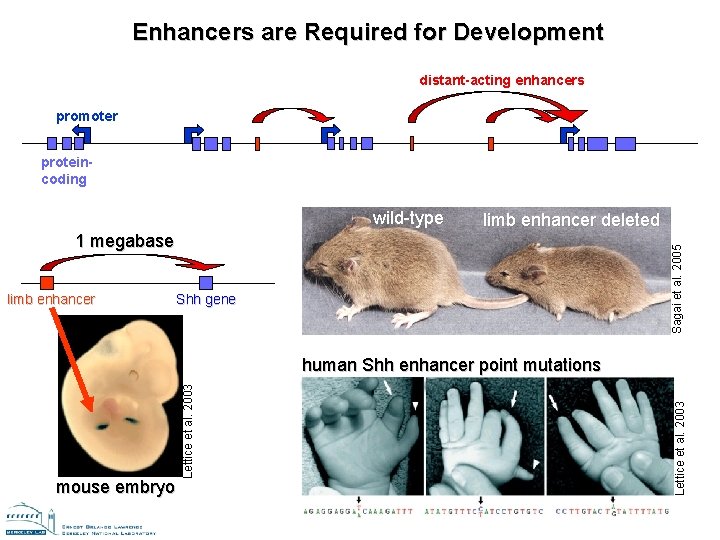
Enhancers are Required for Development distant-acting enhancers promoter proteincoding wild-type limb enhancer deleted limb enhancer Sagai et al. 2005 1 megabase Shh gene Lettice et al. 2003 mouse embryo Lettice et al. 2003 human Shh enhancer point mutations
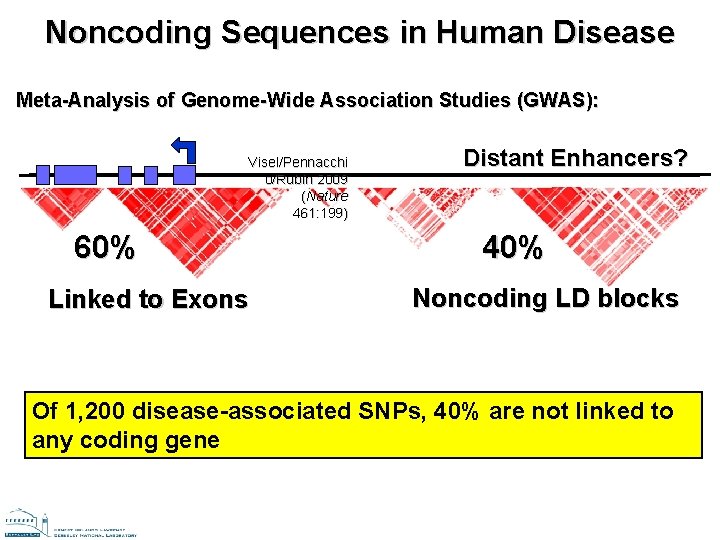
Noncoding Sequences in Human Disease Meta-Analysis of Genome-Wide Association Studies (GWAS): Visel/Pennacchi o/Rubin 2009 (Nature 461: 199) 60% Linked to Exons Distant Enhancers? 40% Noncoding LD blocks Of 1, 200 disease-associated SNPs, 40% are not linked to any coding gene
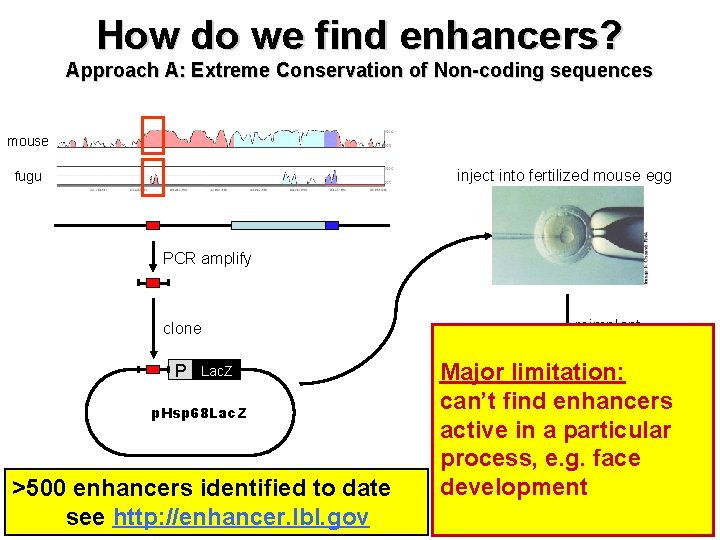
How do we find enhancers? Approach A: Extreme Conservation of Non-coding sequences mouse inject into fertilized mouse egg fugu PCR amplify clone P Lac. Z p. Hsp 68 Lac. Z >500 enhancers identified to date see http: //enhancer. lbl. gov reimplant collect at e 11. 5 Lac. Z staining Major limitation: can’t find enhancers active in a particular process, e. g. face development minimum reproducibility: 3 embryos
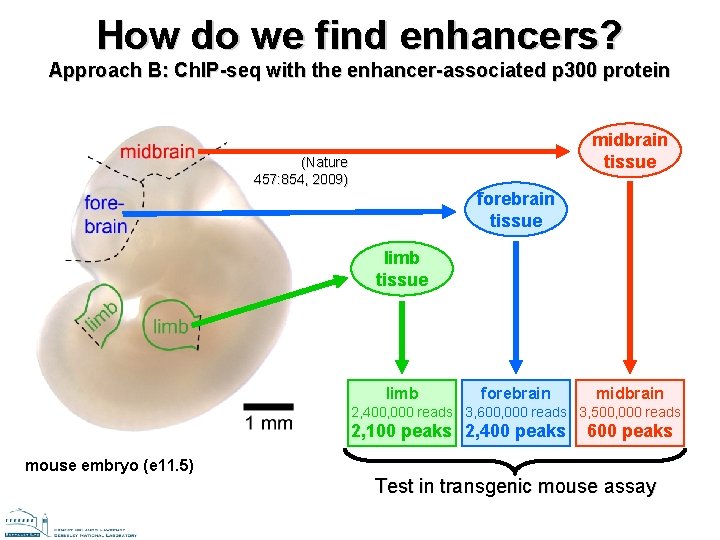
How do we find enhancers? Approach B: Ch. IP-seq with the enhancer-associated p 300 protein microdissection midbrain tissue (Nature 457: 854, 2009) forebrain tissue limb p 300 Ch. IP-Seq forebrain midbrain 2, 400, 000 reads 3, 600, 000 reads 3, 500, 000 reads 2, 100 peaks 2, 400 peaks 600 peaks mouse embryo (e 11. 5) Test in transgenic mouse assay
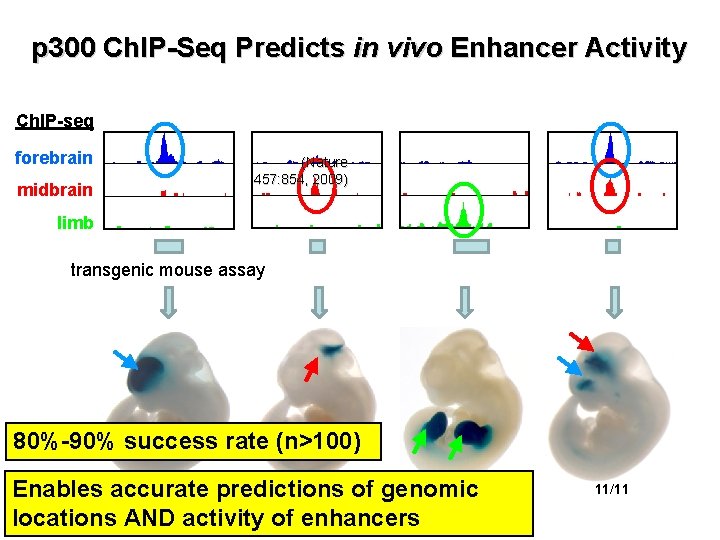
p 300 Ch. IP-Seq Predicts in vivo Enhancer Activity Ch. IP-seq forebrain midbrain (Nature 457: 854, 2009) limb transgenic mouse assay 80%-90% success rate (n>100) 11/12 8/8 5/5 Enables accurate predictions of genomic locations AND activity of enhancers 11/11
3 Face. Base 1 2 Distant-Acting Finding Developmental – Contributions Enhancers Face/Palate and Outline Enhancers Expectations Why are they important? Data and fromreagents preliminary Ch. IP-seq and transgenic How can we find them in the genome (and determine mouse studies Interactions their function)?
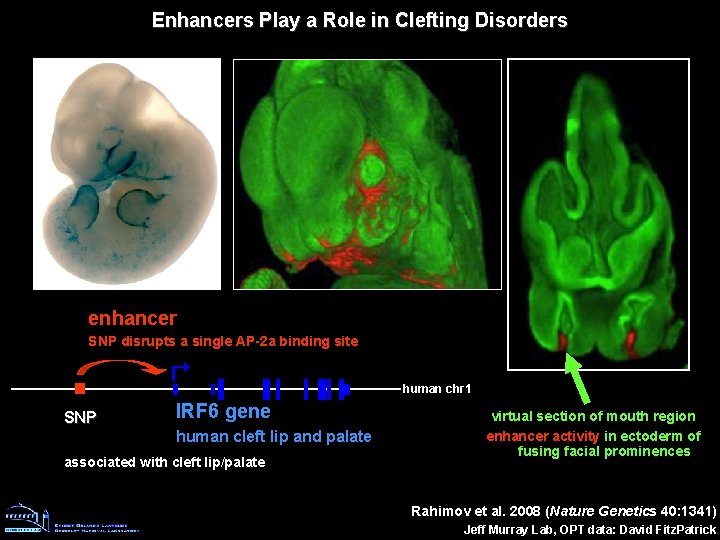
Enhancers Play a Role in Clefting Disorders enhancer SNP disrupts a single AP-2 a binding site x SNP human chr 1 IRF 6 gene human cleft lip and palate associated with cleft lip/palate virtual section of mouth region enhancer activity in ectoderm of fusing facial prominences Rahimov et al. 2008 (Nature Genetics 40: 1341) Jeff Murray Lab, OPT data: David Fitz. Patrick
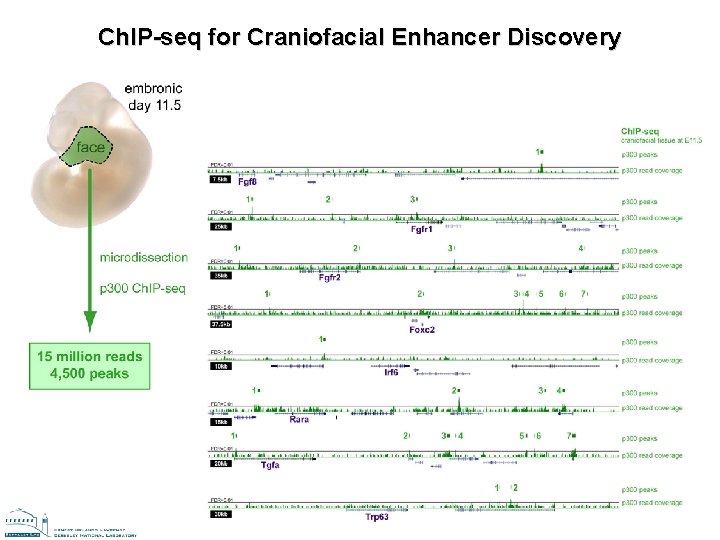
Ch. IP-seq for Craniofacial Enhancer Discovery
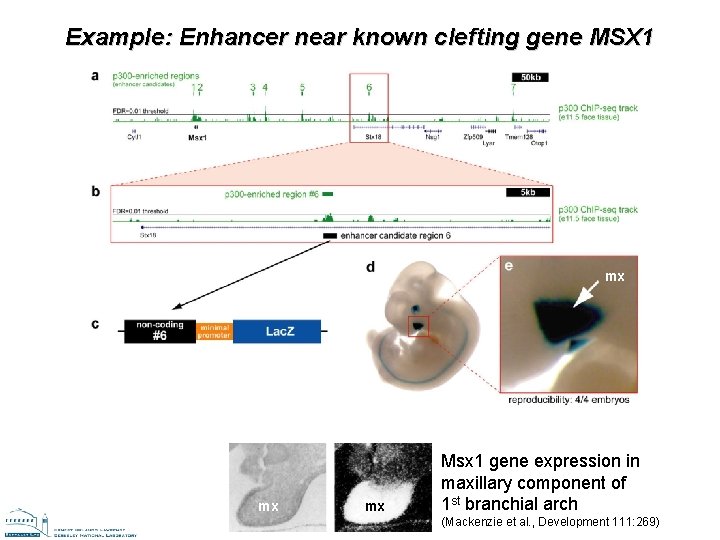
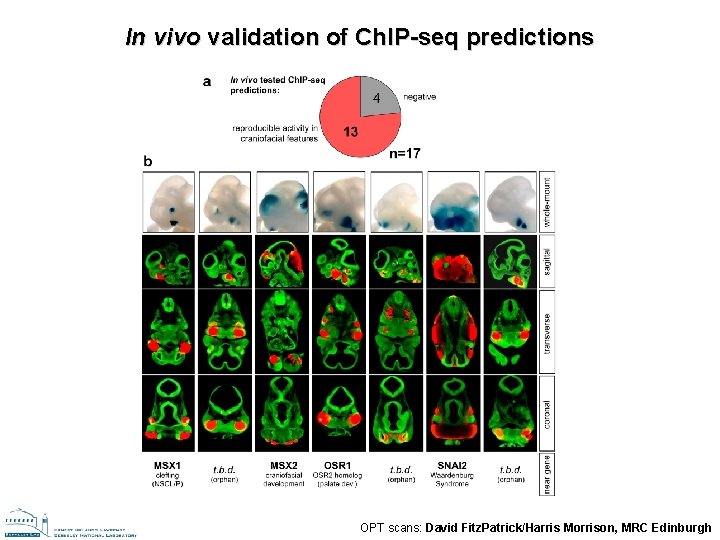
Example: Enhancer near known clefting gene MSX 1 mx mx mx Msx 1 gene expression in maxillary component of 1 st branchial arch (Mackenzie et al. , Development 111: 269)
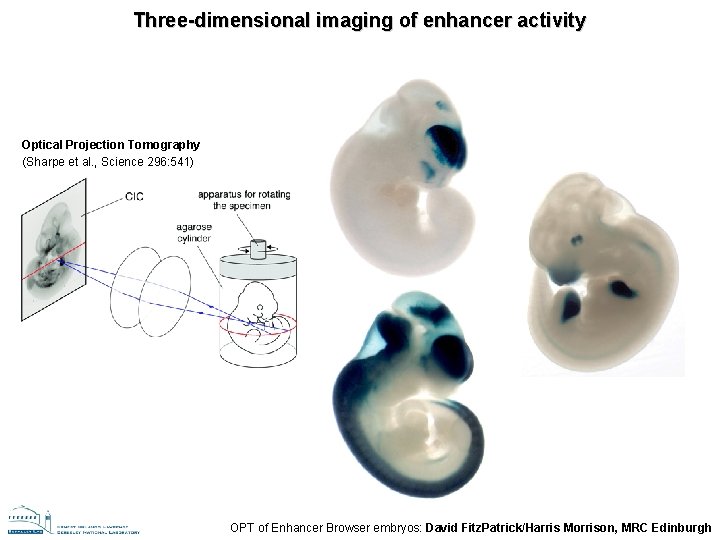
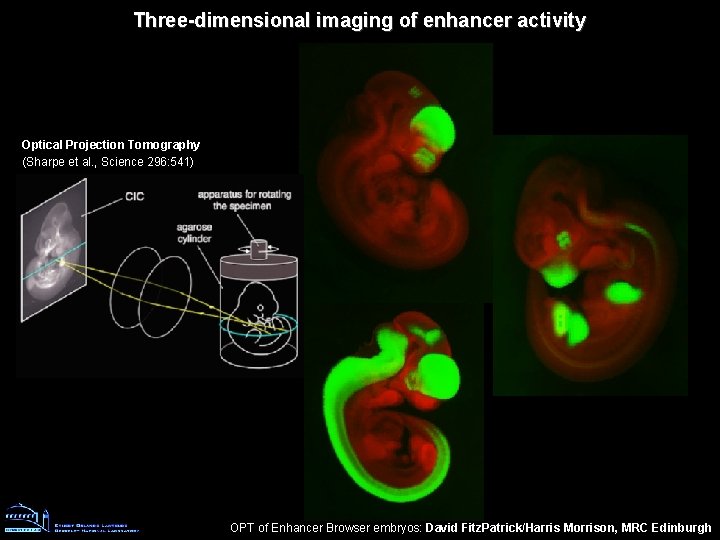
Three-dimensional imaging of enhancer activity Optical Projection Tomography (Sharpe et al. , Science 296: 541) OPT of Enhancer Browser embryos: David Fitz. Patrick/Harris Morrison, MRC Edinburgh
Three-dimensional imaging of enhancer activity Optical Projection Tomography (Sharpe et al. , Science 296: 541) OPT of Enhancer Browser embryos: David Fitz. Patrick/Harris Morrison, MRC Edinburgh
In vivo validation of Ch. IP-seq predictions OPT scans: David Fitz. Patrick/Harris Morrison, MRC Edinburgh
3 Face. Base 1 2 Distant-Acting Finding Developmental – Contributions Enhancers Face/Palate and Outline Enhancers Expectations Why are they important? Data and fromreagents preliminary Ch. IP-seq and transgenic How can we find them in the genome (and determine mouse studies Interactions their function)?
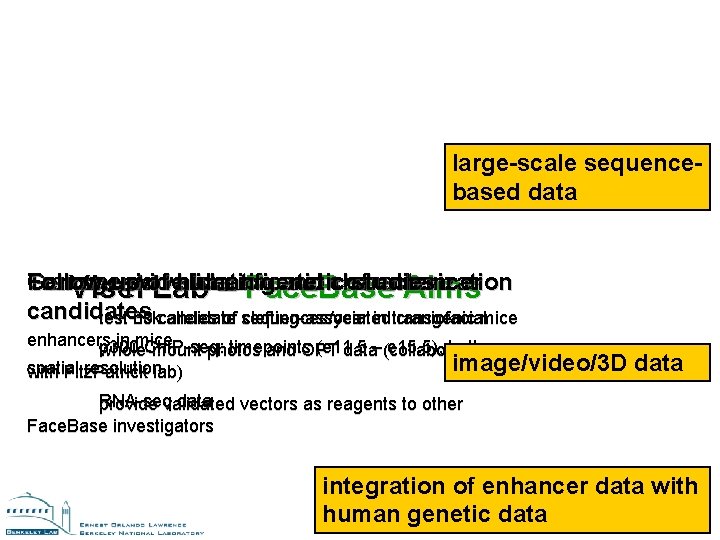
large-scale sequencebased data Transgenic Genome-wide validation identification and characterization of enhancer Follow-up human genetic studies Visel of Lab – Face. Base Aims candidates 30 candidate in transgenic test risk alleles of sequences/year clefting-associated craniofacialmice enhancers in mice p 300 Ch. IP-seq: timepoints (e 11. 5 e 15. 5), better whole-mount photos and OPT data– (collaboration image/video/3 D spatial resolution with Fitz. Patrick lab) data RNA-seq data provide validated vectors as reagents to other Face. Base investigators integration of enhancer data with human genetic data
Human Visel Developmental genetics biology groups and expression Lab – Face. Base imaging groups Please approach us with non-coding cleft-associated Expectations regions! Intersect with gene expression data Use Ch. IP-seq andustransgenics to of search for Please approach with regions interest! enhancers Transgenic testing of cleft-associated risk variants
Acknowledgments Lawrence Berkeley National Lab and DOE Joint Genome Institute Len Pennacchio Eddy Rubin Matt Blow Shyam Prabhakar Mouse Transgenics Malak Shoukry Jennifer Akiyama Veena Afzal Amy Holt Ingrid Plaijzer-Frick Roya Hosseini Collaborators/Contributors: Terri Beaty, Robert Cornell, Michael Dixon, David Fitz. Patrick, Rulang Jiang, Michael Lovett, Mary Marazita, Jeff Murray, Stephen Murray, Leif Oxburgh, Bing Ren, John Rubenstein, Brian Schutte, Alan Scott, Douglas Spicer http: //enhancer. lbl. gov Next-Gen Sequencing NIDCR (Face. Base) Tao Zhang Feng Chen Crystal Wright Enhancer Browser Inna Dubchak Simon Minovitsky DOE, NHGRI