
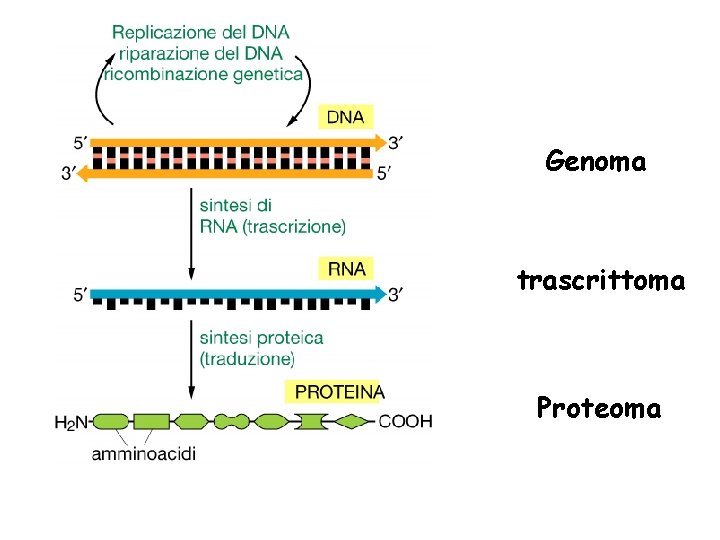
Genoma trascrittoma Proteoma 0720ProvEucar jpg Il destino di
- Slides: 72
Genoma trascrittoma Proteoma
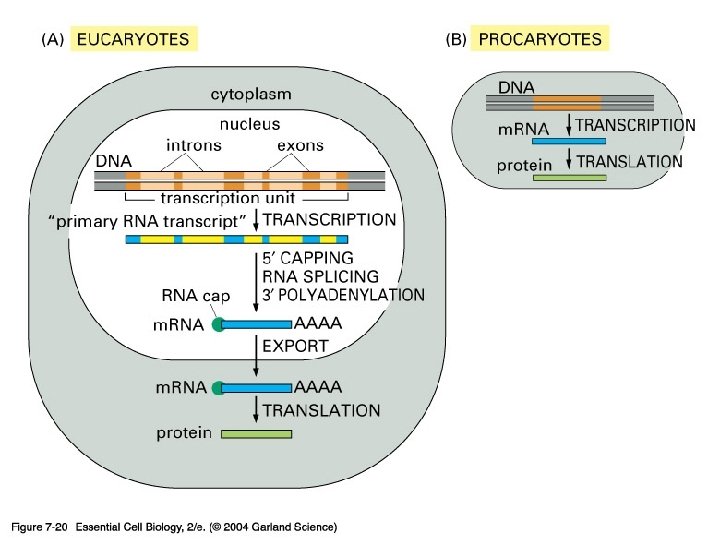
07_20_Pro_v_Eucar. jpg
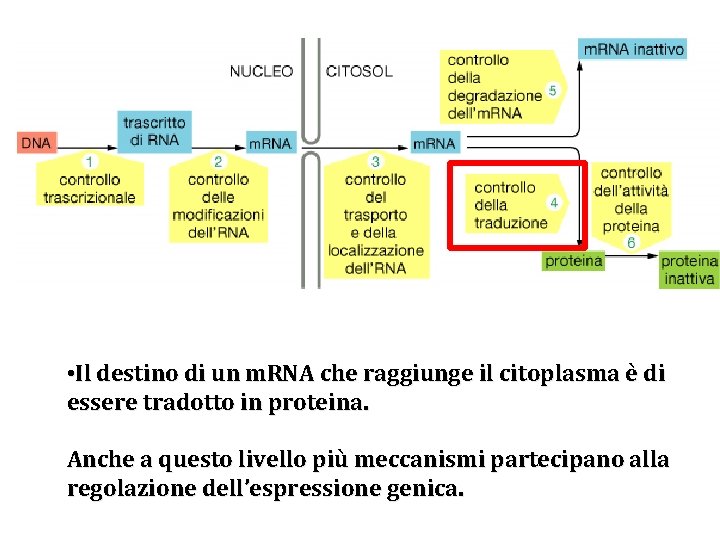
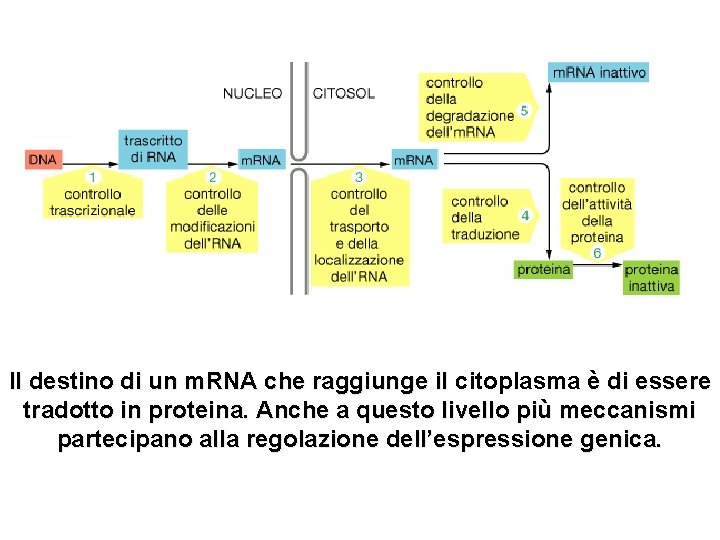
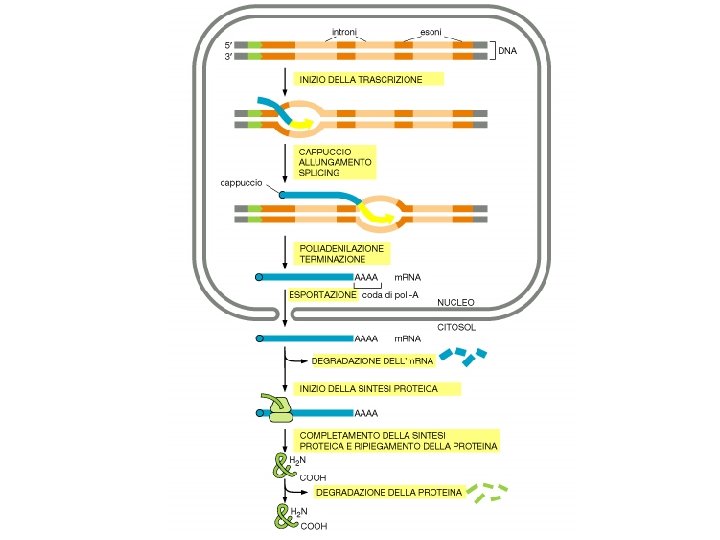
• Il destino di un m. RNA che raggiunge il citoplasma è di essere tradotto in proteina. Anche a questo livello più meccanismi partecipano alla regolazione dell’espressione genica.
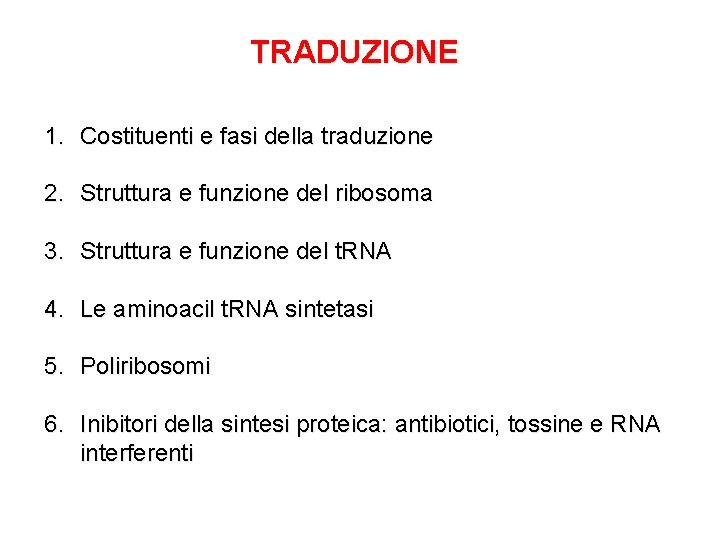
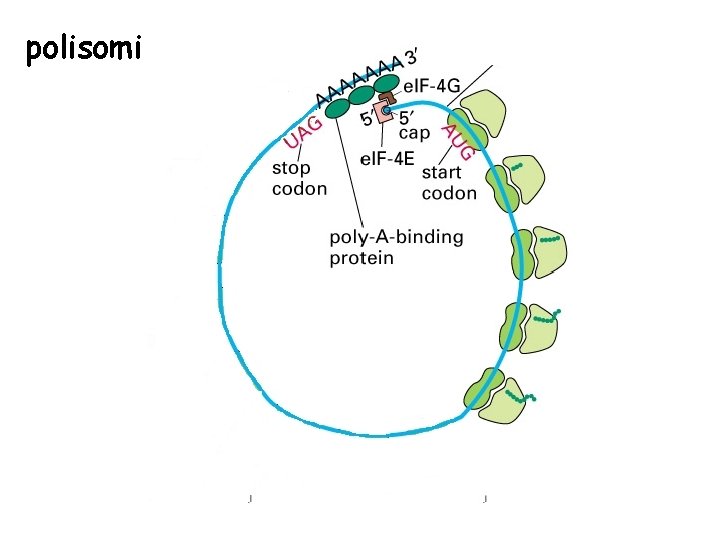
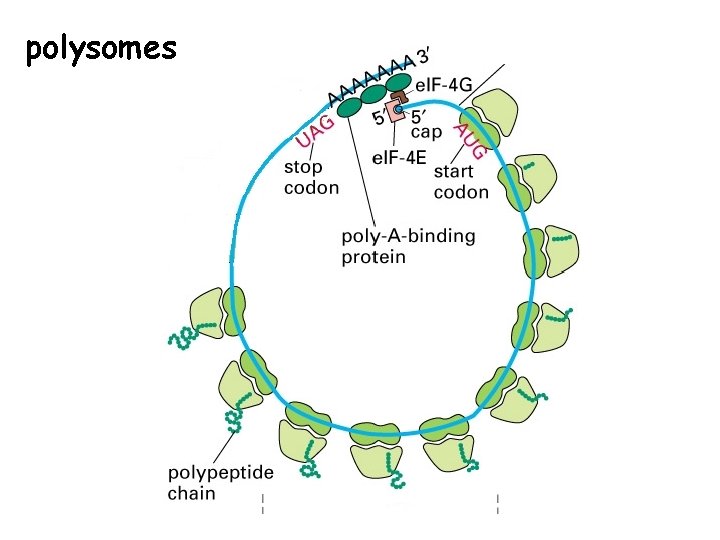
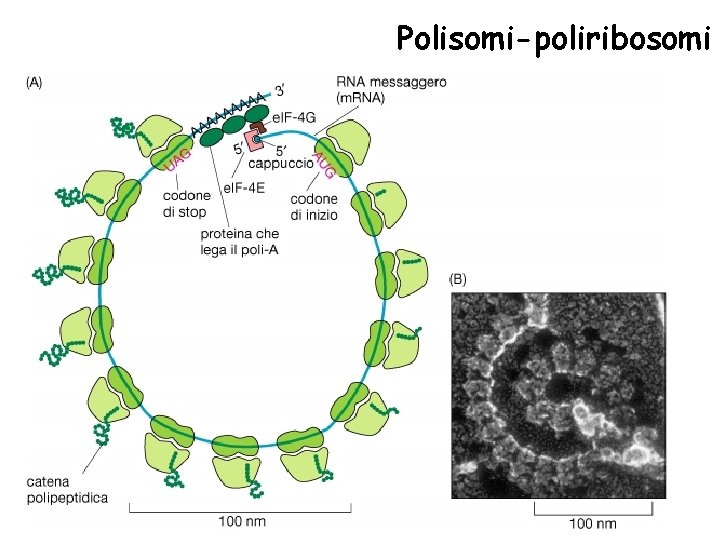
TRADUZIONE 1. Costituenti e fasi della traduzione 2. Struttura e funzione del ribosoma 3. Struttura e funzione del t. RNA 4. Le aminoacil t. RNA sintetasi 5. Poliribosomi 6. Inibitori della sintesi proteica: antibiotici, tossine e RNA interferenti
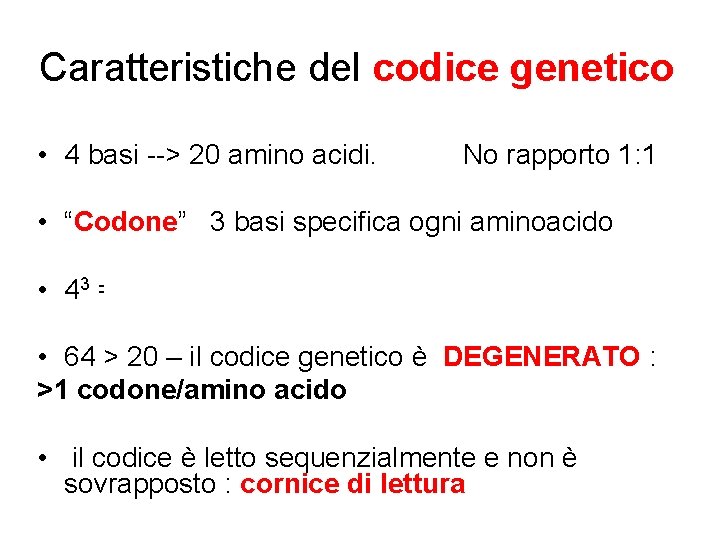
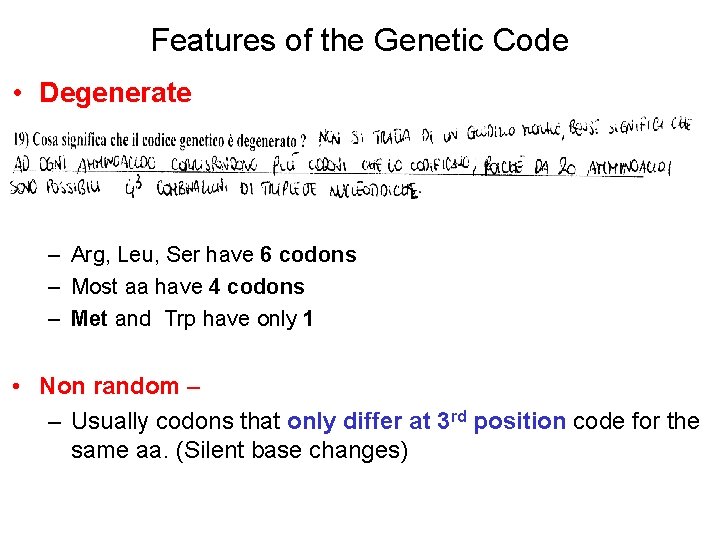
Caratteristiche del codice genetico • 4 basi --> 20 amino acidi. No rapporto 1: 1 • “Codone” 3 basi specifica ogni aminoacido • 43 = 64 combinazioni • 64 > 20 – il codice genetico è DEGENERATO : >1 codone/amino acido • il codice è letto sequenzialmente e non è sovrapposto : cornice di lettura
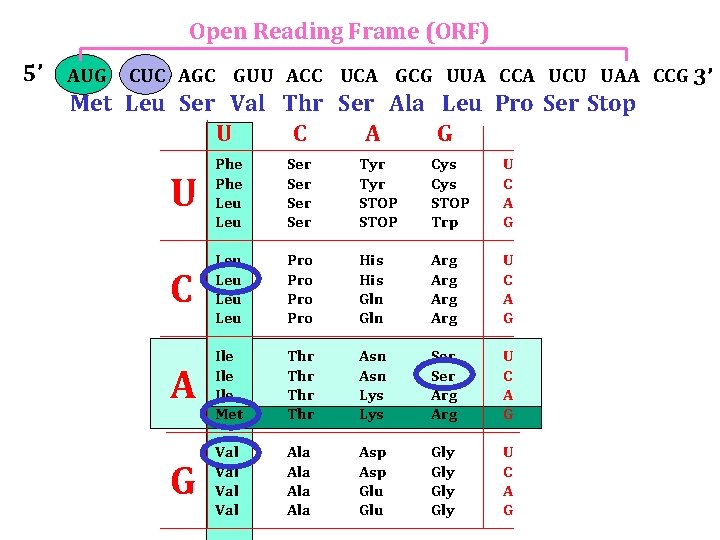
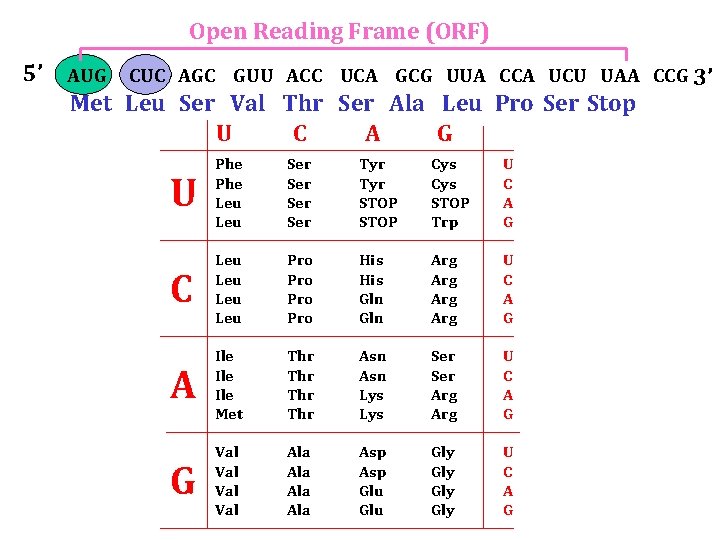
Open Reading Frame (ORF) 5’ AUG CUC AGC GUU ACC UCA GCG UUA CCA UCU UAA CCG 3’ Met Leu Ser Val Thr Ser Ala Leu Pro Ser Stop U C A G U Phe Leu Ser Ser Tyr STOP Cys STOP Trp U C A G C Leu Leu Pro Pro His Gln Arg Arg U C A G A Ile Ile Met Thr Thr Asn Lys Ser Arg U C A G G Val Val Ala Ala Asp Glu Gly Gly U C A G
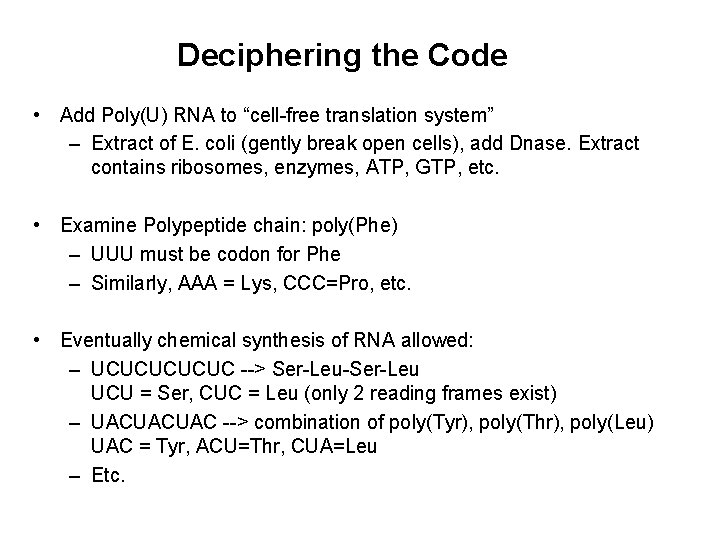
Deciphering the Code • Add Poly(U) RNA to “cell-free translation system” – Extract of E. coli (gently break open cells), add Dnase. Extract contains ribosomes, enzymes, ATP, GTP, etc. • Examine Polypeptide chain: poly(Phe) – UUU must be codon for Phe – Similarly, AAA = Lys, CCC=Pro, etc. • Eventually chemical synthesis of RNA allowed: – UCUCUC --> Ser-Leu-Ser-Leu UCU = Ser, CUC = Leu (only 2 reading frames exist) – UACUACUAC --> combination of poly(Tyr), poly(Thr), poly(Leu) UAC = Tyr, ACU=Thr, CUA=Leu – Etc.
Features of the Genetic Code • Degenerate – Arg, Leu, Ser have 6 codons – Most aa have 4 codons – Met and Trp have only 1 • Non random – – Usually codons that only differ at 3 rd position code for the same aa. (Silent base changes)
Open Reading Frame (ORF) 5’ AUG CUC AGC GUU ACC UCA GCG UUA CCA UCU UAA CCG 3’ Met Leu Ser Val Thr Ser Ala Leu Pro Ser Stop U C A G U Phe Leu Ser Ser Tyr STOP Cys STOP Trp U C A G C Leu Leu Pro Pro His Gln Arg Arg U C A G A Ile Ile Met Thr Thr Asn Lys Ser Arg U C A G G Val Val Ala Ala Asp Glu Gly Gly U C A G
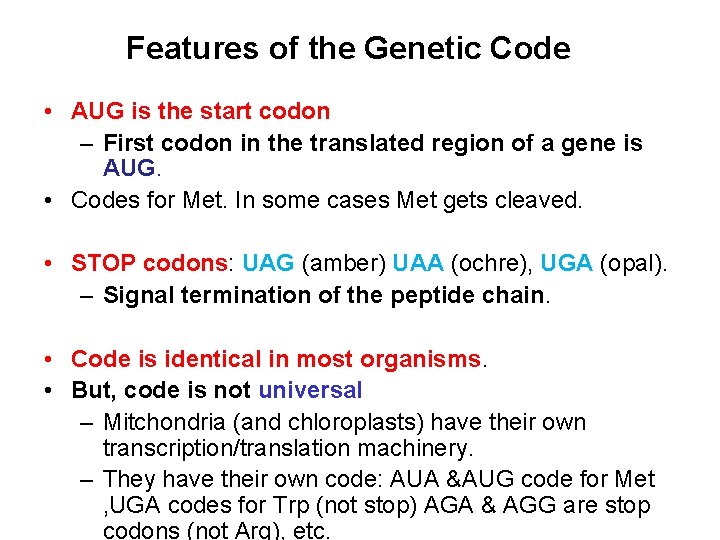
Features of the Genetic Code • AUG is the start codon – First codon in the translated region of a gene is AUG. • Codes for Met. In some cases Met gets cleaved. • STOP codons: UAG (amber) UAA (ochre), UGA (opal). – Signal termination of the peptide chain. • Code is identical in most organisms. • But, code is not universal – Mitchondria (and chloroplasts) have their own transcription/translation machinery. – They have their own code: AUA &AUG code for Met , UGA codes for Trp (not stop) AGA & AGG are stop codons (not Arg), etc.
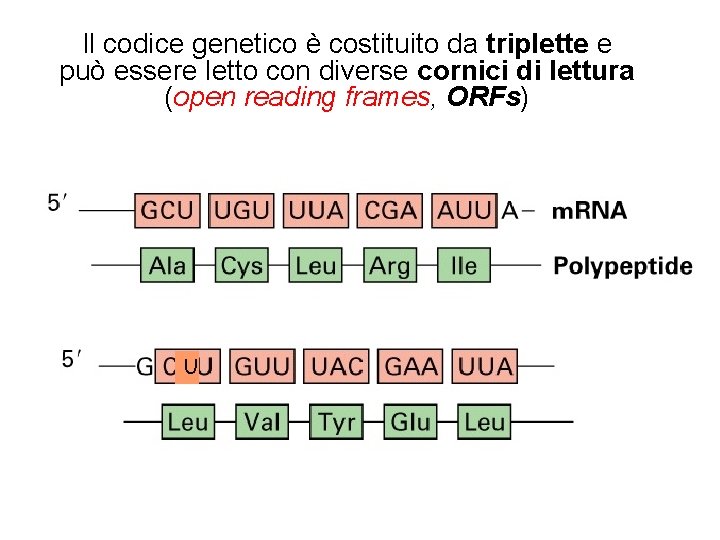
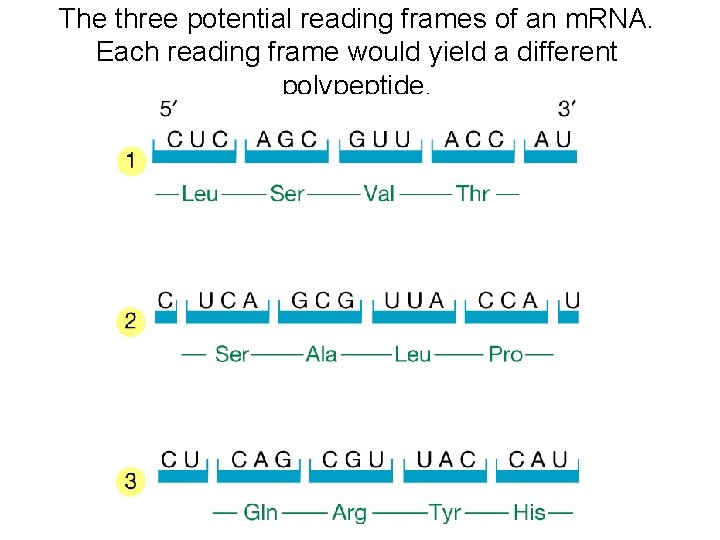
Il codice genetico è costituito da triplette e può essere letto con diverse cornici di lettura (open reading frames, ORFs) U
The three potential reading frames of an m. RNA. Each reading frame would yield a different polypeptide.
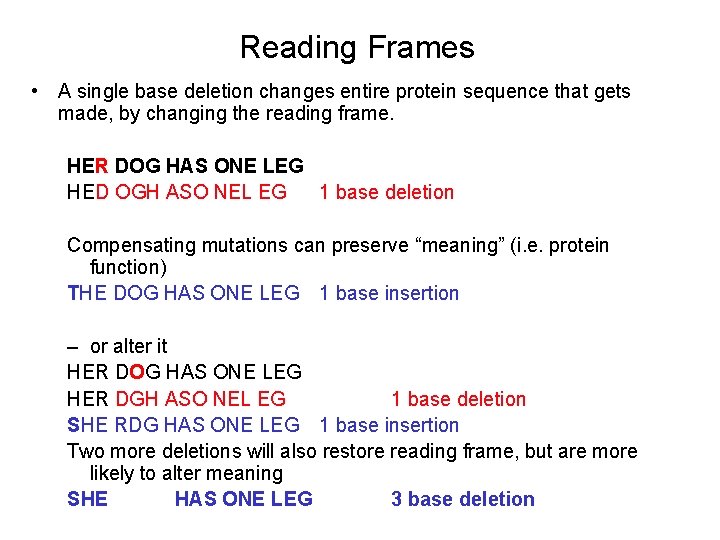
Reading Frames • A single base deletion changes entire protein sequence that gets made, by changing the reading frame. HER DOG HAS ONE LEG HED OGH ASO NEL EG 1 base deletion Compensating mutations can preserve “meaning” (i. e. protein function) THE DOG HAS ONE LEG 1 base insertion – or alter it HER DOG HAS ONE LEG HER DGH ASO NEL EG 1 base deletion SHE RDG HAS ONE LEG 1 base insertion Two more deletions will also restore reading frame, but are more likely to alter meaning SHE HAS ONE LEG 3 base deletion
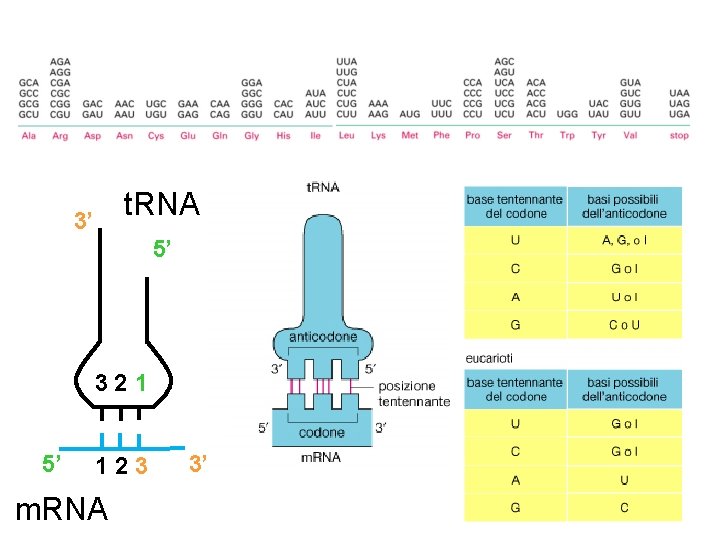
t. RNA 3’ 5’ 321 5’ 123 m. RNA 3’
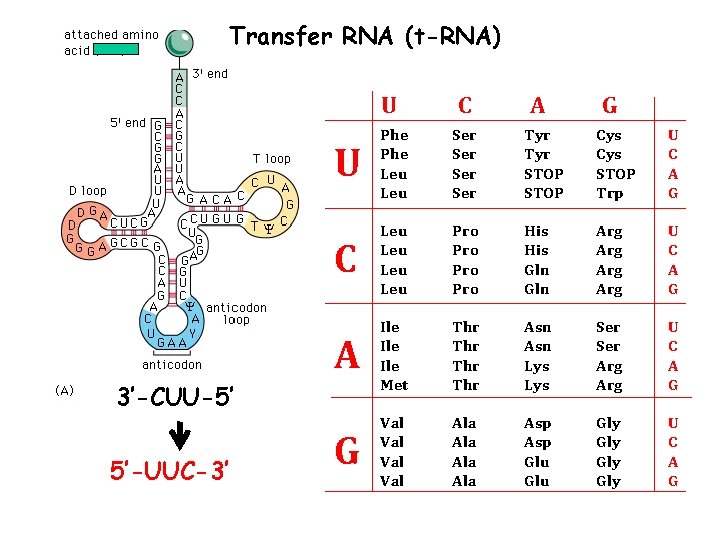
Transfer RNA (t-RNA) U A G U Phe Leu Ser Ser Tyr STOP Cys STOP Trp U C A G C Leu Leu Pro Pro His Gln Arg Arg U C A G A Ile Ile Met Thr Thr Asn Lys Ser Arg U C A G G Val Val Ala Ala Asp Glu Gly Gly U C A G 3’-CUU-5’ 5’-UUC-3’ C
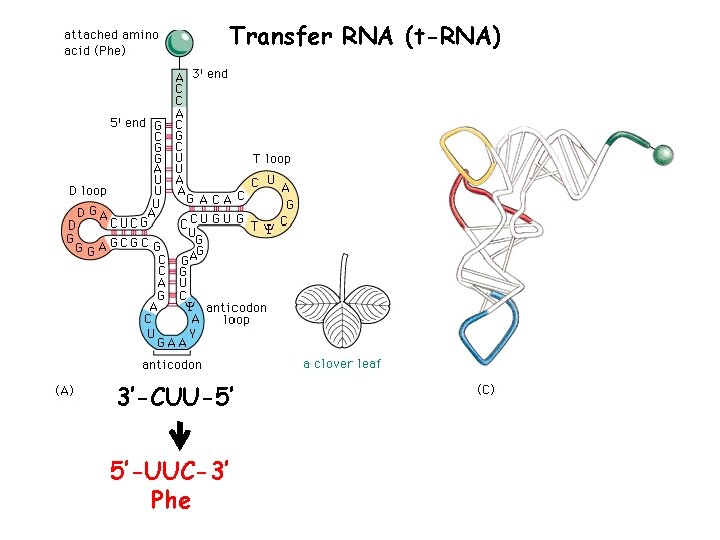
Transfer RNA (t-RNA) 3’-CUU-5’ 5’-UUC-3’ Phe
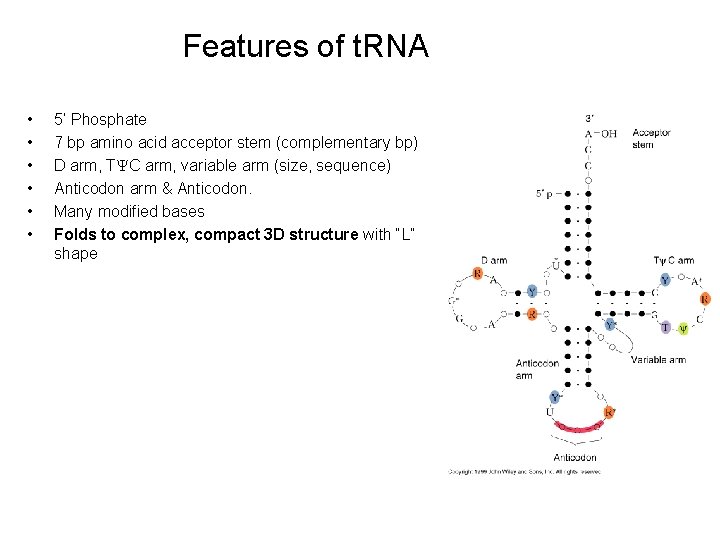
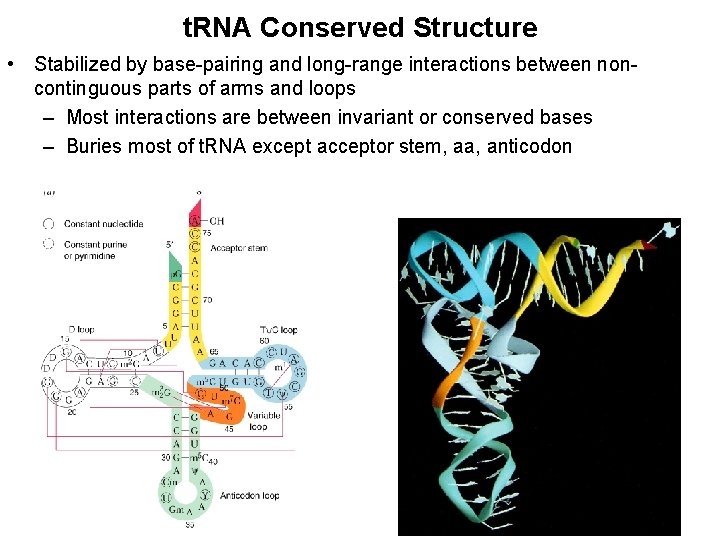
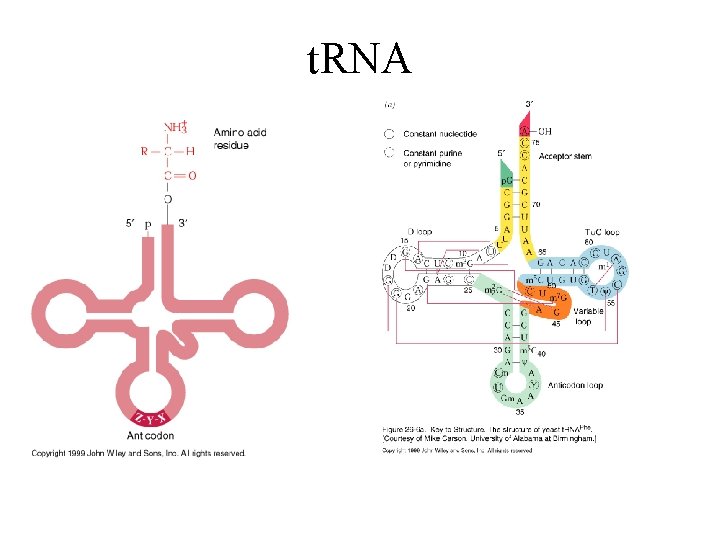
Features of t. RNA • • • 5’ Phosphate 7 bp amino acid acceptor stem (complementary bp) D arm, T C arm, variable arm (size, sequence) Anticodon arm & Anticodon. Many modified bases Folds to complex, compact 3 D structure with “L” shape
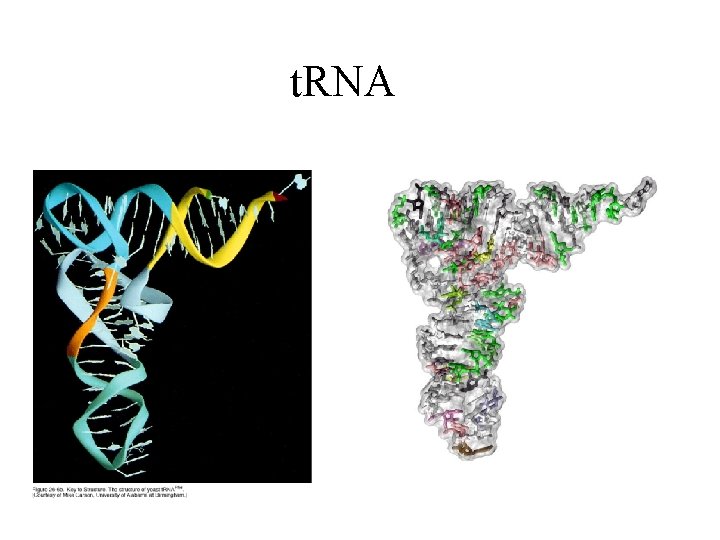
t. RNA
t. RNA Conserved Structure • Stabilized by base-pairing and long-range interactions between noncontinguous parts of arms and loops – Most interactions are between invariant or conserved bases – Buries most of t. RNA except acceptor stem, aa, anticodon
t. RNA
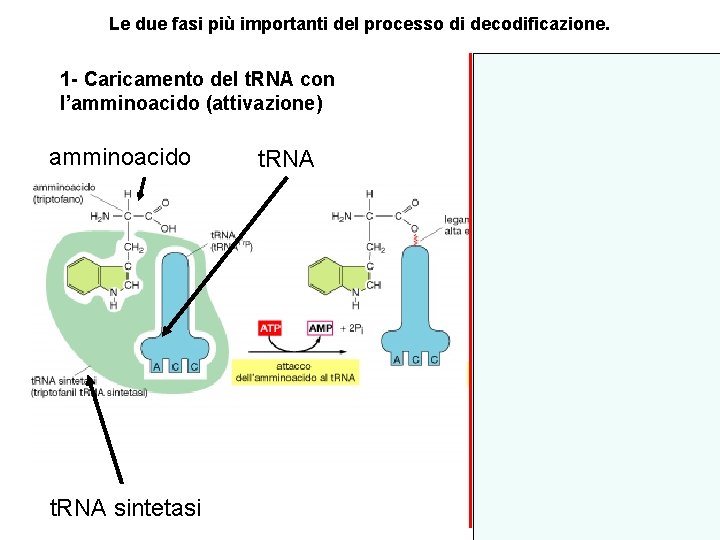
Caricamento del t. RNA con l’amminoacido
AA (Trp) high-energy bond t-RNA (Trp) codon-anticodon base pairing m. RNA Aminoacylt. RNA synthetase (Trp)
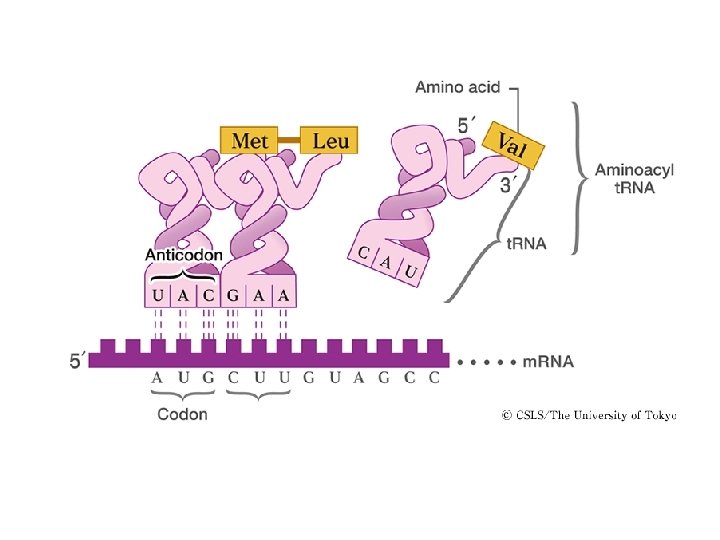
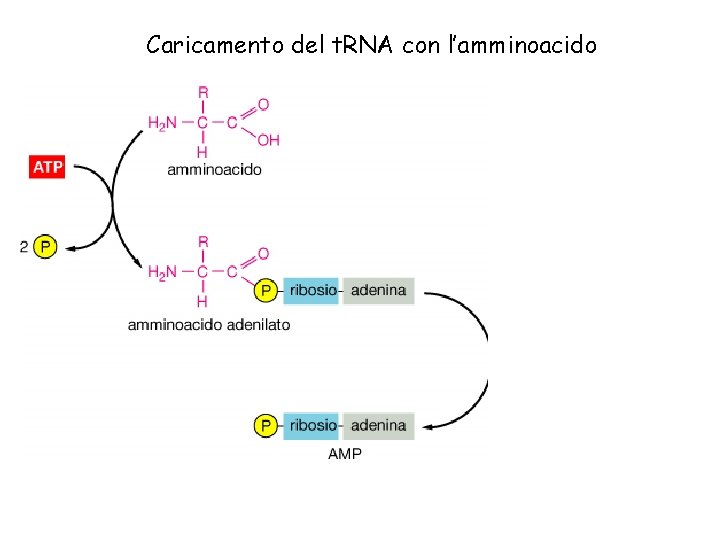
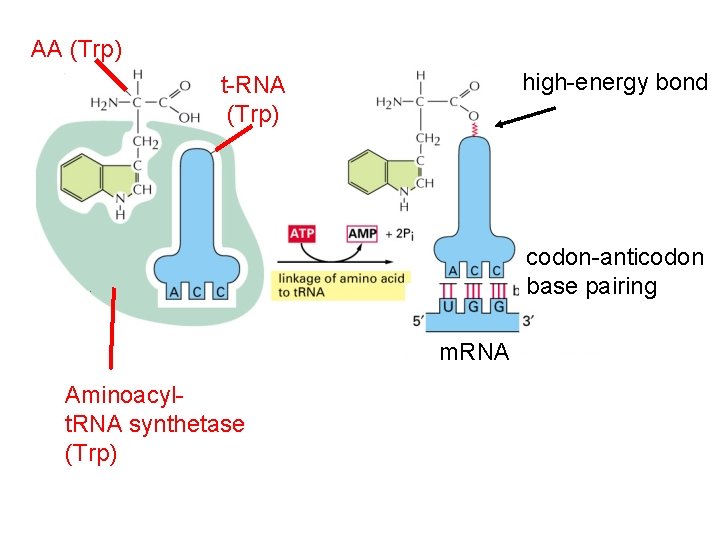
Le due fasi più importanti del processo di decodificazione. 1 - Caricamento del t. RNA con l’amminoacido (attivazione) amminoacido t. RNA sintetasi t. RNA 2 - Appaiamento anticodone/codone nel ribosoma
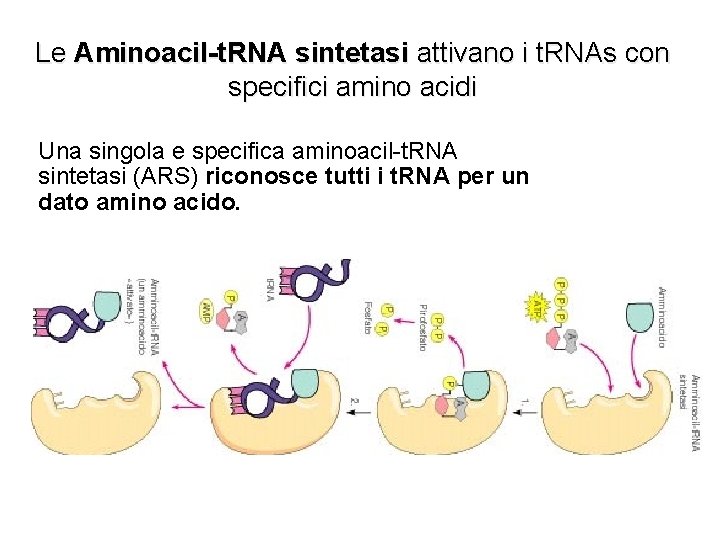
Le Aminoacil-t. RNA sintetasi attivano i t. RNAs con specifici amino acidi Una singola e specifica aminoacil-t. RNA sintetasi (ARS) riconosce tutti i t. RNA per un dato amino acido.
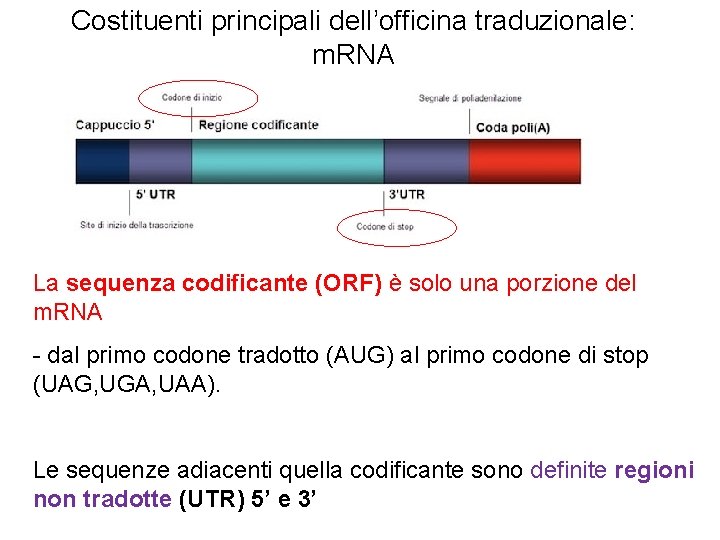
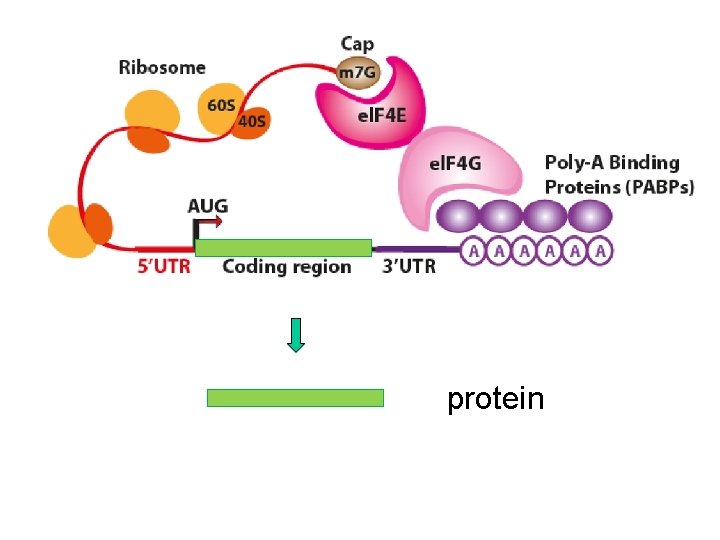
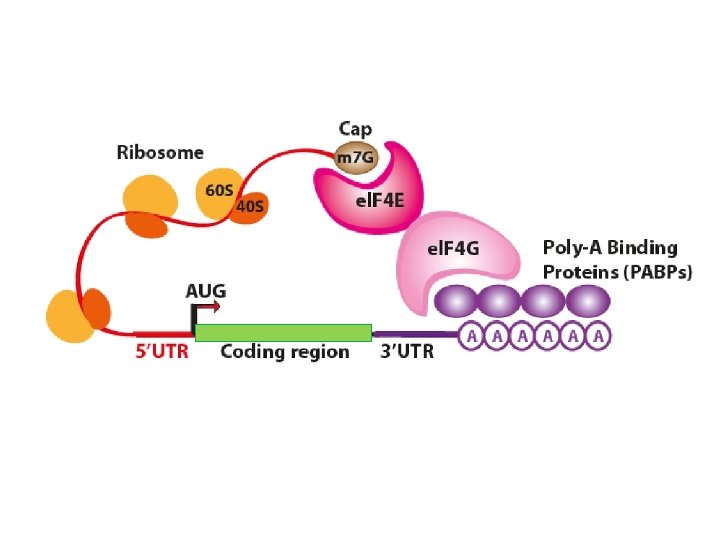
Costituenti principali dell’officina traduzionale: m. RNA La sequenza codificante (ORF) è solo una porzione del m. RNA - dal primo codone tradotto (AUG) al primo codone di stop (UAG, UGA, UAA). Le sequenze adiacenti quella codificante sono definite regioni non tradotte (UTR) 5’ e 3’
protein
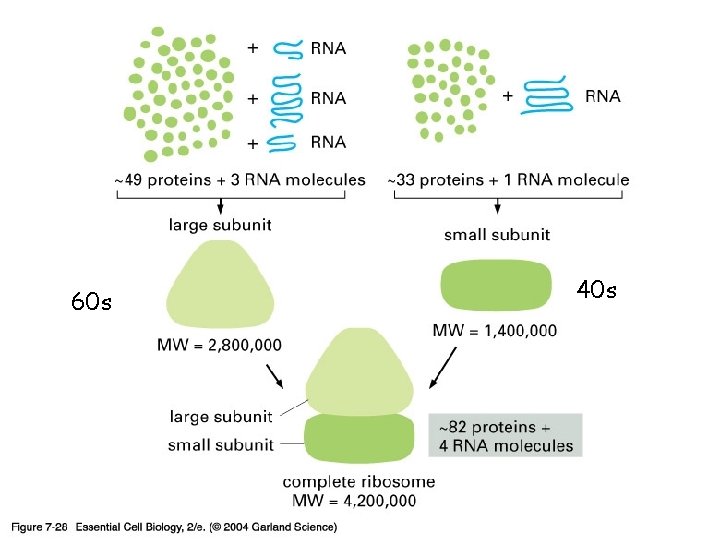
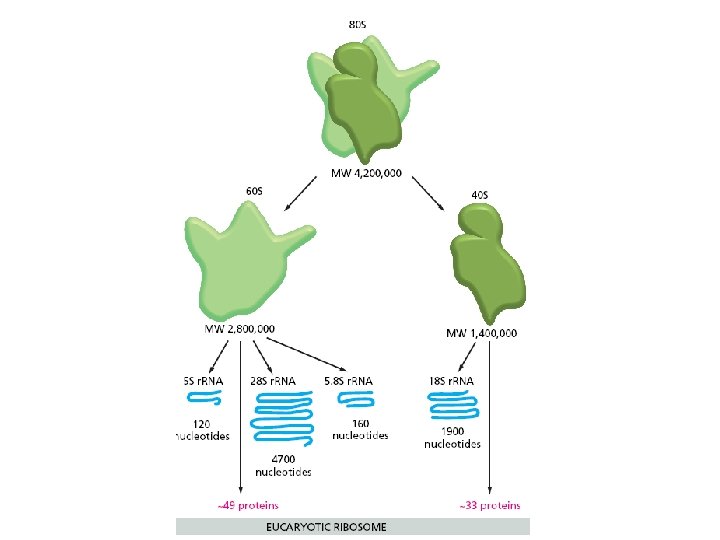
07_28_ribosome. jpg 60 s 40 s
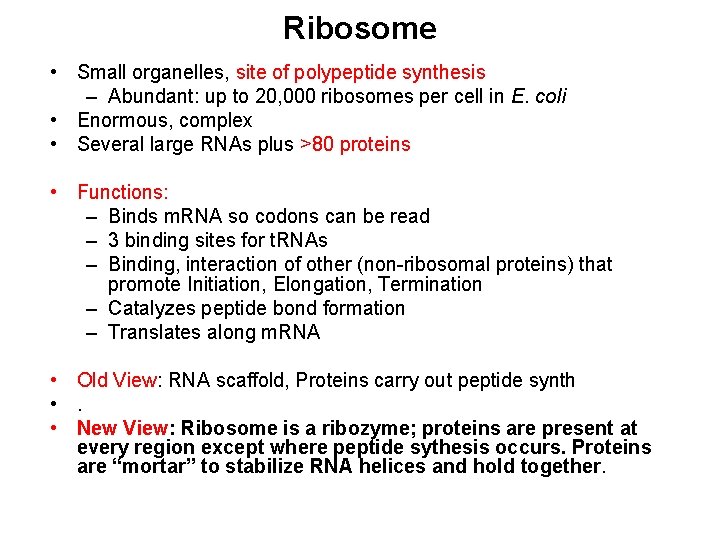
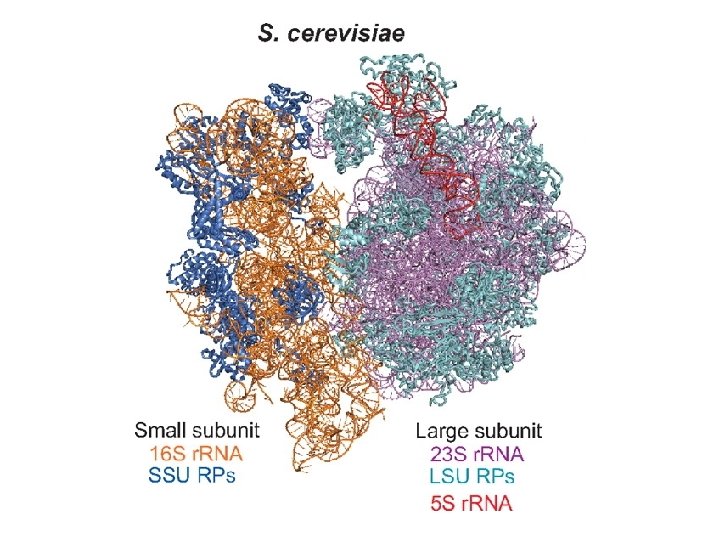
Ribosome • Small organelles, site of polypeptide synthesis – Abundant: up to 20, 000 ribosomes per cell in E. coli • Enormous, complex • Several large RNAs plus >80 proteins • Functions: – Binds m. RNA so codons can be read – 3 binding sites for t. RNAs – Binding, interaction of other (non-ribosomal proteins) that promote Initiation, Elongation, Termination – Catalyzes peptide bond formation – Translates along m. RNA • Old View: RNA scaffold, Proteins carry out peptide synth • . • New View: Ribosome is a ribozyme; proteins are present at every region except where peptide sythesis occurs. Proteins are “mortar” to stabilize RNA helices and hold together.
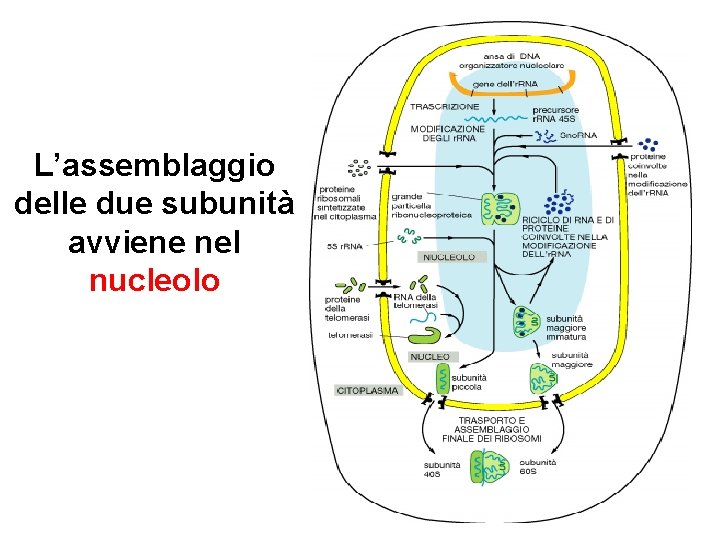
L’assemblaggio delle due subunità avviene nel nucleolo
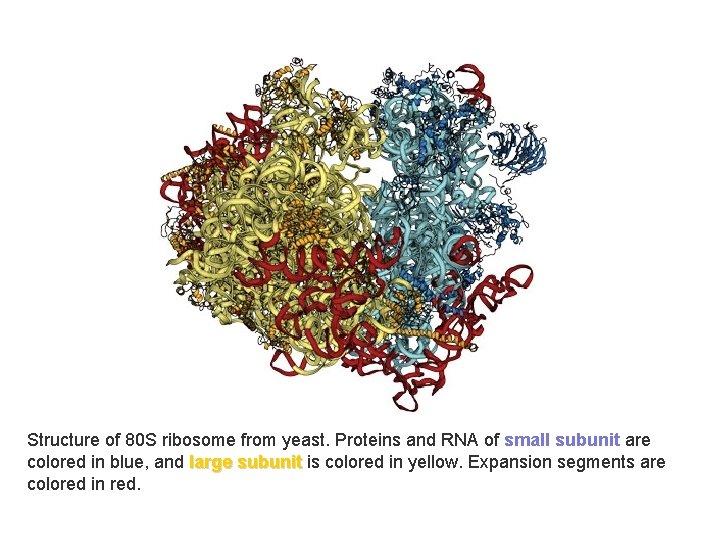
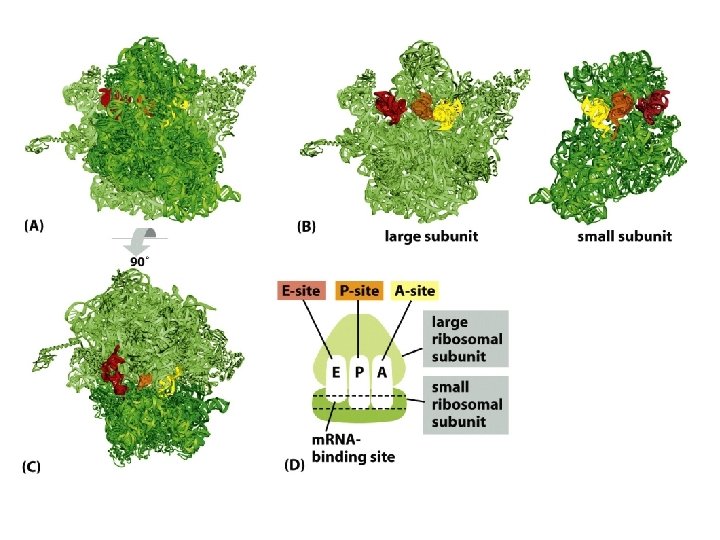
Structure of 80 S ribosome from yeast. Proteins and RNA of small subunit are colored in blue, and large subunit is colored in yellow. Expansion segments are colored in red.
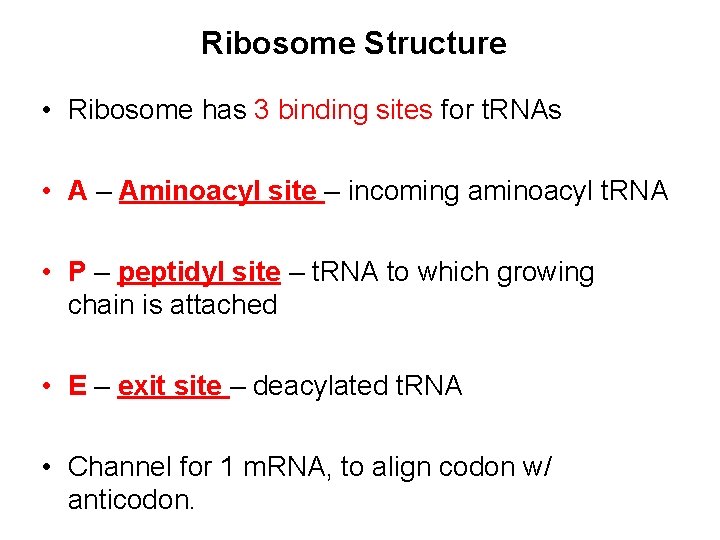
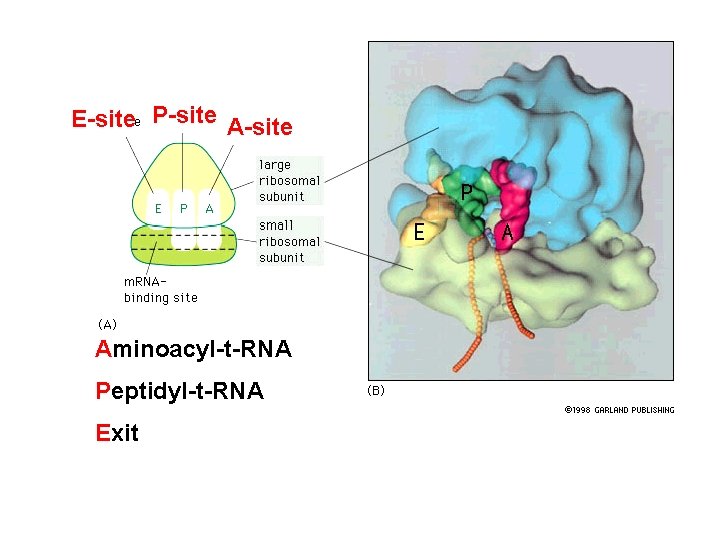
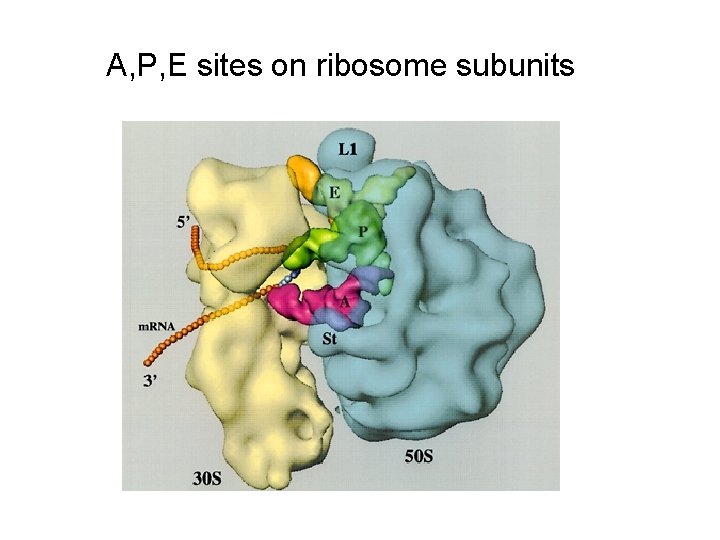
Ribosome Structure • Ribosome has 3 binding sites for t. RNAs • A – Aminoacyl site – incoming aminoacyl t. RNA • P – peptidyl site – t. RNA to which growing chain is attached • E – exit site – deacylated t. RNA • Channel for 1 m. RNA, to align codon w/ anticodon.
E-site P-site Aminoacyl-t-RNA Peptidyl-t-RNA Exit
A, P, E sites on ribosome subunits
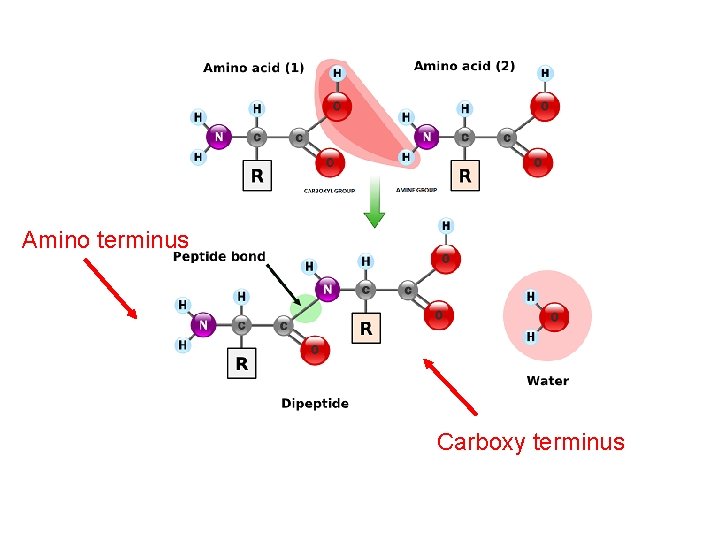
Amino terminus Carboxy terminus
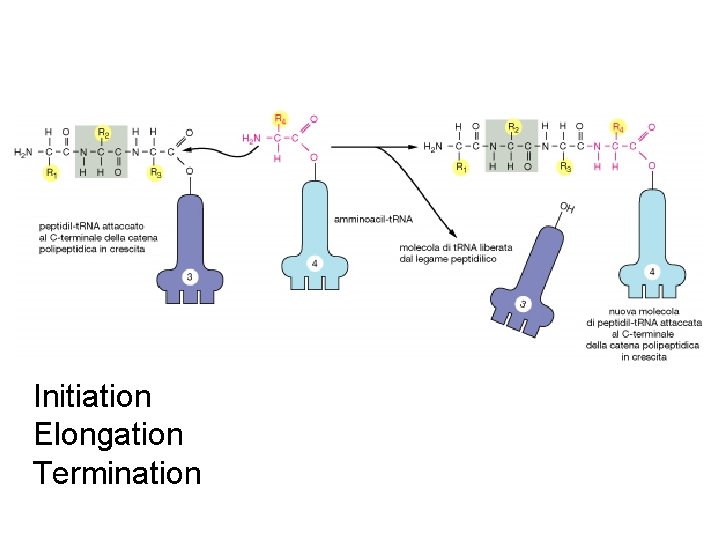
Initiation Elongation Termination
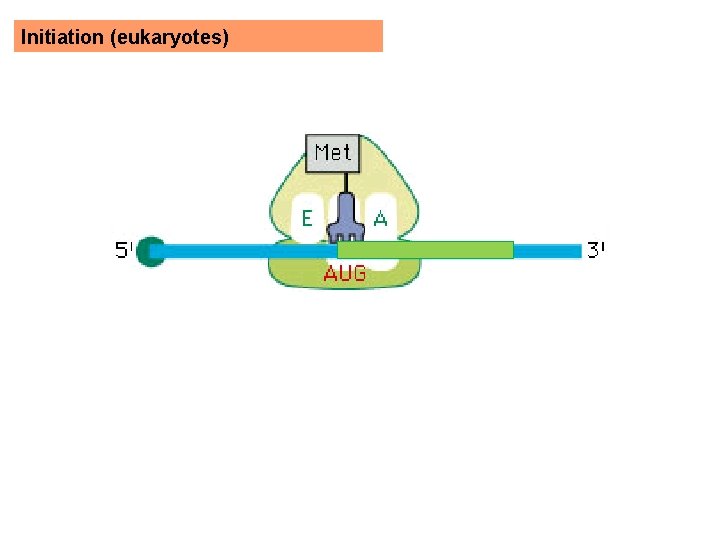
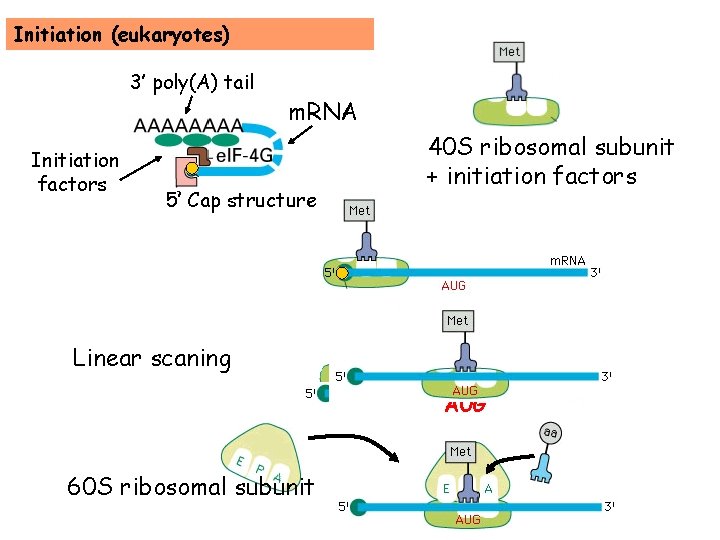
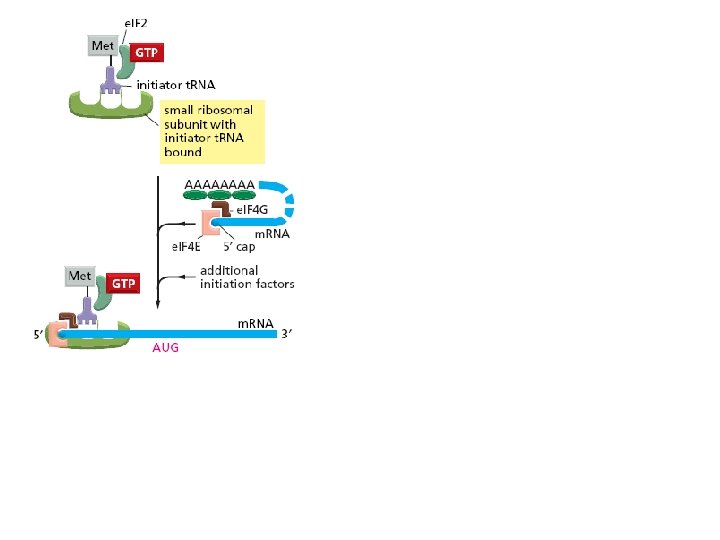
Initiation (eukaryotes)
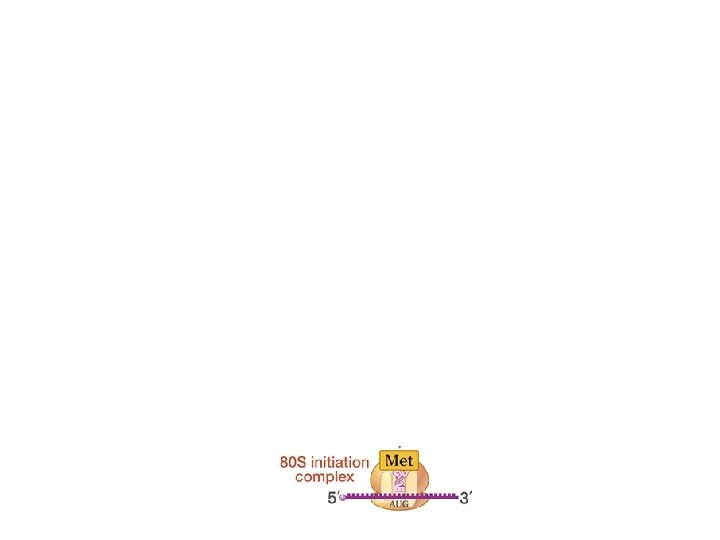
Initiation (eukaryotes) 3’ poly(A) tail Initiation factors m. RNA 5’ Cap structure 40 S ribosomal subunit + initiation factors Linear scaning AUG 60 S ribosomal subunit
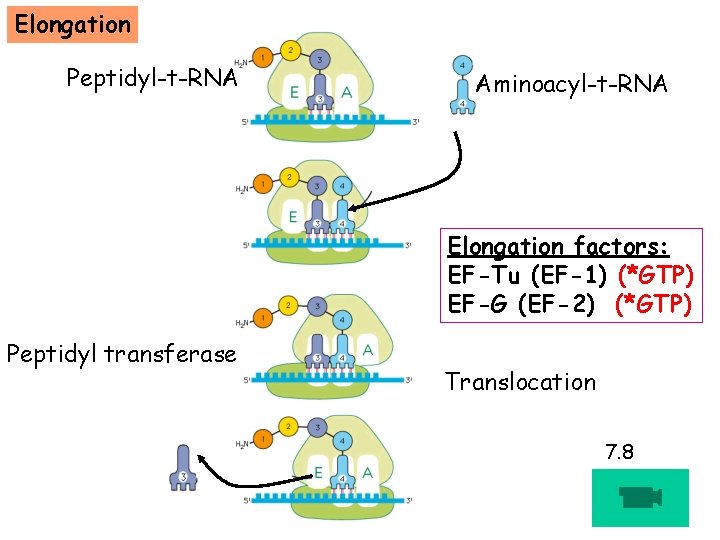
Elongation Peptidyl-t-RNA Aminoacyl-t-RNA Elongation factors: EF-Tu (EF-1) (*GTP) EF-G (EF-2) (*GTP) Peptidyl transferase Translocation 7. 8
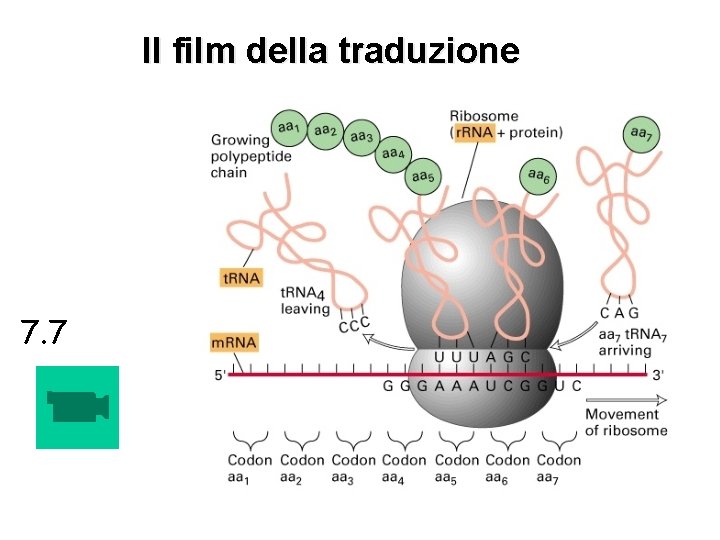
Il film della traduzione 7. 7
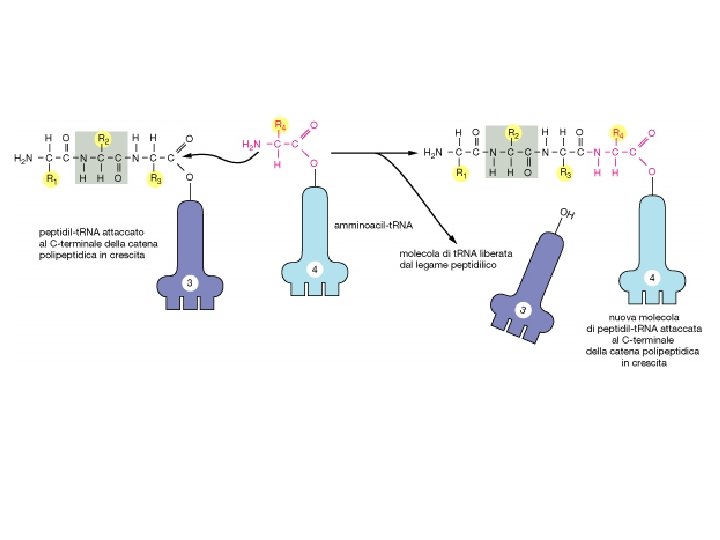
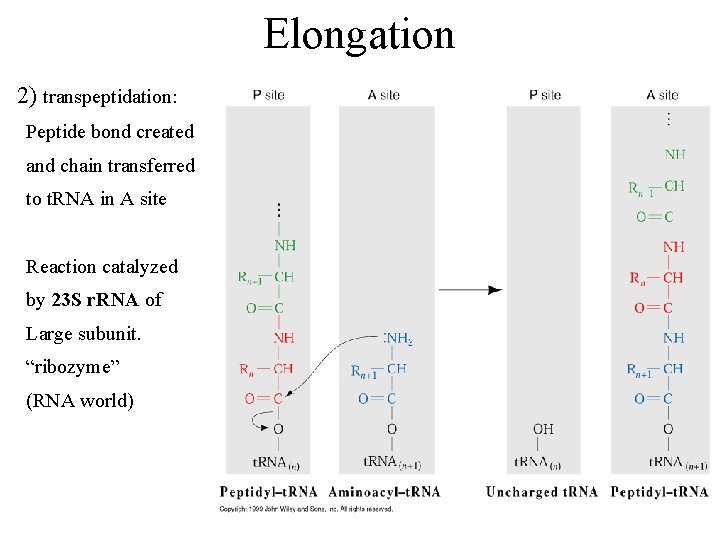
Elongation 2) transpeptidation: Peptide bond created and chain transferred to t. RNA in A site Reaction catalyzed by 23 S r. RNA of Large subunit. “ribozyme” (RNA world)
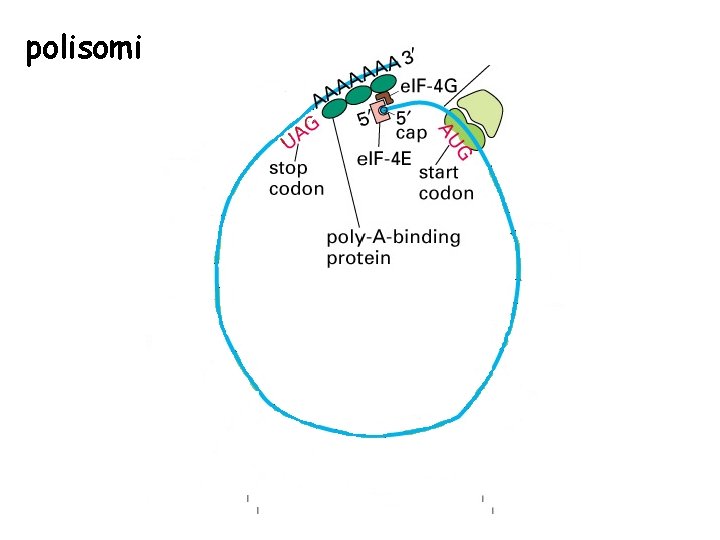
polisomi
polisomi
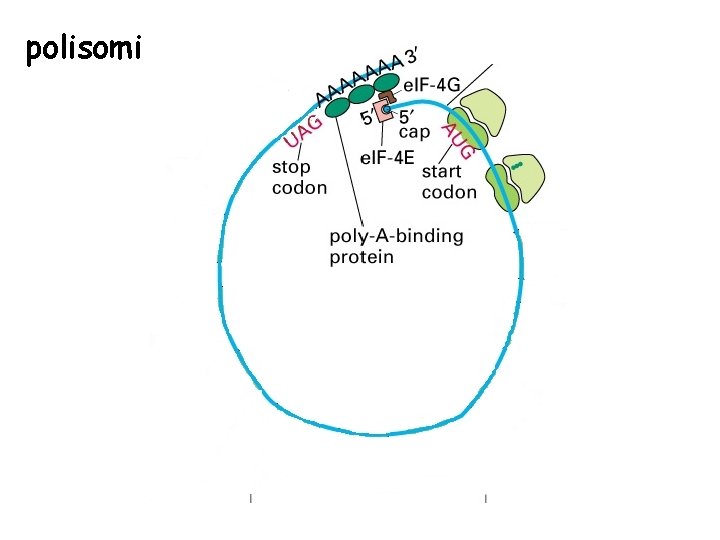
polisomi
polysomes
Polisomi-poliribosomi
Termination 07_34_stop codon. jpg Molecular mimicry
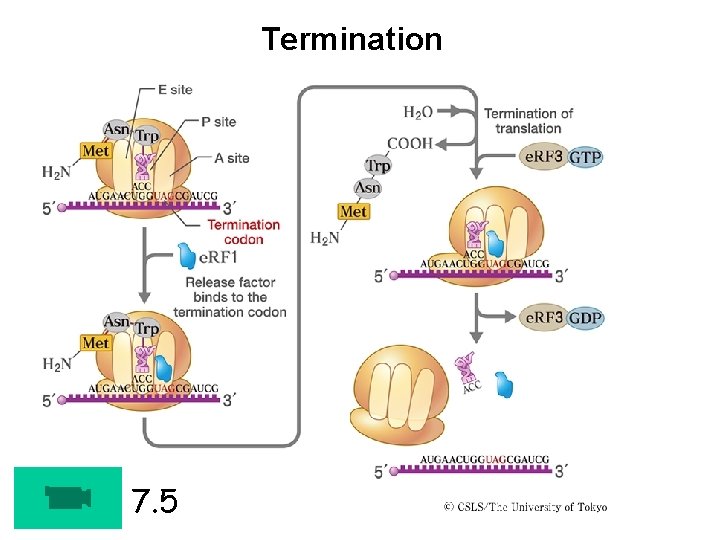
Termination 7. 5
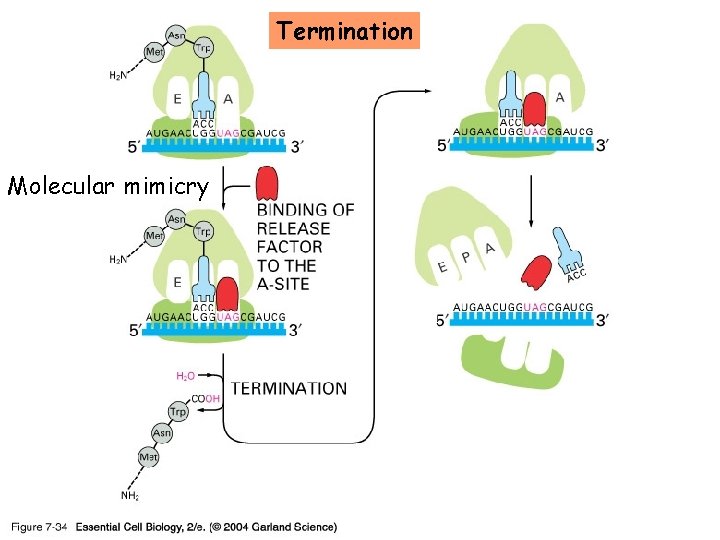
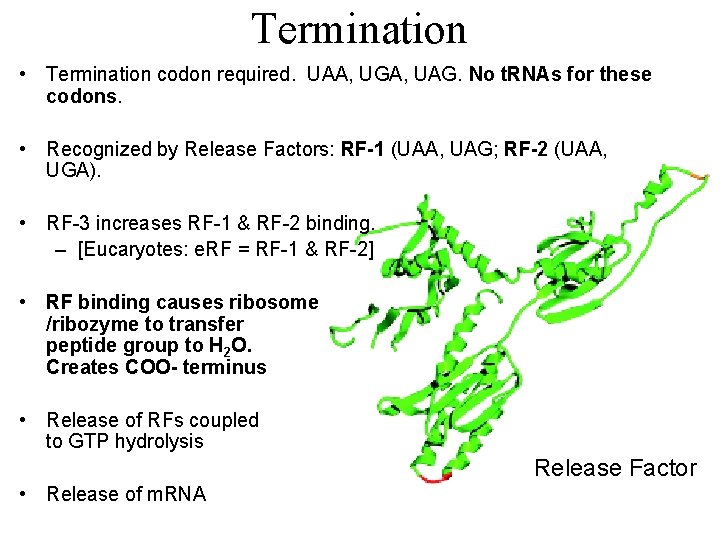
Termination • Termination codon required. UAA, UGA, UAG. No t. RNAs for these codons. • Recognized by Release Factors: RF-1 (UAA, UAG; RF-2 (UAA, UGA). • RF-3 increases RF-1 & RF-2 binding. – [Eucaryotes: e. RF = RF-1 & RF-2] • RF binding causes ribosome /ribozyme to transfer peptide group to H 2 O. Creates COO- terminus • Release of RFs coupled to GTP hydrolysis Release Factor • Release of m. RNA
Il destino di un m. RNA che raggiunge il citoplasma è di essere tradotto in proteina. Anche a questo livello più meccanismi partecipano alla regolazione dell’espressione genica.
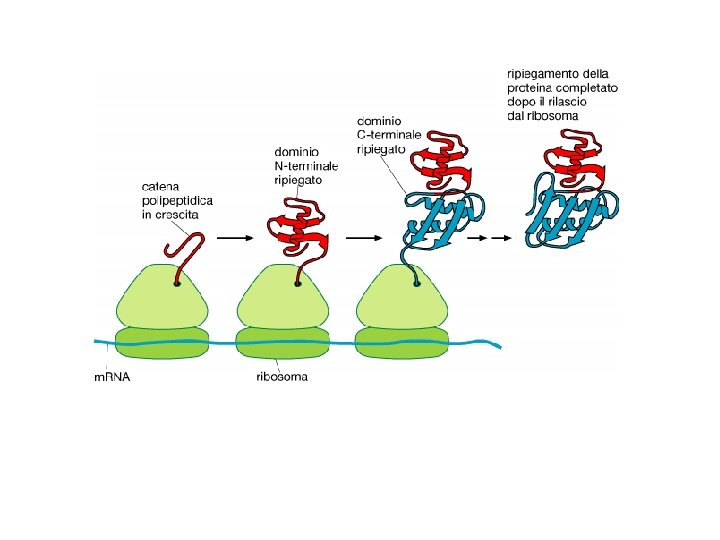
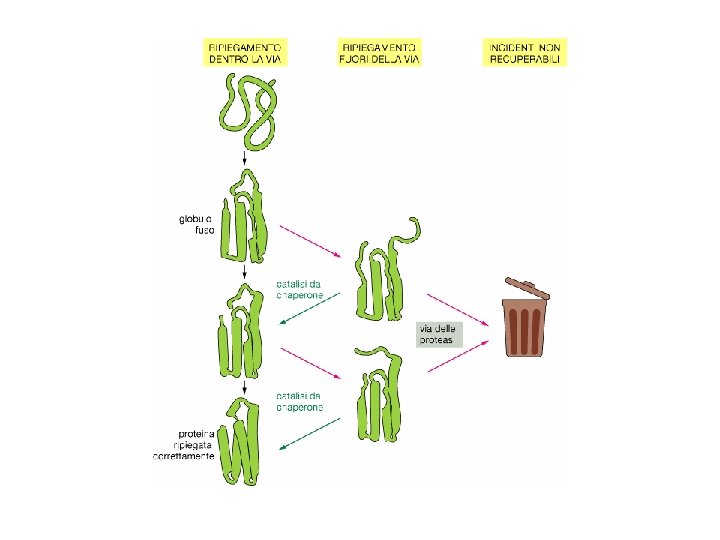
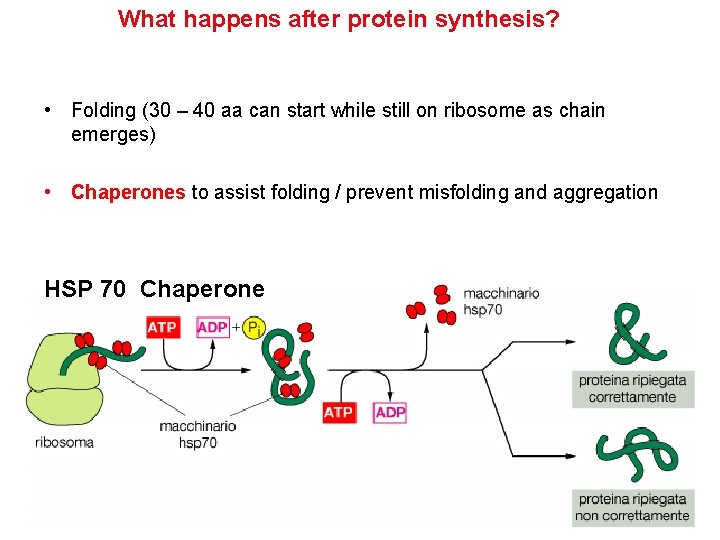
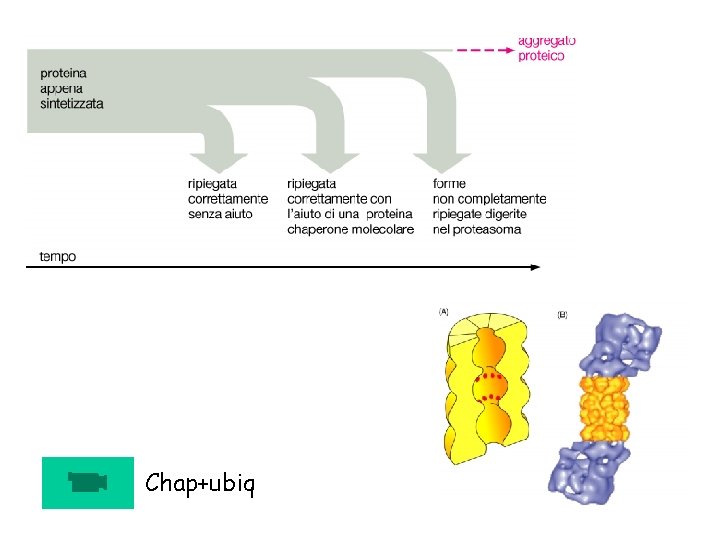
What happens after protein synthesis? • Folding (30 – 40 aa can start while still on ribosome as chain emerges) • Chaperones to assist folding / prevent misfolding and aggregation HSP 70 Chaperone
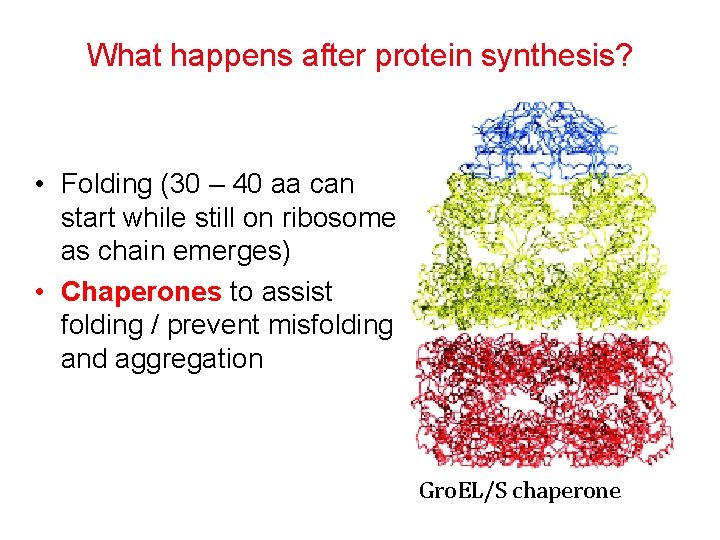
What happens after protein synthesis? • Folding (30 – 40 aa can start while still on ribosome as chain emerges) • Chaperones to assist folding / prevent misfolding and aggregation Gro. EL/S chaperone
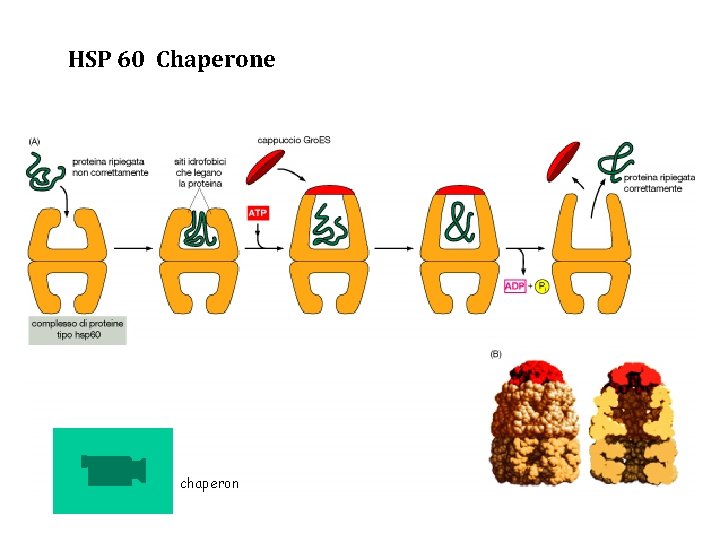
HSP 60 Chaperone chaperon
Chap+ubiq
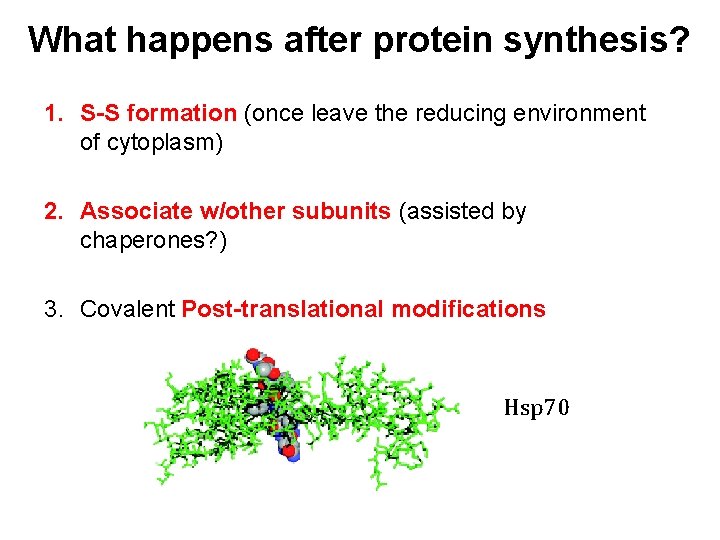
What happens after protein synthesis? 1. S-S formation (once leave the reducing environment of cytoplasm) 2. Associate w/other subunits (assisted by chaperones? ) 3. Covalent Post-translational modifications Hsp 70
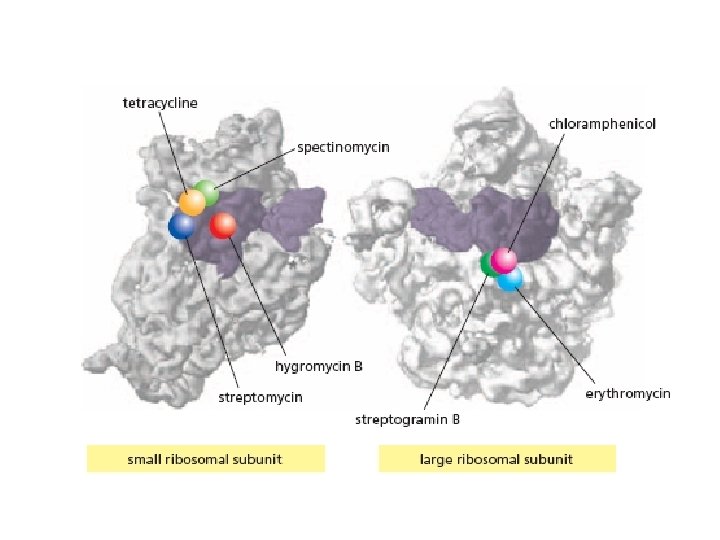
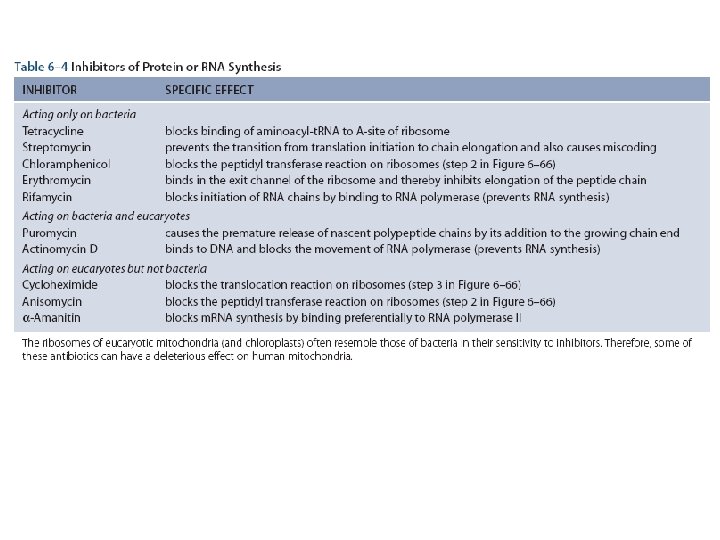
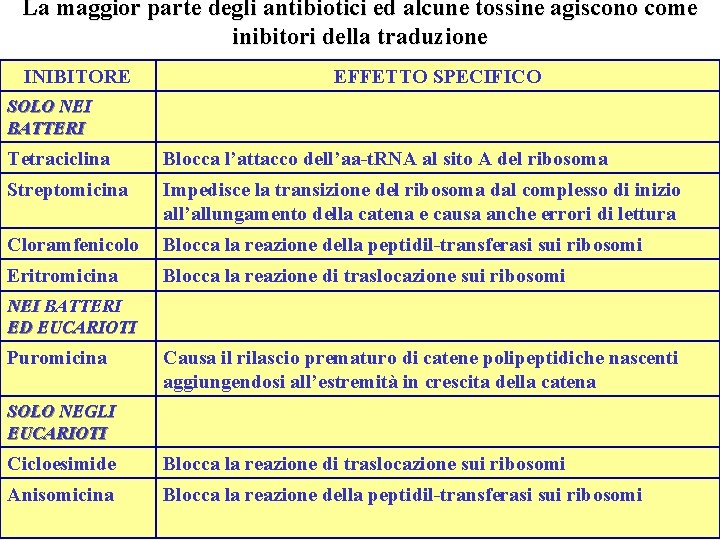
La maggior parte degli antibiotici ed alcune tossine agiscono come inibitori della traduzione INIBITORE EFFETTO SPECIFICO SOLO NEI BATTERI Tetraciclina Blocca l’attacco dell’aa-t. RNA al sito A del ribosoma Streptomicina Impedisce la transizione del ribosoma dal complesso di inizio all’allungamento della catena e causa anche errori di lettura Cloramfenicolo Blocca la reazione della peptidil-transferasi sui ribosomi Eritromicina Blocca la reazione di traslocazione sui ribosomi NEI BATTERI ED EUCARIOTI Puromicina Causa il rilascio prematuro di catene polipeptidiche nascenti aggiungendosi all’estremità in crescita della catena SOLO NEGLI EUCARIOTI Cicloesimide Blocca la reazione di traslocazione sui ribosomi Anisomicina Blocca la reazione della peptidil-transferasi sui ribosomi
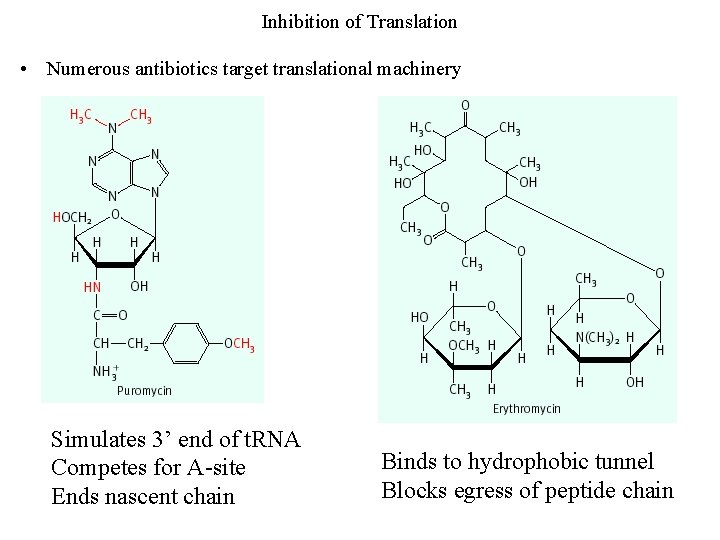
Inhibition of Translation • Numerous antibiotics target translational machinery Simulates 3’ end of t. RNA Competes for A-site Ends nascent chain Binds to hydrophobic tunnel Blocks egress of peptide chain
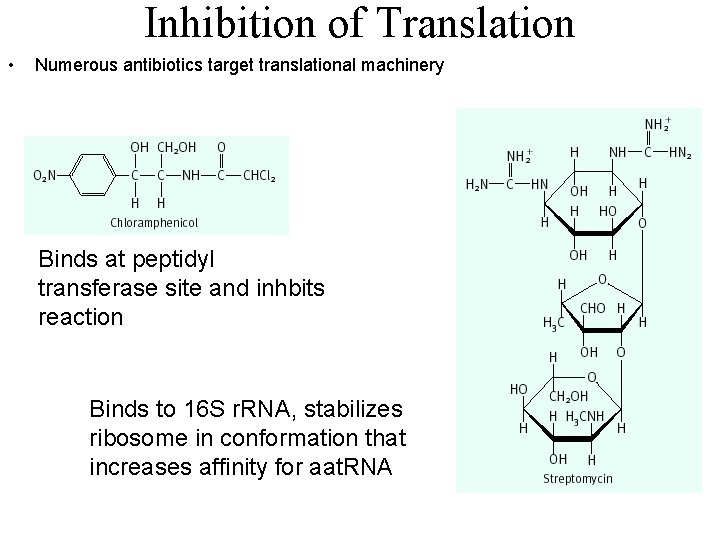
Inhibition of Translation • Numerous antibiotics target translational machinery Binds at peptidyl transferase site and inhbits reaction Binds to 16 S r. RNA, stabilizes ribosome in conformation that increases affinity for aat. RNA