
Genocide th in the 20 Century Pol Pot
- Slides: 15
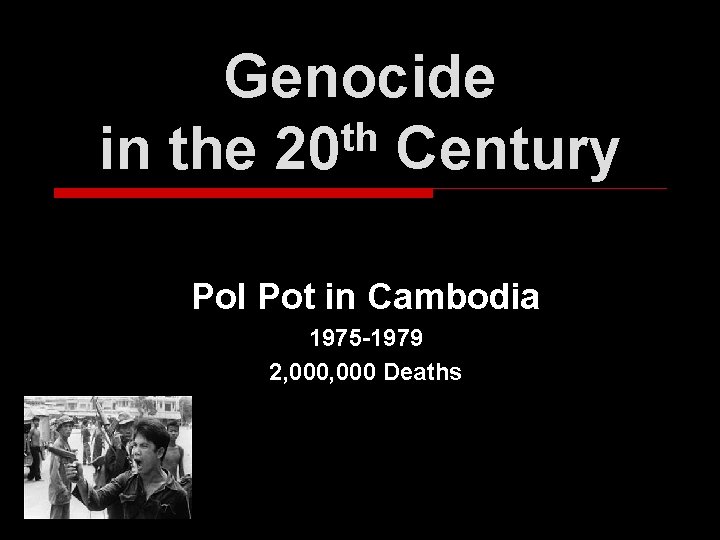
Genocide th in the 20 Century Pol Pot in Cambodia 1975 -1979 2, 000 Deaths
Table of Contents q q q q q Genocide Defined Pol Pot Khmer Rouge U. S. Involvement U. S. Withdraws Mao Zedong's Influence Cambodia Sealed Off Cambodia Enslaved Daily Life Wholesale Death o Pol Pot Deposed o Pol Pot Dies o End of Presentation 2
Genocide Defined o Genocide as defined by the United Nations in 1948, means any of the following acts committed with intent to destroy, in whole or in part, a national, ethnic, racial or religious group, including: 1. Killing members of the group. 2. Causing serious bodily or mental harm to members of the group. 3. Deliberately inflicting on the group conditions of life calculated to bring about its physical destruction in whole or in part. 4. Imposing measures intended to prevent births within the group. 5. Forcibly transferring children of the group to another group. 3
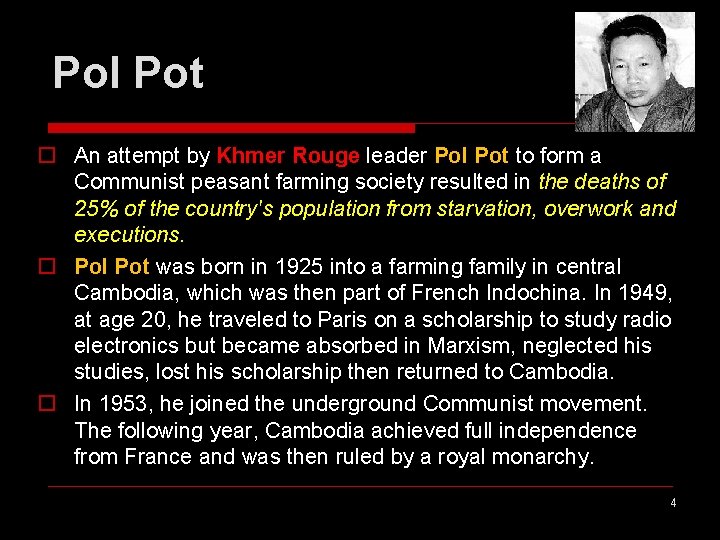
Pol Pot o An attempt by Khmer Rouge leader Pol Pot to form a Communist peasant farming society resulted in the deaths of 25% of the country's population from starvation, overwork and executions. o Pol Pot was born in 1925 into a farming family in central Cambodia, which was then part of French Indochina. In 1949, at age 20, he traveled to Paris on a scholarship to study radio electronics but became absorbed in Marxism, neglected his studies, lost his scholarship then returned to Cambodia. o In 1953, he joined the underground Communist movement. The following year, Cambodia achieved full independence from France and was then ruled by a royal monarchy. 4
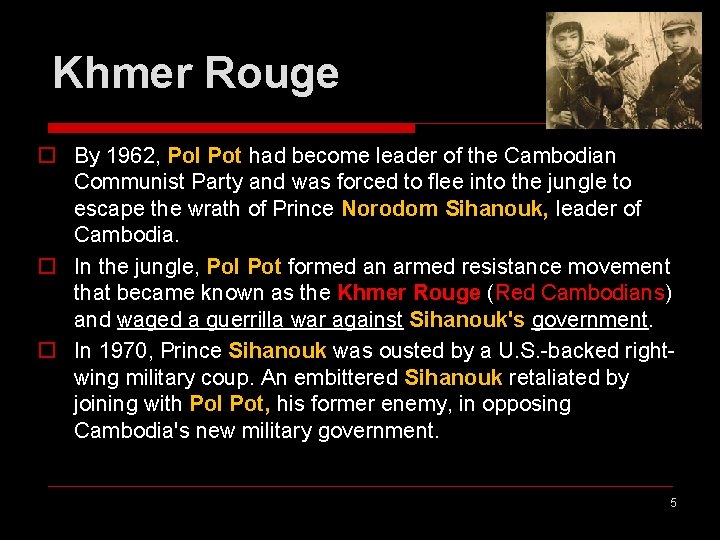
Khmer Rouge o By 1962, Pol Pot had become leader of the Cambodian Communist Party and was forced to flee into the jungle to escape the wrath of Prince Norodom Sihanouk, leader of Cambodia. o In the jungle, Pol Pot formed an armed resistance movement that became known as the Khmer Rouge (Red Cambodians) and waged a guerrilla war against Sihanouk's government. o In 1970, Prince Sihanouk was ousted by a U. S. -backed rightwing military coup. An embittered Sihanouk retaliated by joining with Pol Pot, his former enemy, in opposing Cambodia's new military government. 5
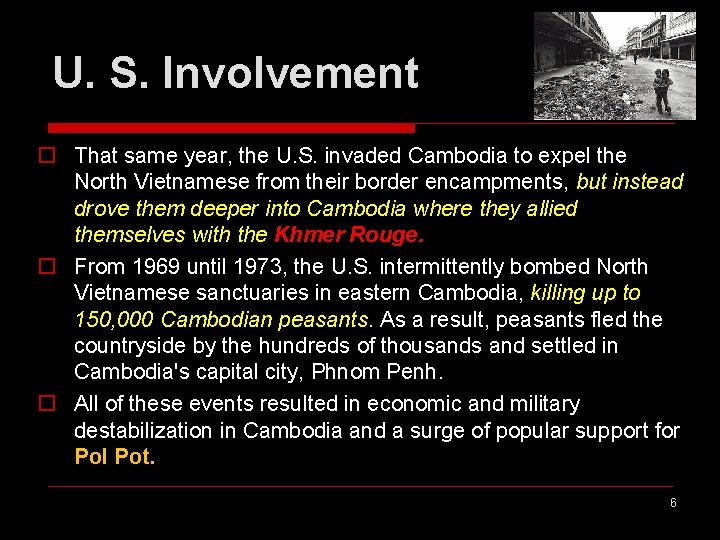
U. S. Involvement o That same year, the U. S. invaded Cambodia to expel the North Vietnamese from their border encampments, but instead drove them deeper into Cambodia where they allied themselves with the Khmer Rouge. o From 1969 until 1973, the U. S. intermittently bombed North Vietnamese sanctuaries in eastern Cambodia, killing up to 150, 000 Cambodian peasants. As a result, peasants fled the countryside by the hundreds of thousands and settled in Cambodia's capital city, Phnom Penh. o All of these events resulted in economic and military destabilization in Cambodia and a surge of popular support for Pol Pot. 6
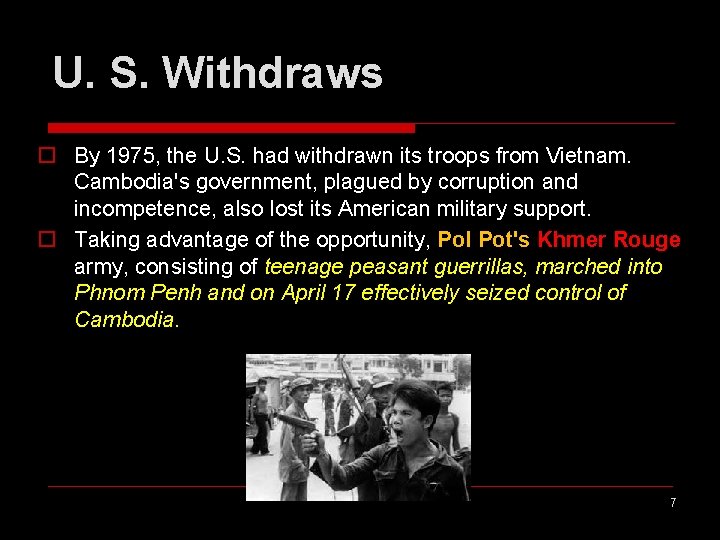
U. S. Withdraws o By 1975, the U. S. had withdrawn its troops from Vietnam. Cambodia's government, plagued by corruption and incompetence, also lost its American military support. o Taking advantage of the opportunity, Pol Pot's Khmer Rouge army, consisting of teenage peasant guerrillas, marched into Phnom Penh and on April 17 effectively seized control of Cambodia. 7
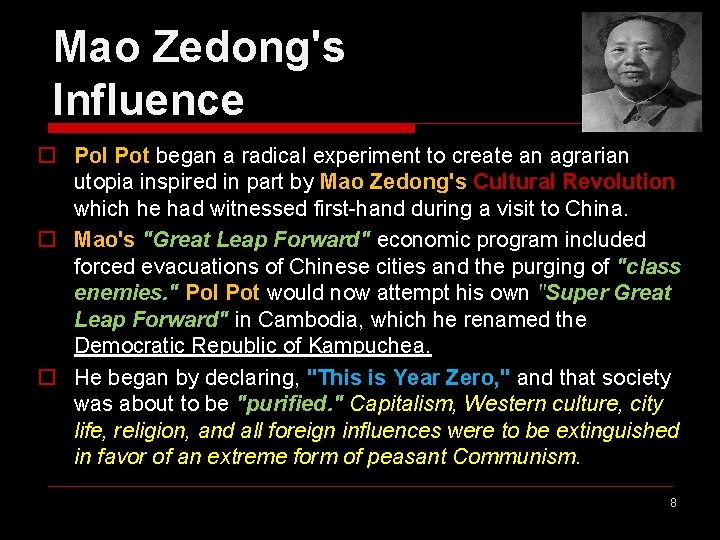
Mao Zedong's Influence o Pol Pot began a radical experiment to create an agrarian utopia inspired in part by Mao Zedong's Cultural Revolution which he had witnessed first-hand during a visit to China. o Mao's "Great Leap Forward" economic program included forced evacuations of Chinese cities and the purging of "class enemies. " Pol Pot would now attempt his own "Super Great Leap Forward" in Cambodia, which he renamed the Democratic Republic of Kampuchea. o He began by declaring, "This is Year Zero, " and that society was about to be "purified. " Capitalism, Western culture, city life, religion, and all foreign influences were to be extinguished in favor of an extreme form of peasant Communism. 8
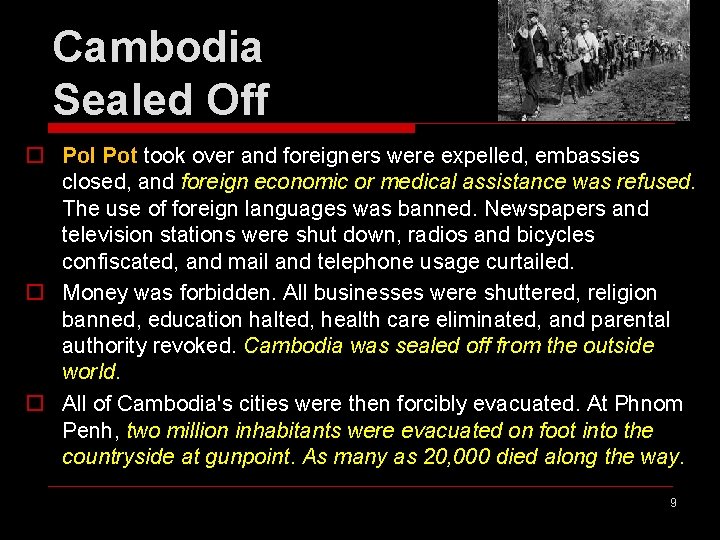
Cambodia Sealed Off o Pol Pot took over and foreigners were expelled, embassies closed, and foreign economic or medical assistance was refused. The use of foreign languages was banned. Newspapers and television stations were shut down, radios and bicycles confiscated, and mail and telephone usage curtailed. o Money was forbidden. All businesses were shuttered, religion banned, education halted, health care eliminated, and parental authority revoked. Cambodia was sealed off from the outside world. o All of Cambodia's cities were then forcibly evacuated. At Phnom Penh, two million inhabitants were evacuated on foot into the countryside at gunpoint. As many as 20, 000 died along the way. 9
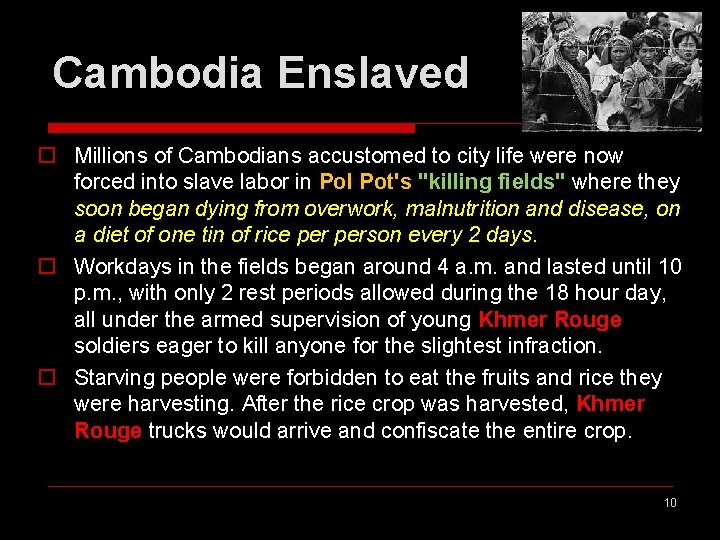
Cambodia Enslaved o Millions of Cambodians accustomed to city life were now forced into slave labor in Pol Pot's "killing fields" where they soon began dying from overwork, malnutrition and disease, on a diet of one tin of rice person every 2 days. o Workdays in the fields began around 4 a. m. and lasted until 10 p. m. , with only 2 rest periods allowed during the 18 hour day, all under the armed supervision of young Khmer Rouge soldiers eager to kill anyone for the slightest infraction. o Starving people were forbidden to eat the fruits and rice they were harvesting. After the rice crop was harvested, Khmer Rouge trucks would arrive and confiscate the entire crop. 10
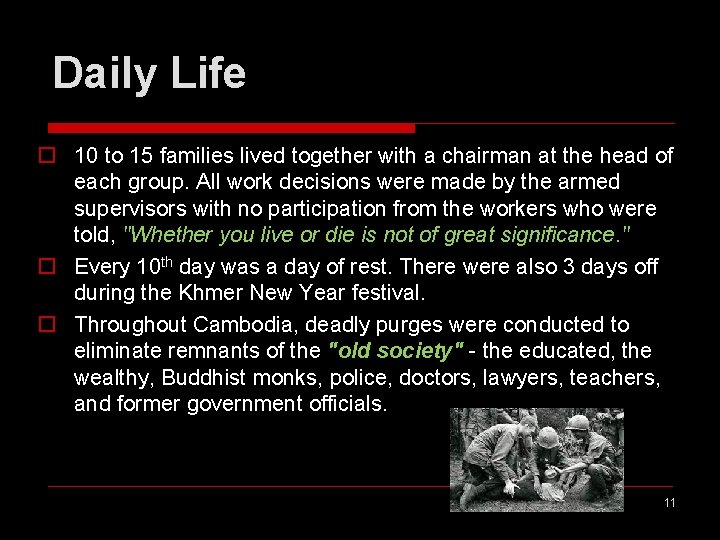
Daily Life o 10 to 15 families lived together with a chairman at the head of each group. All work decisions were made by the armed supervisors with no participation from the workers who were told, "Whether you live or die is not of great significance. " o Every 10 th day was a day of rest. There were also 3 days off during the Khmer New Year festival. o Throughout Cambodia, deadly purges were conducted to eliminate remnants of the "old society" - the educated, the wealthy, Buddhist monks, police, doctors, lawyers, teachers, and former government officials. 11
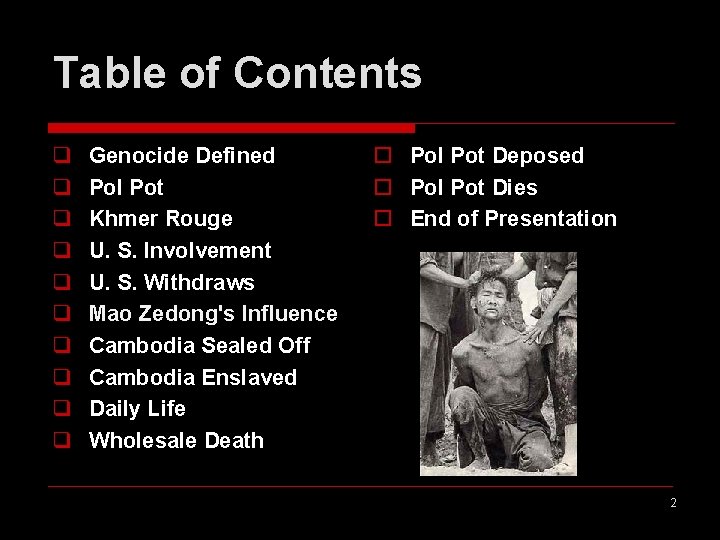
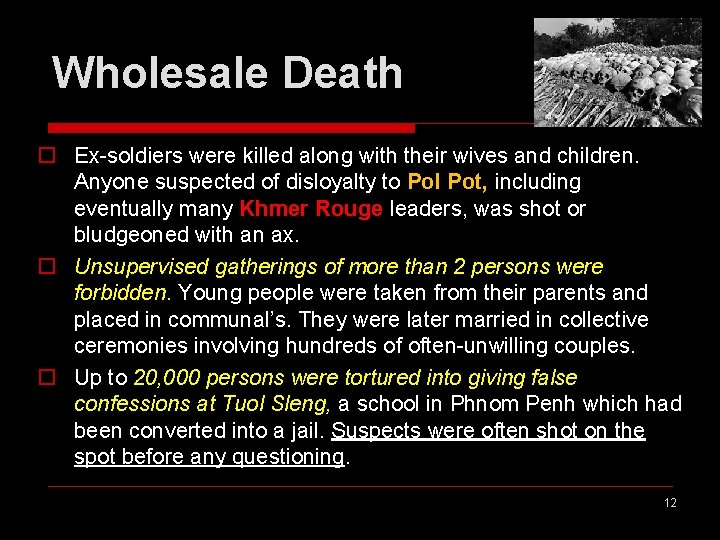
Wholesale Death o Ex-soldiers were killed along with their wives and children. Anyone suspected of disloyalty to Pol Pot, including eventually many Khmer Rouge leaders, was shot or bludgeoned with an ax. o Unsupervised gatherings of more than 2 persons were forbidden. Young people were taken from their parents and placed in communal’s. They were later married in collective ceremonies involving hundreds of often-unwilling couples. o Up to 20, 000 persons were tortured into giving false confessions at Tuol Sleng, a school in Phnom Penh which had been converted into a jail. Suspects were often shot on the spot before any questioning. 12
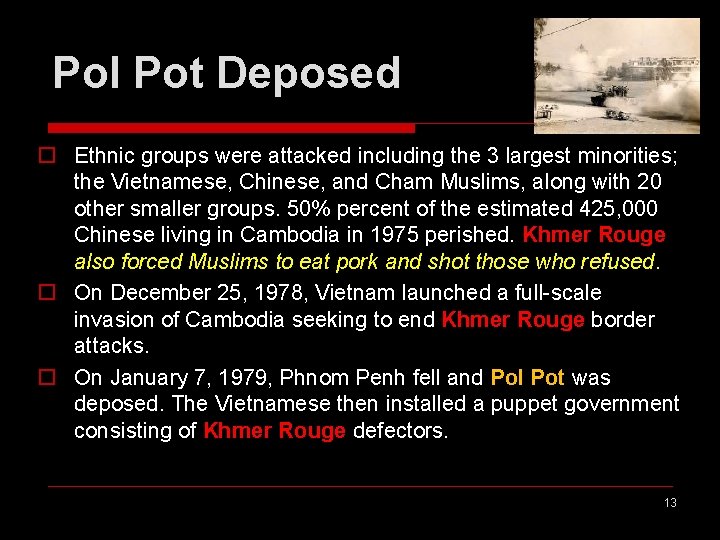
Pol Pot Deposed o Ethnic groups were attacked including the 3 largest minorities; the Vietnamese, Chinese, and Cham Muslims, along with 20 other smaller groups. 50% percent of the estimated 425, 000 Chinese living in Cambodia in 1975 perished. Khmer Rouge also forced Muslims to eat pork and shot those who refused. o On December 25, 1978, Vietnam launched a full-scale invasion of Cambodia seeking to end Khmer Rouge border attacks. o On January 7, 1979, Phnom Penh fell and Pol Pot was deposed. The Vietnamese then installed a puppet government consisting of Khmer Rouge defectors. 13
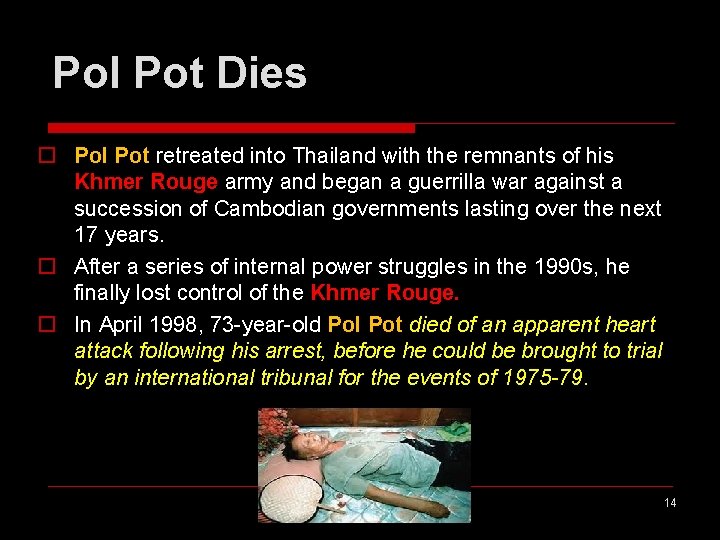
Pol Pot Dies o Pol Pot retreated into Thailand with the remnants of his Khmer Rouge army and began a guerrilla war against a succession of Cambodian governments lasting over the next 17 years. o After a series of internal power struggles in the 1990 s, he finally lost control of the Khmer Rouge. o In April 1998, 73 -year-old Pol Pot died of an apparent heart attack following his arrest, before he could be brought to trial by an international tribunal for the events of 1975 -79. 14
End of Presentation 15