
GENI Global Environment for Network Innovations Jennifer Rexford
GENI: Global Environment for Network Innovations Jennifer Rexford On behalf of Allison Mankin (NSF) 1
Is the Internet broken? • It is great at what it does. – Everyone should be proud of this. – All sorts of things can be built on top of it. • But… – Security is weak and not getting better. – Availability continues to be a challenge. – It is hard to manage and getting harder. – It does not handle mobility well. – A long list, once you start… 2
FIND: Future Internet Design • NSF research initiative – Requirements for global network of 10 -15 years out? – Re-conceive the network, if we could design from scratch? • Conceive the future, by letting go of the present: – This is not change for the sake of change – Rather, it is a chance to free our minds – Figuring out where to go, and then how to get there • Perhaps a header format is not the defining piece of a new architecture – Definition and placement of functionality – Not just data plane, but also control and management – And division between end hosts and the network 3
The Importance of Building • Systems-oriented computer science research needs to build and try out its ideas to be effective – Paper designs are just idle speculation – Simulation is only occasionally a substitute • We need: – Real implementation – Real experience – Real network conditions – Real users – To live in the future 4
GENI • Experimental facility – MREFC proposal to build a large-scale facility – Jointly from NSF’s CS directorate, & research community – We are currently at the “Conceptual Design” stage – Will eventually require Congressional approval • Global Environment for Network Innovations – Prototyping new architectures – Realistic evaluation – Controlled evaluation – Shared facility – Connecting to real users – Enabling new services See http: //www. geni. net 5
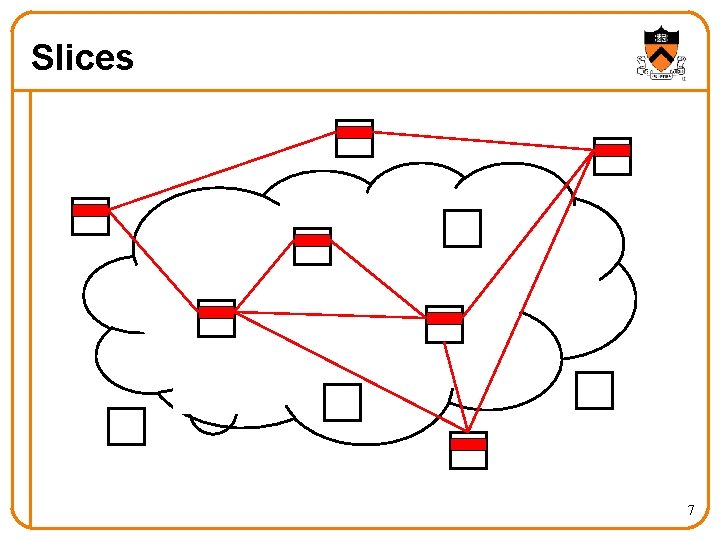
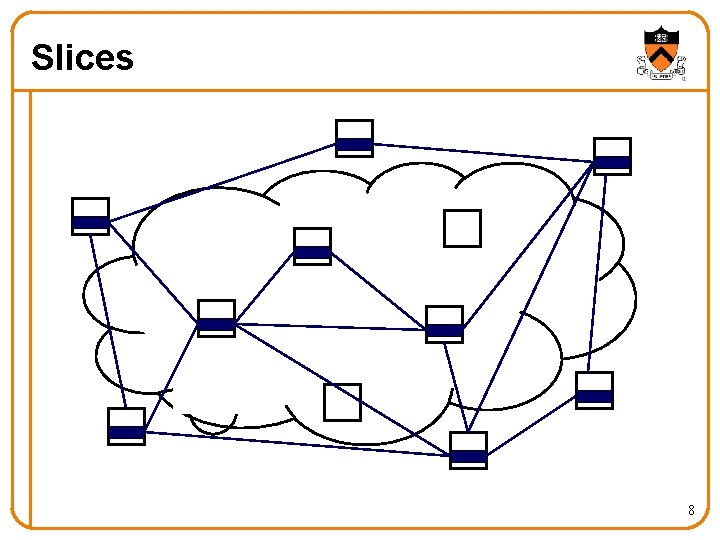
Three Key Ideas in GENI • Virtualization – Multiple architectures on a shared facility – Amortizes the cost of building the facility – Enables long-running experiments and services • Programmable – Enable prototyping and evaluation of new architectures – Enable a revisiting of today’s “layers” • Opt-in on a per-user / per-application basis – Attract real users • Demand drives deployment / adoption – Connect to the Internet • To reach users, and to connect to existing services 6
Slices 7
Slices 8
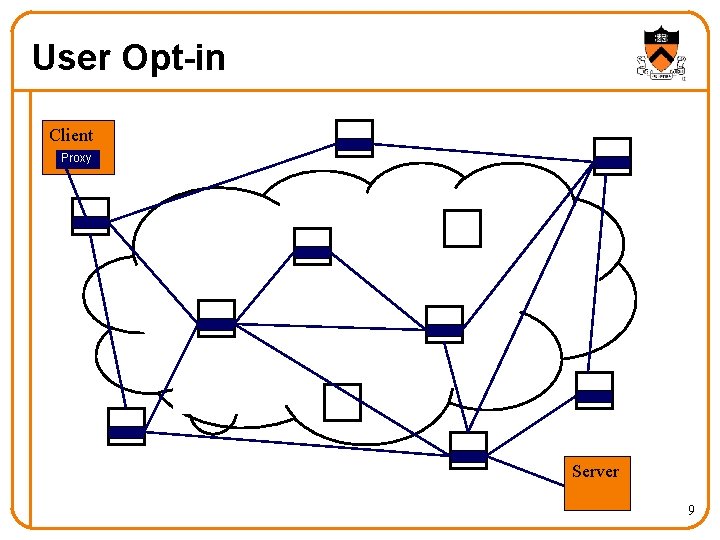
User Opt-in Client Proxy Server 9
Realizing the Ideas • Slices embedded in a substrate of resources – Physical network substrate • Expandable collection of building block components • Nodes / links / subnets – Software management framework • Knits building blocks together into a coherent facility • Embeds slices in the physical substrate • Builds on ideas in past systems – Planet. Lab, Emulab, ORBIT, X-Bone, … 10
Challenges in Realizing the Goals of GENI Jennifer Rexford Princeton University 11
What is the Goal of GENI? • Network architecture research – Revisit the definition and placement of function – For better security, scalability, manageability, … • Enable evaluation of network architectures – In a controlled and realistic fashion – With long-running deployment studies – With real user traffic, and real network conditions • Challenges – Using GENI effectively – Designing, building, and running GENI 12
Challenge #1: Theory and Systems • “Clean-slate” network architecture research – Creative ideas unconstrained by existing artifacts – A chance for theory to drive future architectures – … and to finally have a “science of design” for networks • Emphasis on deployment and experimentation – Evaluation of prototypes under realistic conditions – A chance for systems work to drive future architectures – … and to finally have a “tech transfer” path • Can we connect good theory with good systems? – Turning distributed algorithms into network protocols 13
Challenge #2: Revisiting the Layers • Today’s architecture is a collection of layers – Application, transport, network, link, … – Organizing principle for networking textbooks – Fragmentation of the research community • Revisiting the division of functionality is hard – Inherently a “cross-layer” research problem – Benefits from expertise across multiple layers • Can we, as researchers, cross the layer boundaries? – And create tools for decomposing a system, and analyzing the resulting complexity? 14
Example Research Questions • Traffic management – Today: congestion control (end hosts), routing protocols (routers), and traffic engineering (network operators) – Tomorrow: discovering the right division of labor • Scalable routing – Today: exciting theoretical results in compact routing – Tomorrow: turning those into network protocols • Mobile hosts – Today: network backbone ignores host mobility – Tomorrow: wired-network support for mobile hosts • Adversarial settings – Today: protocols based on trust in the participants – Tomorrow: protocols that are robust to greed and malice 15
These are Hard Problems • Interdisciplinary research is hard – Theory and systems – Crossing, and revisiting, the layers • But these issues are at the core of networking – We must grapple with them – Not just to “fix the Internet”, but also as scholars • To move networking from a problem domain to an intellectual discipline • To teach our students better • GENI is an enabler, but not a solution 16
Building Networks like GENI • Programmable virtual networks – A distributed, programmable experimental facility – Shared on a small timescale, carrying real user traffic • Theoretical challenges – Embedding a virtual topology in a shared substrate – Coordinating resource allocation across a federation • Platform for investigating the challenges – VINI: VIrtual Network Infrastructure – http: //www. cs. princeton. edu/~jrex/virtual. html • Maybe net virtualization is itself an architecture – No “One Architecture to Rule Them All”… 17
- Slides: 17