
Genetics Types of Inheritance Test Cross This is
- Slides: 12
Genetics – Types of Inheritance
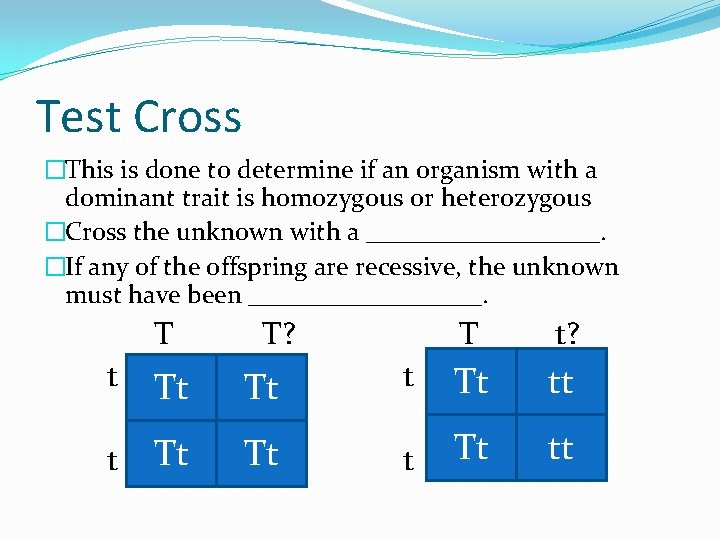
Test Cross �This is done to determine if an organism with a dominant trait is homozygous or heterozygous �Cross the unknown with a _________. �If any of the offspring are recessive, the unknown must have been _________. T T? T t? t Tt Tt t tt
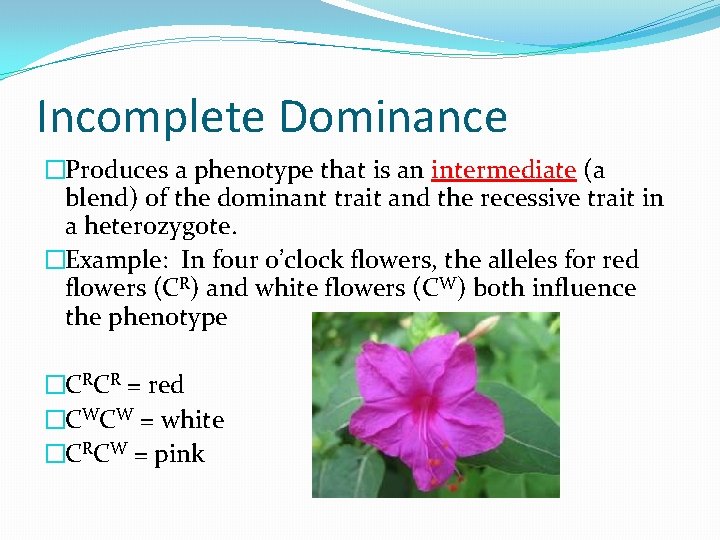
Incomplete Dominance �Produces a phenotype that is an intermediate (a blend) of the dominant trait and the recessive trait in a heterozygote. �Example: In four o’clock flowers, the alleles for red flowers (CR) and white flowers (CW) both influence the phenotype �CRCR = red �CWCW = white �CRCW = pink
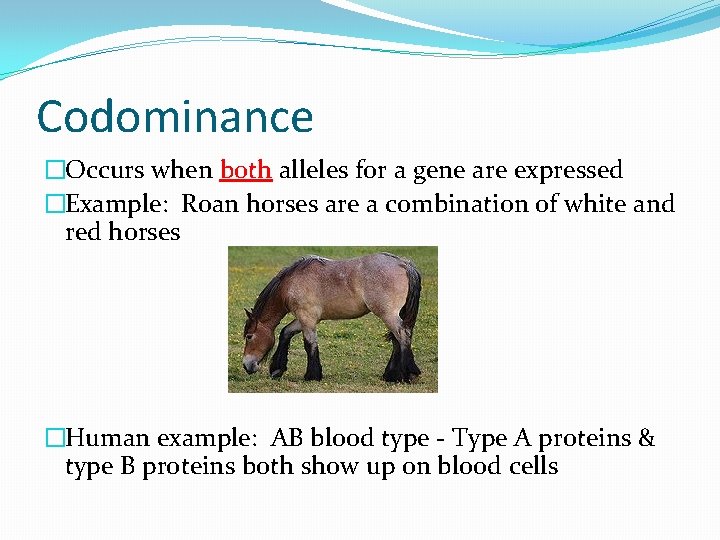
Codominance �Occurs when both alleles for a gene are expressed �Example: Roan horses are a combination of white and red horses �Human example: AB blood type - Type A proteins & type B proteins both show up on blood cells
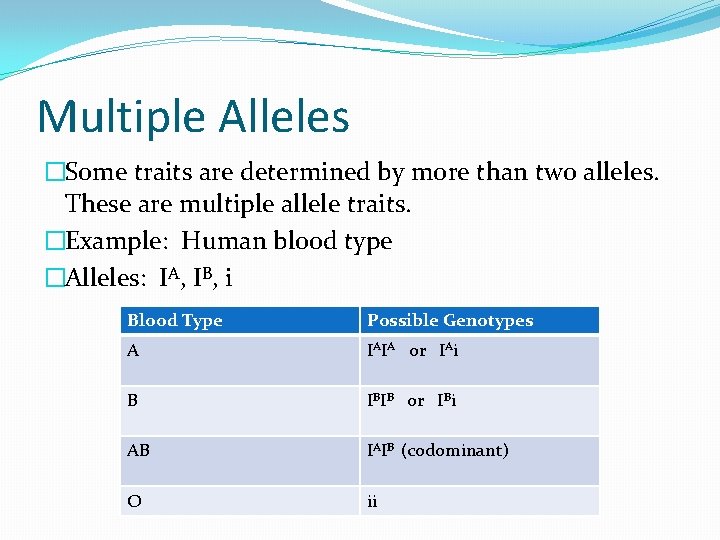
Multiple Alleles �Some traits are determined by more than two alleles. These are multiple allele traits. �Example: Human blood type �Alleles: IA, IB, i Blood Type Possible Genotypes A IAIA or IAi B IBIB or IBi AB IAIB (codominant) O ii
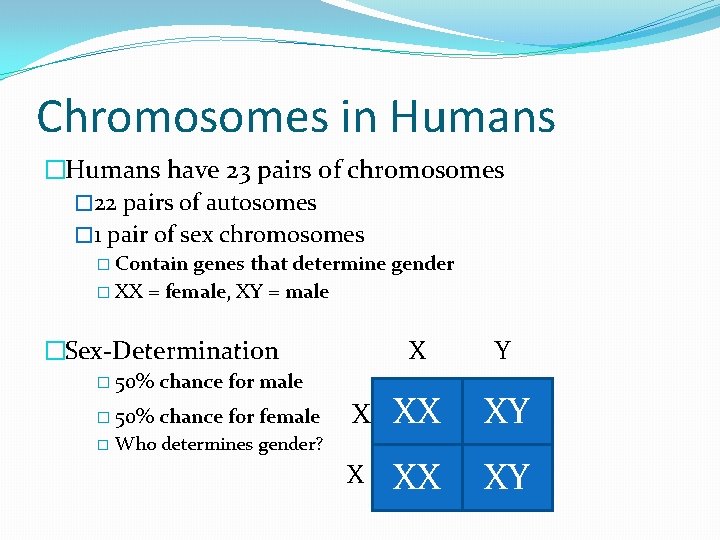
Chromosomes in Humans �Humans have 23 pairs of chromosomes � 22 pairs of autosomes � 1 pair of sex chromosomes � Contain genes that determine gender � XX = female, XY = male �Sex-Determination � 50% chance for male � 50% chance for female � X Y X XX XY Who determines gender?
Sex Chromosomes �Genes located on the X chromosome are X-linked genes. �Genes located on the Y chromosome are Y-linked genes. �Sex-linked traits are coded for by an allele on a sex chromosome. �More on X chromosome because it’s larger �Because males only have one X chromosome, if they carry a recessive allele on the X chromosome, they exhibit the trait. �Examples: color-blindness, hemophilia
Mutations �Germ-cell mutations occur in gametes �Affect offspring only �Somatic-cell mutations occur in body cells �Affect the organism only, not inherited �Lethal mutations cause death, often before birth �Some mutations are beneficial and give an organism an evolutionary advantage.
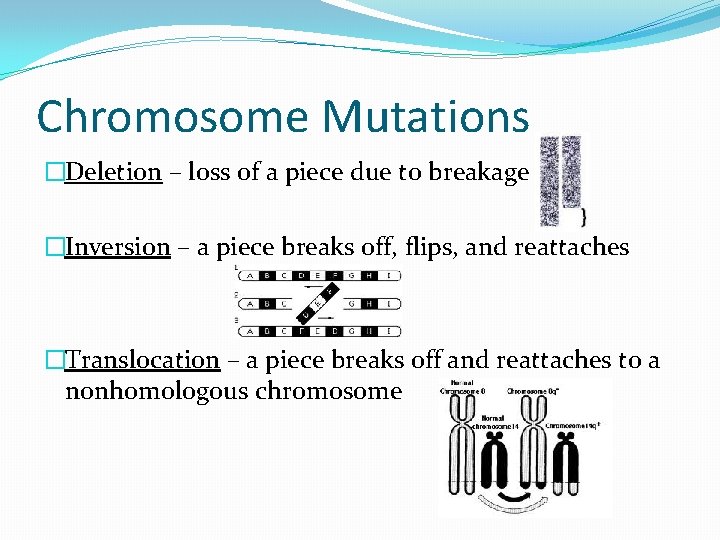
Chromosome Mutations �Deletion – loss of a piece due to breakage �Inversion – a piece breaks off, flips, and reattaches �Translocation – a piece breaks off and reattaches to a nonhomologous chromosome
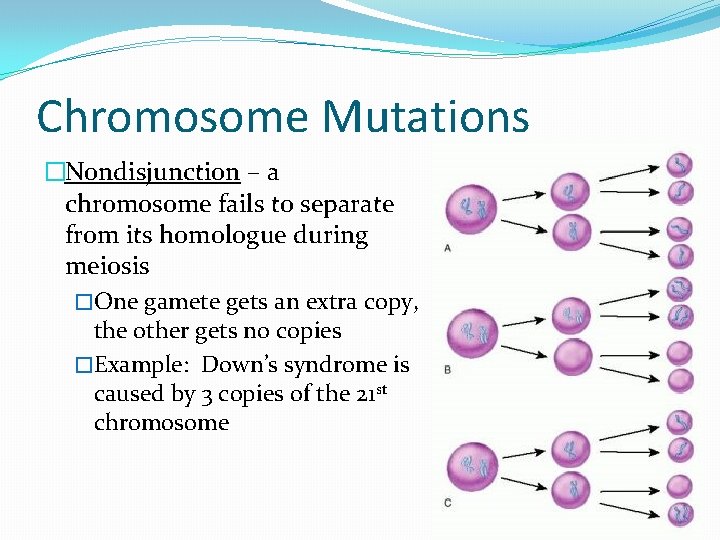
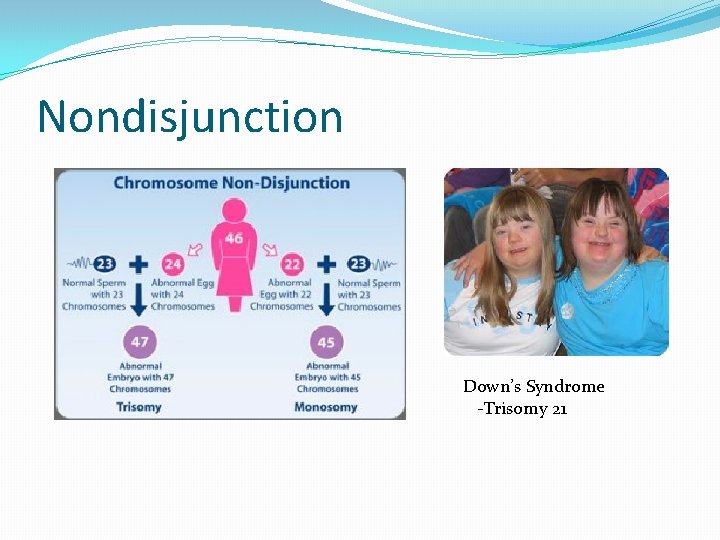
Chromosome Mutations �Nondisjunction – a chromosome fails to separate from its homologue during meiosis �One gamete gets an extra copy, the other gets no copies �Example: Down’s syndrome is caused by 3 copies of the 21 st chromosome
Nondisjunction Down’s Syndrome -Trisomy 21
Gene Mutations �Point Mutation – A mutation in a single nucleotide �Substitution – one nucleotide changed for another �C = A instead of C = G �Frameshift Mutation – Results when all of the codons are changed due to an addition or deletion of a nucleotide �Addition – one nucleotide added �Deletion – one nucleotide removed