
Genetics The field of Biology that studies how
Genetics The field of Biology that studies how characteristics are transferred from parent to offspring. Also called Heredity, the study of how one generation is similar to the previous generation
Cell Division • Cell division is a constant process in all living species. • There are two types of cell division: – Mitosis: The division of somatic (diploid) or body cells – Meiosis: The creation of gametes (haploid) or reproductive cells: sperm in males and ovum (plural ova) or egg in the females
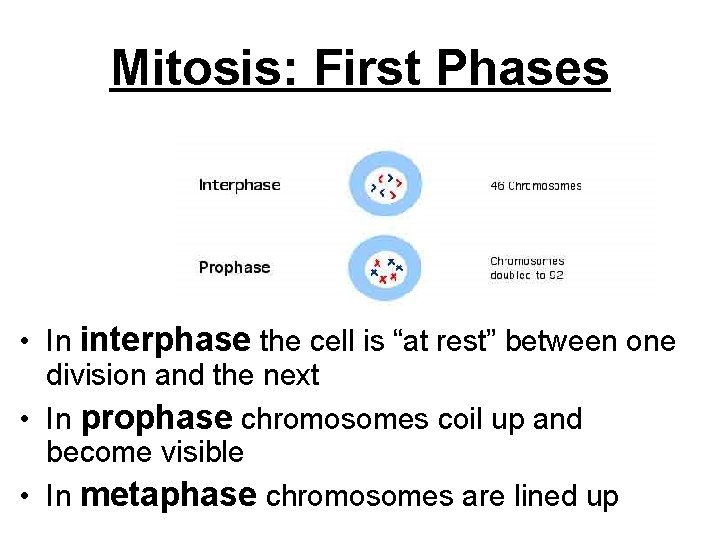
Mitosis: First Phases • In interphase the cell is “at rest” between one division and the next • In prophase chromosomes coil up and become visible • In metaphase chromosomes are lined up
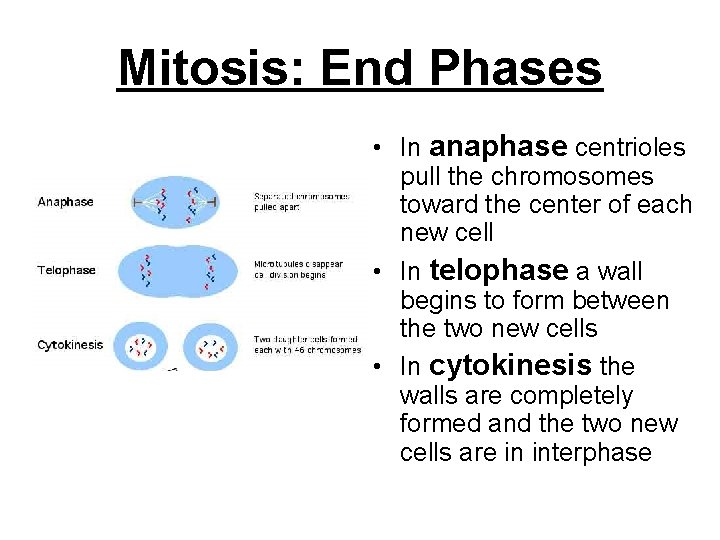
Mitosis: End Phases • In anaphase centrioles pull the chromosomes toward the center of each new cell • In telophase a wall begins to form between the two new cells • In cytokinesis the walls are completely formed and the two new cells are in interphase

Genetic Facts and Fallacies True or False? ? 1. Certain acquired characteristics, such as mechanical or mathematical skill, may be inherited. 2. Identical twins are always the same sex. 3. Fraternal twins are more closely related to each other than to other children in a family. 4. The father determines the sex of a child. 5. Each parent contributes half of a child’s genetic makeup. 6. Certain thoughts or experiences of a mother may mark of alter the hereditary makeup of an unborn child. 7. Color blindness is more common in males than in females. 8. A person may transmit (pass to someone else) traits through a blood transfusion. 9. Identical twins are more closely related to each other than to other children in a family.

Genetic Facts and Fallacies True / False cont. 10. Males are biologically stronger than females. 11. The tendency to produce twins may run in families. 12. A craving for a food such as strawberries may cause a birthmark on an unborn child. 13. Many of a person’s inherited traits are not apparent (visible by eyesight). 14. The parent with the stronger will contributes more to a child’s inheritance than the other parent. 15. If a person loses a limb in an accident, it is likely that he or she will have a child with a missing limb. 16. The attitude of parents toward each other influences the emotional makeup of an unborn child. 17. Children born to older parents usually lack the vitality of those born to younger parents.

Gregor Johann Mendel: Early Life • Born in 1822 to a farming family in Austria • Often portrayed as a lucky, observant monk
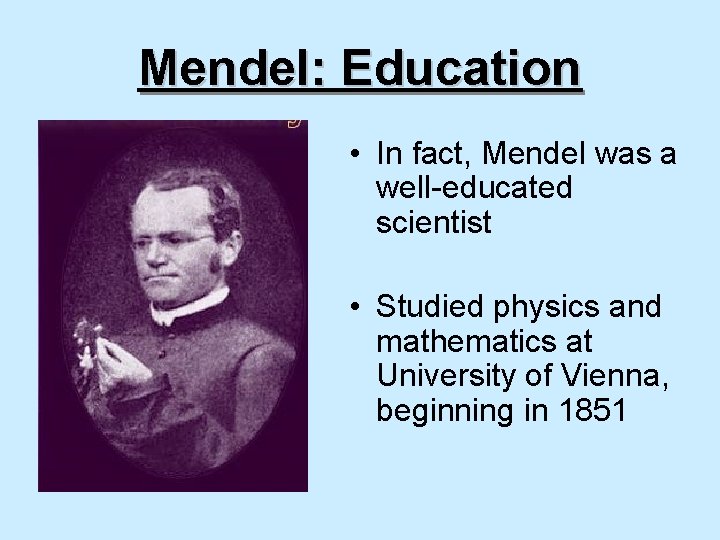
Mendel: Education • In fact, Mendel was a well-educated scientist • Studied physics and mathematics at University of Vienna, beginning in 1851
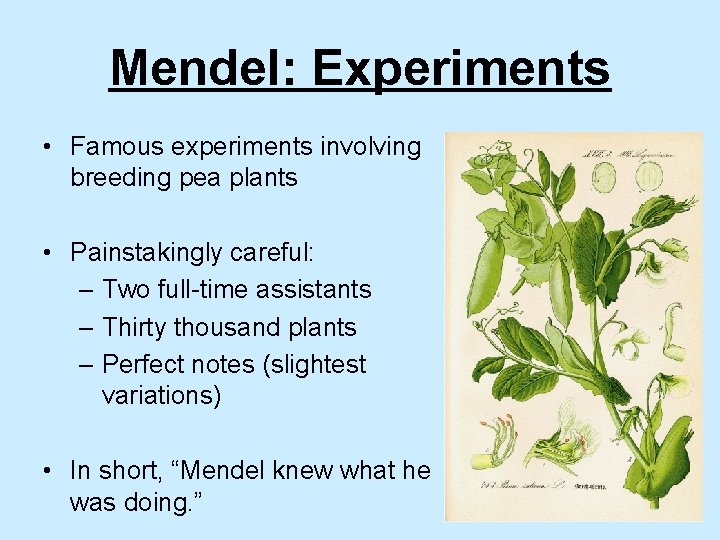
Mendel: Experiments • Famous experiments involving breeding pea plants • Painstakingly careful: – Two full-time assistants – Thirty thousand plants – Perfect notes (slightest variations) • In short, “Mendel knew what he was doing. ”
Mendel: Legacy • Often called “Father of Genetics” • NEVER used the word “gene”. Instead used the word “factors” • Found two factors within each seed that could be used to predict patterns in inheritance in offspring

Pea Plants • Mendel observed seven characteristics. • Each occurred in two contrasting traits.
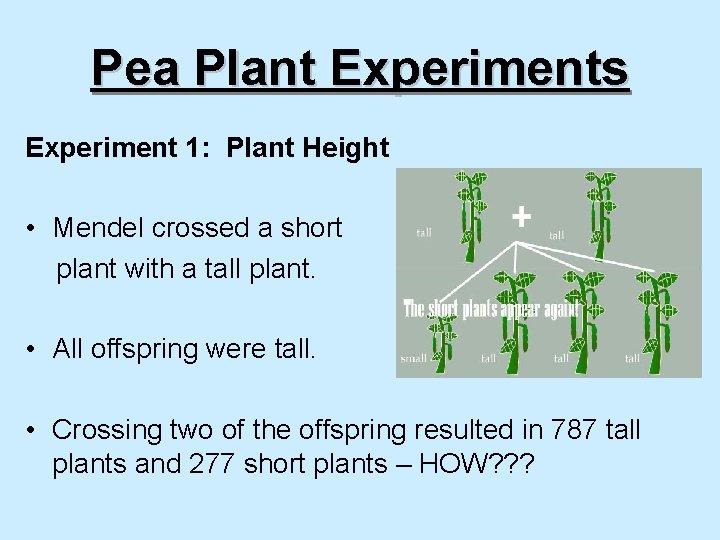
Pea Plant Experiments Experiment 1: Plant Height • Mendel crossed a short plant with a tall plant. • All offspring were tall. • Crossing two of the offspring resulted in 787 tall plants and 277 short plants – HOW? ? ?

Pea Plant Experiments Experiment 2: Seed Color • Mendel crossed a yellow-seed plant with a greenseed plant. • All offspring had yellow seeds. • Crossing two of the offspring resulted in 6, 022 yellow-seed plants and 2001 green-seed plants – HOW? ? ?
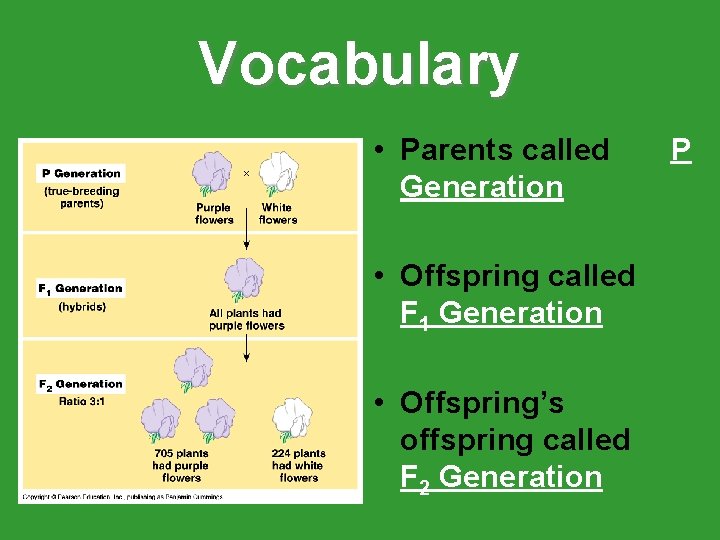
Vocabulary • Parents called Generation • Offspring called F 1 Generation • Offspring’s offspring called F 2 Generation P
Mendel’s Conclusions • Some FACTOR within the pea plants controlled what trait appeared in the offspring • Because the traits he studied had two alternate forms, he hypothesized that each plant had a PAIR of factors
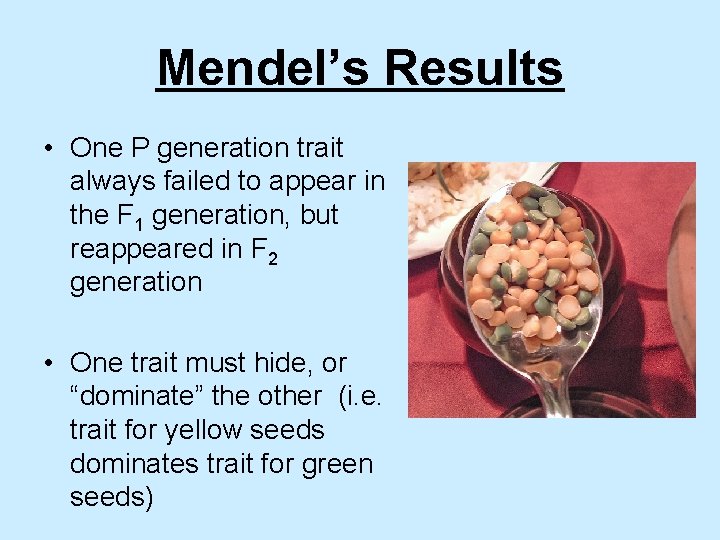
Mendel’s Results • One P generation trait always failed to appear in the F 1 generation, but reappeared in F 2 generation • One trait must hide, or “dominate” the other (i. e. trait for yellow seeds dominates trait for green seeds)
Mendel’s Laws • Law of Dominance: Some “factors” dominate or cover-up others • Law of Segregation: Each parent only passes on one of its two factors for each trait to the next generation • Law of Independent Assortment: Each trait is independent of all others (exp. If pea plants were round this did not affect its flower color)
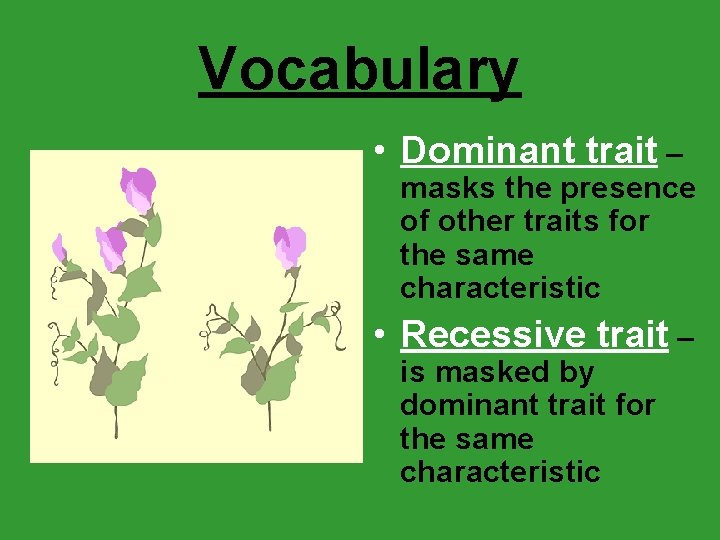
Vocabulary • Dominant trait – masks the presence of other traits for the same characteristic • Recessive trait – is masked by dominant trait for the same characteristic
Probability • Difference between the words possible and probable • Possible = it can happen (although it may or may not be likely) • Probable = how likely is it that it will happen / what are the chances or odds • Probability only makes predictions
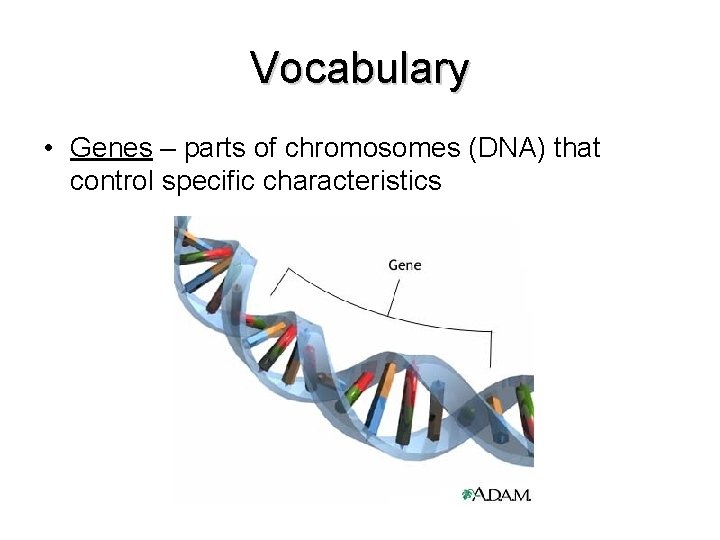
Vocabulary • Genes – parts of chromosomes (DNA) that control specific characteristics
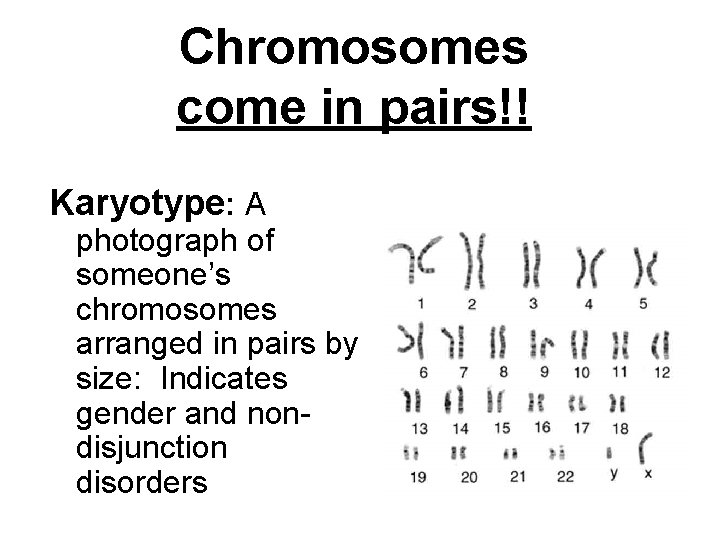
Chromosomes come in pairs!! Karyotype: A photograph of someone’s chromosomes arranged in pairs by size: Indicates gender and nondisjunction disorders
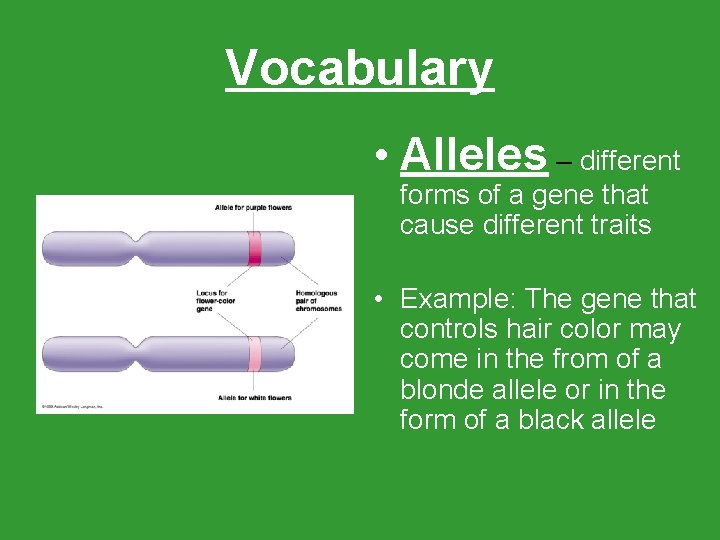
Vocabulary • Alleles – different forms of a gene that cause different traits • Example: The gene that controls hair color may come in the from of a blonde allele or in the form of a black allele
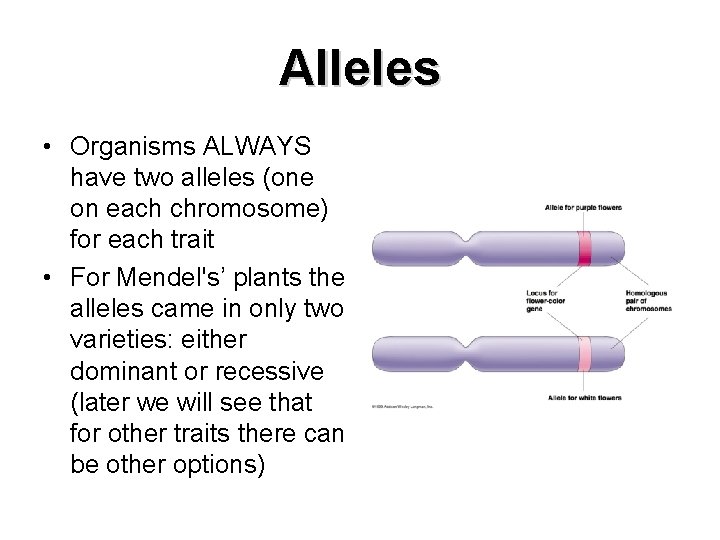
Alleles • Organisms ALWAYS have two alleles (one on each chromosome) for each trait • For Mendel's’ plants the alleles came in only two varieties: either dominant or recessive (later we will see that for other traits there can be other options)
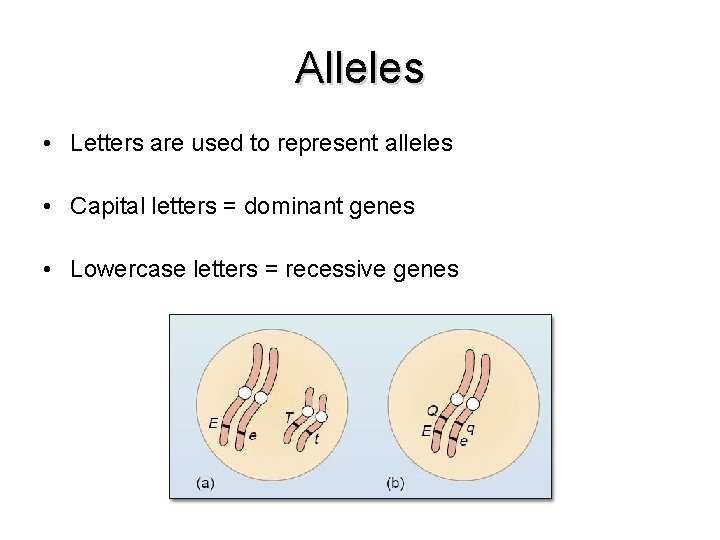
Alleles • Letters are used to represent alleles • Capital letters = dominant genes • Lowercase letters = recessive genes
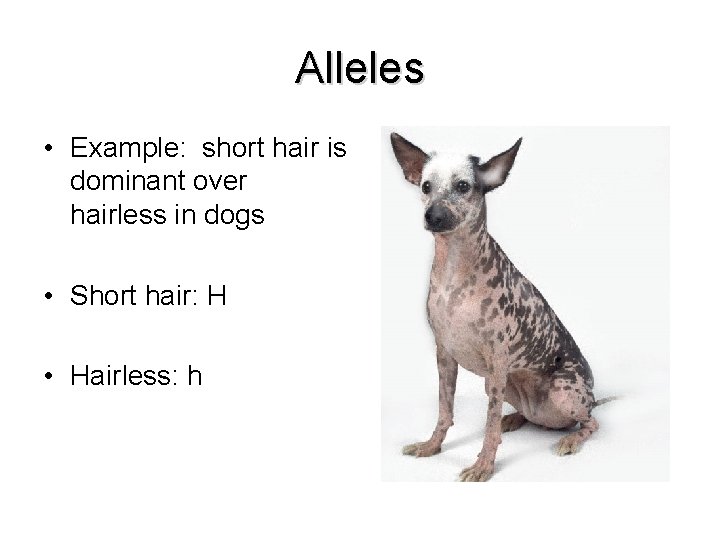
Alleles • Example: short hair is dominant over hairless in dogs • Short hair: H • Hairless: h
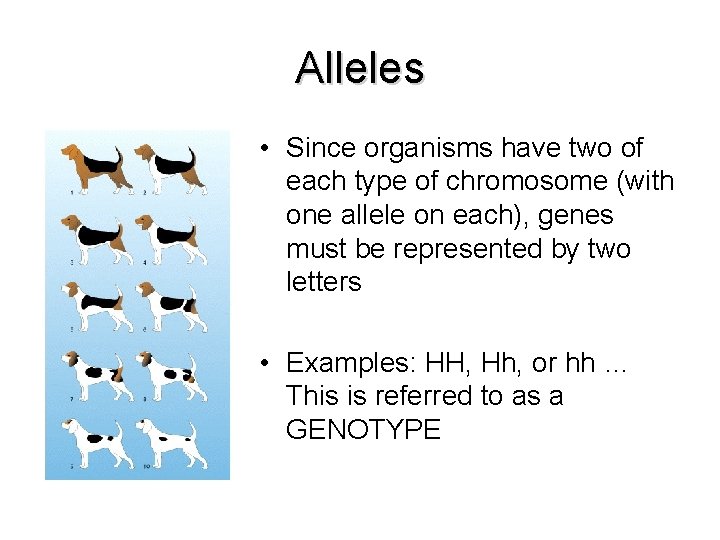
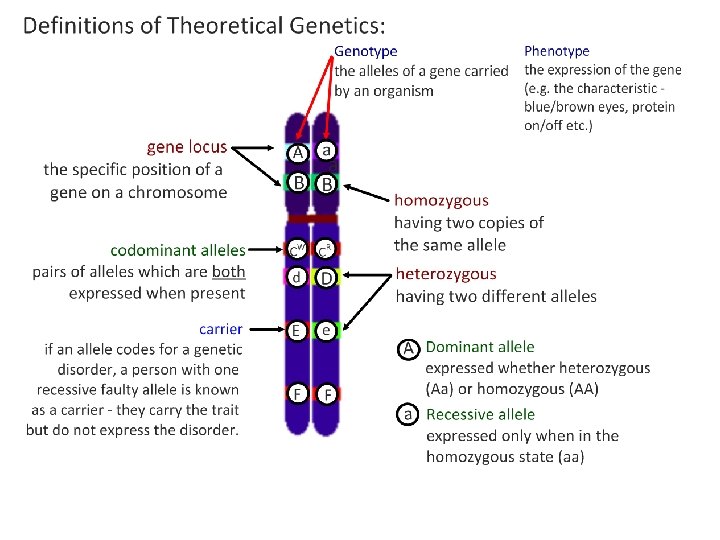
Alleles • Since organisms have two of each type of chromosome (with one allele on each), genes must be represented by two letters • Examples: HH, Hh, or hh … This is referred to as a GENOTYPE
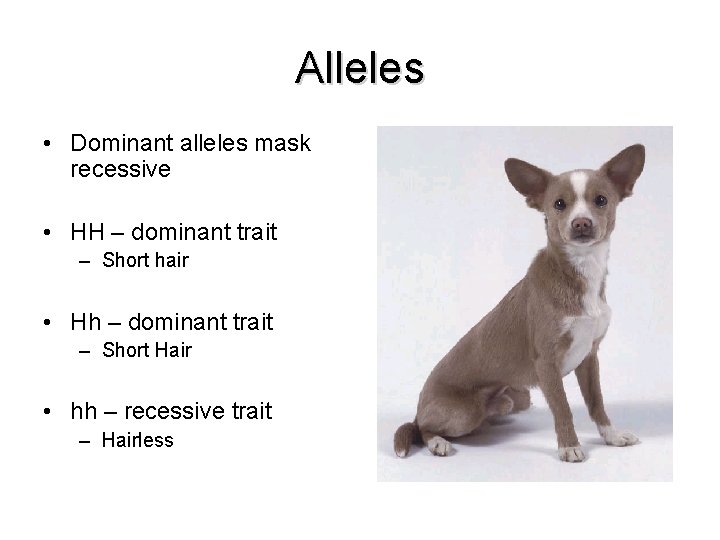
Alleles • Dominant alleles mask recessive • HH – dominant trait – Short hair • Hh – dominant trait – Short Hair • hh – recessive trait – Hairless
Vocabulary • Homozygous – two of the same alleles • Homozygous dominant – two dominant alleles • Homozygous recessive – two recessive alleles • Heterozygous – two different alleles
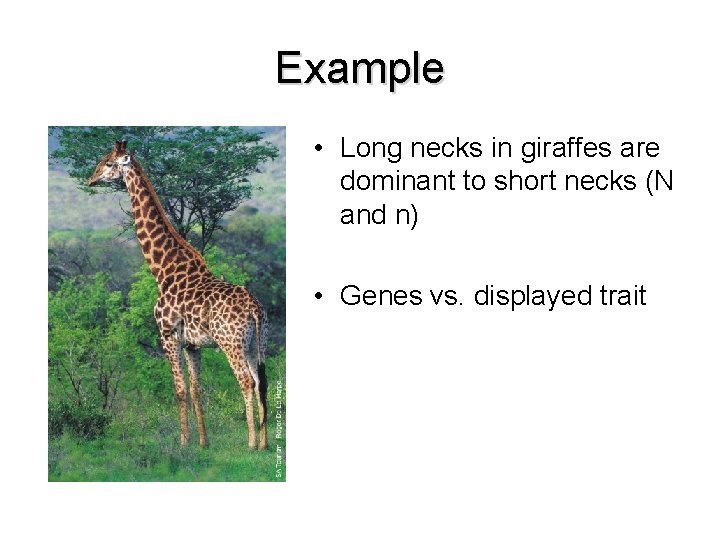
Example • Long necks in giraffes are dominant to short necks (N and n) • Genes vs. displayed trait
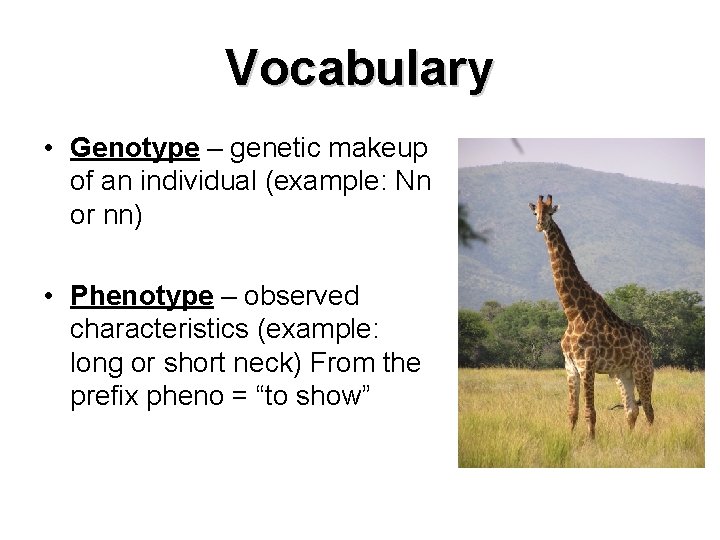
Vocabulary • Genotype – genetic makeup of an individual (example: Nn or nn) • Phenotype – observed characteristics (example: long or short neck) From the prefix pheno = “to show”
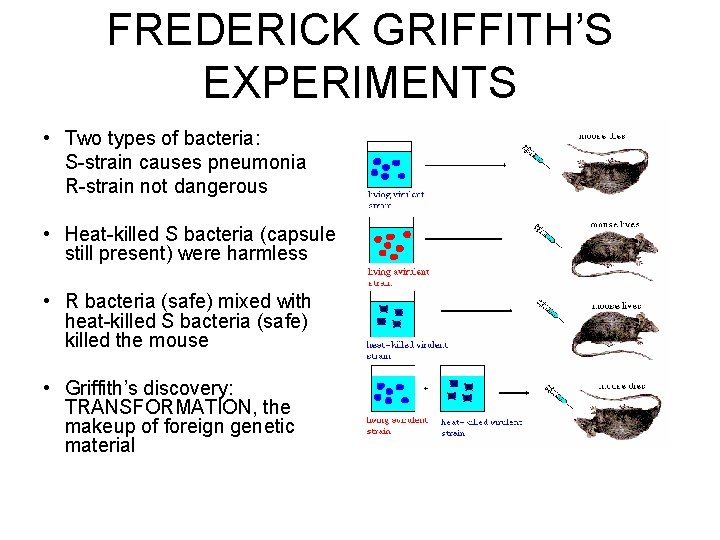
FREDERICK GRIFFITH’S EXPERIMENTS • Two types of bacteria: S-strain causes pneumonia R-strain not dangerous • Heat-killed S bacteria (capsule still present) were harmless • R bacteria (safe) mixed with heat-killed S bacteria (safe) killed the mouse • Griffith’s discovery: TRANSFORMATION, the makeup of foreign genetic material
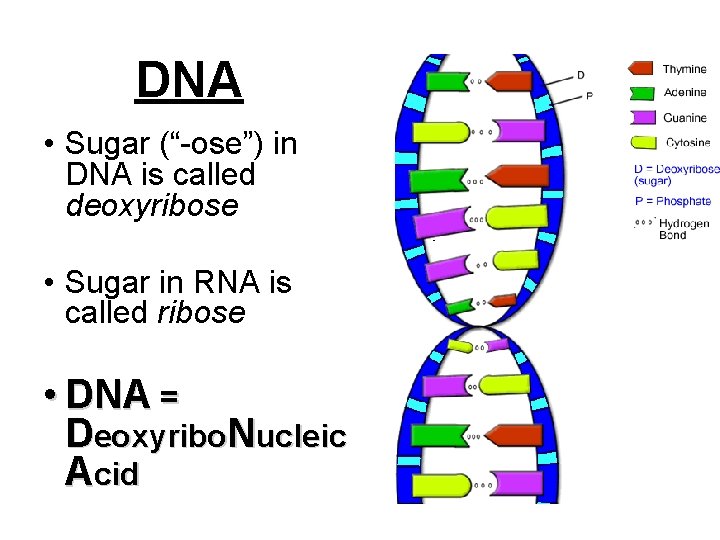
DNA • Sugar (“-ose”) in DNA is called deoxyribose • Sugar in RNA is called ribose • DNA = Deoxyribo. Nucleic Acid
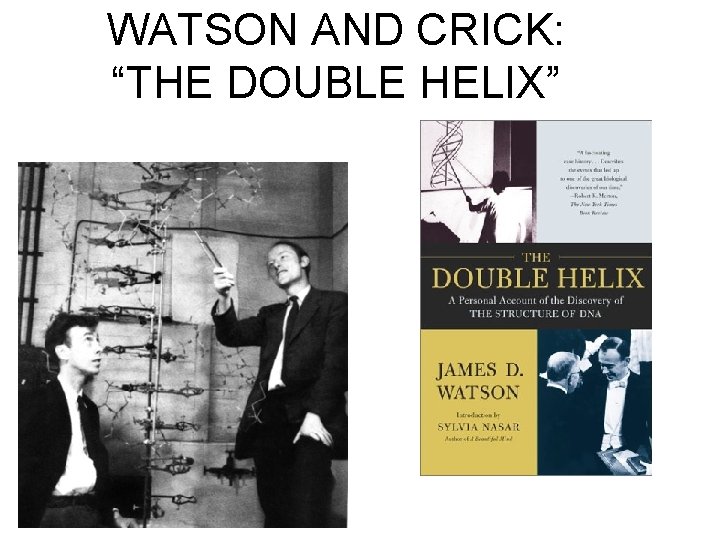
WATSON AND CRICK: “THE DOUBLE HELIX”
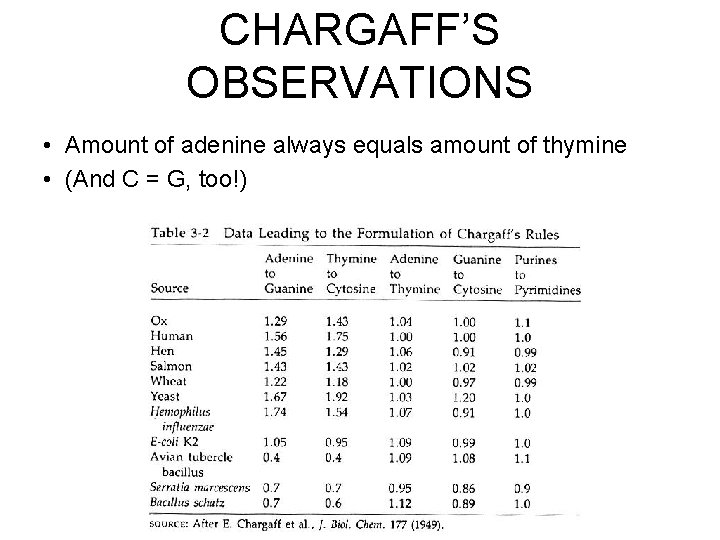
CHARGAFF’S OBSERVATIONS • Amount of adenine always equals amount of thymine • (And C = G, too!)
Discovery of Structure of DNA • 1953 • James Watson and Francis Crick (with help of Rosalind Franklin and Maurice Wilkins) • Nucleotide Chains • Nucleotide = sugar, Nitrogen Base (a, t, g, c) and a phosphate
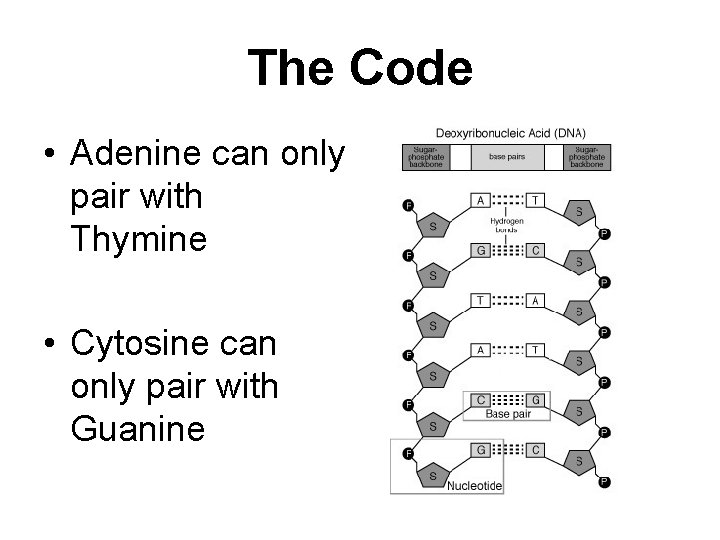
The Code • Adenine can only pair with Thymine • Cytosine can only pair with Guanine
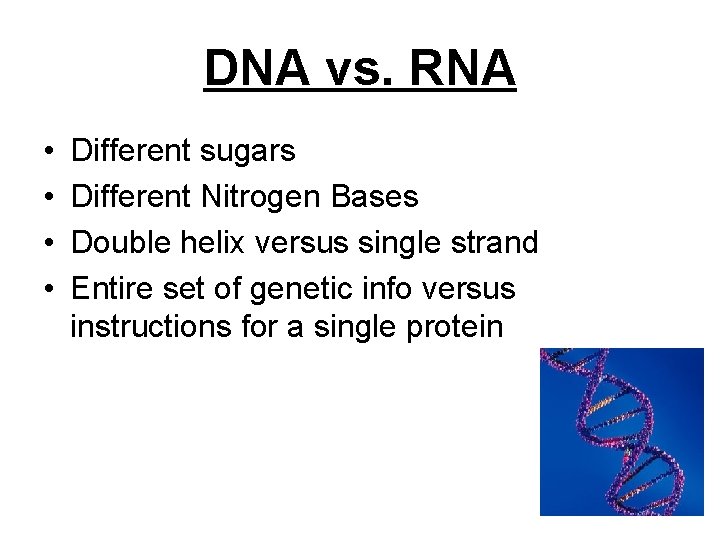
DNA vs. RNA • • Different sugars Different Nitrogen Bases Double helix versus single strand Entire set of genetic info versus instructions for a single protein
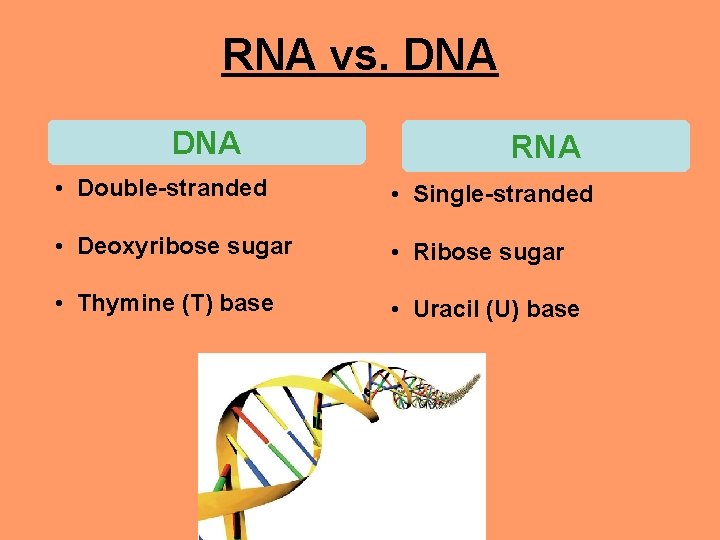
RNA vs. DNA RNA • Double-stranded • Single-stranded • Deoxyribose sugar • Ribose sugar • Thymine (T) base • Uracil (U) base
DNA/RNA processes • Replication: Occurs in the nucleus during interphase. Exact duplicate copies of entire DNA sequence • Transcription: Occurs in nucleus. m. RNA copies part of the DNA sequence • Translation: In cytoplasm/ribosome, RNA code is translated into amino acid code
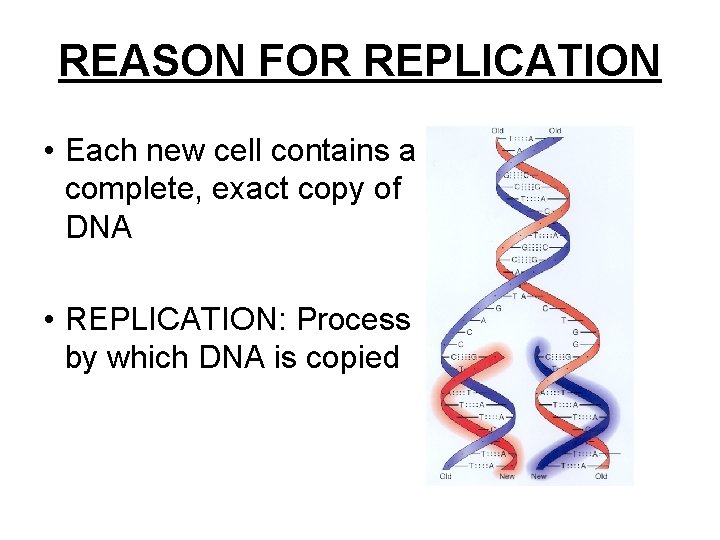
REASON FOR REPLICATION • Each new cell contains a complete, exact copy of DNA • REPLICATION: Process by which DNA is copied
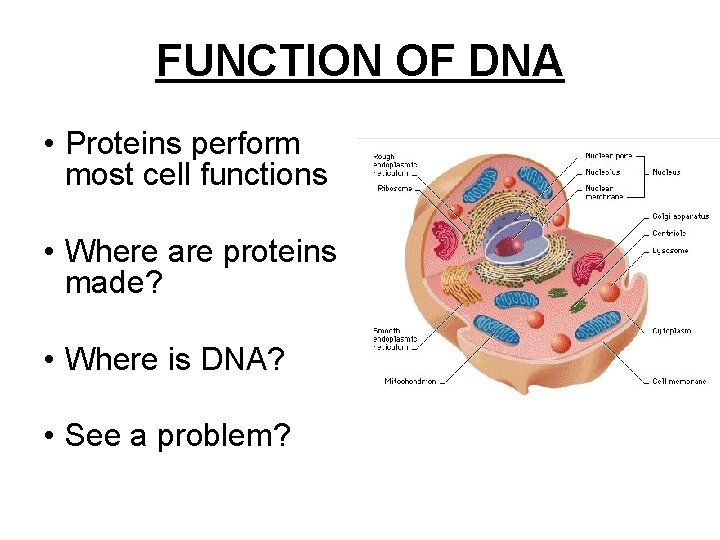
FUNCTION OF DNA • Proteins perform most cell functions • Where are proteins made? • Where is DNA? • See a problem?
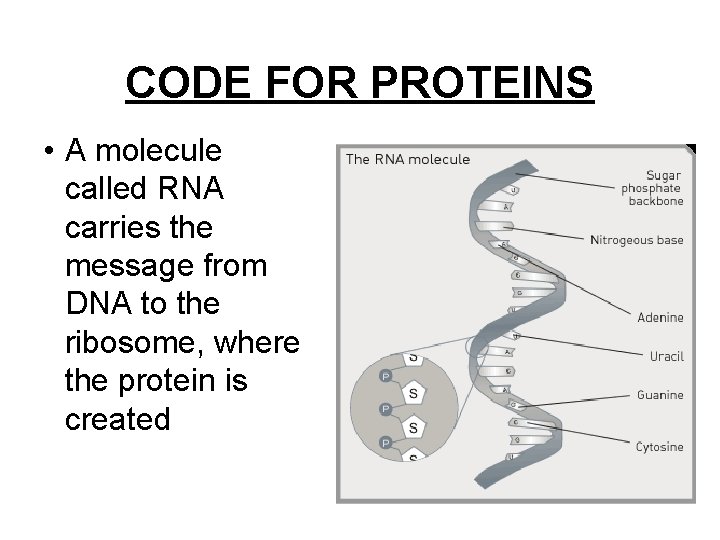
CODE FOR PROTEINS • A molecule called RNA carries the message from DNA to the ribosome, where the protein is created
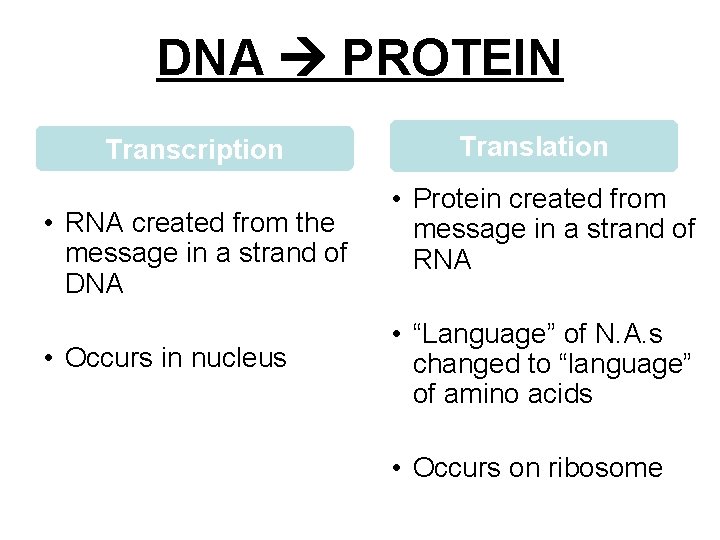
DNA PROTEIN Transcription • RNA created from the message in a strand of DNA • Occurs in nucleus Translation • Protein created from message in a strand of RNA • “Language” of N. A. s changed to “language” of amino acids • Occurs on ribosome
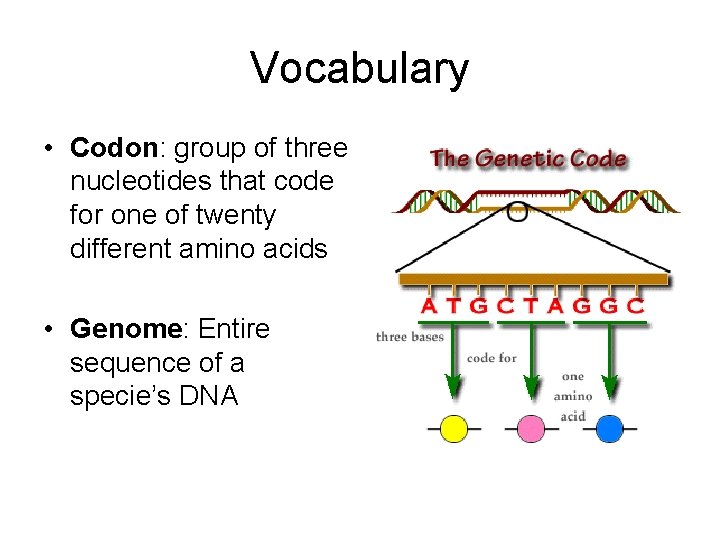
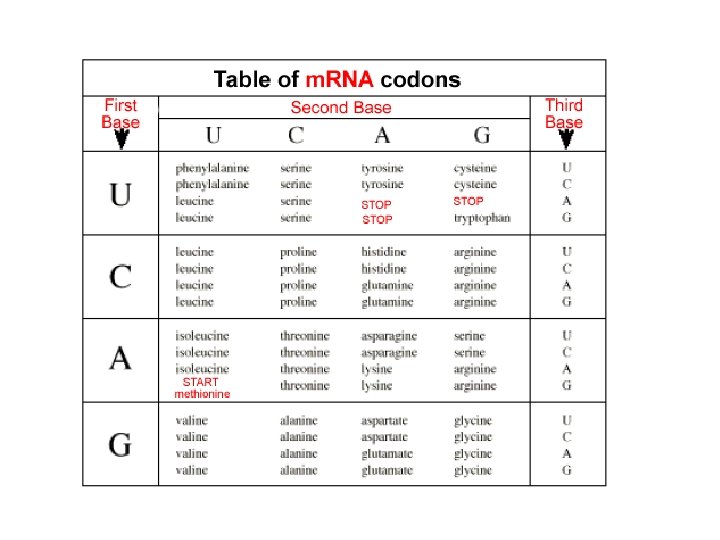
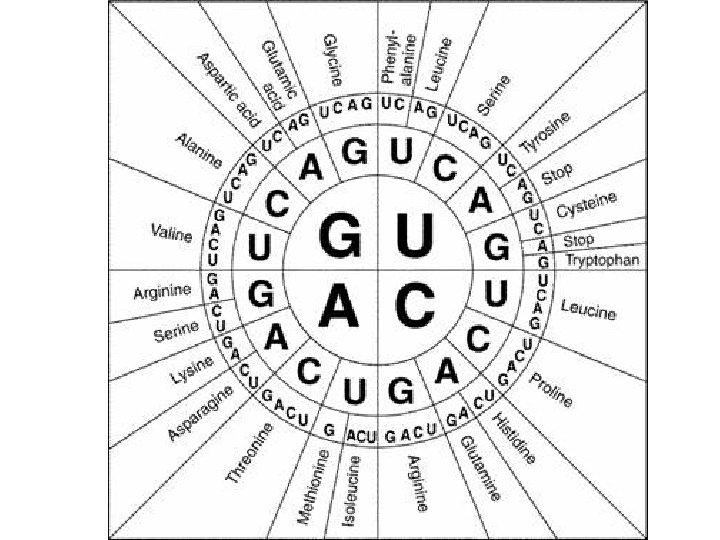
Vocabulary • Codon: group of three nucleotides that code for one of twenty different amino acids • Genome: Entire sequence of a specie’s DNA
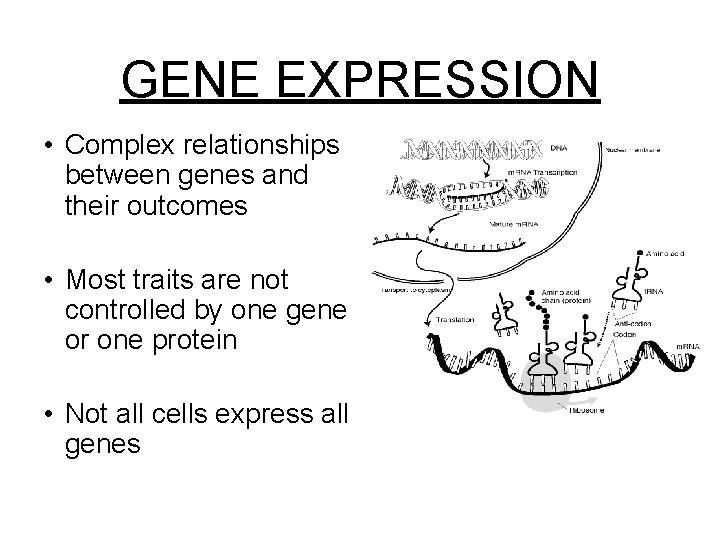
GENE EXPRESSION • Complex relationships between genes and their outcomes • Most traits are not controlled by one gene or one protein • Not all cells express all genes
MUTATIONS • Changes in structure/amount of DNA • Cause genetic variation (or worse) • Essential to evolution
Cancer Vocabulary • Mutation: Mistake made during replication • Tumor: Abnormal growth of cells • Benign Tumor: Non-cancerous • Malignant Tumor: Cancer (mal = bad) • Carcinogen: Chemical that promotes cancer • Metastasis: The spread of cancer • Leukemia: Cancer of white blood cells
Cancer Cells • Continue dividing indefinitely • Continue dividing even not attached to other cells • Continue dividing even when cells are crowded together Normal Cells • Often stop dividing after 20 -50 cells • Stop dividing if not attached • Stop dividing when crowded
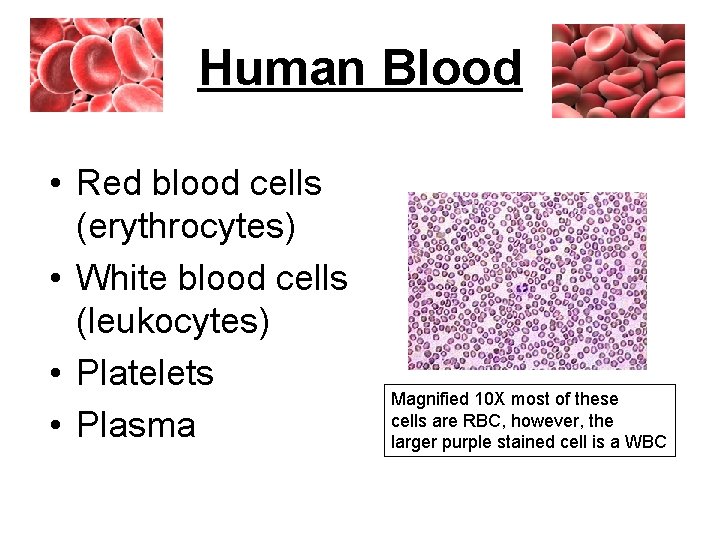
Human Blood • Red blood cells (erythrocytes) • White blood cells (leukocytes) • Platelets • Plasma Magnified 10 X most of these cells are RBC, however, the larger purple stained cell is a WBC
Blood Types • Refer to the antigens (proteins) on the Red Blood Cells • ABO Blood types (A, B, AB, and O) are caused by one gene • Rhesus Factor (+/-) is caused by a different gene • The ABO factor is an example of a genetic MULTIPLE ALLELES problem
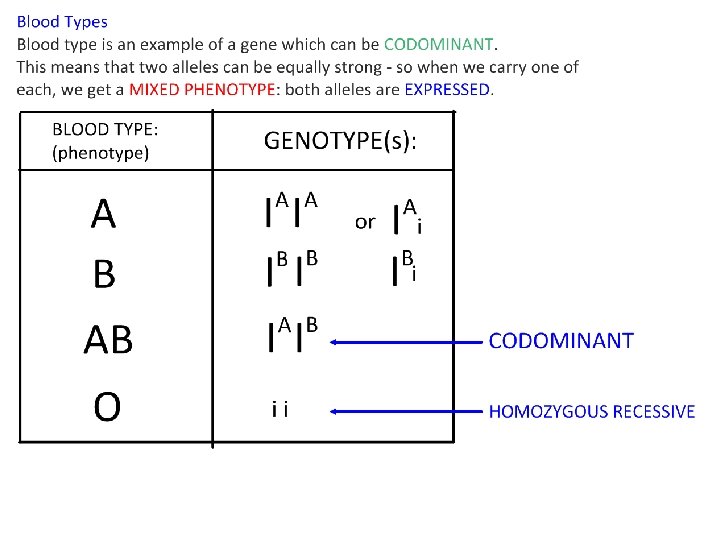
Blood Types • Red blood cells may or may not have an antigen on their surface. This antigen is recognized by the immune system. If an antigen is present it is either A, B, or both (AB). If no antigen is present it is called O blood type. • Antibodies react with antigens
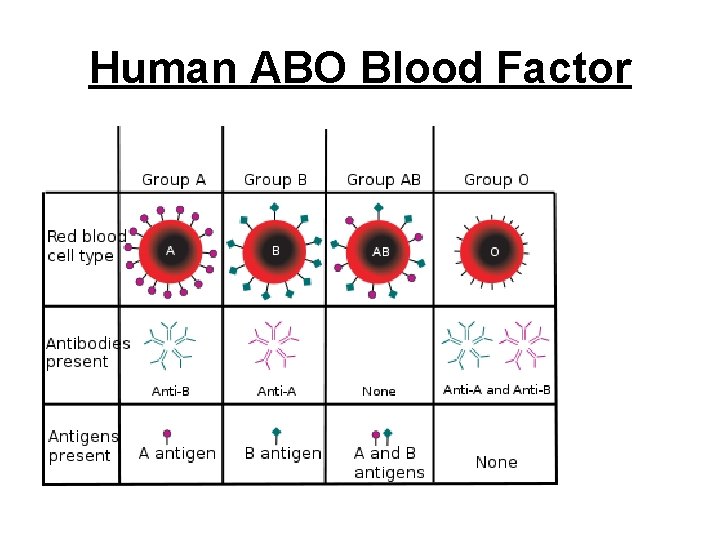
Human ABO Blood Factor
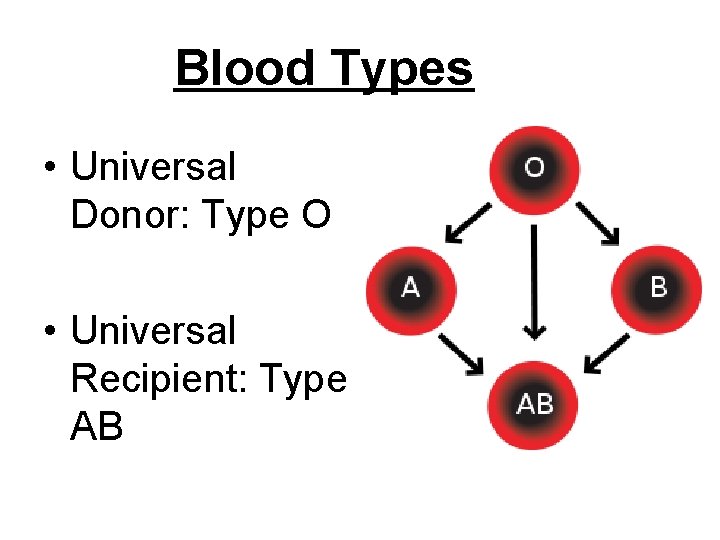
Blood Types • Universal Donor: Type O • Universal Recipient: Type AB
Patterns of inheritance • • Autosomal Dominant Autosomal Recessive Co-dominance / Incomplete Dominance Multiple Alleles X-linked Non-Disjunctive disorders Polygenetic traits
Nature vs. Nurture • What you are born with (your genes) only determines part of how you will develop (nurture) • Gene Expression: Genes need to be “turned on” or activated to create specific proteins • Genetic Predisposition: May have the genetics for a trait, however, the gene/genes may never be activated • You control part of your nurture HOWEVER some is out of your control
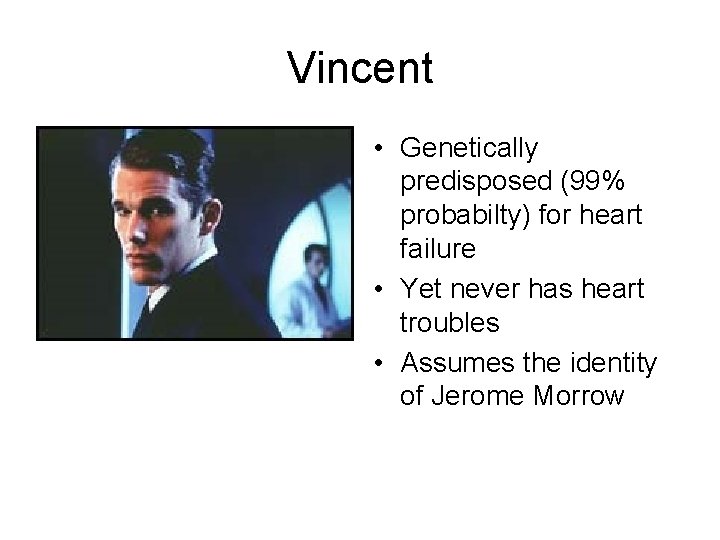
Vincent • Genetically predisposed (99% probabilty) for heart failure • Yet never has heart troubles • Assumes the identity of Jerome Morrow
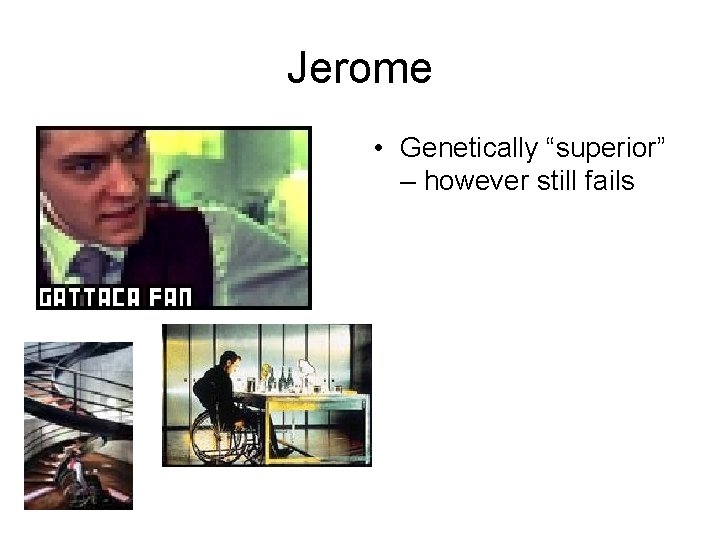
Jerome • Genetically “superior” – however still fails
In-Vitro Fertilization • Egg and sperm fertilized outside the human body
Polygenic traits • All the traits Mendel studied were MONOgenetic (caused by a single gene) • Most traits are caused by multiple genes (POLY = “MANY”) • Examples: Human height, intelligence
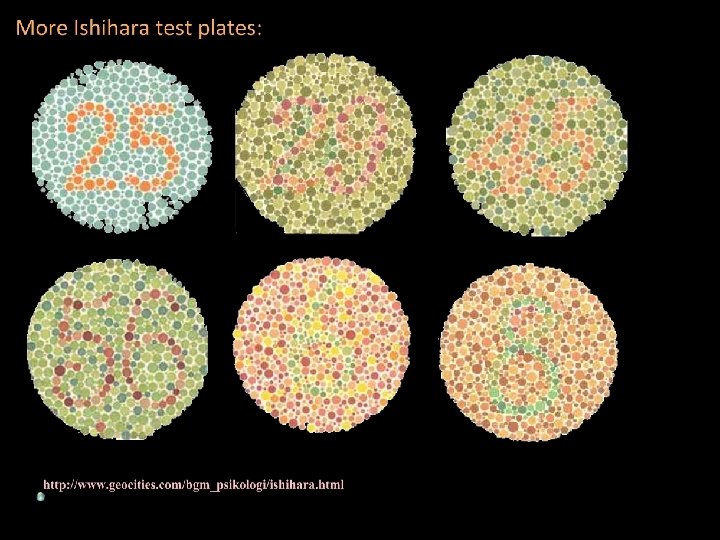
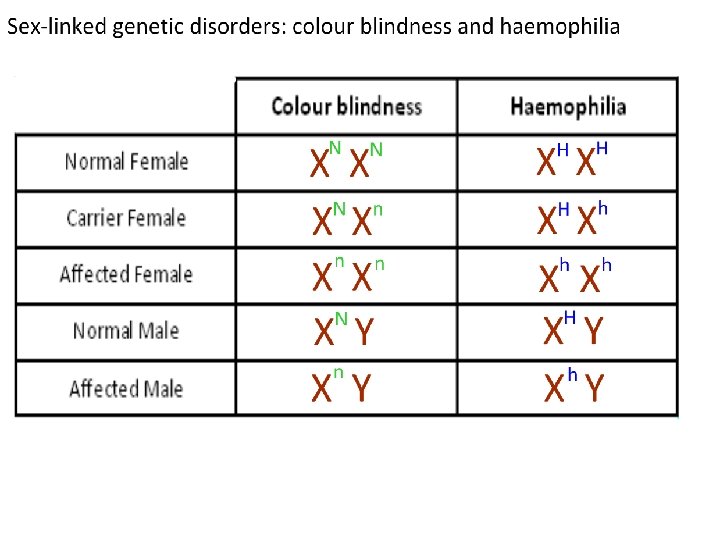
Sex-Linked Traits • Gene located on the X Chromosome - Color blindness - Hemophilia
You a man. Y. Yes that is correct!
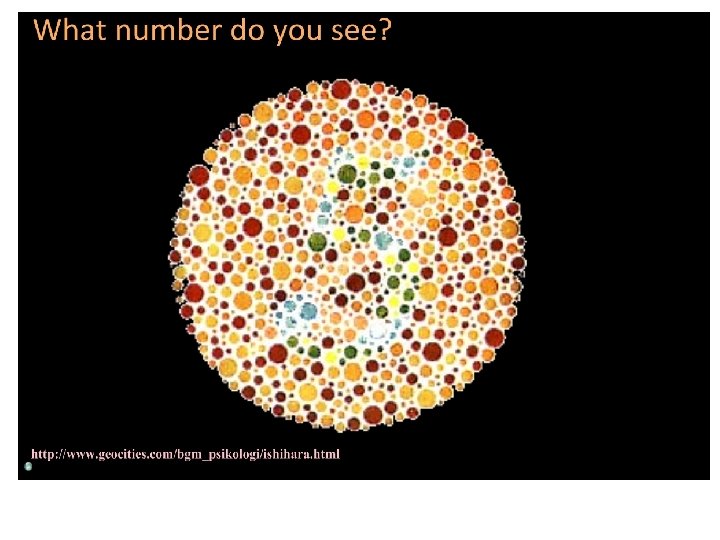
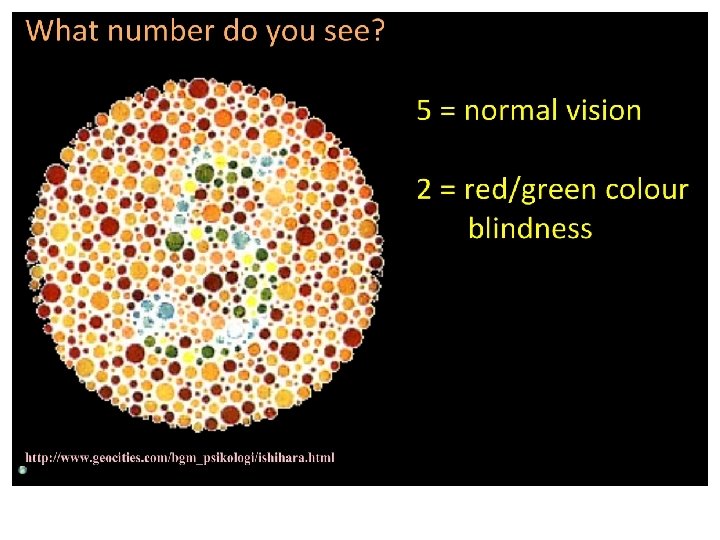
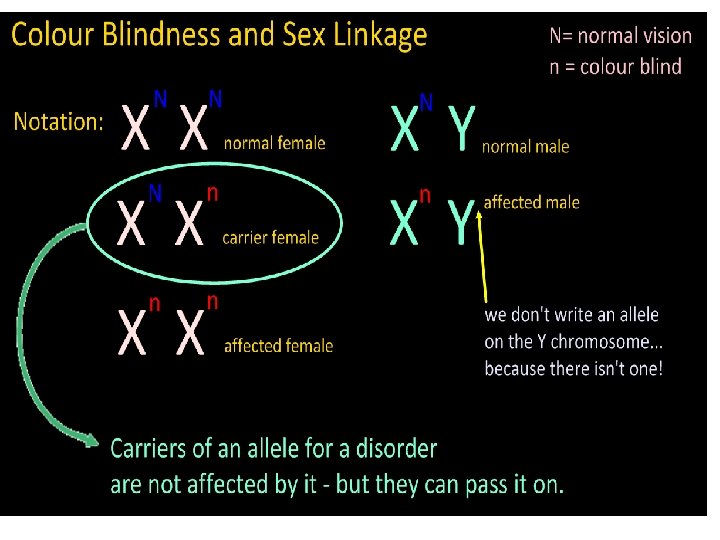
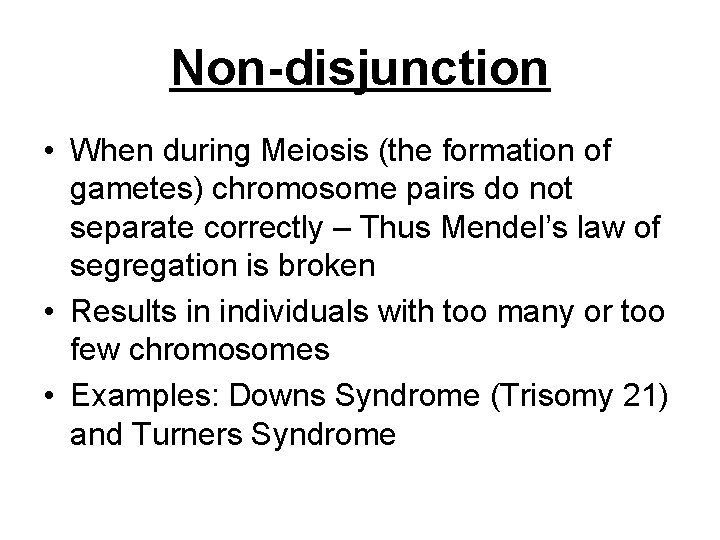
Non-disjunction • When during Meiosis (the formation of gametes) chromosome pairs do not separate correctly – Thus Mendel’s law of segregation is broken • Results in individuals with too many or too few chromosomes • Examples: Downs Syndrome (Trisomy 21) and Turners Syndrome
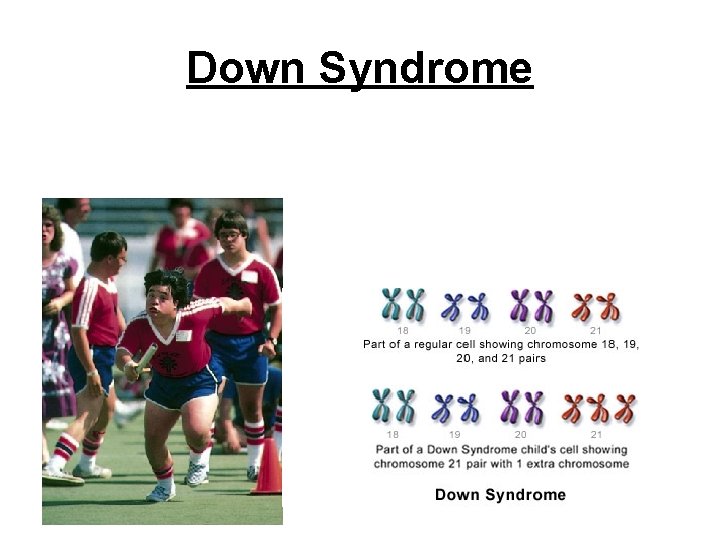
Down Syndrome
Amniocentesis • Using a needle amniotic fluid is removed from the women and tested • Much different from an ultrasound or sonogram that only uses sound waves to create a picture of the baby
What is a Pedigree? • A pedigree is a chart of the genetic history of family over several generations. A “family tree” • Scientists or a genetic counselor would find out about your family history and make this chart to analyze.
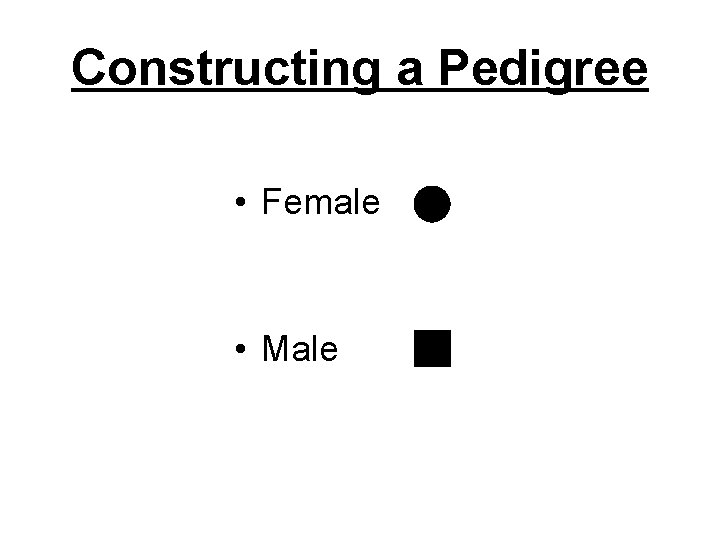
Constructing a Pedigree • Female • Male
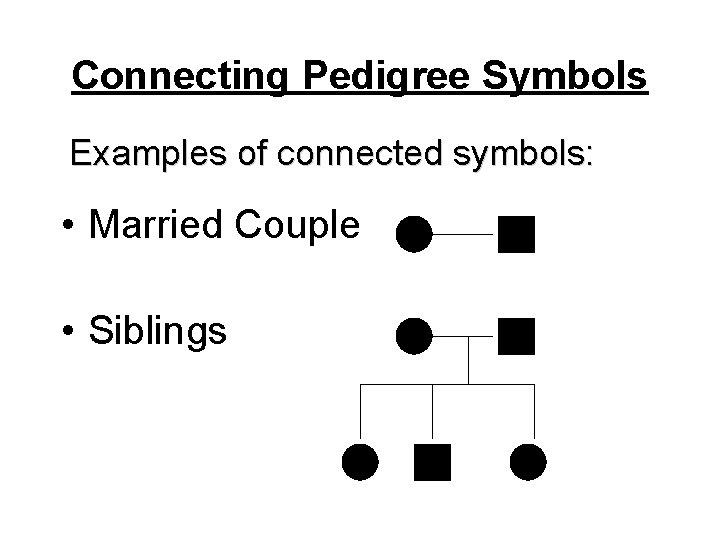
Connecting Pedigree Symbols Examples of connected symbols: • Married Couple • Siblings
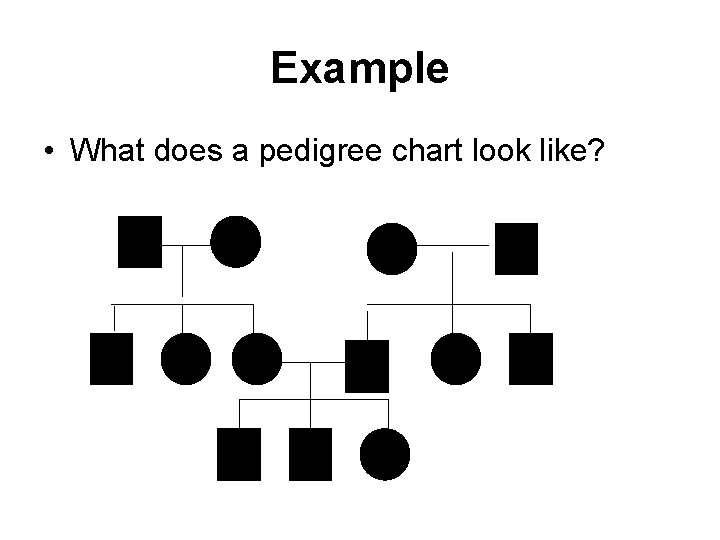
Example • What does a pedigree chart look like?
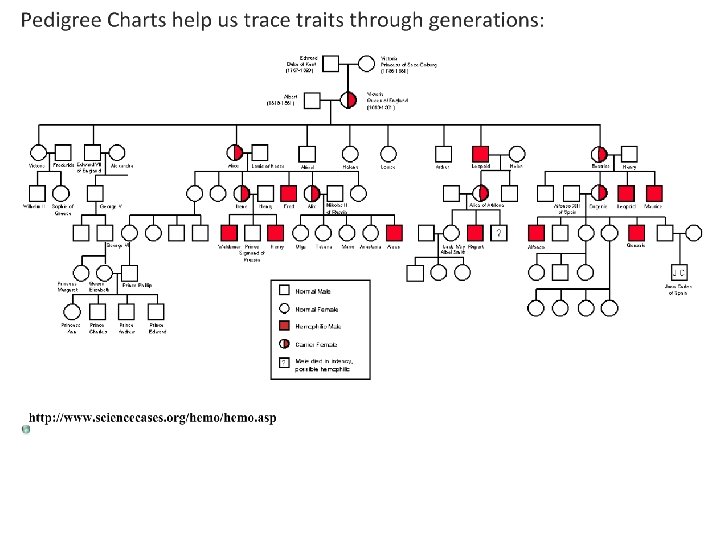
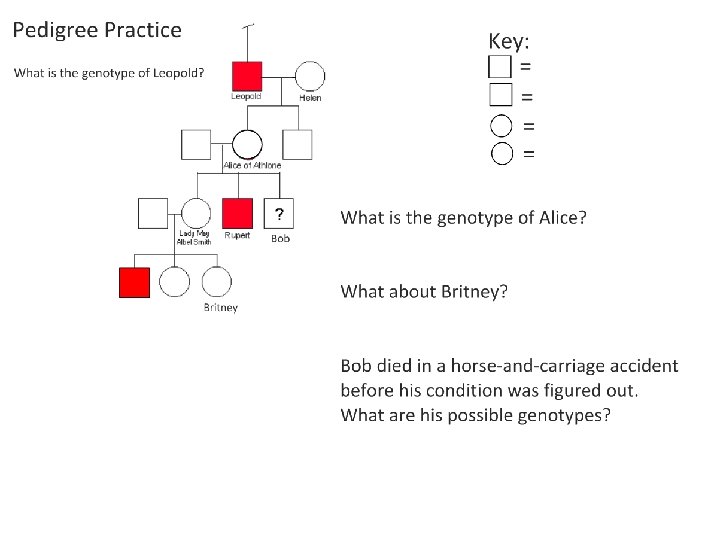
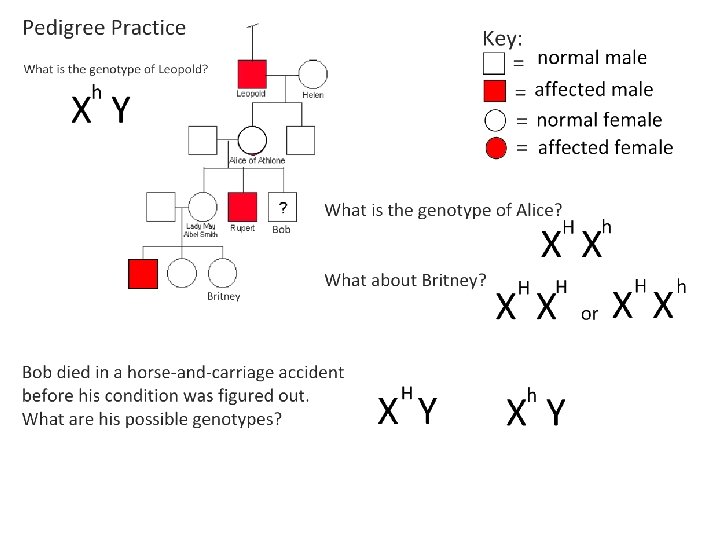
Genetic Disorders Autosomal Recessive Disorders • • Cystic Fibrosis Sickle Cell Anemia Tay-Sachs PKU (Phenylketonuria) Autosomal Dominant Disorders • Huntington’s • Marfan Syndrome
Simple Human Traits Monogenetic with only two alleles: Dominate and Recessive (Most human traits DO NOT fall into this category)
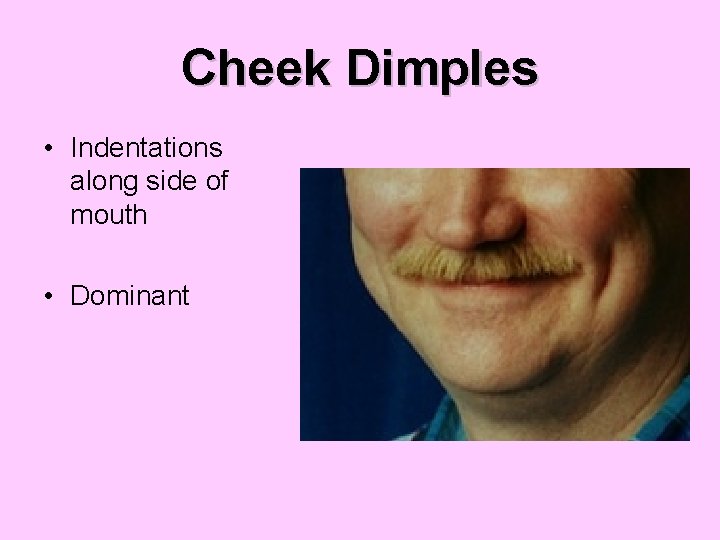
Cheek Dimples • Indentations along side of mouth • Dominant
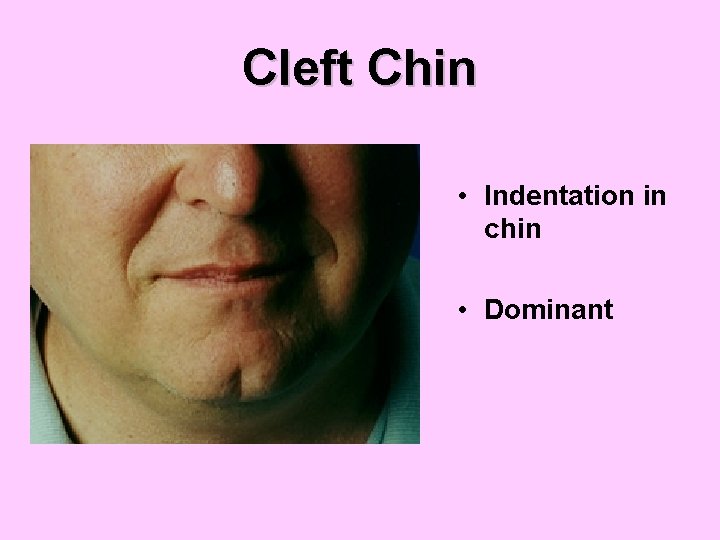
Cleft Chin • Indentation in chin • Dominant
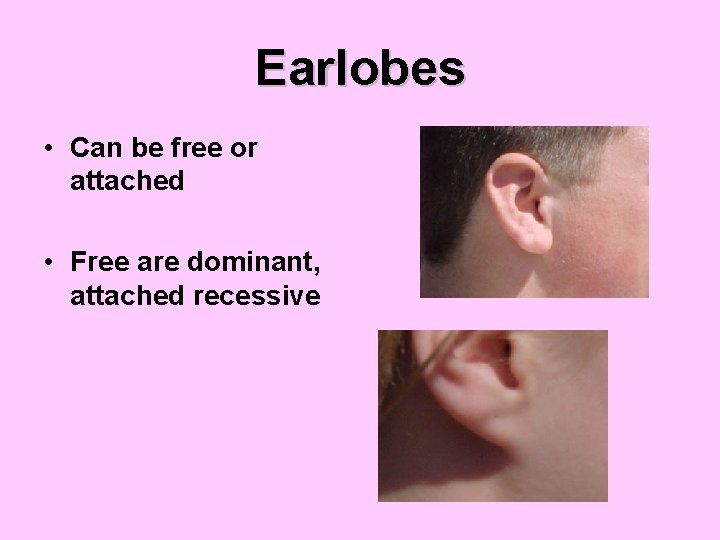
Earlobes • Can be free or attached • Free are dominant, attached recessive
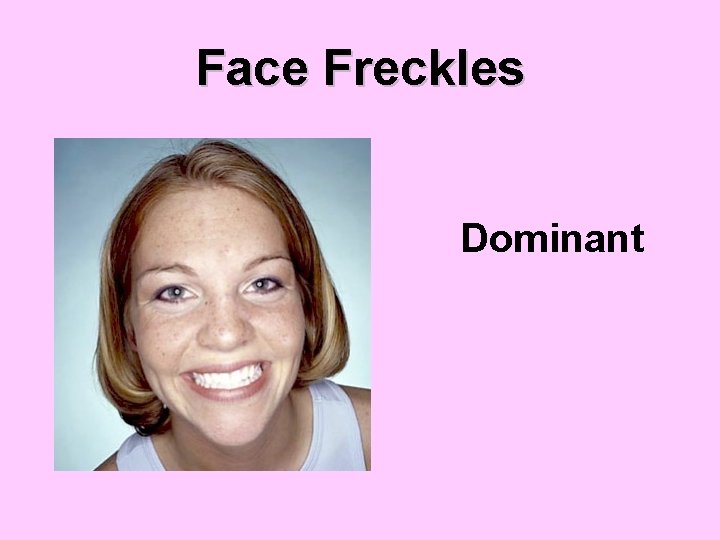
Face Freckles Dominant
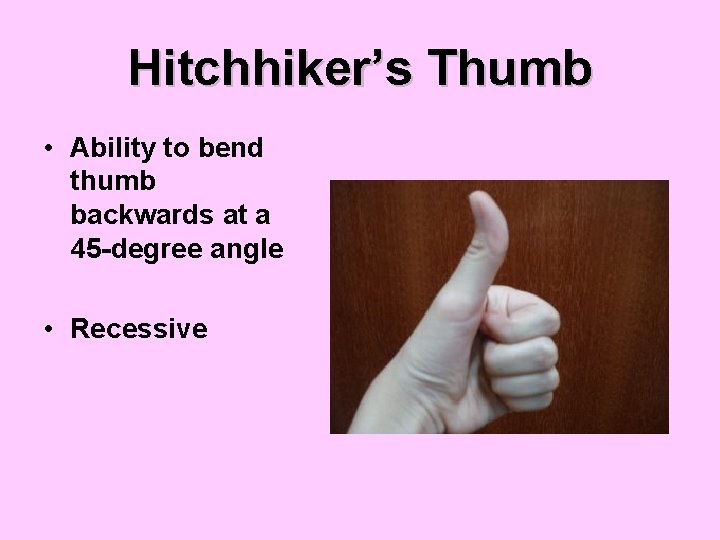
Hitchhiker’s Thumb • Ability to bend thumb backwards at a 45 -degree angle • Recessive
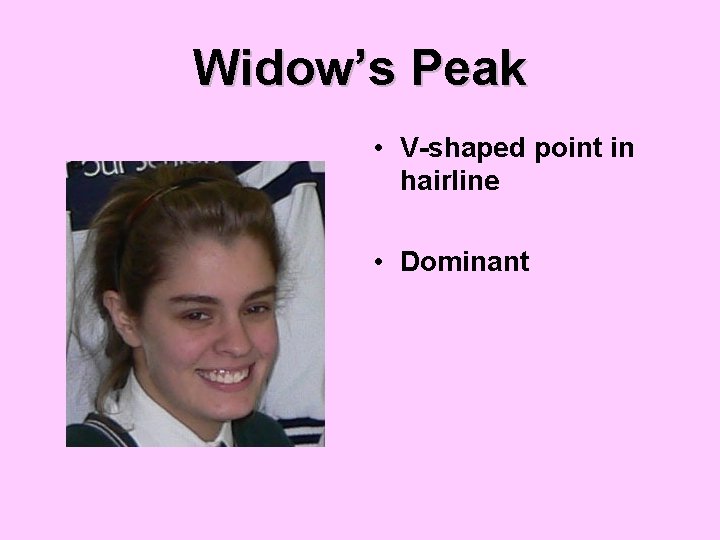
Widow’s Peak • V-shaped point in hairline • Dominant
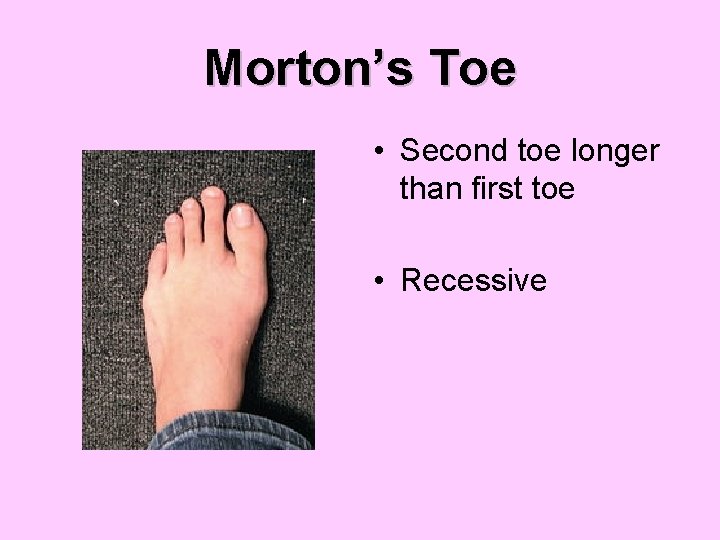
Morton’s Toe • Second toe longer than first toe • Recessive
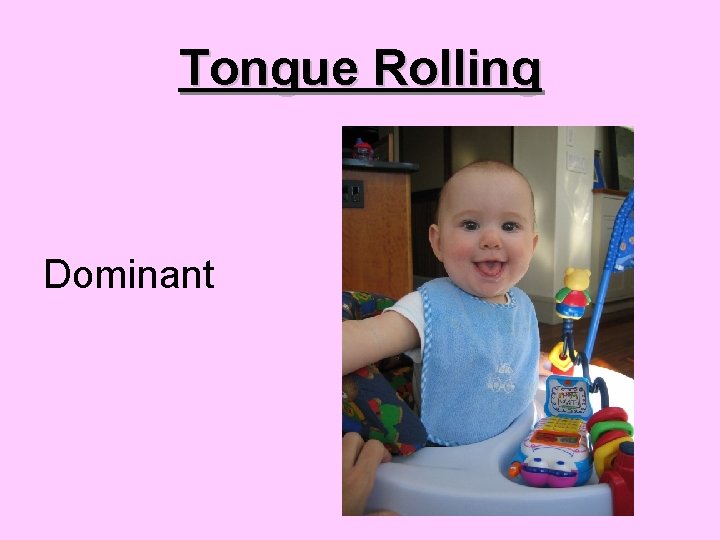
Tongue Rolling Dominant
- Slides: 91