
Genetics Patterns of Inheritance Genetics Vocabulary GeneticsThe branch
Genetics Patterns of Inheritance
Genetics Vocabulary � � � � Genetics-The branch of biology that studies heredity Gene- A unit of genetic material that determines a trait Allele- Alternate form of the same gene Heredity- The passing of physical characteristics from parent to child/offspring Traits- Characteristics that are inherited Inherit- To acquire a trait from your parents Carrier- An individual that carries one gene for a recessive trait. (A carrier does not express that trait, but when mated with another can produce offspring that do. )
More Vocabulary Chromosome-a thread-like strand in the nucleus that controls the cell activity and carries the genetic material to pass traits to offspring � Phenotype- The actual characteristics that an organism demonstrates � Genotype- The allele combination an organism contains � Punnett square-a visual diagram that demonstrates the possible genotypes person could inherit from the parents � Gregor Mendel- Austrian monk who studies pea plants and figured out the rules of heredity. The “father” of genetics �
Even MORE Vocabulary Dominant gene/allele- Strong form of a gene, which is expressed even if a recessive gene is present � Recessive gene/allele- The weak form of a gene, which is not expressed when the dominant form is also present � Meiosis- Cell division that happens in sex cells only. Produces gametes have one set of unpaired chromosomes � Heterozygous- Having 2 different alleles for a trait (also known as hybrid) � Homozygous- Having 2 of the same alleles (also known as purebred) �
Last Page of Vocabulary (I PROMISE!) � � � � Gamete- Sex cell Sex-linked Trait- A recessive trait carried on the X chromosome Co-dominant- Two(2) alleles of a gene pair in a heterozygote that are both fully expressed Incomplete dominance- A condition that results when genes produce a trait somewhere in between the trait of the parents Karyotype- A picture of a person’s chromosomes Mutation- A change in DNA or chromosomes Polygenic- A trait that requires more than one gene Pedigree- A line of ancestors; visual representation
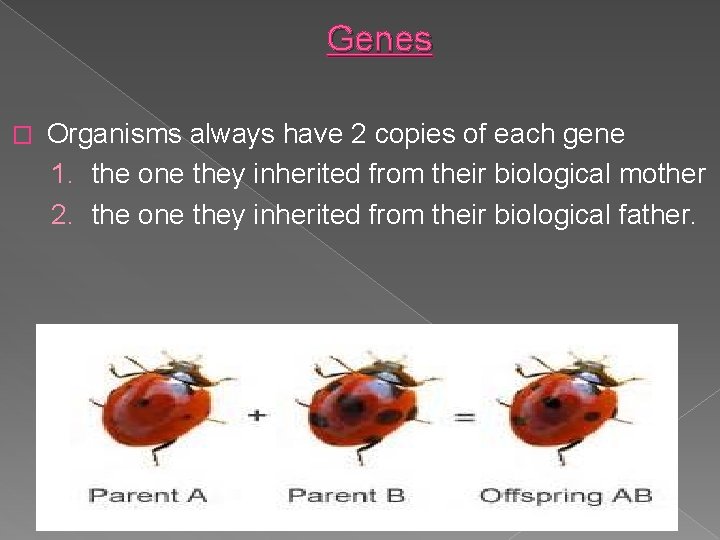
Genes � Organisms always have 2 copies of each gene 1. the one they inherited from their biological mother 2. the one they inherited from their biological father.
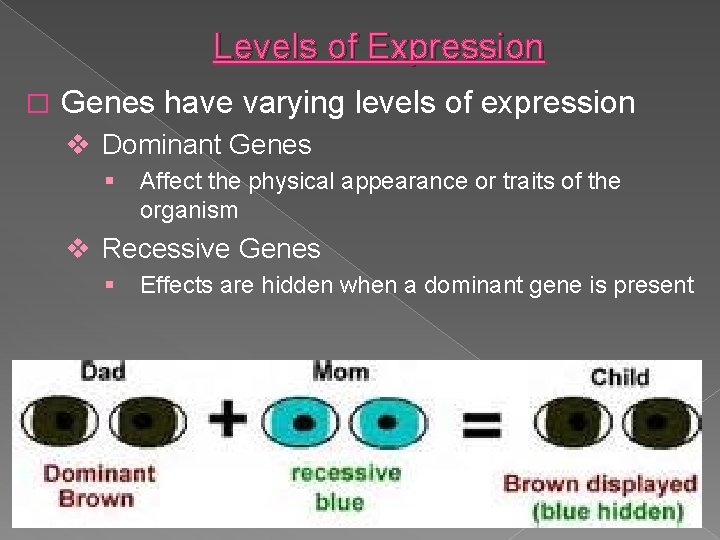
Levels of Expression � Genes have varying levels of expression v Dominant Genes § Affect the physical appearance or traits of the organism v Recessive Genes § Effects are hidden when a dominant gene is present
What is a Genotype? � A person's genotype refers to the combination of genes he/she inherited. � There are 3 genotypes 1. Heterozygous 2. Homozygous dominant 3. Homozygous recessive.
Genotypes � RR = homozygous dominant (the individual has 2 dominant versions of the gene) � Rr = heterozygous (the individual has 1 dominant version and 1 recessive version of the gene) � rr = homozygous recessive (the individual has 2 recessive versions of the gene)
What is a Phenotype? � A person's phenotype refers to the physical manifestation of his/her genes � For instance, a person with a 'Rr' genotype would have a tongue-rolling phenotype since the presence of a dominant gene allows for the dominant expression of that trait
Phenotypes vs Genotypes � The way an organism looks and behaves is called its phenotype. This is a physical trait. � The allele combination an organism contains is known as its genotype. This is a genetic trait that may not be seen. › › Three (3) examples of possible representations PP (two capital letters) Pp (one capital letter, one lowercase letter) pp (two lowercase letters
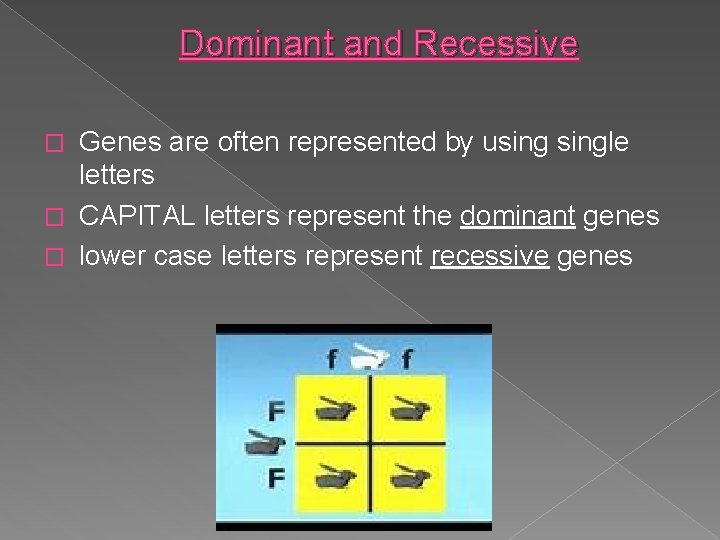
Dominant and Recessive Genes are often represented by usingle letters � CAPITAL letters represent the dominant genes � lower case letters represent recessive genes �
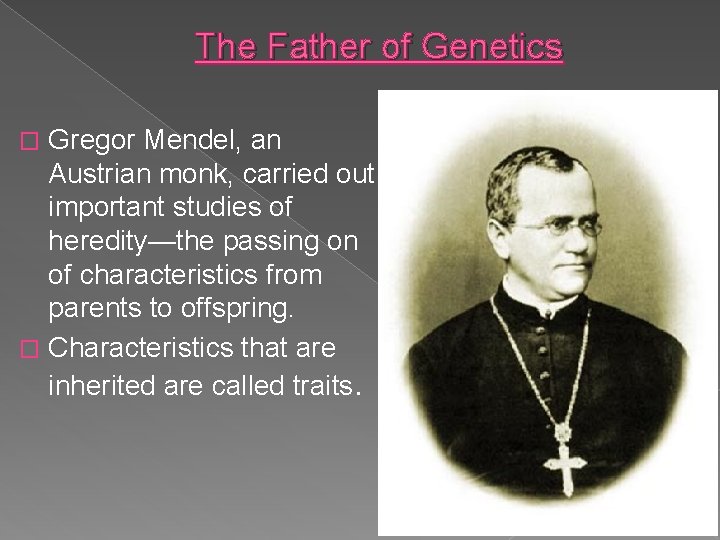
The Father of Genetics Gregor Mendel, an Austrian monk, carried out important studies of heredity—the passing on of characteristics from parents to offspring. � Characteristics that are inherited are called traits. �
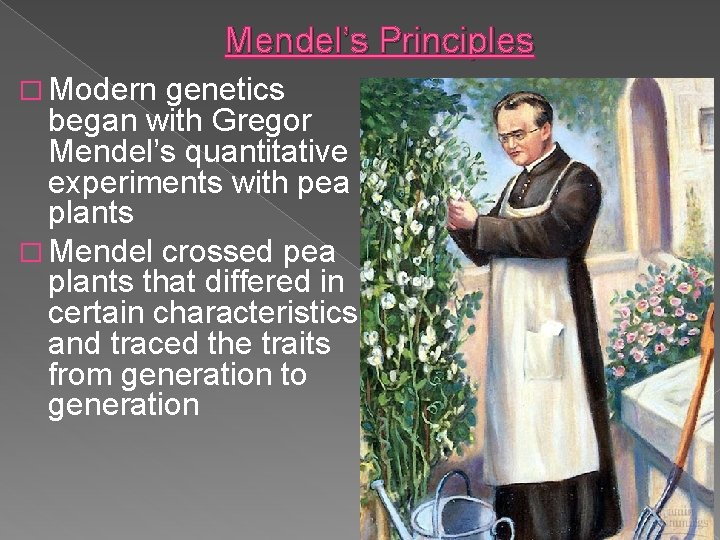
Mendel’s Principles � Modern genetics began with Gregor Mendel’s quantitative experiments with pea plants � Mendel crossed pea plants that differed in certain characteristics and traced the traits from generation to generation
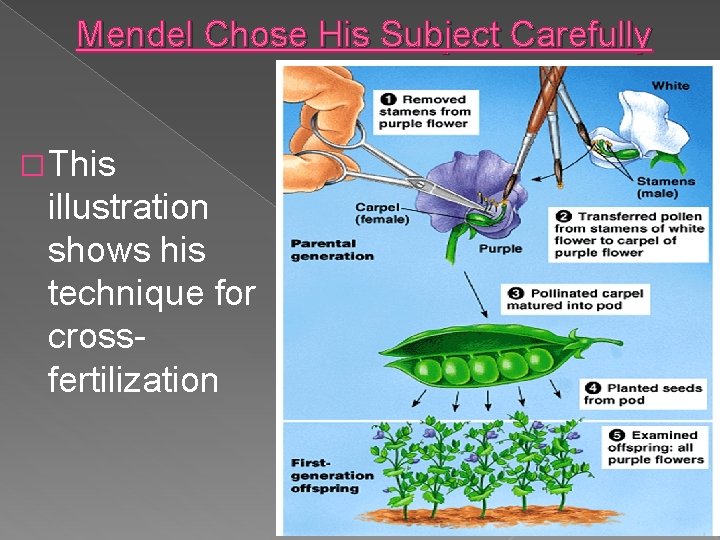
Mendel Chose His Subject Carefully � This illustration shows his technique for crossfertilization
Mendel was a Careful Researcher � He studied only one trait at a time to control variables, and he analyzed his data mathematically. › Variable- A factor that can influence the outcome of an experiment › Probability-the percent chance of inheriting a trait › Ratio-relation in degree or number between two different things
Mendel’s Research � The tall pea plants he worked with were from populations of plants that had been tall for many generations and had always produced tall offspring. � Such �A plants are said to be true breeding hybrid (heterozygous) is the offspring of parents that have different forms of a trait, such as tall and short height.
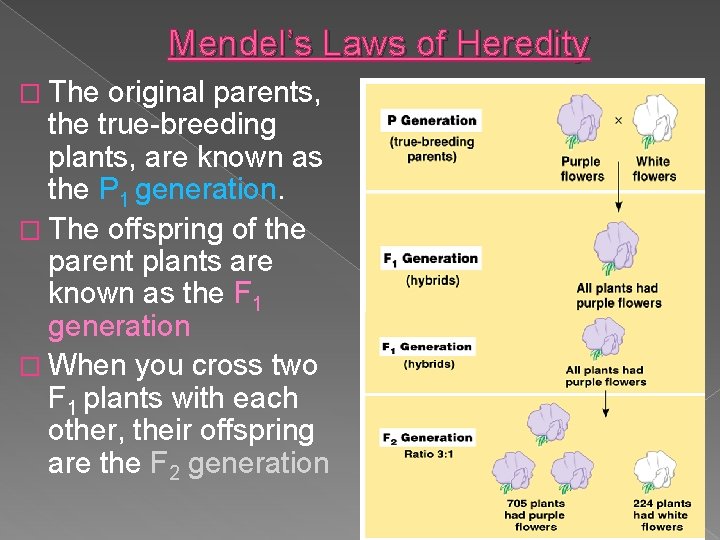
Mendel’s Laws of Heredity � The original parents, the true-breeding plants, are known as the P 1 generation. � The offspring of the parent plants are known as the F 1 generation � When you cross two F 1 plants with each other, their offspring are the F 2 generation
Mendel’s Principle of Segregation � Mendel’s principle of segregation describes the inheritance of a single characteristic � From his experimental data, Mendel deduced that an organism has two genes (alleles) for each inherited characteristic › One characteristic comes from each parent �A sperm or egg carries only one allele of each pair › The pairs of alleles separate when gametes form › This process describes Mendel’s law of segregation
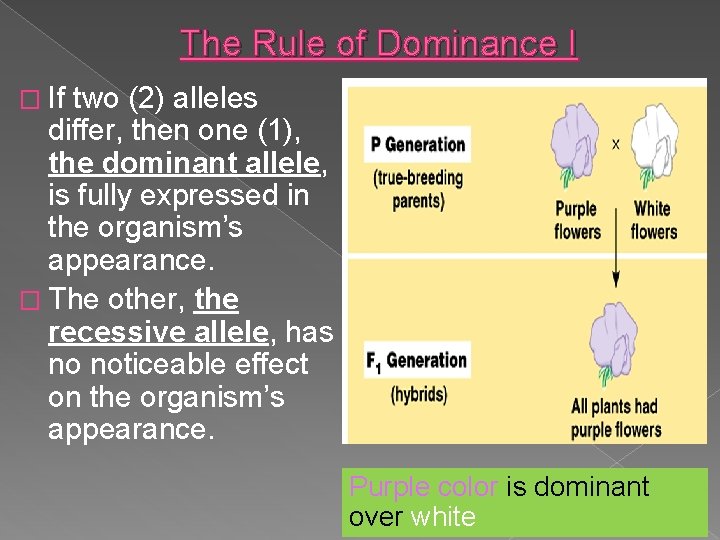
The Rule of Dominance I � If two (2) alleles differ, then one (1), the dominant allele, is fully expressed in the organism’s appearance. � The other, the recessive allele, has no noticeable effect on the organism’s appearance. Purple color is dominant over white
The Rule of Dominance II � An uppercase letter is used for the dominant allele and a lowercase letter for the recessive allele. � The dominant allele is always written first. � An organism is homozygous for a trait if its two alleles for the trait are the same. PP (dominant) or pp (recessive) � An organism is heterozygous for a trait if its two alleles for the trait differ from each other. (Pp) (dominant)
Punnett Squares � In 1905, Reginald Punnett, an English biologist, devised a shorthand way of finding the expected proportions of possible genotypes in the offspring of a cross � A Punnett square predicts the results of a genetic cross between individuals of known genotype
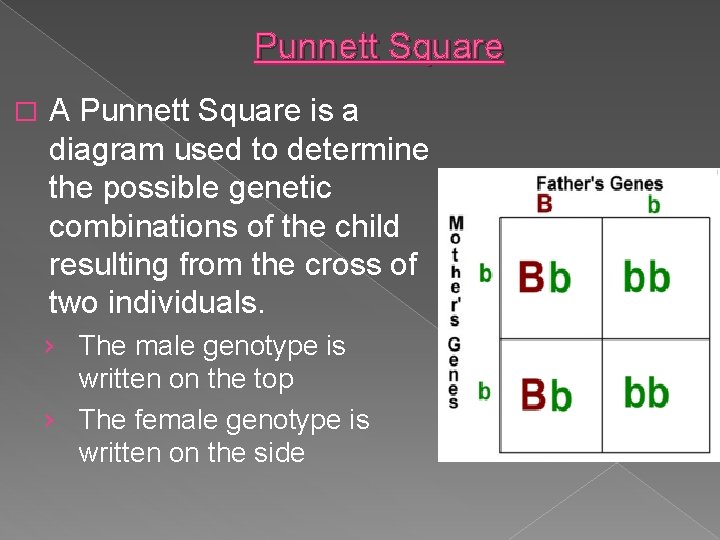
Punnett Square � A Punnett Square is a diagram used to determine the possible genetic combinations of the child resulting from the cross of two individuals. › The male genotype is written on the top › The female genotype is written on the side
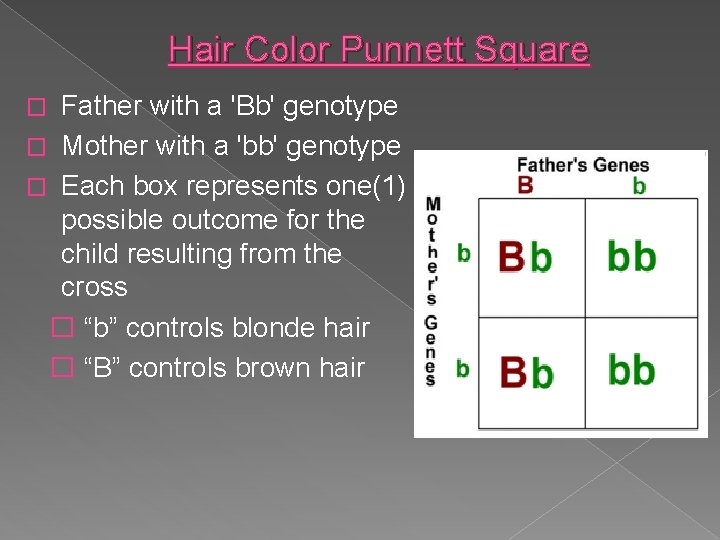
Hair Color Punnett Square Father with a 'Bb' genotype � Mother with a 'bb' genotype � Each box represents one(1) possible outcome for the child resulting from the cross � “b” controls blonde hair � “B” controls brown hair �
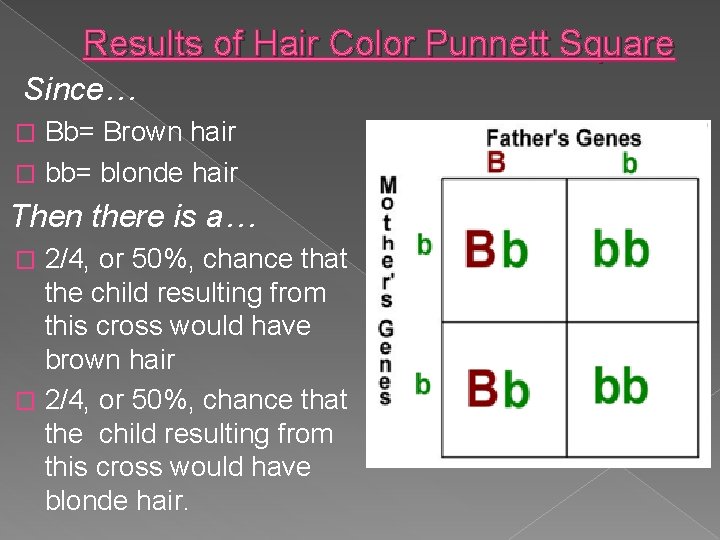
Results of Hair Color Punnett Square Since… Bb= Brown hair � bb= blonde hair � Then there is a… 2/4, or 50%, chance that the child resulting from this cross would have brown hair � 2/4, or 50%, chance that the child resulting from this cross would have blonde hair. �
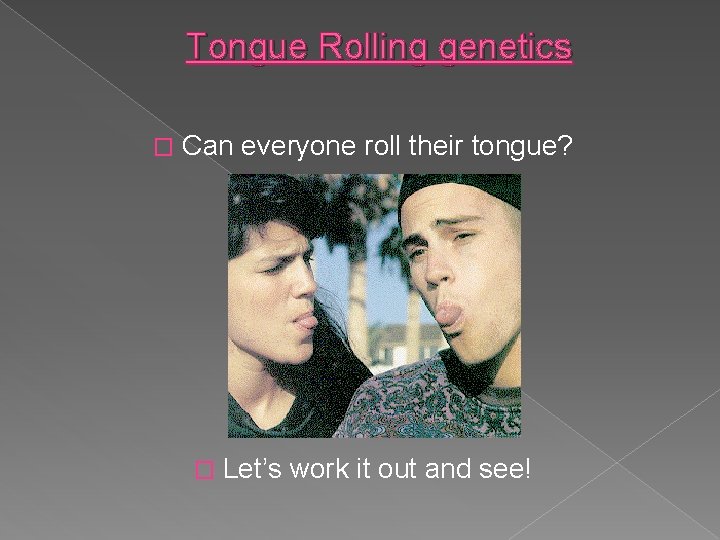
Tongue Rolling genetics � Can everyone roll their tongue? � Let’s work it out and see!
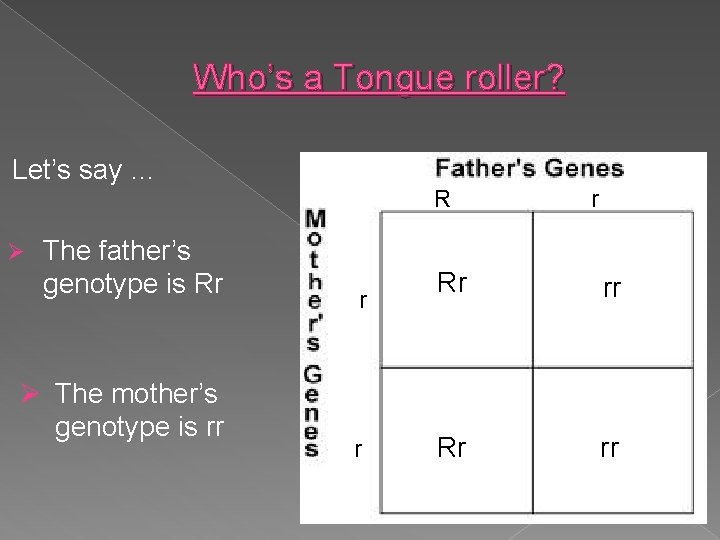
Who’s a Tongue roller? Let’s say … R Ø The father’s genotype is Rr Ø The mother’s genotype is rr r Rr rr
What Are The Results? • • • We can determine that there is a 50% chance that the child will be a tongue roller We can determine that there is a 50%chance that the child will NOT be a tongue roller WHY? The father’s genotype is dominant The mother’s genotype is recessive
Can everyone roll their tongue? � NO! It is an inherited trait! If a person has one dominant and one recessive tongue-rolling gene, their genotype could be written as 'Rr. ‘ • If a person inherited two recessive tongue-rolling genes, their genotype would be written as 'rr. ' •
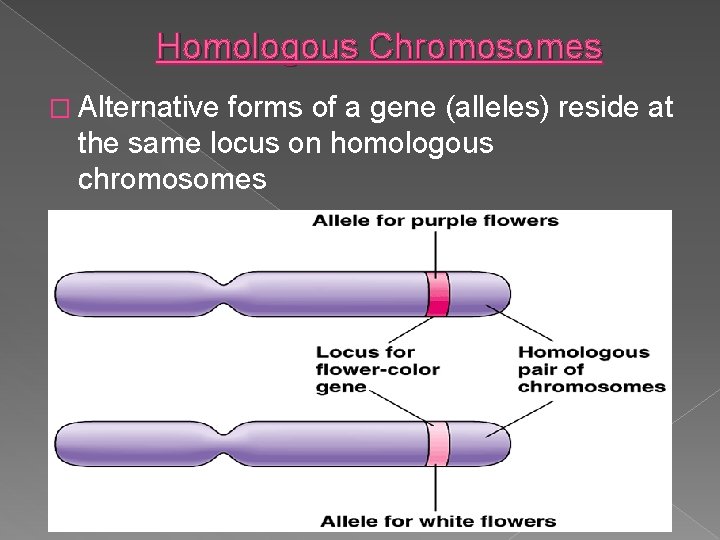
Homologous Chromosomes � Alternative forms of a gene (alleles) reside at the same locus on homologous chromosomes
Principle of Independent Assortment � The principle of independent assortment is revealed by tracking two characteristics at once � By looking at two characteristics at once, Mendel found that the alleles of a pair segregate independently of other allele pairs during gamete formation
- Slides: 31