
Genetics Notes Who is Gregor Mendel Father of
- Slides: 36
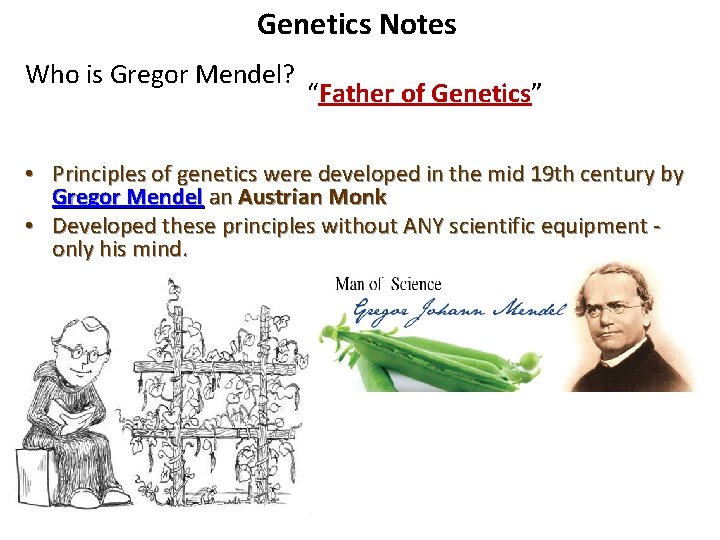
Genetics Notes Who is Gregor Mendel? “Father of Genetics” • Principles of genetics were developed in the mid 19 th century by Gregor Mendel an Austrian Monk • Developed these principles without ANY scientific equipment only his mind.
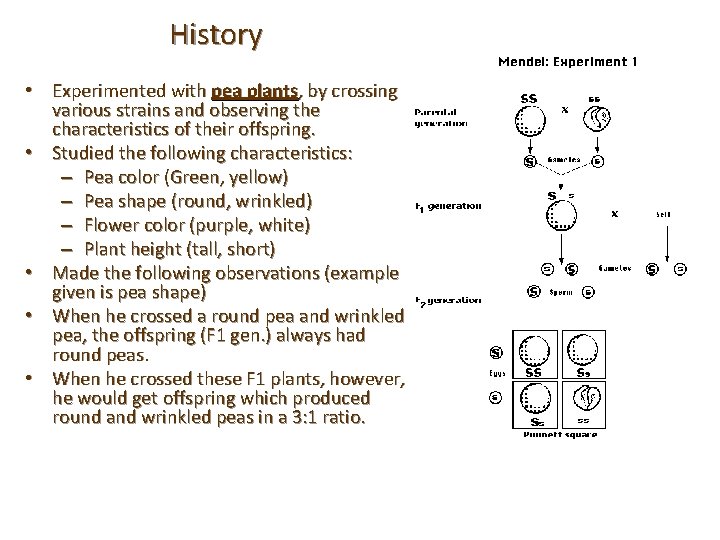
History • Experimented with pea plants, by crossing various strains and observing the characteristics of their offspring. • Studied the following characteristics: – Pea color (Green, yellow) – Pea shape (round, wrinkled) – Flower color (purple, white) – Plant height (tall, short) • Made the following observations (example given is pea shape) • When he crossed a round pea and wrinkled pea, the offspring (F 1 gen. ) always had round peas. • When he crossed these F 1 plants, however, he would get offspring which produced round and wrinkled peas in a 3: 1 ratio.
Vocabulary Genetics: The scientific study of heredity Allele: Alternate forms of a gene/factor. Genotype: combination of alleles an organism has. Phenotype: How an organism appears. Dominant: An allele which is expressed (masks the other). Recessive: An allele which is present but remains unexpressed (masked) • Homozygous: Both alleles for a trait are the same. • Heterozygous: The organism's alleles for a trait are different. • • •
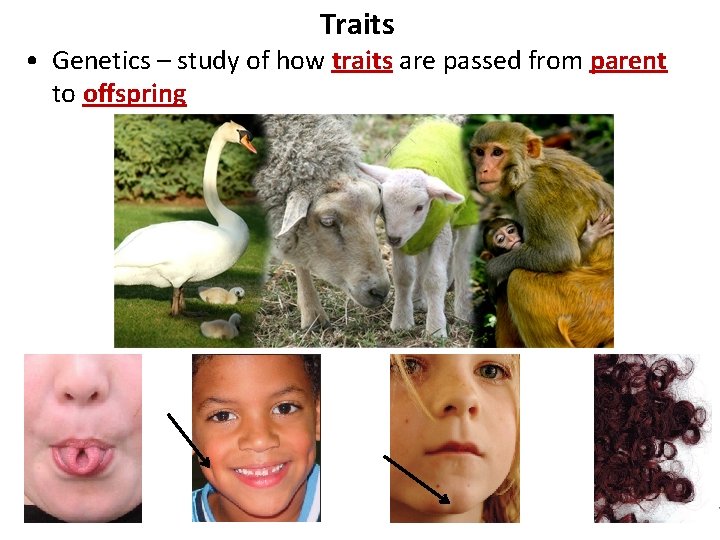
Traits • Genetics – study of how traits are passed from parent to offspring
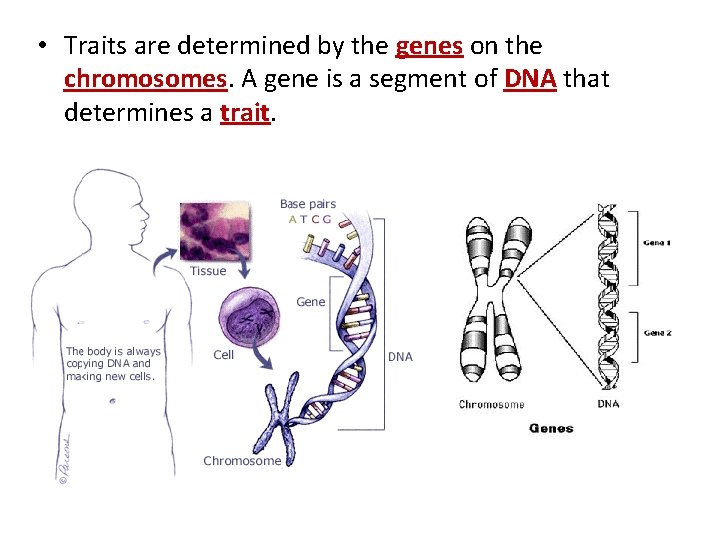
• Traits are determined by the genes on the chromosomes. A gene is a segment of DNA that determines a trait.
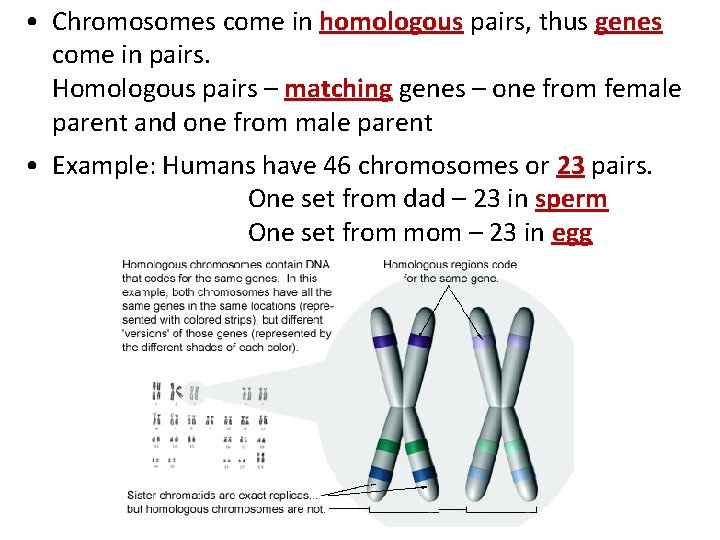
• Chromosomes come in homologous pairs, thus genes come in pairs. Homologous pairs – matching genes – one from female parent and one from male parent • Example: Humans have 46 chromosomes or 23 pairs. One set from dad – 23 in sperm One set from mom – 23 in egg
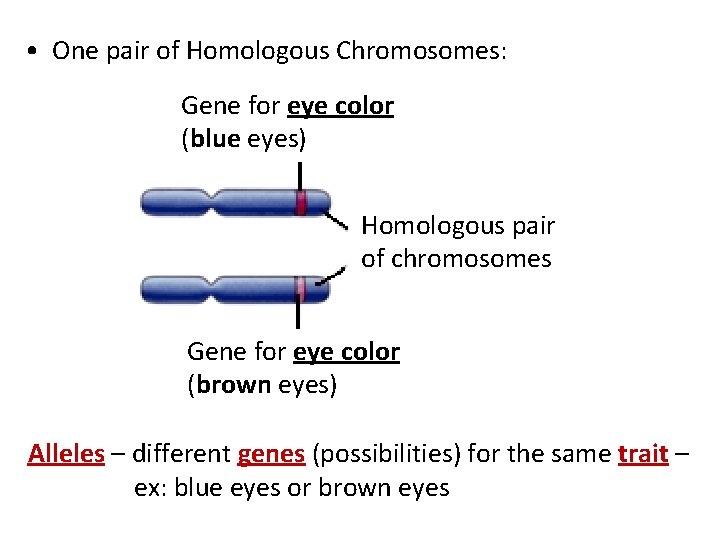
• One pair of Homologous Chromosomes: Gene for eye color (blue eyes) Homologous pair of chromosomes Gene for eye color (brown eyes) Alleles – different genes (possibilities) for the same trait – ex: blue eyes or brown eyes
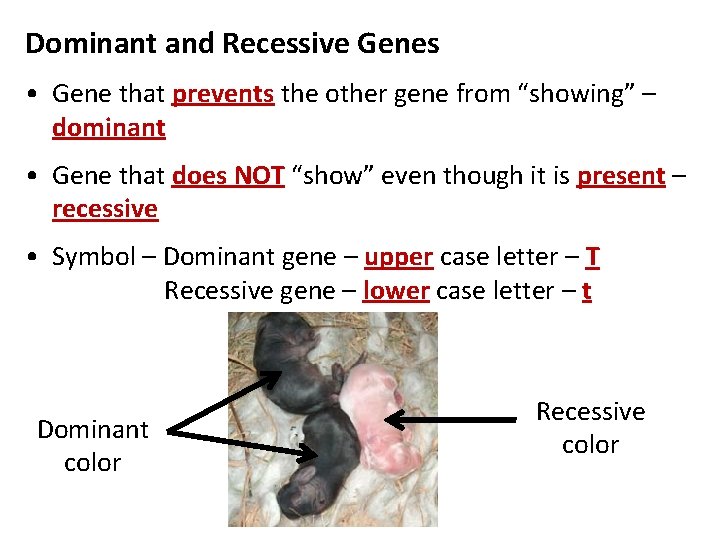
Dominant and Recessive Genes • Gene that prevents the other gene from “showing” – dominant • Gene that does NOT “show” even though it is present – recessive • Symbol – Dominant gene – upper case letter – T Recessive gene – lower case letter – t Dominant color Recessive color
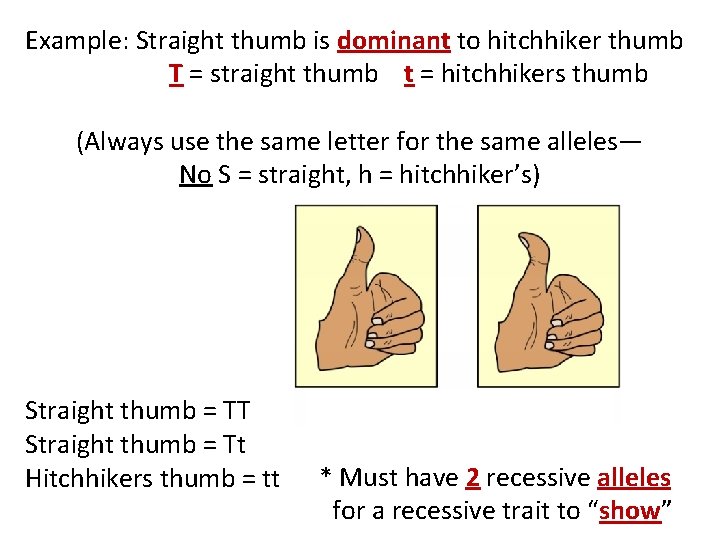
Example: Straight thumb is dominant to hitchhiker thumb T = straight thumb t = hitchhikers thumb (Always use the same letter for the same alleles— No S = straight, h = hitchhiker’s) Straight thumb = TT Straight thumb = Tt Hitchhikers thumb = tt * Must have 2 recessive alleles for a recessive trait to “show”
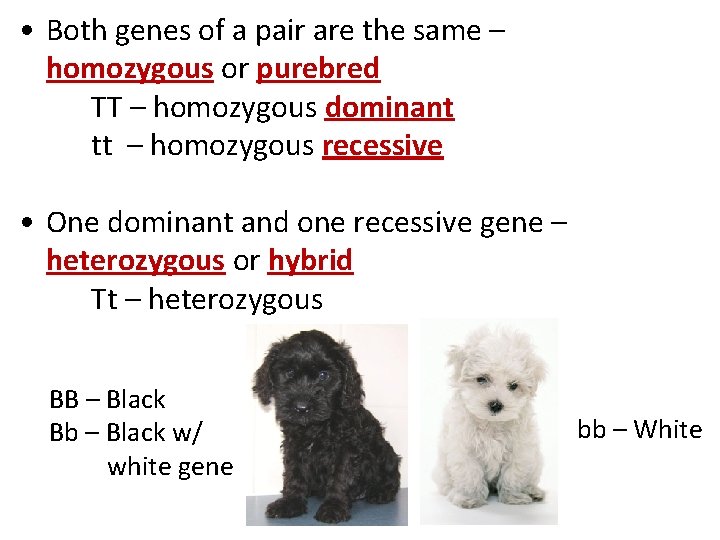
• Both genes of a pair are the same – homozygous or purebred TT – homozygous dominant tt – homozygous recessive • One dominant and one recessive gene – heterozygous or hybrid Tt – heterozygous BB – Black Bb – Black w/ white gene bb – White
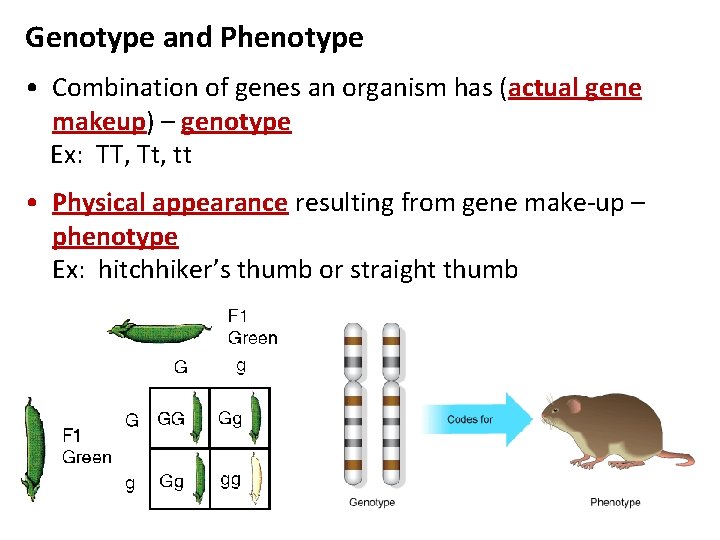
Genotype and Phenotype • Combination of genes an organism has (actual gene makeup) – genotype Ex: TT, Tt, tt • Physical appearance resulting from gene make-up – phenotype Ex: hitchhiker’s thumb or straight thumb
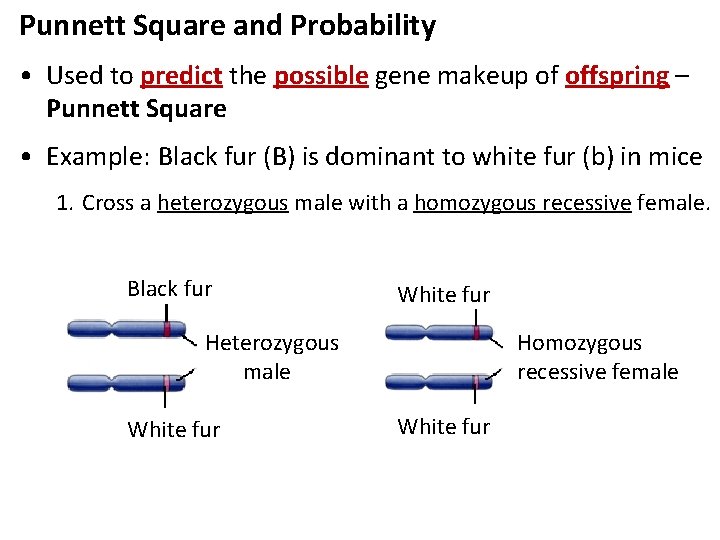
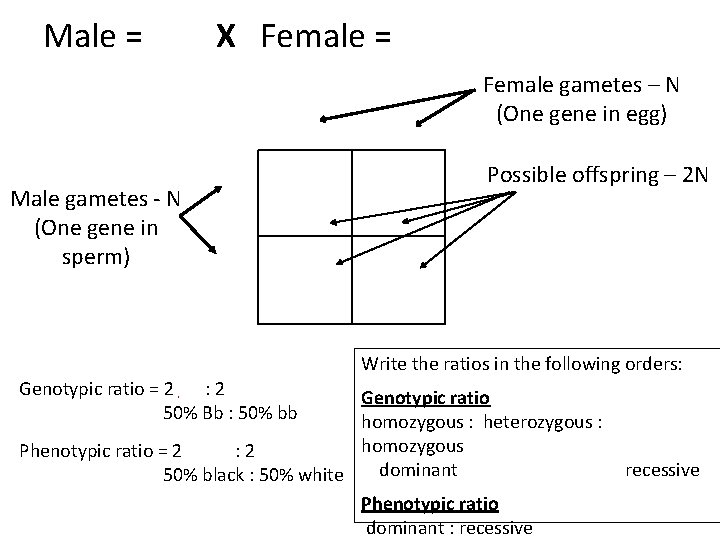
Punnett Square and Probability • Used to predict the possible gene makeup of offspring – Punnett Square • Example: Black fur (B) is dominant to white fur (b) in mice 1. Cross a heterozygous male with a homozygous recessive female. Black fur (B) Heterozygous male White fur (b) Homozygous recessive female White fur (b)
Male = Bb X Female = bb b Male gametes - N (One gene in sperm) B b b Bb Bb bb bb Female gametes – N (One gene in egg) Possible offspring – 2 N Write the ratios in the following orders: Genotypic ratio = 2 Bb : 2 bb 50% Bb : 50% bb Genotypic ratio homozygous : heterozygous : homozygous Phenotypic ratio = 2 black : 2 white dominant 50% black : 50% white Phenotypic ratio dominant : recessive
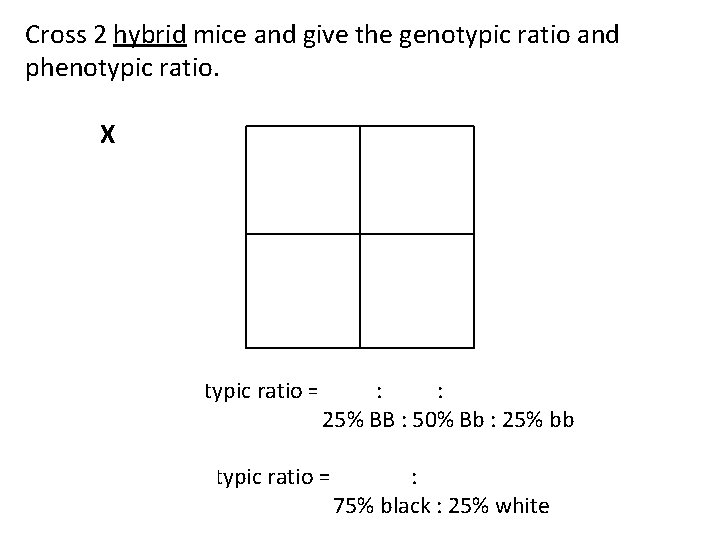
Cross 2 hybrid mice and give the genotypic ratio and phenotypic ratio. B b B BB Bb bb Bb X Bb Genotypic ratio = 1 BB : 2 Bb : 1 bb 25% BB : 50% Bb : 25% bb Phenotypic ratio = 3 black : 1 white 75% black : 25% white
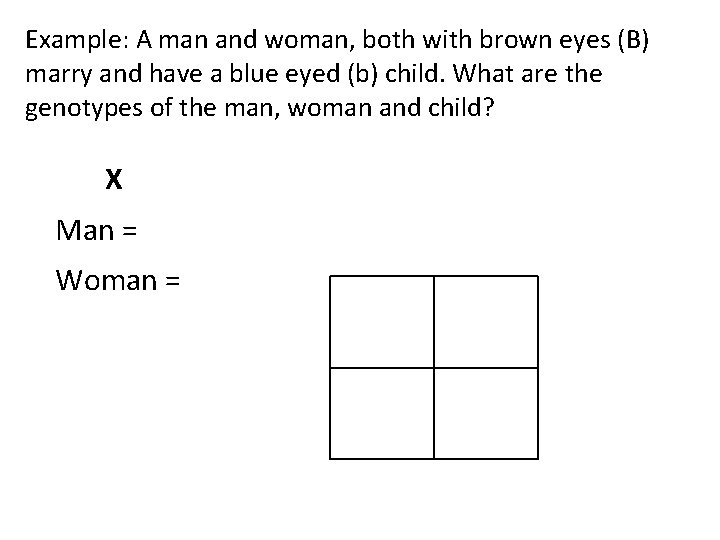
Example: A man and woman, both with brown eyes (B) marry and have a blue eyed (b) child. What are the genotypes of the man, woman and child? Bb X Bb Man = Bb B BB Bb bb Woman = Bb
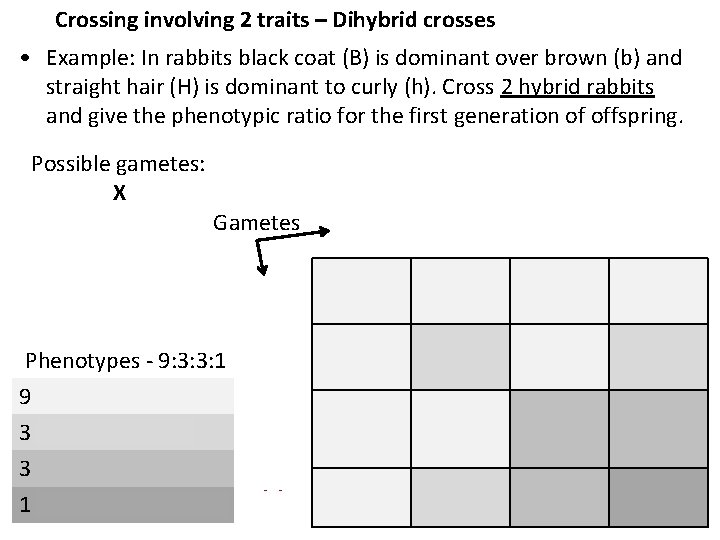
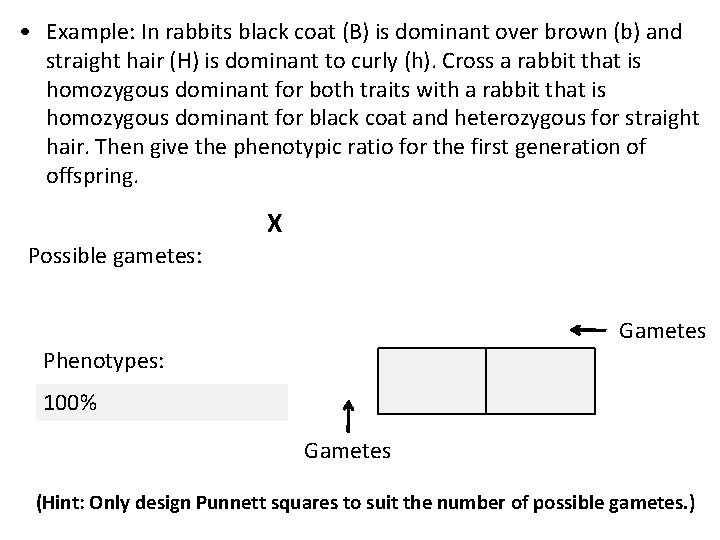
Crossing involving 2 traits – Dihybrid crosses • Example: In rabbits black coat (B) is dominant over brown (b) and straight hair (H) is dominant to curly (h). Cross 2 hybrid rabbits and give the phenotypic ratio for the first generation of offspring. Possible gametes: Bb. Hh X Bb. Hh BH BH Gametes Bh Bh b. H BH bh bh Phenotypes - 9: 3: 3: 1 9 black and straight 3 black and curly 3 brown and straight 1 brown and curly BH Bh b. H bh BBHH BBHh Bb. HH Bb. Hh Bh BBHh BBhh Bb. Hh Bbhh b. H Bb. Hh bb. HH bb. Hh bh Bb. Hh Bbhh bb. Hh bbhh
• Example: In rabbits black coat (B) is dominant over brown (b) and straight hair (H) is dominant to curly (h). Cross a rabbit that is homozygous dominant for both traits with a rabbit that is homozygous dominant for black coat and heterozygous for straight hair. Then give the phenotypic ratio for the first generation of offspring. BBHH X BBHh Possible gametes: BH Phenotypes: 100% black and straight BH Bh BH BH BBHH Bh Gametes BBHh Gametes (Hint: Only design Punnett squares to suit the number of possible gametes. )
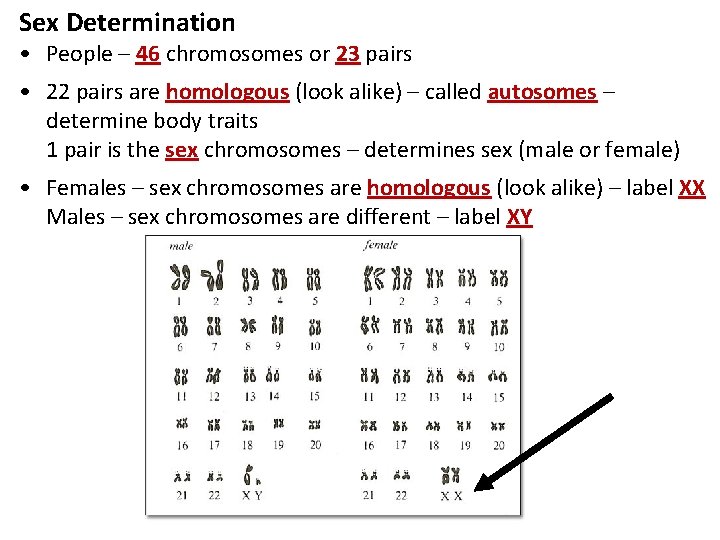
Sex Determination • People – 46 chromosomes or 23 pairs • 22 pairs are homologous (look alike) – called autosomes – determine body traits 1 pair is the sex chromosomes – determines sex (male or female) • Females – sex chromosomes are homologous (look alike) – label XX Males – sex chromosomes are different – label XY
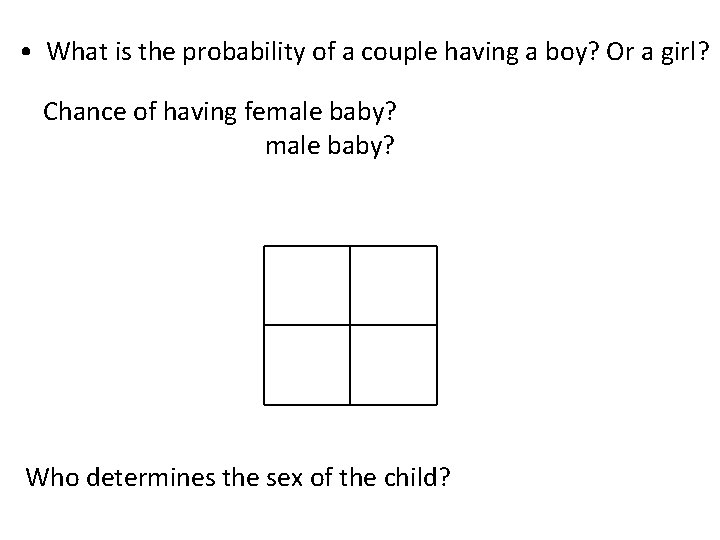
• What is the probability of a couple having a boy? Or a girl? Chance of having female baby? 50% X X X XX XX Y XY XY Who determines the sex of the child? father
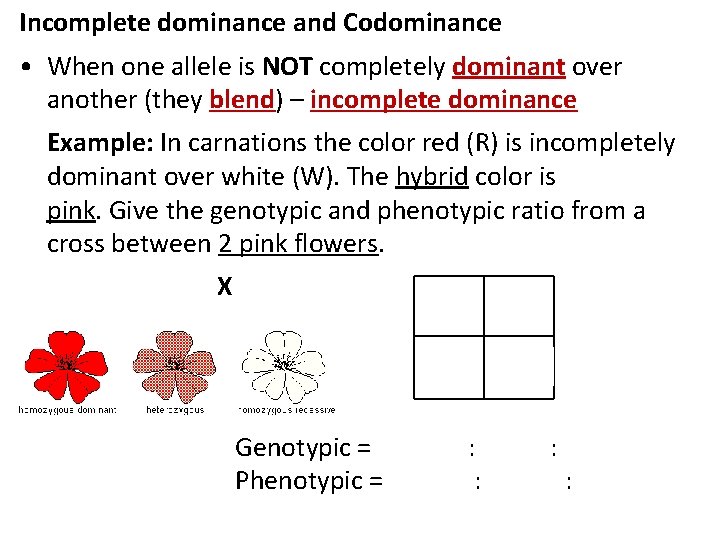
Incomplete dominance and Codominance • When one allele is NOT completely dominant over another (they blend) – incomplete dominance Example: In carnations the color red (R) is incompletely dominant over white (W). The hybrid color is pink. Give the genotypic and phenotypic ratio from a cross between 2 pink flowers. RW X RW R R W RR RW WW Genotypic = 1 RR : 2 RW : 1 WW Phenotypic = 1 red : 2 pink : 1 white
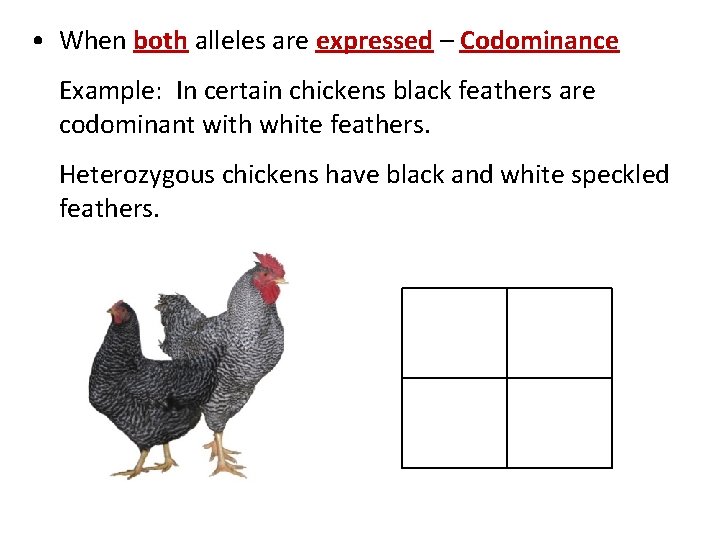
• When both alleles are expressed – Codominance Example: In certain chickens black feathers are codominant with white feathers. Heterozygous chickens have black and white speckled feathers.
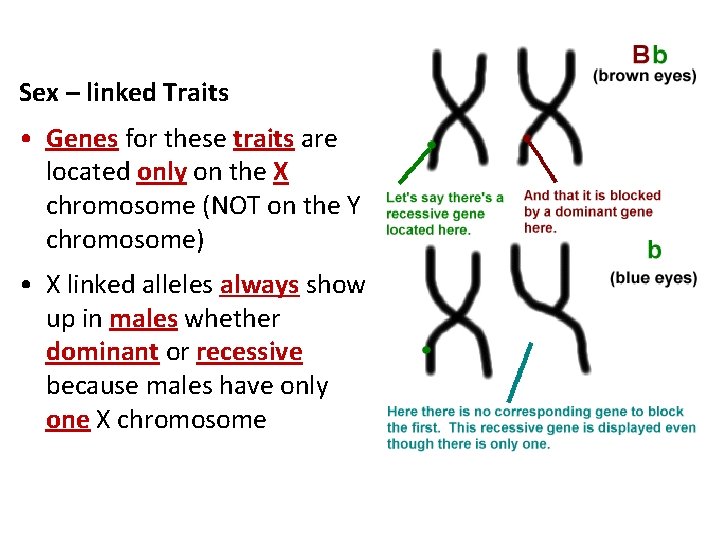
Sex – linked Traits • Genes for these traits are located only on the X chromosome (NOT on the Y chromosome) • X linked alleles always show up in males whether dominant or recessive because males have only one X chromosome
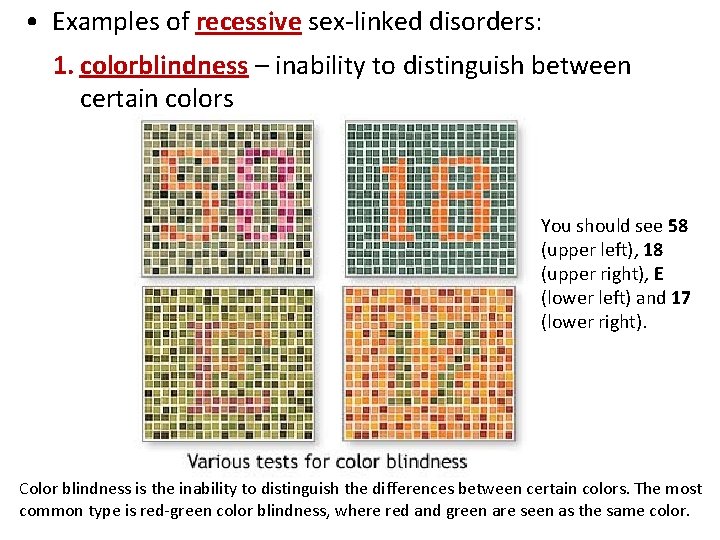
• Examples of recessive sex-linked disorders: 1. colorblindness – inability to distinguish between certain colors You should see 58 (upper left), 18 (upper right), E (lower left) and 17 (lower right). Color blindness is the inability to distinguish the differences between certain colors. The most common type is red-green color blindness, where red and green are seen as the same color.
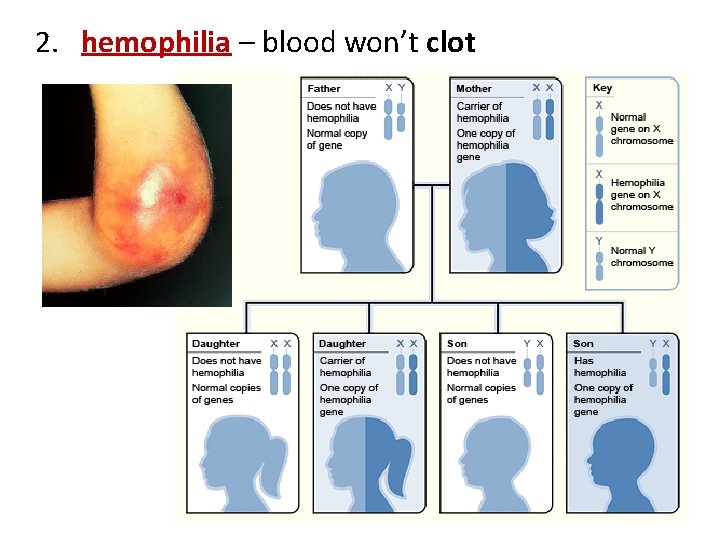
2. hemophilia – blood won’t clot
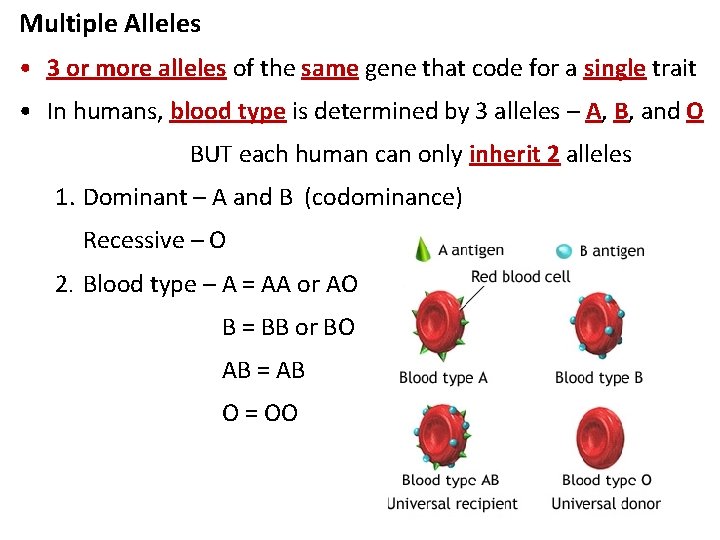
Multiple Alleles • 3 or more alleles of the same gene that code for a single trait • In humans, blood type is determined by 3 alleles – A, B, and O BUT each human can only inherit 2 alleles 1. Dominant – A and B (codominance) Recessive – O 2. Blood type – A = AA or AO B = BB or BO AB = AB O = OO
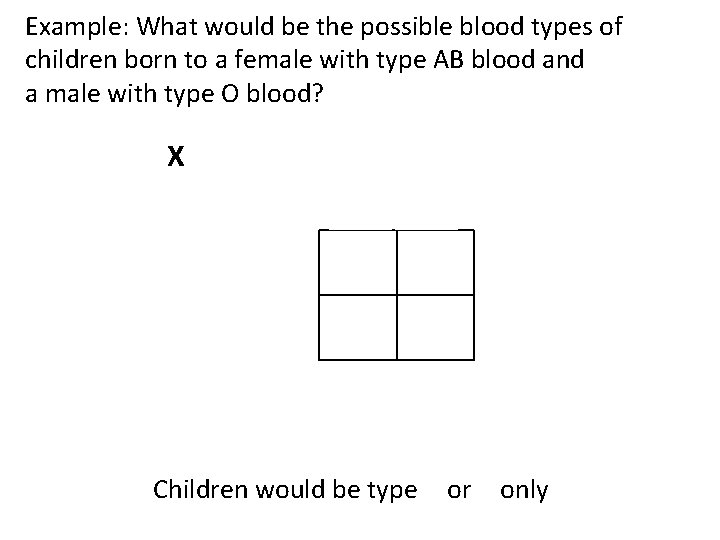
Example: What would be the possible blood types of children born to a female with type AB blood and a male with type O blood? AB X OO A O AO B BO O AO BO Children would be type A or B only
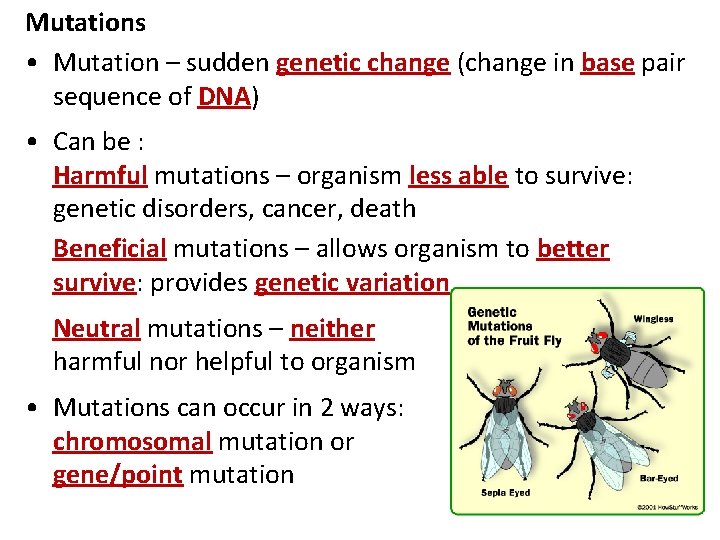
Mutations • Mutation – sudden genetic change (change in base pair sequence of DNA) • Can be : Harmful mutations – organism less able to survive: genetic disorders, cancer, death Beneficial mutations – allows organism to better survive: provides genetic variation Neutral mutations – neither harmful nor helpful to organism • Mutations can occur in 2 ways: chromosomal mutation or gene/point mutation
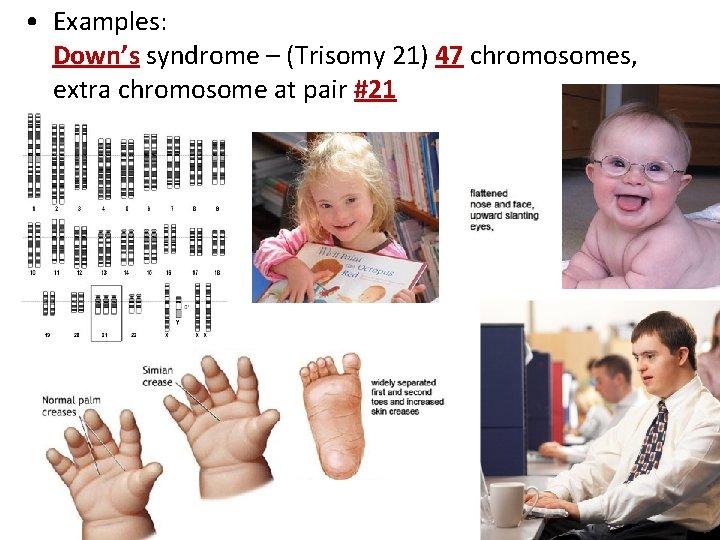
• Examples: Down’s syndrome – (Trisomy 21) 47 chromosomes, extra chromosome at pair #21
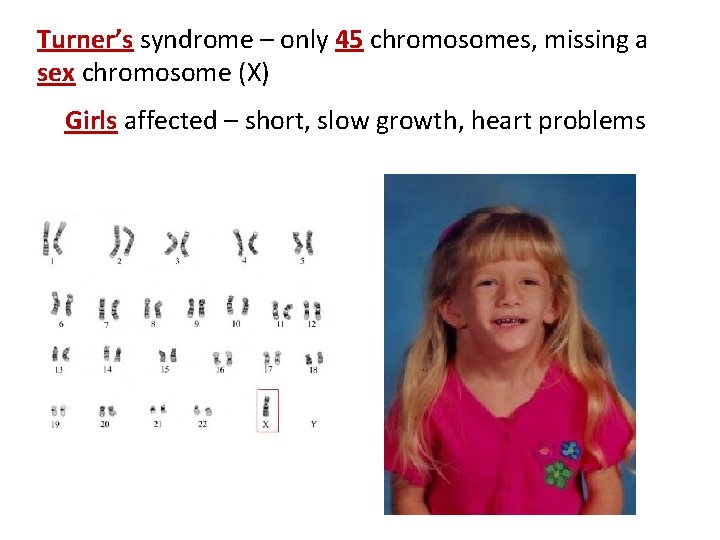
Turner’s syndrome – only 45 chromosomes, missing a sex chromosome (X) Girls affected – short, slow growth, heart problems
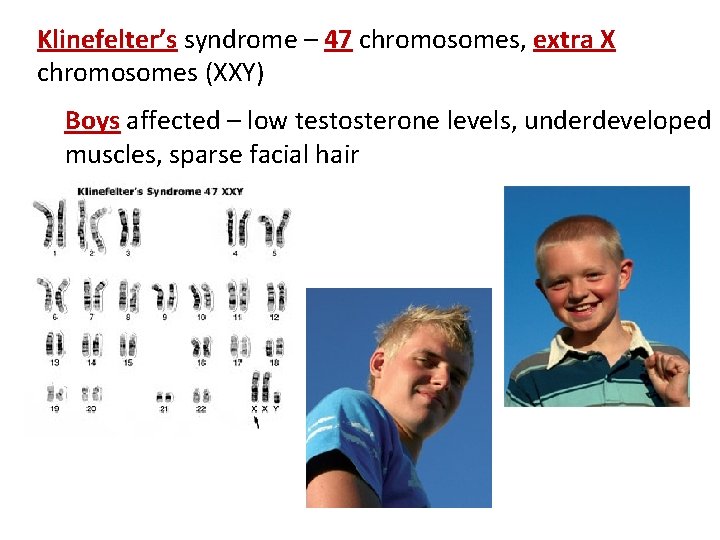
Klinefelter’s syndrome – 47 chromosomes, extra X chromosomes (XXY) Boys affected – low testosterone levels, underdeveloped muscles, sparse facial hair
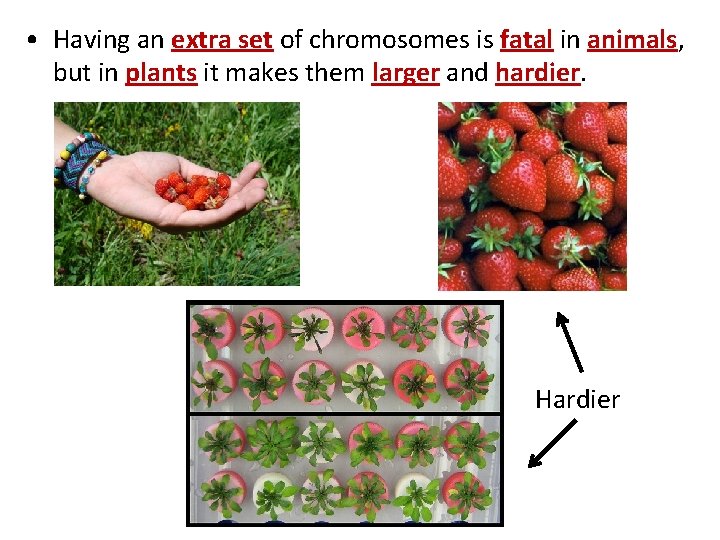
• Having an extra set of chromosomes is fatal in animals, but in plants it makes them larger and hardier. Hardier
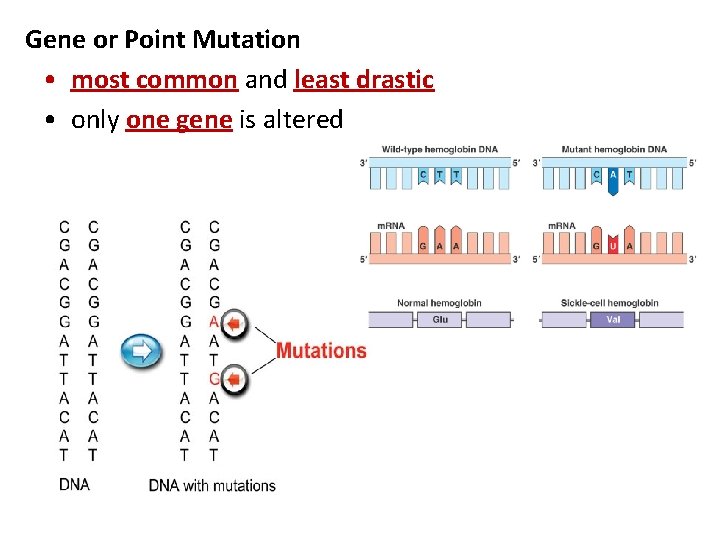
Gene or Point Mutation • most common and least drastic • only one gene is altered
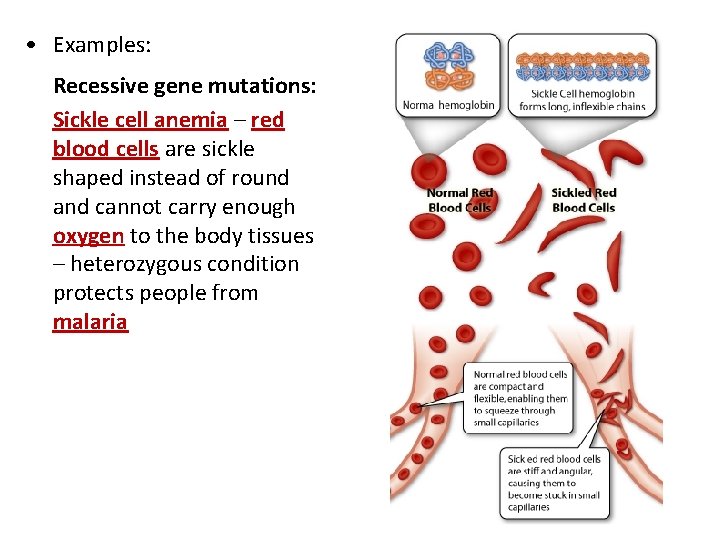
• Examples: Recessive gene mutations: Sickle cell anemia – red blood cells are sickle shaped instead of round and cannot carry enough oxygen to the body tissues – heterozygous condition protects people from malaria
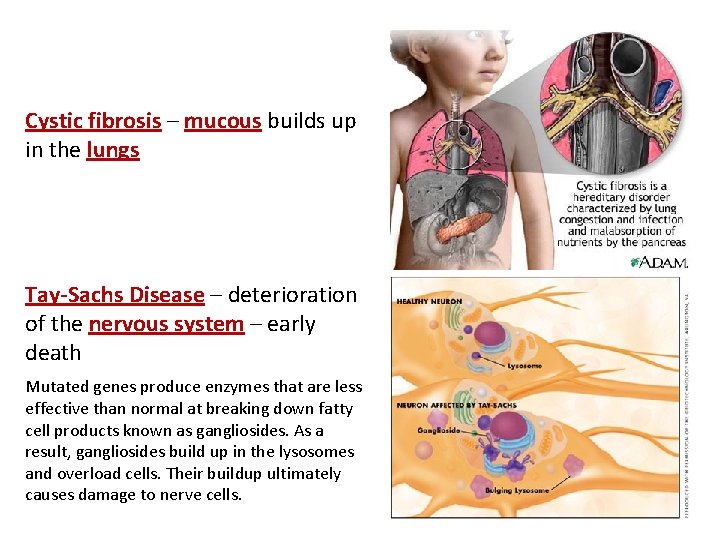
Cystic fibrosis – mucous builds up in the lungs Tay-Sachs Disease – deterioration of the nervous system – early death Mutated genes produce enzymes that are less effective than normal at breaking down fatty cell products known as gangliosides. As a result, gangliosides build up in the lysosomes and overload cells. Their buildup ultimately causes damage to nerve cells.
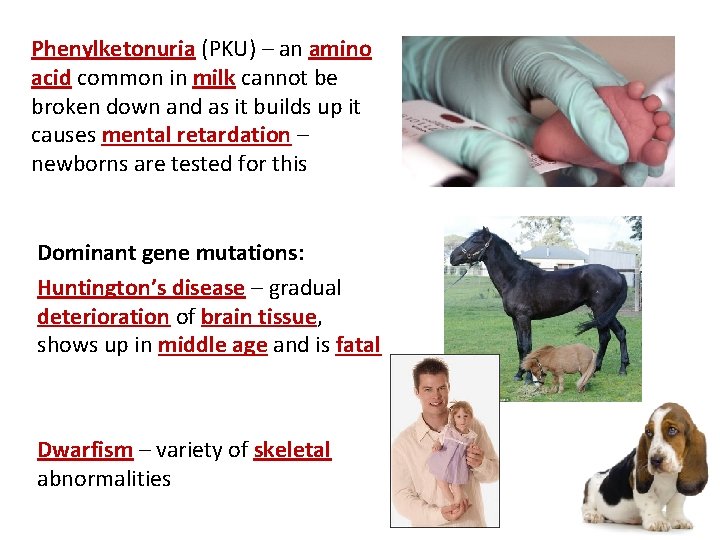
Phenylketonuria (PKU) – an amino acid common in milk cannot be broken down and as it builds up it causes mental retardation – newborns are tested for this Dominant gene mutations: Huntington’s disease – gradual deterioration of brain tissue, shows up in middle age and is fatal Dwarfism – variety of skeletal abnormalities
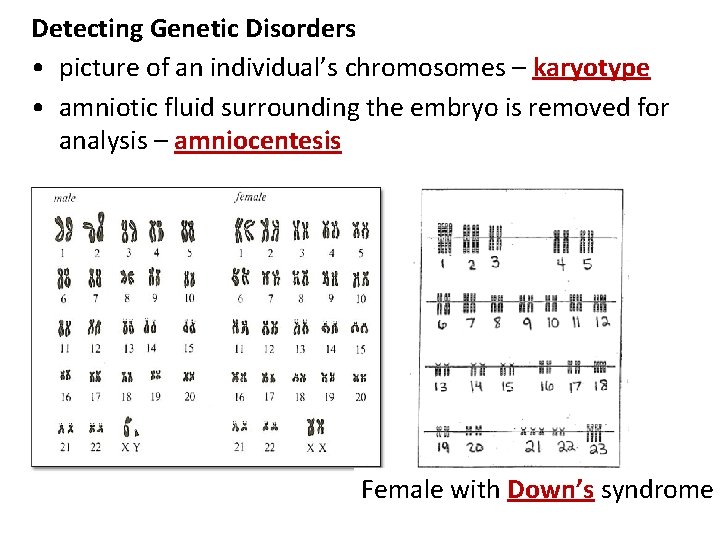
Detecting Genetic Disorders • picture of an individual’s chromosomes – karyotype • amniotic fluid surrounding the embryo is removed for analysis – amniocentesis Female with Down’s syndrome